TL;DR: The law says every business must have a health and safety policy. HSE says that if you have five or more employees you must write it down, and you must share it and any changes with your employees. It should have three parts: a statement of intent signed by the most senior person, the names and roles of people with responsibility, and the practical arrangements, such as risk assessment, training and safety signs. Alongside it you must assess risks, consult employees, appoint a competent person, display the law poster or give out the leaflet and report certain injuries.
Last updated: 19 November 2026

A practice inherits its health and safety folder from the previous owner. It holds a policy dated eleven years ago, signed by someone who has left, naming a practice manager who has left too, and referring to a first aider who retired. Nobody has read it since. When an inspector visits after a needlestick injury, the policy is the first document they ask for. It describes a business that no longer exists.
A health and safety policy is not a formality. It is the document that says how your practice manages the risks that vet work creates, who is responsible and what the arrangements are. This guide explains what HSE says the law requires, the three parts to write, how it links to risk assessments and other duties and how to keep it alive. It is general information, not legal advice.
Yes. HSE says the law requires every business to have a policy for managing health and safety. If you have five or more employees, you must write it down. If you have fewer than five, you do not have to write anything down, but HSE says it is useful to do so. You must share the policy and any changes with your employees.
The HSE page on how to prepare a health and safety policy explains that the policy sets out your general approach and how you, as an employer, will manage health and safety. It should clearly say who does what, when and how. The page on the law says the legal requirement to write a policy is in the Health and Safety at Work etc Act, and the Management of Health and Safety at Work Regulations explain the steps to take.
Count employees across the practice, not the site. A group with several branches should check that each branch has the group policy, plus any site-specific arrangements, such as the location of the first aid kit and the fire assembly point. Part-time and fixed-term staff count as employees, and the duty to protect extends to others affected by the work, such as contractors, visitors and clients.
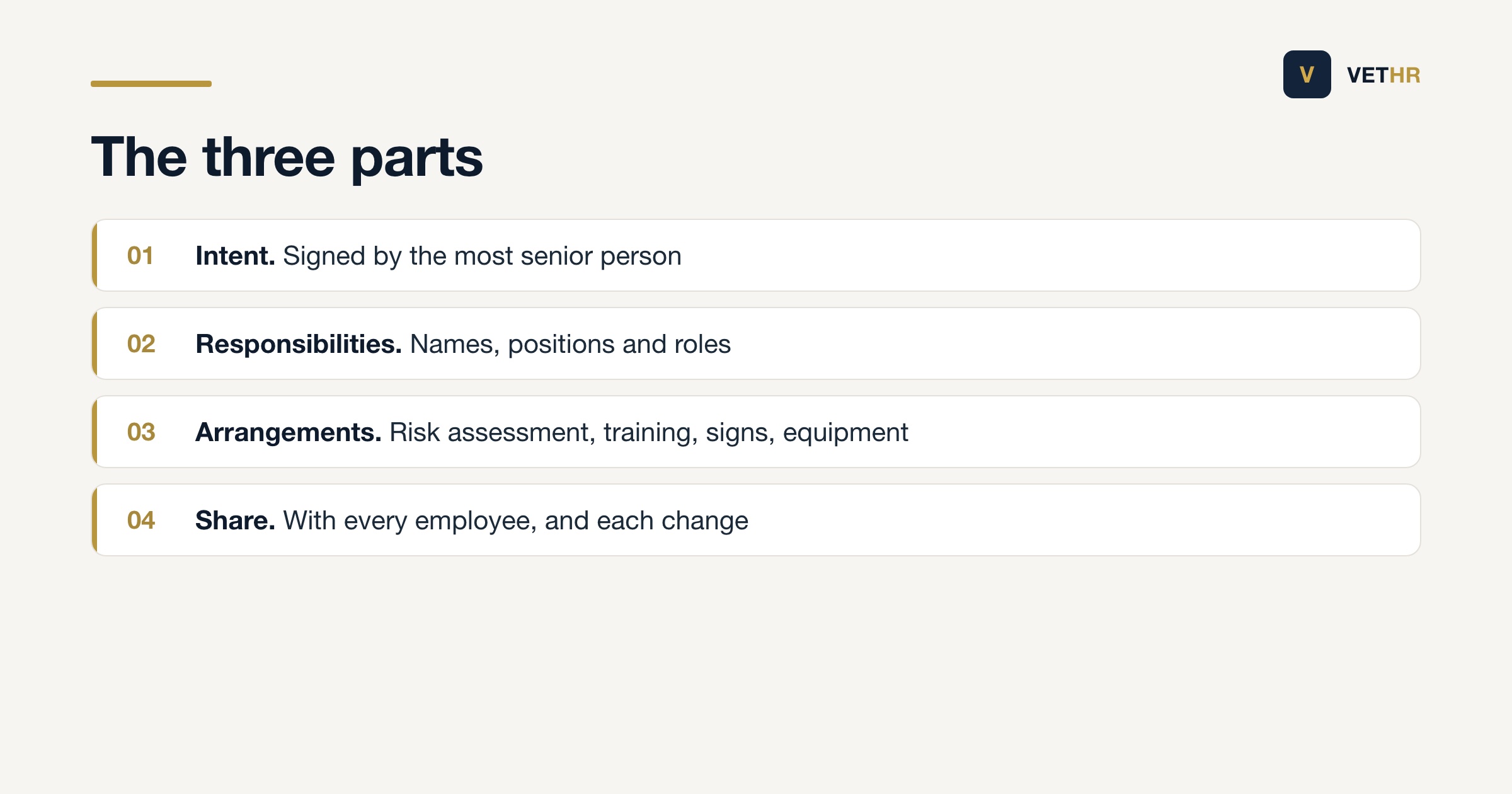
HSE says the policy should cover a statement of intent, responsibilities and arrangements. The statement of intent says what you commit to. The responsibilities list names, positions and roles. The arrangements describe the practical measures, such as risk assessment, training and safety signs, that deliver the aims.
The HSE page on how to write your policy sets them out.
Part 1: statement of intent. State your general policy on health and safety at work, including your commitment to managing health and safety and your aims. HSE says the employer or most senior person should sign it and review it regularly. In a practice that is usually the principal, the partners or the managing director.
Part 2: responsibilities. List the names, positions and roles of the people with specific responsibility for health and safety. In a practice this typically includes the practice manager, the clinical director, the head nurse, the person responsible for radiation protection, the first aiders and the fire marshals.
Part 3: arrangements. Give details of the practical arrangements showing how the aims will be achieved. HSE’s examples are doing a risk assessment, training employees and using safety signs or equipment. For a practice, this is where the detail goes: sharps handling, COSHH, manual handling, lone working, violence, radiation, anaesthetic gases and so on.
HSE provides a worked example and template that you can adapt. Use it as a structure, then replace its generic wording with your own. A policy that could belong to any business is unlikely to help anyone in yours.
The arrangements should cover the risks that arise in your work. For a practice, HSE’s list of common workplace risks is a useful prompt: asbestos, display screen equipment, electrical safety, fire, gas safety, harmful substances, manual handling, noise, PPE, pressure equipment, radiations, slips and trips, vibration, working at height, workplace transport and work-related stress.
HSE’s page on common workplace risks groups the most common causes of serious injury at work and links to specific guidance. It also notes that some health conditions can be caused or made worse by work, including lung disease, stress and musculoskeletal disorders such as back pain.
Match each of those to a section of your arrangements, with a named owner, and link to the detailed guidance you hold. Our guides cover many of them for veterinary practices: asbestos, work at height, pressure systems, violence at work, manual handling, radiation protection, COSHH, fire safety, lone working and stress.
Add the practice-specific items that do not appear in a generic list: sharps and needlestick procedures, zoonoses, animal handling and restraint, controlled drugs security, anaesthetic gas control, clinical waste and out-of-hours working. Our guides to needlestick injuries and zoonoses cover two of them.
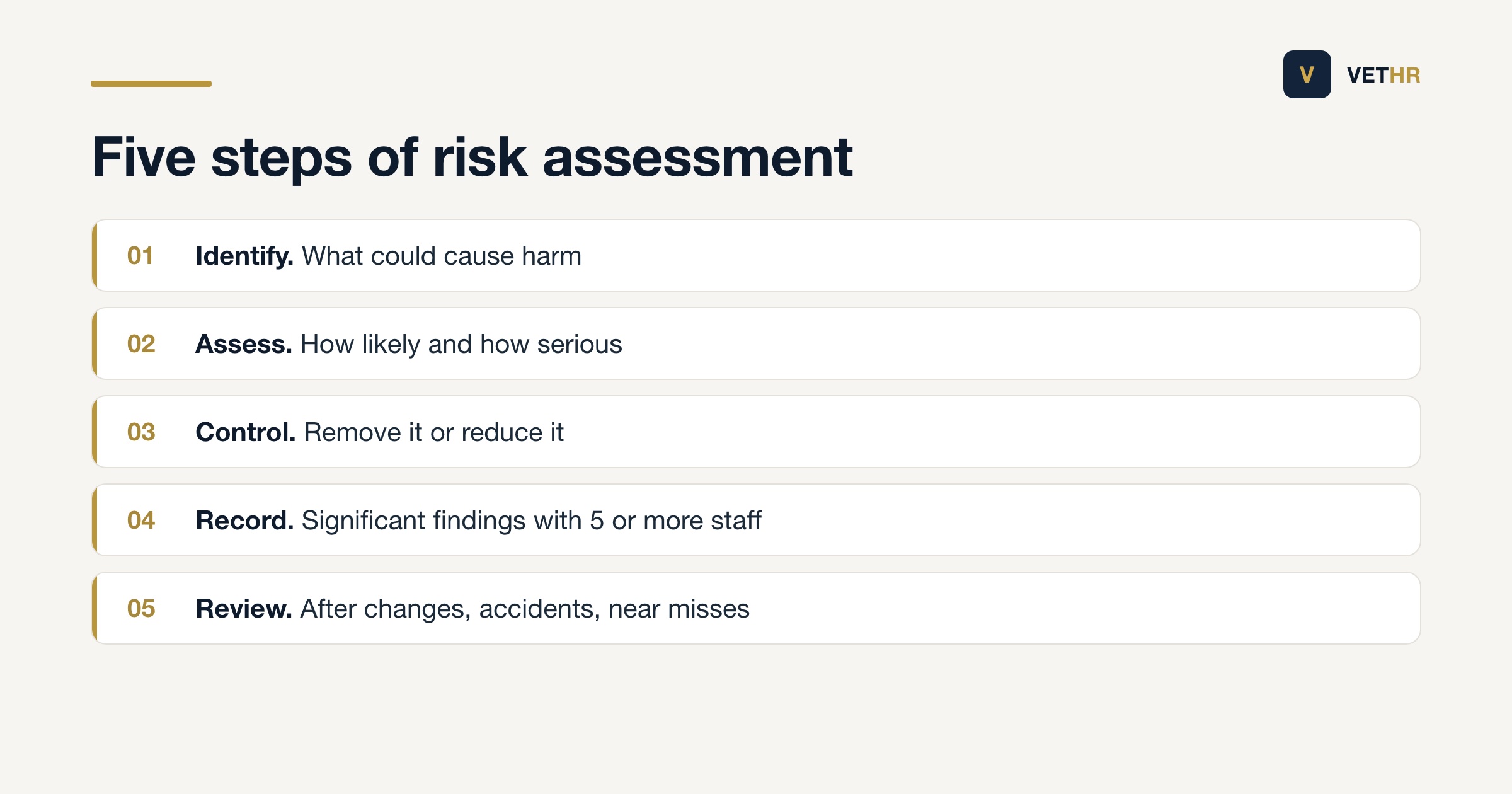
The policy says that you will assess risk. The risk assessment does it. Under the Management of Health and Safety at Work Regulations, HSE says the minimum is to identify hazards, decide how likely it is that someone could be harmed and how seriously, and take action to eliminate the hazard or control the risk. With five or more employees, record the significant findings.
HSE’s page on steps needed to manage risk gives five steps: identify hazards, assess the risks, control the risks, record your findings and review the controls. To identify hazards, look around, think about how people work, what substances are used and the state of the premises, and look back at accident and ill-health records. Include non-routine work such as maintenance and cleaning. Think about employees, contractors, visitors and members of the public, and about vulnerable workers, including young workers, new or expectant mothers and people with disabilities.
To control risks, ask first whether you can get rid of the hazard. If not, consider redesigning the job, replacing materials or machinery, organising the work to reduce exposure, putting practical measures in place and providing PPE. HSE says you are not expected to eliminate all risks but must do everything reasonably practicable, balancing the risk against the money, time or trouble needed.
Record the hazards, who might be harmed and how, and what you are doing to control the risks. HSE adds that you should not rely purely on paperwork, because the priority is to control the risks in practice. Review the controls to make sure they work, and when there are changes in staff, process, substances or equipment, or after accidents and near misses.
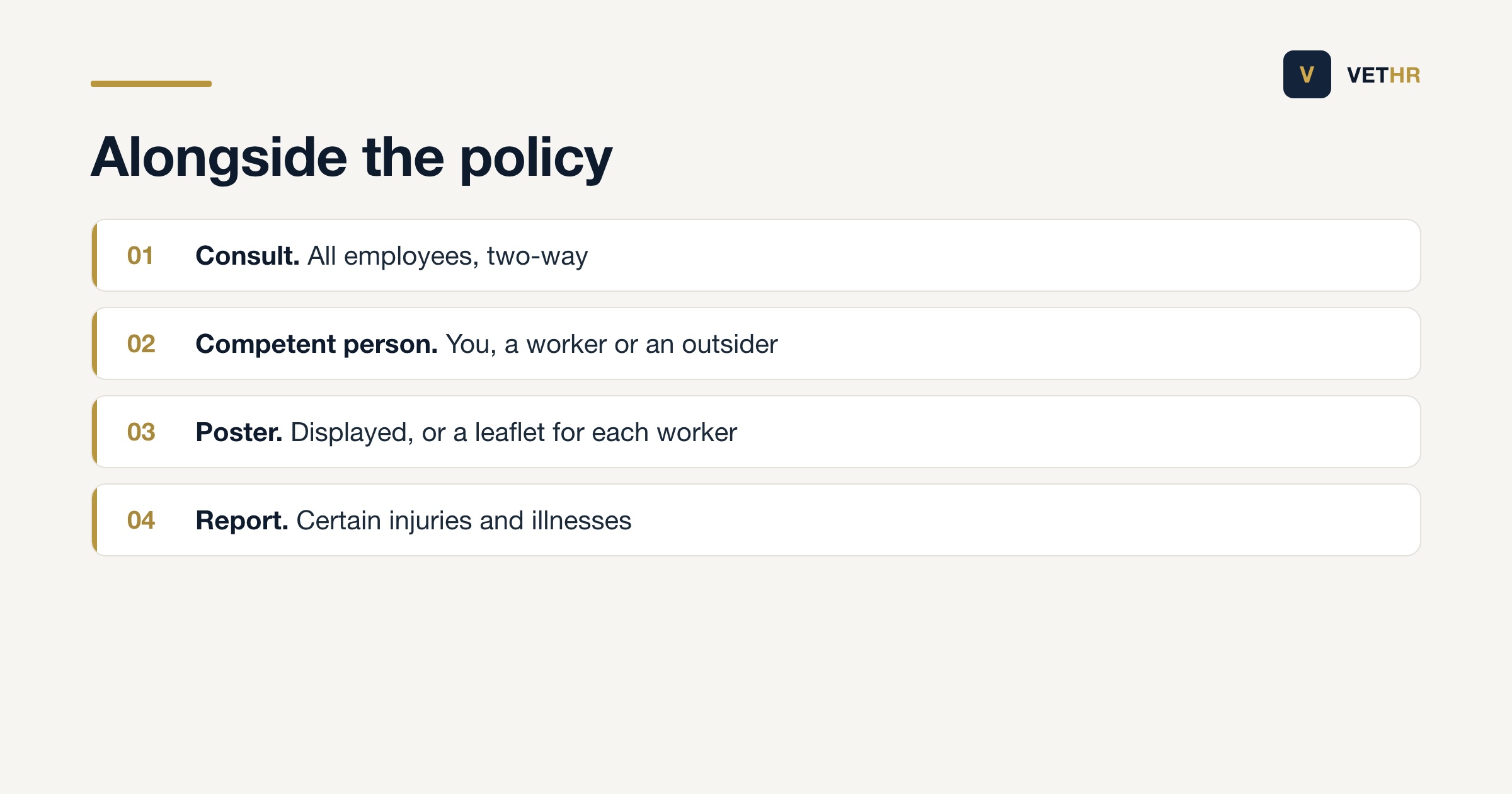
HSE says you must consult all your employees on health and safety, in a two-way process, and must appoint a competent person or people to help you meet your legal duties. A competent person needs the skills, knowledge and experience to recognise hazards and help you put sensible controls in place. Formal qualifications are not usually essential.
On consultation, HSE’s page says you can do it by listening and talking to employees about health and safety and the work they do, how risks are controlled and the best ways to provide information and training. In a small business you might consult directly. Larger businesses may consult through a health and safety representative chosen by employees or selected by a trade union, and HSE says the employer cannot decide who the representative will be.
On competence, HSE says you could appoint yourself, one or more workers, someone from outside the business, or a combination. If there is a competent person within the workforce, use them in preference to an outsider. If the business lacks the competence, for example if it is large, complex or high risk, you can use a consultant, but managing health and safety remains your legal duty.
In a practice the competent person might be the practice manager, with support from an external adviser for specialist areas such as radiation and COSHH. Write the name, the date of appointment and the areas of competence in the policy. Our guide to the training matrix helps show what training each person has had.
HSE’s basics list includes reporting accidents and illness, providing information and training, having the right workplace facilities, first aid, displaying the law poster and appointing a competent person. The poster must be displayed where workers can easily read it, or you must give each worker the equivalent leaflet.
On the poster, HSE’s page says if you employ anyone you must either display the health and safety law poster where your workers can easily read it or provide each worker with the equivalent leaflet. The poster explains British health and safety laws and lists what workers and employers should do, and you can add details of any employee safety representatives or health and safety contacts.
On reporting, HSE says certain injuries, near-misses and work-related illnesses must be reported. Our guides to RIDDOR and incident reporting explain what to report and how to record the rest. On facilities and first aid, our guides to welfare facilities and first aid at work set out the practical requirements.
Do not forget insurance. Our guide to employers’ liability insurance explains the certificate that must be displayed or made available.
Review it at least once a year and whenever something significant changes: a new building, a new service, new equipment, a change of people named in the policy or after a serious incident. Share each change with employees, and keep a record that they have seen it.
HSE says the employer or most senior person should sign the statement of intent and review it regularly, and that you must share the policy and any changes with your employees. Put it in the induction, on the staff noticeboard and in the staff handbook, and ask people to confirm they have read it. Our guide to the staff handbook shows where it fits.
A useful annual routine is a half-hour review at a team meeting. Read the statement, check that the names are still right, walk through the arrangements and ask what has changed or gone wrong. Record the date, the attendees and the changes made. Bring in the incident log and near-miss reports so the policy reflects what actually happens.
Keep it short and readable. A policy that is thirty pages long will not be read. Put the detail in separate procedures and risk assessments, and keep the policy as the map that points to them.
The usual mistakes with a health and safety policy are using an old or generic template, not naming the people responsible, not signing and dating it, not sharing it with staff, never reviewing it, and having arrangements that do not match what the practice actually does.
HSE says if you have five or more employees you must write it down. If you have fewer than five you do not have to, but it is useful to do so.
HSE says three areas: a statement of intent, responsibilities for health and safety with names, positions and roles, and the practical arrangements for managing health and safety.
HSE says the employer or most senior person in the company should sign the statement of intent and review it regularly.
Yes. HSE says you must share the policy, and any changes to it, with your employees.
Yes. HSE says employers must appoint a competent person or people to help meet legal duties. It can be you, a worker or someone from outside, and formal qualifications are not usually essential.
If you want a health and safety policy, a risk assessment register and a review calendar set up for your practice, book a free 30-minute HR health check through our contact page. See also our HR consultancy for veterinary practices and the policies and handbook system.
Sources: HSE: health and safety basics for your business, prepare a health and safety policy, how to write your policy, managing risks and risk assessment, steps needed to manage risk, consult your workers, appoint a competent person, display the law poster.
Contracts, rotas, holiday, a difficult conversation. Tell us what you are dealing with and we will come back within one working day. Nothing to sign up to.
Got it. We will come back to you within one working day. If you do not see a reply, please check your spam folder.
