TL;DR: HSE defines violence at work as any incident in which a person is abused, threatened or assaulted in circumstances relating to their work, including verbal abuse and threats from clients. Employers must assess the risk, consult workers, put proportionate controls in place, train people at risk, record incidents and support those affected. Report to HSE under RIDDOR any violent act that causes a death, a specified injury or a physical injury leaving a worker unable to do normal duties for more than seven days, and keep a record of injuries causing more than three days off.
Last updated: 22 October 2026
A client is told that their dog needs more tests before anyone can say what is wrong. The estimate is higher than they expected, the waiting room is full, and they have been up all night. They shout at the receptionist, then at the vet nurse who comes out to help. Nobody is hurt. By the end of the shift two members of staff are shaken, one of them is thinking about her notice, and the practice manager has no record that any of it happened.
That scenario of violence at work is ordinary in veterinary work, because owners are often frightened, grieving or worried about cost. This guide explains what HSE expects an employer to do about violence at work, including abuse that stops short of a physical attack, how to assess the risk, what controls and training are expected, when RIDDOR applies and how to look after staff afterwards. It is general information and not legal advice.
Yes. HSE defines work-related violence as any incident in which a person is abused, threatened or assaulted in circumstances relating to their work. It says this can include verbal abuse or threats, face to face, online and over the telephone, as well as physical attacks, and violence from members of the public, customers and clients.
The HSE guide to protecting workers from violence and aggression adds two points that matter for a practice. The violence must be connected to the work activity, so a personal dispute between a worker and a family member is not included. And serious or persistent verbal abuse or threats can have a serious effect on a worker’s mental health, not only physical harm.
HSE lists the costs to the employer as well: increased staff sickness, poor morale, a damaged reputation that makes it hard to recruit and keep staff, and extra cost through higher insurance premiums and compensation payments. For a practice that is already finding vets and nurses hard to keep, that last point is worth repeating to the partners.
HSE also says it is not the primary authority for bullying, harassment or domestic abuse in the workplace, and points to Acas and GOV.UK for those. Our guides to bullying at work and domestic abuse support cover the HR side.
On violence at work, the Health and Safety at Work Act requires employers to ensure, so far as reasonably practicable, the health, safety and welfare of workers, which includes protecting them from work-related violence. The Management of Health and Safety at Work Regulations require a risk assessment, competent people, emergency procedures, information and training.
HSE’s page on what the law says also names RIDDOR, which requires employers and people in control of premises to report certain injuries, dangerous occurrences and diseases, and the consultation regulations, which require employers to consult workers or their representatives on health and safety matters.
Workers have duties too. They must use the information and training they receive and report dangerous situations or failings in the arrangements. That is a reason to make it easy for them to report.
A practice with five or more employees must also have a written health and safety policy and record the significant findings of its risk assessment. The risk of violence at work should appear in both. If it is not in the policy and the assessment, an inspector will assume it has not been considered.
HSE’s three steps are to identify the hazards, assess how likely and how serious harm could be, and decide how to control it. You must consult workers, record your findings and review the assessment regularly. A risk assessment alone will not reduce violence. The actions that follow it should.
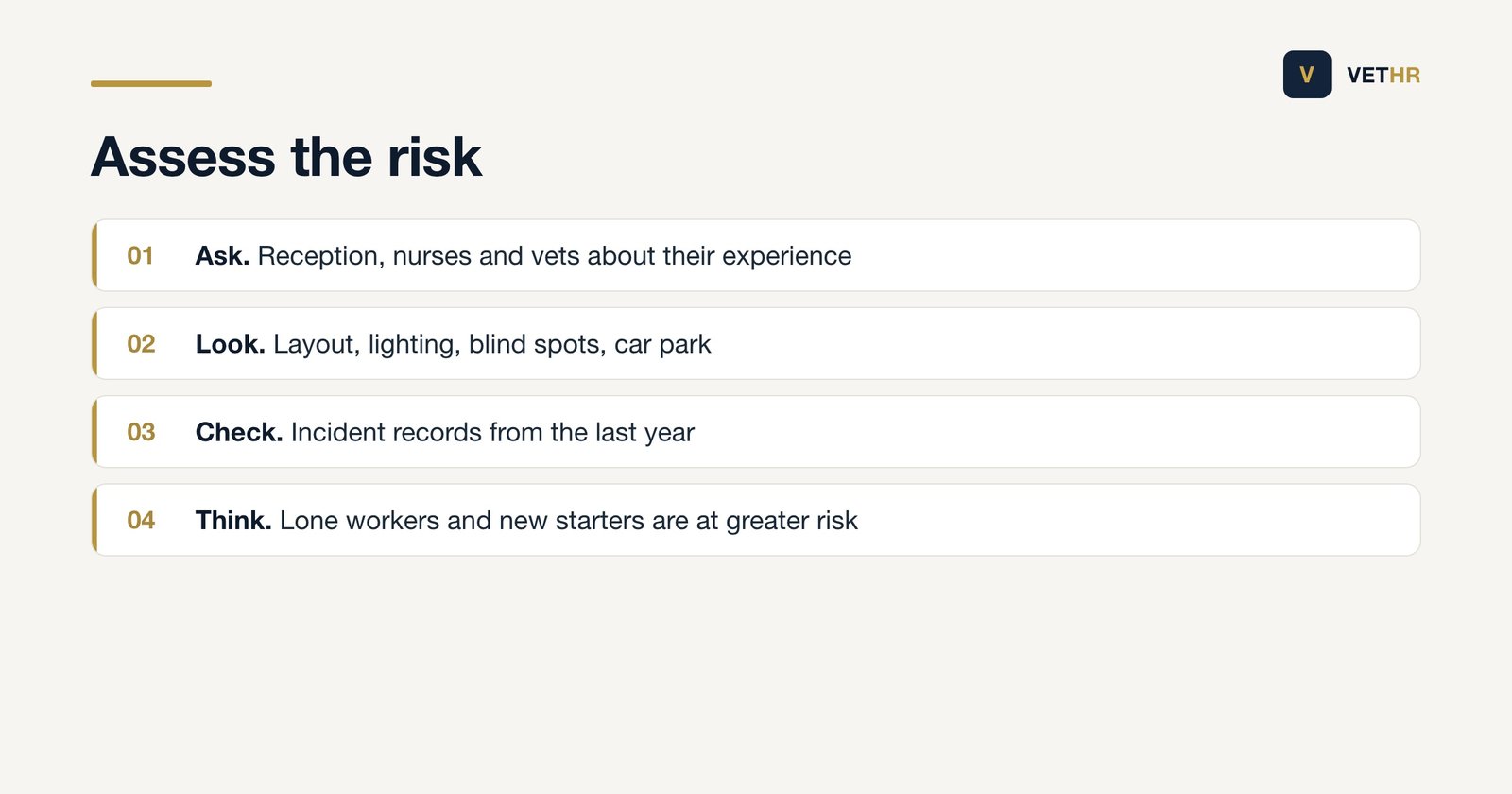
On identifying hazards, HSE suggests asking workers about their experiences, looking around the workplace and at how people work, and looking back at incident records. For a practice, that means a conversation with reception, nurses and vets, a walk through the waiting room, consulting rooms and car park, and a look at any record of abusive incidents over the last year. If there is no record, that is itself a finding.
On assessing risk, HSE says to think about workers at different or additional risk. Lone workers may be at greater risk because there is no nearby support, and new starters, trainees and other vulnerable workers are also often at greater risk. In a practice that points to a receptionist alone at the front desk, a nurse closing up in the evening, an out-of-hours vet on call and a student on extramural studies. Our guide to lone working in a veterinary practice covers the arrangements.
On deciding controls, HSE asks two questions: can you get rid of the hazard altogether, and if not, how can you control the risks so that harm is unlikely? It also says to ask workers for ideas. They know which conversations go wrong and which parts of the building feel unsafe.
HSE says no single control is likely to work alone and that you should reduce the risk so far as reasonably practicable. Its examples cover the workplace, the way work is done and training. They include good visibility and lighting, security measures, clear signage, managing expectations, keeping in touch with lone workers and adequate staffing.
The workplace. HSE suggests good visibility and lighting to remove blind spots, a suitable queuing system where tension could build, security measures such as CCTV, alarm systems and building security, and carefully worded signage that reminds people to respect each other. For a practice, think about the layout of reception, a way for staff to leave a consulting room quickly, a panic alarm at the front desk and a notice that abuse of staff will not be tolerated.
The work itself. HSE suggests good communication, thinking about what might trigger people to act aggressively, and managing expectations with clear information about delays or problems. A waiting-time notice, a clear estimate process and a simple explanation of the next steps all reduce the pressure points. It also suggests keeping in touch with lone workers, for example by mobile phones and personal alarms, and having adequate staffing levels to manage violence and respond to incidents.
Working with others. HSE mentions working with the police and local authorities and other organisations in the same sector. A practice can agree a point of contact with the local police and share what it learns with neighbouring practices.
Staffing deserves a line of its own. A practice that runs with too few people at the front desk is more likely to have long queues, short tempers and nobody free to help a colleague. Our guide to being short staffed looks at the HR side of that.
HSE says training should be available to everyone who may be at risk, including cleaners, maintenance workers and temporary or agency workers, and should reflect the needs identified in your risk assessment. Basic training covers causes, warning signs, communication skills, working practices, control measures and incident reporting. Refresh it periodically.
HSE’s list of basic topics is useful as a training outline: identifying underlying and immediate causes of violence, understanding that it should not be accepted as part of the job, recognising warning signs such as body language, interpersonal skills including verbal and non-verbal communication, details of working practices and control measures, and incident reporting procedures. More specialised training, such as physical intervention, is only needed where there is a serious risk of physical aggression.
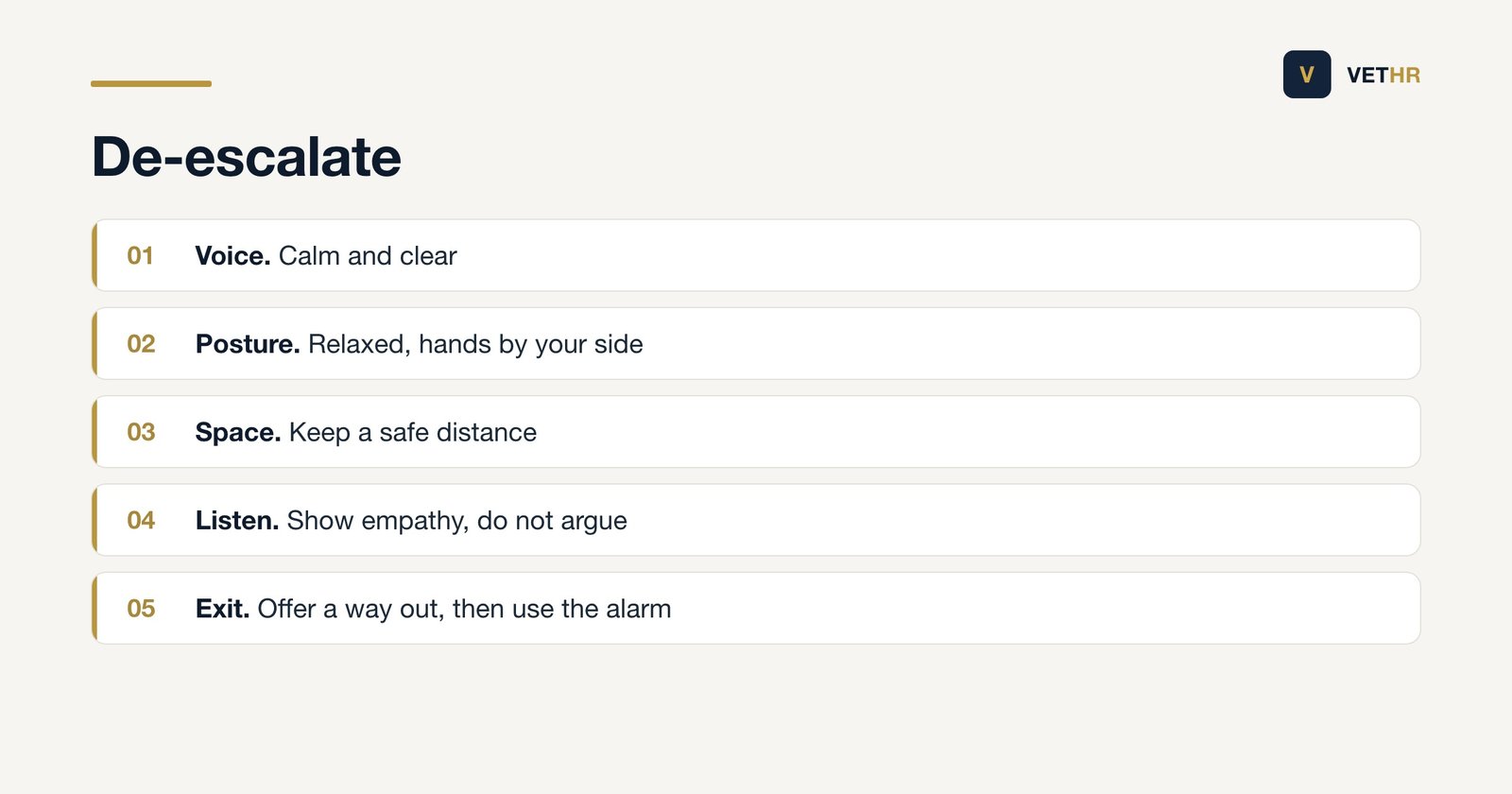
HSE also gives simple de-escalation techniques that any member of staff can use: be polite and use a clear, calm voice, relax your posture and keep your hands by your side, keep a safe distance and allow personal space, face the person and keep eye contact, show empathy and acknowledge their feelings, avoid raising your voice and arguing, and offer alternative solutions so the person has a way out other than aggression.
If de-escalation is not working, HSE says to trust your instincts and use a diversion tactic, such as saying you need to check with your manager, and if that fails to follow your emergency procedures, such as using a panic alarm. Make sure every new starter knows what the alarm is, where it is and who responds. Our guide to training matrices shows how to track who has had which training.
Under RIDDOR you must report any act of work-related violence that results in death, a specified injury, or a physical injury that means a worker cannot carry out normal duties for more than seven days. You do not have to report injuries causing more than three days off, but you must keep a record of them.
HSE’s page on reporting and learning from incidents also says RIDDOR only covers accidents that arise out of or in connection with work, so an injury from a personal dispute between workers, or from a relative or friend visiting about a domestic matter, is not reportable. You or your workers may also report violence or intimidation to the police, online or by calling 101.
For a practice, the point is to decide in advance who makes the call. The practice manager or a named deputy should know the thresholds and the deadline, and our guide to RIDDOR for veterinary practices sets them out in full. Most client abuse will never reach RIDDOR, which is why the practice’s own recording matters even more.
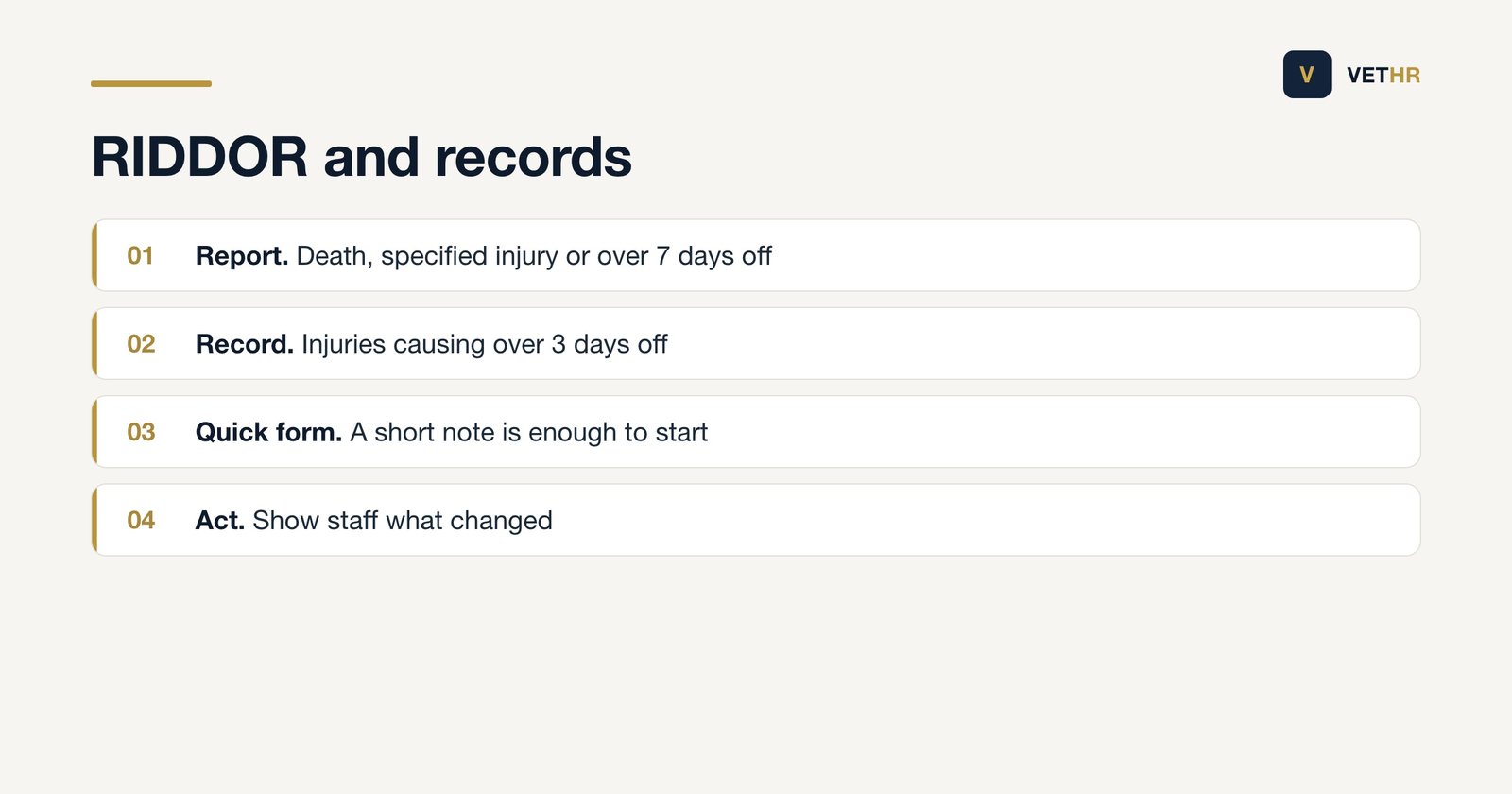
HSE says to make recording quick and easy, because staff often do not report abuse. Reasons include believing it is part of the job, fearing blame, not knowing how to report, a process that is slow or complicated, believing nothing will be done, or worrying about the business’s reputation. A short form and visible action fix most of those.
HSE suggests using the accident book or a simple incident form, offered in several formats such as paper, online or a mobile app, with a brief note of what happened, when and who was involved as enough to start with, particularly for verbal abuse. Keep the records and examine them regularly to see whether the controls are working and whether the problem is changing.
Useful fields for a practice are the date and time, where it happened, who was involved, what was said or done, the trigger if known, the effect on staff, what was done at the time and what was done afterwards. Add a field for whether the client is to be warned, restricted or removed from the register, so there is a consistent outcome.
Tell the team what you did with the records. If staff report three incidents and see nothing change, they will stop. If they see a new alarm, a revised queuing system or a client warning letter, they will keep reporting.
The practice can set out standards for client behaviour and say what happens if they are not met. HSE does not prescribe the steps for vets, but it does say employers should consider signage and carefully worded notices, and that violence should not be accepted as part of the job. Take legal advice before restricting a client’s access to care.
A sensible client behaviour policy states that abuse, threats and violence towards staff will not be tolerated, describes the warnings and possible outcomes, and says how staff can raise a concern. It should be consistent so that people are treated fairly, and it should consider the animal’s welfare and any professional duties, which the practice should check with its professional body and legal adviser.
Include it in the client terms and display it, so that violence at work is dealt with before it starts. Staff are far more confident to challenge unacceptable behaviour when they know the practice will back them, and clients are more likely to behave when the rules are visible.
HSE says to provide suitable support, record and report the incident, and review whether further controls are needed. Offer a chance to talk soon after, consider changing a person’s role or conditions if they are particularly affected, offer counselling or details of local services and Victim Support, and make sure the people giving support are trained.
The HSE page adds that witnesses can be affected as well as the person directly involved, and that violence can lead to stress. Our guides to the employee assistance programme and the stress risk assessment cover the support and the follow-up duties.
A practical routine is a short conversation on the day with a manager, a check-in a few days later, a note of any time off or adjustments, and a review of the incident at the next team meeting to see what can change. Do not leave the affected person to deal with the client’s follow-up contact. Pass it to a manager.
If an incident leads to sickness absence, handle it with care and in line with your policy. Our guide to managing sickness absence explains the process, and the occupational health guide covers when to bring in specialist advice.
The usual mistakes with violence at work are treating abuse as part of the job, having no recording system, training only the vets, forgetting the front desk and evening staff, leaving the client policy unwritten and failing to act on the incident log. All are fixable in a month.
Yes. HSE’s definition includes abuse and threats, face to face, online and by telephone, as well as physical attacks, where they relate to the person’s work.
Yes. The Management of Health and Safety at Work Regulations require employers to assess the risks to workers, including the risk of work-related violence, to consult workers and to record the findings and review them.
HSE says training should be available to everyone who may be at risk, including cleaners, maintenance workers and temporary or agency workers, at a level that reflects the risk assessment, with periodic refreshers.
When it results in death, a specified injury or a physical injury that stops a worker doing normal duties for more than seven days. Injuries causing more than three days off must be recorded but need not be reported.
That depends on professional duties and the circumstances, which HSE does not cover. Set out standards in your client terms and take advice from your professional body and a solicitor before restricting access.
If you want a violence at work risk assessment, an incident form and a client behaviour policy that fit your practice, book a free 30-minute HR health check through our contact page. See also our HR consultancy for veterinary practices and the policies and handbook system.
Sources: HSE: how employers can protect workers from violence and aggression, what the law says, assessing the risks, control measures, reporting and learning from incidents.
Contracts, rotas, holiday, a difficult conversation. Tell us what you are dealing with and we will come back within one working day. Nothing to sign up to.
Got it. We will come back to you within one working day. If you do not see a reply, please check your spam folder.
