Last updated: 27 June 2026
TL;DR: Managing sickness absence in a veterinary practice means having a clear reporting routine, knowing the Statutory Sick Pay basics, using self-certification and fit notes correctly, holding a calm return-to-work chat and keeping fair, consistent records. Treat short-term and long-term absence differently. Plan cover early so the rest of the team is not quietly worn down. Done well, it is fair to the person off sick and to everyone still on the floor.

Sickness is the one part of the rota you cannot plan in advance. A single text at 6am can unpick a whole day. The practices that handle it well are not luckier, they are simply ready. Managing sickness absence in a veterinary practice comes down to a clear process, the right paperwork and a fair way to share the load. This guide walks through each piece.
A sickness absence policy should set out how to report sickness, who to contact and by when, how pay works, when a fit note is needed, what happens on return, and how repeated absence is reviewed. Written down and applied consistently, it removes guesswork and protects you from claims of unfair treatment when a difficult case arrives.
The value of a policy is consistency. If one nurse is asked for a fit note and another in the same situation is not, you have created a fairness problem before you have managed a single day of absence. A clear standard, the same for everyone, is your best defence and your kindest option at once.
Acas recommends a written absence policy so staff know what is expected and managers act consistently, and advises recording absence carefully while respecting data protection, in its guidance on recording and reducing sickness absence. For a practice, that policy also has to reflect shift patterns, out-of-hours cover and branch sites, which a generic office template rarely does. Our veterinary HR policies are written for exactly that.
Staff should report sickness as early as possible, ideally before their shift starts, by a named method to a named person, so cover can be arranged. For the first seven days of absence, employees self-certify, meaning they confirm they were unwell without needing proof from a doctor. A short, consistent reporting routine keeps the morning calm.
Self-certification has a clear limit. GOV.UK states that if employees are off work for seven days or fewer, they do not need to give their employer a fit note or other proof of sickness, as set out in its guidance on taking sick leave. A simple self-certification form, completed on the first day back, captures the dates and reason cleanly for your records.
Decide the practicalities in advance: a phone call rather than a text where you can, a deadline such as an hour before shift, and a clear chain if the first contact does not answer. In a clinic, the person taking the call also needs to trigger cover fast, so the reporting route and the rota need to talk to each other rather than living apart.
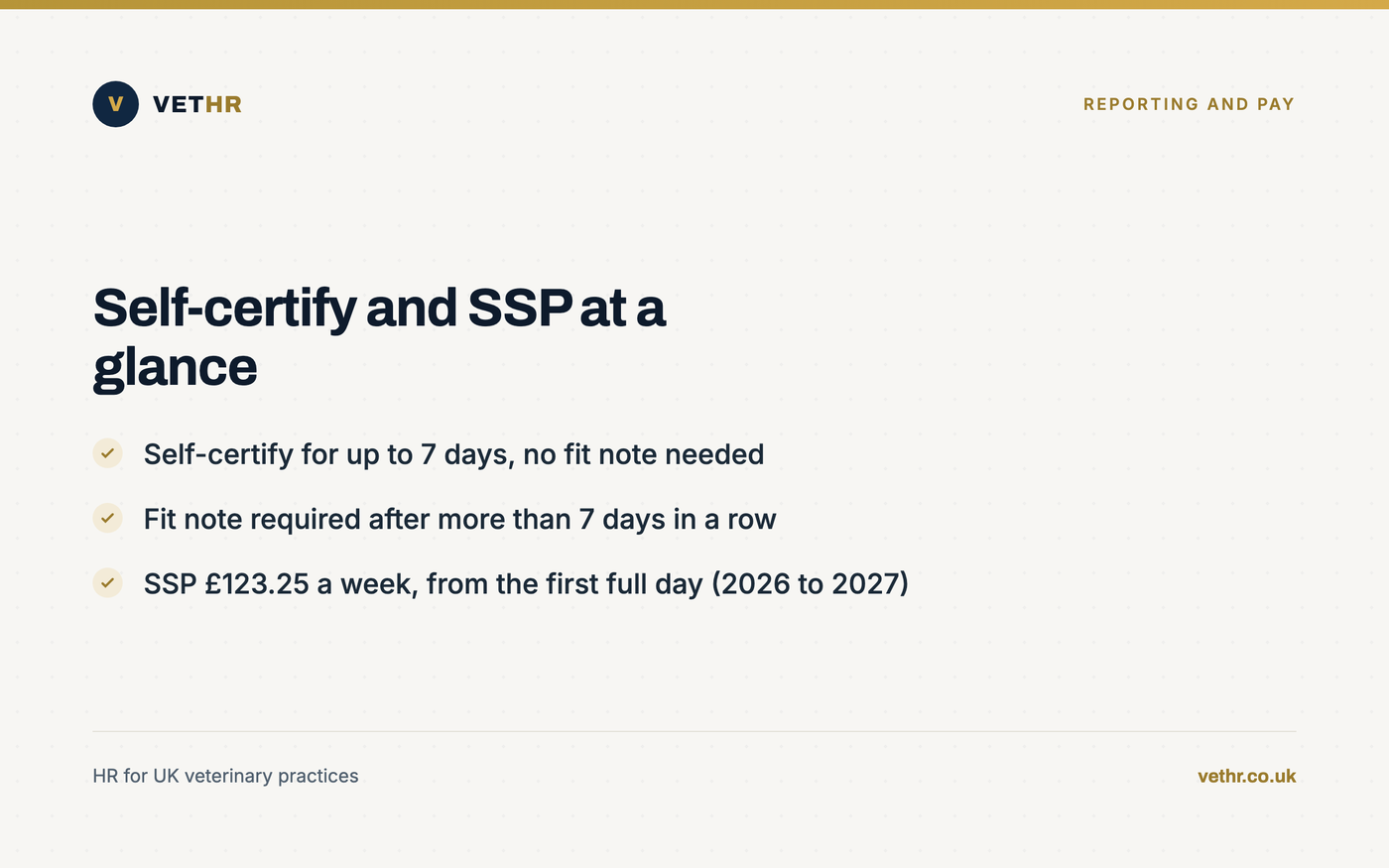
Statutory Sick Pay is the legal minimum you pay an eligible employee who is off sick. For 2026 to 2027 it is £123.25 a week, or 80 percent of normal weekly earnings if that is lower, paid by the employer for up to 28 weeks. Your own contractual sick pay can be more generous, but never less than this.
Two recent changes matter for practices. GOV.UK confirms that from 6 April 2026 SSP is paid from the first full day of sickness rather than from day four, and all eligible employees are now entitled to it regardless of income, as set out in the April 2026 Employer Bulletin. The old three-day waiting period and the lower earnings limit have gone.
The current flat rate is confirmed on the GOV.UK Statutory Sick Pay overview, which puts the maximum at £123.25 a week. In practice this means a part-day off does not count, but a first full day now does, so your payroll and your absence records need to capture sickness from day one rather than the old day four. If a contractual scheme applies, it sits on top of this minimum.
You need a fit note, sometimes called a sick note, once an employee has been ill for more than seven days in a row, including non-working days. Before that, self-certification is enough. The fit note is written by a healthcare professional and tells you whether the person is not fit for work or may be fit for work with support.
That “may be fit for work” option is the useful one. GOV.UK explains that a fit note will say the employee is either not fit for work or may be fit for work, on its taking sick leave guidance. If the note suggests adjustments, such as lighter duties or a phased return, you discuss what is workable. You are not obliged to agree everything, but you should consider it properly and keep a note of what you decided and why.
In a practice, adjustments are concrete: fewer consults, no heavy lifting or restraint for a while, a daytime-only run before returning to out-of-hours. None of that is automatic, and a fit note is advice rather than an instruction, but treating it seriously protects both the person and the practice and usually gets someone back to full duties sooner.
Not sure your sickness process would hold up to scrutiny? A 30-minute conversation usually makes it clear. Book a free HR health check and we will look at how you handle reporting, pay, fit notes and records today, then tell you honestly where it is solid and where a gap could cost you. No jargon, nothing sold for the sake of it.
A return-to-work meeting is a short, supportive chat when someone comes back, to check they are well enough to be there, confirm the dates and reason, and agree any support. Hold it before or as soon as the person returns, every time, for every length of absence. Done consistently, it is fair, not an interrogation.
Acas advises that when someone returns after sickness, the employer should talk with them to make sure they are ready and have any support they need, ideally meeting before or as soon as possible after they return, in its guidance on returning to work after absence. The conversation also flags emerging patterns early, while they are still easy to support.
Keep it human and brief. Welcome them back, check how they are, confirm what was missed, and ask whether anything would help. Note the key points calmly. The same five-minute conversation after a one-day cold and a two-week absence is what makes the process feel fair, because nobody is singled out and everyone gets the same care.
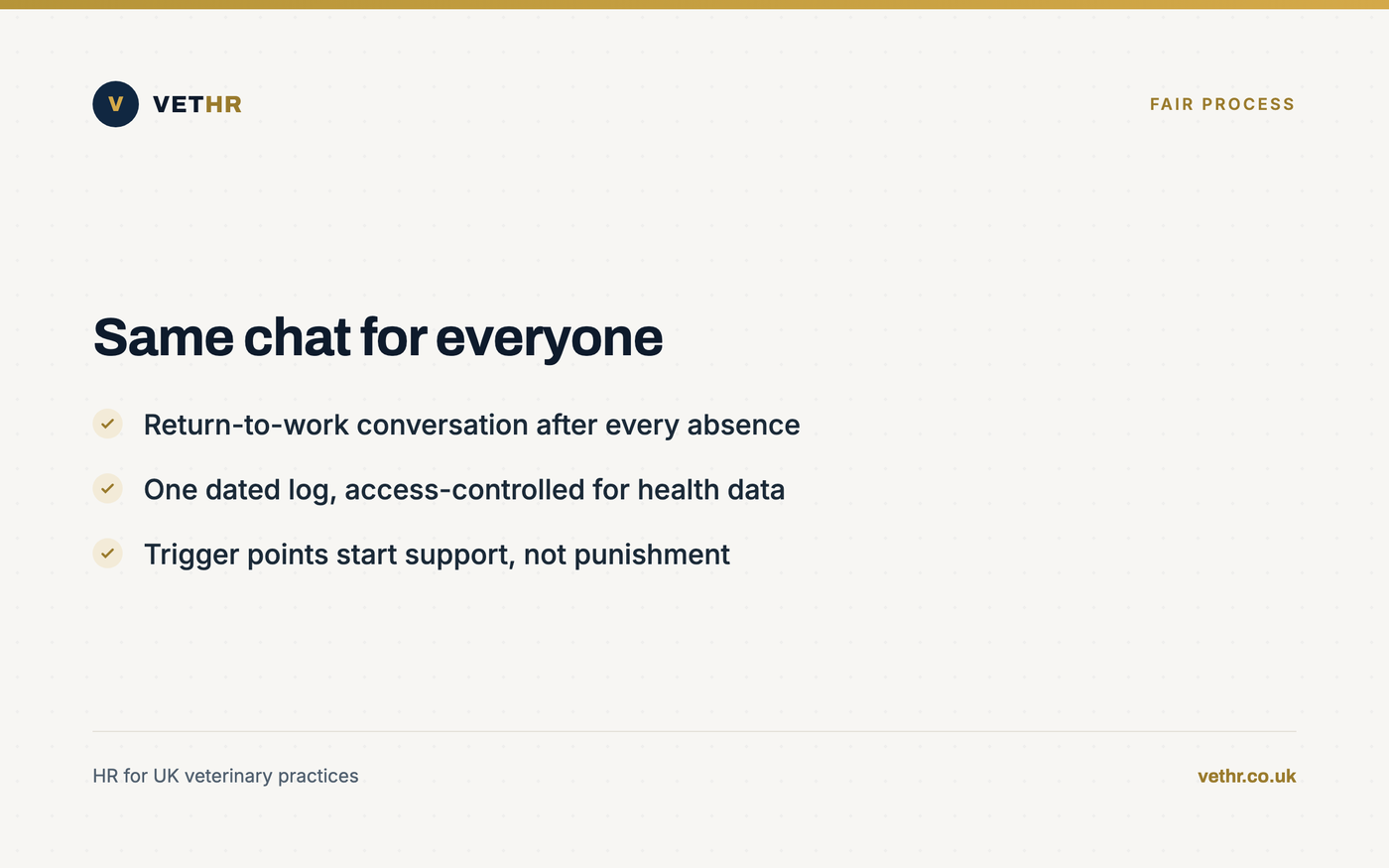
Keep a simple, consistent record for every absence: dates, who reported it and how, the reason given, whether it was self-certified or covered by a fit note, and the return-to-work note. Apply the same standard to everyone. Health information is sensitive personal data, so store it securely and limit who can see it.
Acas suggests recording absence against trigger or review points to manage it fairly, while warning that you must not discriminate and must respect data protection when recording reasons for sickness, in its guidance on recording sickness absence. A trigger point is a fair, agreed threshold, for example a set number of separate absences in a rolling period, that prompts a supportive conversation rather than an automatic penalty.
The practical risk in most practices is scatter: a text here, a memory there, a note in a drawer. When a pattern needs managing or a tribunal asks what happened, vague records help nobody. A single dated log, with sickness reasons access-controlled, turns a sensitive task into a defensible one. Our staff systems keep absence, rota and records in one place.
Short-term absence is frequent, brief spells, often a day or two at a time. Long-term absence is one continuous period, usually four weeks or more. They need different responses: short-term absence is about patterns and fairness, while long-term absence is about support, medical advice and a realistic plan to return.
Repeated short-term absence is managed through your trigger points and return-to-work chats. The aim is to understand the cause, not to punish. Sometimes it is a genuine run of bugs; sometimes it signals stress, a caring responsibility or an underlying condition. A calm, curious conversation early usually surfaces it and points to the right support.
Long-term absence needs a different rhythm: stay in gentle contact, gather medical advice with consent, and consider adjustments or a phased return. Take care where a disability may be involved, as you may have a duty to make reasonable adjustments. This is the territory where a wrong step gets expensive, so it is worth getting advice. Our HR consultancy handles these cases with you.
Cover sickness fairly by planning for it before it happens: a known call-down order, a willing list for extra shifts, agreed freelance vet cover contacts, and a rota that shows gaps clearly. The team burns out when the same two reliable people are asked every time, so spread the load and track who has stepped in.
The hidden cost of absence is rarely the day itself; it is the strain on whoever absorbs it. A rota that shows cover clearly, and a record of who has stepped up, lets you share the load fairly and notice when one person is carrying too much. Our veterinary rota system makes those gaps and that goodwill visible.
Employees can self-certify for up to seven days, including non-working days. GOV.UK states they need a fit note only if they have been ill for more than seven days in a row and have taken sick leave. For absences of seven days or fewer, a self-certification form completed on return is enough for your records.
For 2026 to 2027, Statutory Sick Pay is £123.25 a week, or 80 percent of normal weekly earnings if that is lower, paid for up to 28 weeks. From 6 April 2026 it is paid from the first full day of sickness and all eligible employees qualify regardless of income. Contractual sick pay can be more generous.
Sometimes, but only after a fair process: clear records, supportive conversations, medical advice where relevant, and consideration of adjustments, especially if a disability may be involved. Dismissal is a last resort, not a first reaction to a run of absence. Because the risks are real, this is a point to take HR advice before acting.
A common approach is a set number of separate absences within a rolling period, which prompts a supportive review rather than an automatic penalty. The exact figure is yours to set, but it must be applied consistently and never used to discriminate. The point of a trigger is to start a fair conversation, not to punish.
Yes, but gently and by agreement. Staying in touch shows support and helps plan a return, as long as it does not feel like pressure. Agree how often and by what method, respect that they are unwell, and keep the focus on their wellbeing and any help they need rather than on when they will be back.
None of this is about being tough or being soft. It is about being consistent: the same reporting routine, the same return-to-work chat and the same fair records for everyone. Get those right and the hard cases become rare, because most issues are caught early and handled kindly.
If your process is more habit than system, that is worth fixing before the difficult month arrives. To tidy it up, look at our HR policies, see how cover works in our rota system, or simply book a free HR health check and we will give you a straight read on where you stand. Nothing sold that you do not need.
The Vet HR Team provides HR consultancy and white-labelled staff systems exclusively to UK veterinary practices.
Read next: Statutory Sick Pay for Veterinary Staff and Long Term Sickness in a Veterinary Practice.
Contracts, rotas, holiday, a difficult conversation. Tell us what you are dealing with and we will come back within one working day. Nothing to sign up to.
Got it. We will come back to you within one working day. If you do not see a reply, please check your spam folder.
