Last updated: 5 September 2026
TL;DR: Lone working is lawful, but the Health and Safety Executive requires employers to manage the risks before anyone works alone. In veterinary practice that means assessing branch surgeries, sole charge shifts, home visits, out of hours and overnight in-patient care, then putting communication, escalation and emergency arrangements in place and recording them.
Every practice has a version of it. The nurse who opens the branch alone on a Tuesday. The vet doing a euthanasia at a farm at dusk. The person staying with a critical in-patient overnight. None of that is unusual in veterinary work, and none of it is unlawful. What matters is whether anyone has assessed it and written it down.
Yes, with conditions. The Health and Safety Executive is direct about the duty: as an employer, you must manage any health and safety risks before people can work alone, because lone workers face greater risks without direct supervision or anyone to help if things go wrong.
The phrase “before people can work alone” is the operative one. The assessment comes first, not after an incident, and HSE publishes detailed guidance in Protecting lone workers: How to control the risks of working alone (INDG73) for employers who need the detail.
Some tasks should not be done alone at all, and deciding which is part of the assessment. A practice that has never written that list down is relying on individual judgement at 11pm, which is precisely when judgement is worst.
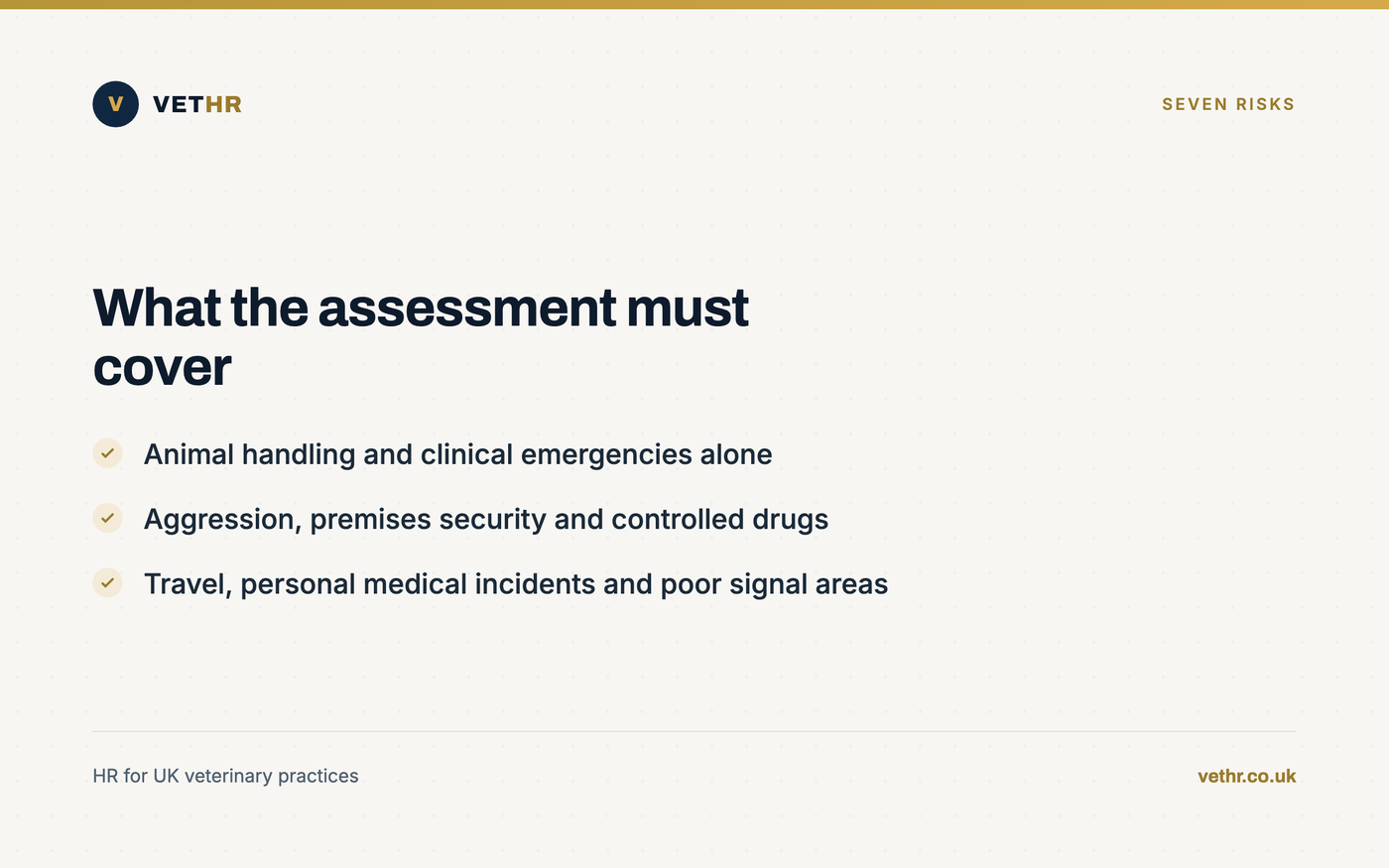
Veterinary lone working combines hazards that most workplaces meet one at a time. Assess each of these by role and by location rather than as a single practice-wide statement.
Rank them honestly. In most small animal practices, aggression and premises security at opening and closing come out higher than people expect, and animal handling injuries are more common than dramatic incidents.
Branches are where lone working becomes routine rather than exceptional, which is exactly why it stops being noticed. A receptionist opening alone, a nurse running a clinic with no vet on site, a vet consulting with nobody else in the building: each is a distinct arrangement needing its own assessment.
Sole charge also has a professional dimension alongside the safety one. Accreditation standards address staffing levels, and following the RCVS five-yearly review at least one RVN must be employed at General Practice level, with hospitals requiring an RVN on site during all normal opening hours. Our guide to the Practice Standards Scheme and your HR covers those requirements.
Three practical rules make branch working safer without adding cost. Nobody opens or closes alone without a check-in call. The front door stays locked when one person is alone in the building outside consulting hours. And a named colleague knows the shift start and finish times and notices if the finish call does not come.
With information before the vet leaves, not after. Home and farm visits are the highest variability part of veterinary lone working, because the environment is unknown, the animals are unrestrained and the vet is often carrying controlled drugs.
Make it explicit that a vet may abandon a visit on safety grounds without needing to justify it afterwards. Staff will only use that permission if it has been given in advance and in front of everyone.
It is lone working with fatigue added. An overnight nurse alone with hospitalised patients faces clinical risk, security risk and the effects of a long shift, and the working time rules on night work and rest apply alongside the health and safety duty.
The assessment should cover who the person escalates to clinically, how quickly that person can attend, what happens if a client arrives at the door, and what rest is possible during the shift. Vague answers here are common and expensive.
Look at the rota pattern as well as the shift. Repeated nights, or a night shift bookended by day shifts, turns an acceptable arrangement into an unsafe one. See our guides to working time rules and fair out of hours rotas.
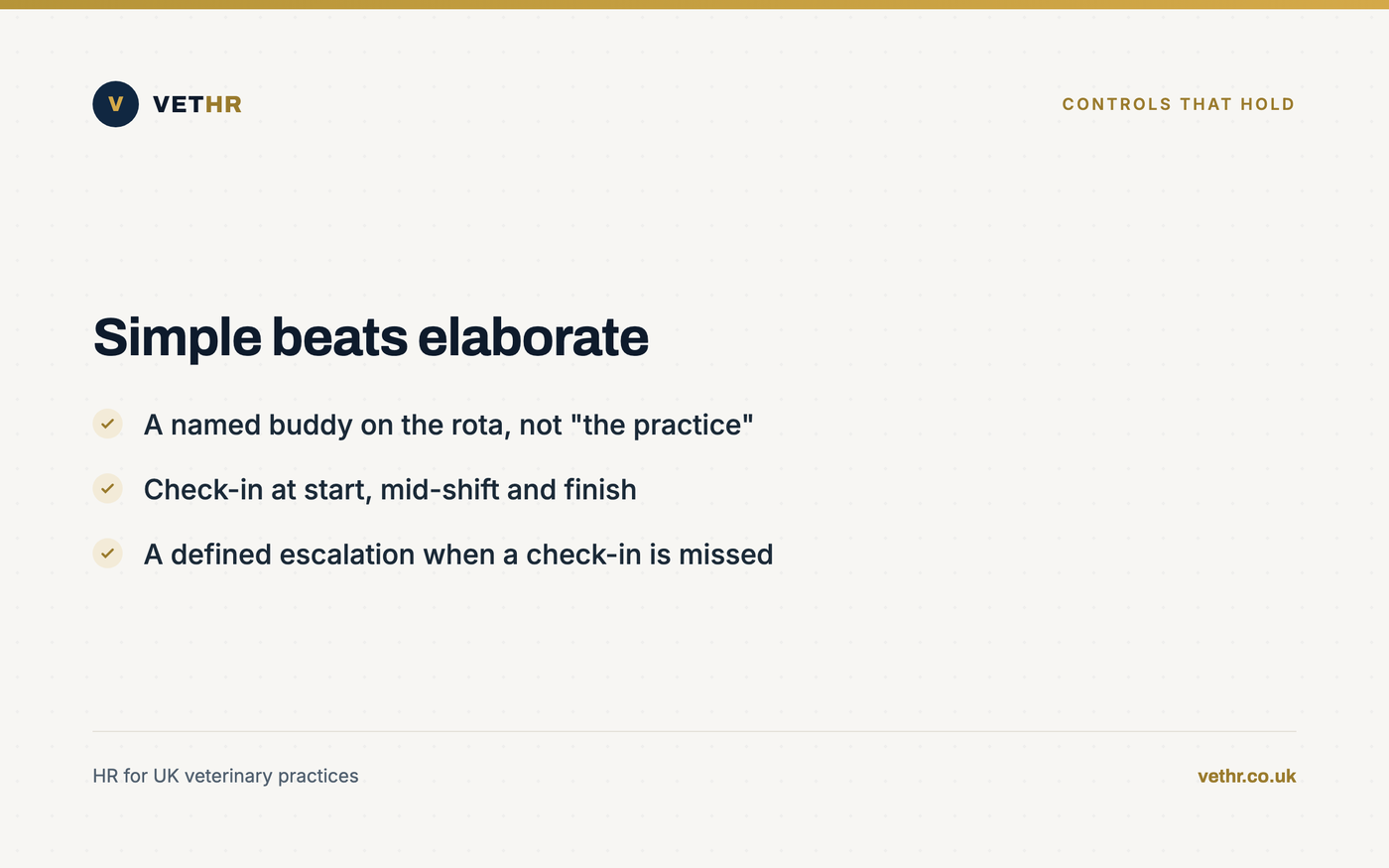
Simple ones that people use. Elaborate systems fail in practice because they add a step to a shift that is already busy, while a check-in call that takes ten seconds becomes habit within a fortnight.
Point six is where most practices are weakest. Staff absorb aggression from clients as part of the job and rarely report it, so the practice never sees the pattern. Our See It Report It system exists to make reporting quick enough that it actually happens.
One document per arrangement, not one for the whole practice. The Tuesday branch opening, the weekend sole charge clinic, the farm visit round and the overnight in-patient shift are four different situations with four different control sets, and a single generic page covers none of them properly.
Share it with the people doing the shifts rather than filing it. A lone working assessment nobody has read protects nobody, and if an inspector or an insurer asks, the question will be what the staff understood rather than what the folder contained.
Review after any incident and at least annually. Working alone changes as the rota changes, and a control designed around a colleague who has since left is no control at all. Our guide to incident reporting in veterinary practices covers how those reviews get triggered.
Running branch shifts with one person on site? A free 30-minute HR health check will show you what your assessment is missing. Book your HR health check.
Usually yes, provided the arrangement has been assessed and controlled. HSE requires the risks to be managed before someone works alone, so the questions are who knows they are there, what happens if they do not check in, whether the door stays locked before opening, and what they should do if someone arrives distressed.
Not necessarily. Devices help where staff are frequently off site or in poor signal areas, but for a practice the more reliable control is usually a named buddy and defined check-in points. Choose the control that fits the risk you actually identified rather than buying technology first.
Your assessment should name them explicitly. Practices commonly restrict handling of certain large or aggressive patients, some procedures involving sedation, and any work at height or with specific equipment. Writing the list down removes the pressure on an individual to make that call under time pressure.
It can, and both groups need individual consideration. A pregnancy risk assessment should specifically address lone working, restraint and out of hours duties, and apprentices or young workers may need supervision arrangements that rule out working alone in certain circumstances.
The employer’s duty to manage the risk applies whether or not the work happens on your premises. That is why the visit record, the check-in arrangement and the permission to withdraw all matter: they are the evidence that the risk was managed rather than delegated to the individual.
Lone working in veterinary practice is normal and will remain so. The point of assessing it is not to stop branch shifts or home visits, but to make sure that when something goes wrong at 8pm in an empty building, somebody knows, somebody comes, and the person on their own knew in advance exactly what to do.
If your assessment is a single line in a health and safety folder, it will not do that. Our policy library and HR consultancy cover lone working alongside the rest of your people paperwork, and the free HR health check is where most practices start.
The Vet HR Team provides HR consultancy and white-labelled staff systems exclusively to UK veterinary practices. Health and safety decisions should also be checked against current HSE guidance.
Contracts, rotas, holiday, a difficult conversation. Tell us what you are dealing with and we will come back within one working day. Nothing to sign up to.
Got it. We will come back to you within one working day. If you do not see a reply, please check your spam folder.
