Last updated: 14 June 2026
TL;DR: Incident reporting for veterinary practices is the simple, structured habit of logging every accident, sharps scare and near miss the moment it happens. A timestamped record turns a vague memory into proof. That audit trail protects the practice three ways: it answers an insurer or inspector with facts, it settles disputes before they escalate, and it shows the team where to fix the system so the same thing does not happen twice.
Most practices already react to incidents. Someone gets a needlestick, a fractious patient bites an RVN, the wrong vial is reached for and caught in time. The problem is rarely the response. The problem is that six months later, when it matters, nothing is written down. This guide explains what good incident reporting for veterinary practices looks like and why the record itself protects you.
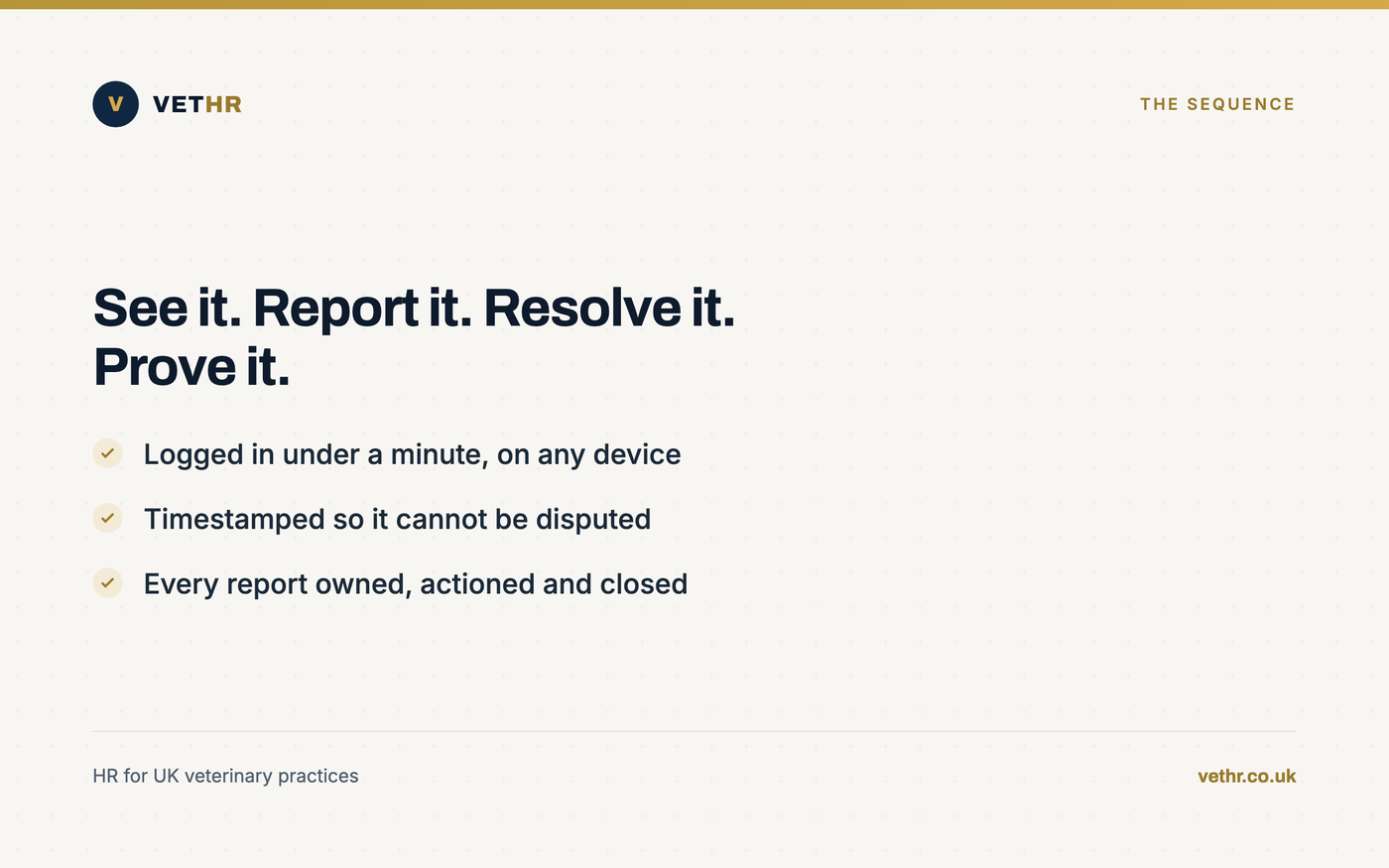
See It Report It is a plain-language way of saying that anyone who notices a safety event logs it straightaway, on any device, in under a minute. The phrase carries a sequence: see it, report it, resolve it, prove it. The point is to make reporting faster than the workaround, because a system only gets used when it beats the group chat it replaces.
In practice that means an RVN does not have to find the practice manager or remember the detail until the end of a twelve-hour day. They open a form on a phone or the front-desk PC, pick a severity level, type two lines, and it is logged with a date and time stamp. The manager sees it, acts on it, and signs it off, so the loop closes the same day instead of dissolving into a half-remembered conversation.
This sits inside what the profession calls clinical governance, which the Royal College of Veterinary Surgeons defines as “a continuing process of reflection, analysis and improvement in professional practice for the benefit of the animal patient and the client owner.” Structured incident reporting for veterinary practices is the engine that feeds that process with real events instead of guesswork.
An incident is anything that did, or nearly did, cause harm to a person, a patient or the practice. A near miss is the one that nearly did: the dose corrected before it reached the patient, the wet floor spotted before someone slipped, the overfull sharps bin emptied before a scratch. Near misses are the most valuable reports you will collect, because they are warnings without a casualty.
The reason near misses matter is scale. A peer-reviewed study of veterinary hospitals found roughly five errors reported per 1,000 patient visits, with 45% reaching the patient and 15% causing harm; drug errors were the most common category, followed by communication failures (Wallis et al., Frontiers in Veterinary Science, 2019). Behind each harmful error sit near misses nobody logged.
For a working practice, the reportable list is wider than people assume.
The rule of thumb is generous on purpose: if a reasonable colleague would want to know, log it. You can always grade it down later. You cannot recover what nobody wrote.
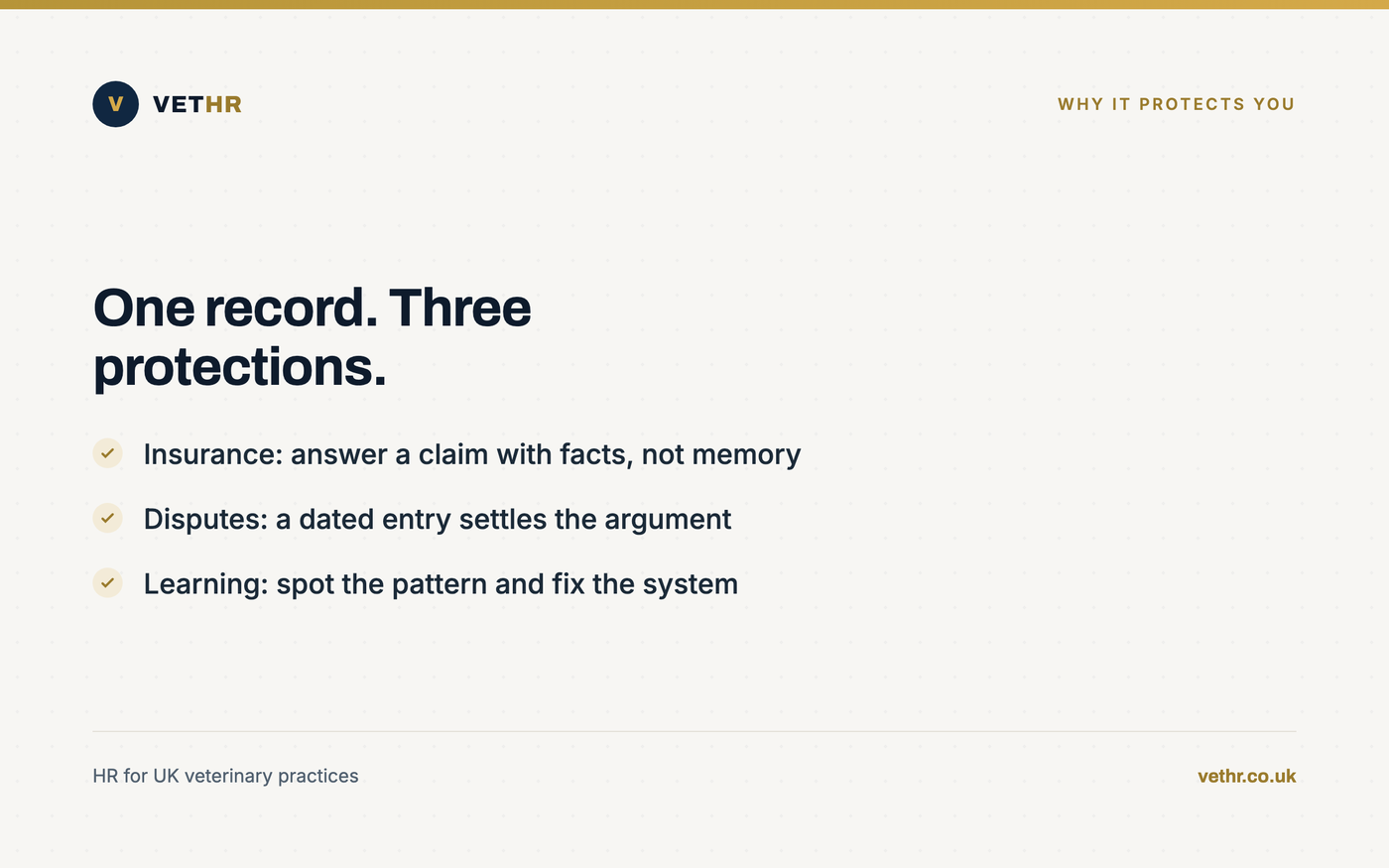
Incident reporting for veterinary practices protects you because it converts memory into evidence. The incident you can prove is the incident that protects you. When an insurer, an inspector or a tribunal asks what happened, a contemporaneous, timestamped entry is worth far more than the best recollection of a busy team months later. The protection works on three fronts.
If a member of staff later brings an employer’s-liability claim, or a client alleges harm, the defence rests on what you can show. A clean log of the event, the action taken and the date it was closed shows that the practice took the matter seriously and responded reasonably. A gap in the record does the opposite. Insurers and their solicitors work from documents, not goodwill.
Many workplace disputes turn on a contested version of events. Was the hazard reported? Was anything done? An honest, dated entry usually settles the question in seconds and stops a small disagreement becoming a formal grievance. The same record protects the person who reported, which is exactly why staff trust the system enough to use it.
The biggest return is the quietest. RCVS Knowledge is clear that the goal is to ensure “these events are seen as an opportunity for learning and improving systems” and to move “from a blame culture to a learning culture” (RCVS Knowledge). When three sharps injuries this quarter all happened at the same bench, you fix the bench. Without the log, you never saw the pattern.
Booking a free 30-minute HR health check is the quickest way to see where your current records would stand up, and where they would not.
Some of it is, and the line matters. Vet HR is an HR consultancy, not a law firm, so treat this as orientation and confirm specifics against the official source. Internal logging of every incident is good practice and supports your professional duties. Separately, certain serious events carry a statutory duty to report to the Health and Safety Executive, and that official reporting still applies whatever your internal system looks like.
The statutory threshold sits under RIDDOR, the Reporting of Injuries, Diseases and Dangerous Occurrences Regulations 2013. The “responsible person”, usually the employer, must report defined events to the HSE. Reportable specified injuries include “all fractures, other than to fingers, thumbs and toes”, amputations, any injury likely to cause permanent loss of or reduction in sight, serious burns over 10% of the body, and loss of consciousness from head injury or asphyxia (HSE, Specified injuries to workers).
The timeframes are specific. Deaths and specified injuries must be notified without delay and reported within 10 days of the incident. An injury that keeps a worker off their normal duties for more than seven consecutive days must be reported within 15 days. An over-three-day injury does not have to be reported to the HSE, but it must still be recorded (Weightmans, A guide to RIDDOR reporting). Where a statutory threshold is crossed, do not rely on your internal log alone; the formal HSE report is a separate legal step.
There is a record-keeping duty too. Any employer with 10 or more staff must keep an accident book under the Social Security (Claims and Payments) Regulations 1979, capturing the injured person, the date, time, place, and the cause and nature of the injury (HASpod). RIDDOR records must be kept for at least three years. A good digital system covers the accident book, the internal log and the RIDDOR audit trail in one place.
On the professional side, the RCVS Code asks veterinary surgeons and RVNs to reflect on “any unexpected critical events” and, when something goes wrong, to hold “a no-blame meeting of all staff involved as soon as possible after the incident and record all the details” (RCVS, Clinical governance guidance). A reporting system is how you keep that promise without it depending on memory.
A good audit trail is contemporaneous, complete and closed. Contemporaneous means logged at the time, not reconstructed later, so the timestamp carries weight. Complete means it records who, what, when, where and what was done. Closed means every entry ends in an action that is signed off. A trail that captures problems but never shows a response can look worse than none at all.
This is also where reporting connects to your written rules. When an incident reveals a gap, the fix often lives in a policy or a standard operating procedure. Linking each correction back to the governing practice policy turns one event into a permanent improvement, not a one-off conversation.
The single biggest barrier to reporting is fear of blame. RCVS Knowledge names “blame and shame” as the factor that stops people speaking up, and the fix is a culture where a report is treated as a gift, not a confession. The team needs to see that logging an event makes things better and never gets the reporter in trouble for honesty. That is a leadership behaviour first and a software setting second.
The practical levers are straightforward. Make reporting fast, because friction kills it. Offer named, anonymous or manager-only reporting, so people can raise a concern in the way they feel safe doing. Most importantly, close the loop out loud: when a near miss leads to a change, tell the team the change came from a report. People keep doing what they can see works.
This matters because under-reporting is invisible. A quiet incident log usually does not mean a safe practice; it means people have given up on the form. The aim is the opposite signal: a steady flow of small reports, most of them near misses, because that is what a practice paying attention looks like.
You can start this week without buying anything. Setting up incident reporting for veterinary practices is mostly about removing friction and agreeing what good looks like. The four steps below get a basic system running, and a dedicated tool simply makes each one faster.
Our See It Report It system packages this into a white-labelled form your team opens in seconds, with a timestamped audit trail, consistent severity grading and a clean record of every action signed off and closed. It is built so the system is faster than the workaround, which is the only way reporting ever sticks.
An incident is an event that caused harm or loss. A near miss is an event that could have, but was caught in time. Both should be logged. Near misses are especially valuable because they warn you about a risk before anyone is hurt, so a healthy report log usually contains more near misses than actual incidents.
Certain serious events are. Under RIDDOR 2013 the employer must report defined injuries, diseases and dangerous occurrences to the HSE, with deaths and specified injuries reported within 10 days and over-seven-day injuries within 15 days (HSE). Internal logging of everything else is strong practice and supports your professional duties, but it does not replace the statutory report when a threshold is crossed.
RIDDOR records must be kept for at least three years from the date the record was made (Weightmans). Many practices keep them longer, because a civil claim can sometimes be brought several years after the event. Store them securely, as they contain personal data covered by your data-protection obligations.
If you normally employ 10 or more people, yes. The Social Security (Claims and Payments) Regulations 1979 require an accident book recording the injured person, the date, time, place and the cause and nature of the injury (HASpod). A digital incident system can serve as your accident book provided it captures the required details.
That is a practice choice, not a fixed rule. Offering named, anonymous and manager-only options tends to lift reporting because people can raise a concern in the way they feel safest. The goal is honesty and volume of reports, so give staff the route that makes them most likely to speak up.
Incident reporting is not paperwork for its own sake. It is the quiet system that answers an insurer with facts, settles a dispute before it grows, and shows your team where to fix the practice so the same near miss does not become next year’s injury. The work is small and the protection is real, but only if the record exists when you need it.
Done well, incident reporting for veterinary practices is less a chore than an early-warning system for the things that would otherwise cost you.
If you want a calm, second opinion on where your records stand, start with a free 30-minute HR health check. We can also white-label a ready-made See It Report It system for your team and align it with your practice policies, so reporting, evidence and learning all live in one place.
The Vet HR Team provides HR consultancy and white-labelled staff systems exclusively to UK veterinary practices.
Read next: First Aid at Work in a Veterinary Practice, The COSHH Assessment Your Veterinary Practice Probably Needs to Redo and Needlestick Injuries in a Veterinary Practice.
Contracts, rotas, holiday, a difficult conversation. Tell us what you are dealing with and we will come back within one working day. Nothing to sign up to.
Got it. We will come back to you within one working day. If you do not see a reply, please check your spam folder.
