Last updated: 8 October 2026
TL;DR: Zoonoses are diseases that pass from animals to humans, and because they are caused by micro-organisms they fall under COSHH. That means a written assessment, controls, training and regular review. Hand gel is not an acceptable substitute for hand washing, and a diagnosed infection from work can be reportable to the HSE.
A student veterinary nurse picks up ringworm from a rescue kitten in her second week. She is off for four days, three other staff develop lesions, and the practice discovers that the only written reference to zoonoses anywhere in its paperwork is a line in a COSHH folder from 2019 saying that staff should wash their hands. That is not a risk assessment.
Diseases that animals carry and that can also affect humans. HSE guidance for agriculture puts it plainly: all farm animals naturally carry a range of diseases, some of which can also affect humans, and these diseases are known as zoonoses.
The same HSE page lists examples including anthrax, bovine tuberculosis, brucellosis, campylobacteriosis, E. coli O157, leptospirosis, Q fever, rabies and salmonella, each linked to particular animal carriers.
Small animal practice has its own set, ringworm and campylobacter among the ones staff actually get. The point is not the list. It is that exposure to zoonoses is a foreseeable part of the work rather than an accident.
COSHH, because the regulations cover hazardous substances and that includes micro-organisms. So the duties you already know from your dispensary and your disinfectants apply to biological hazards too.
That is a useful simplification. You do not need a separate legal framework for zoonoses; you need your COSHH assessment to include them, which most practice assessments do not.
Check yours. If it lists chemicals and cleaning products with nothing about biological agents, that is the gap. Our guide to the COSHH assessment in a veterinary practice covers how to build it.
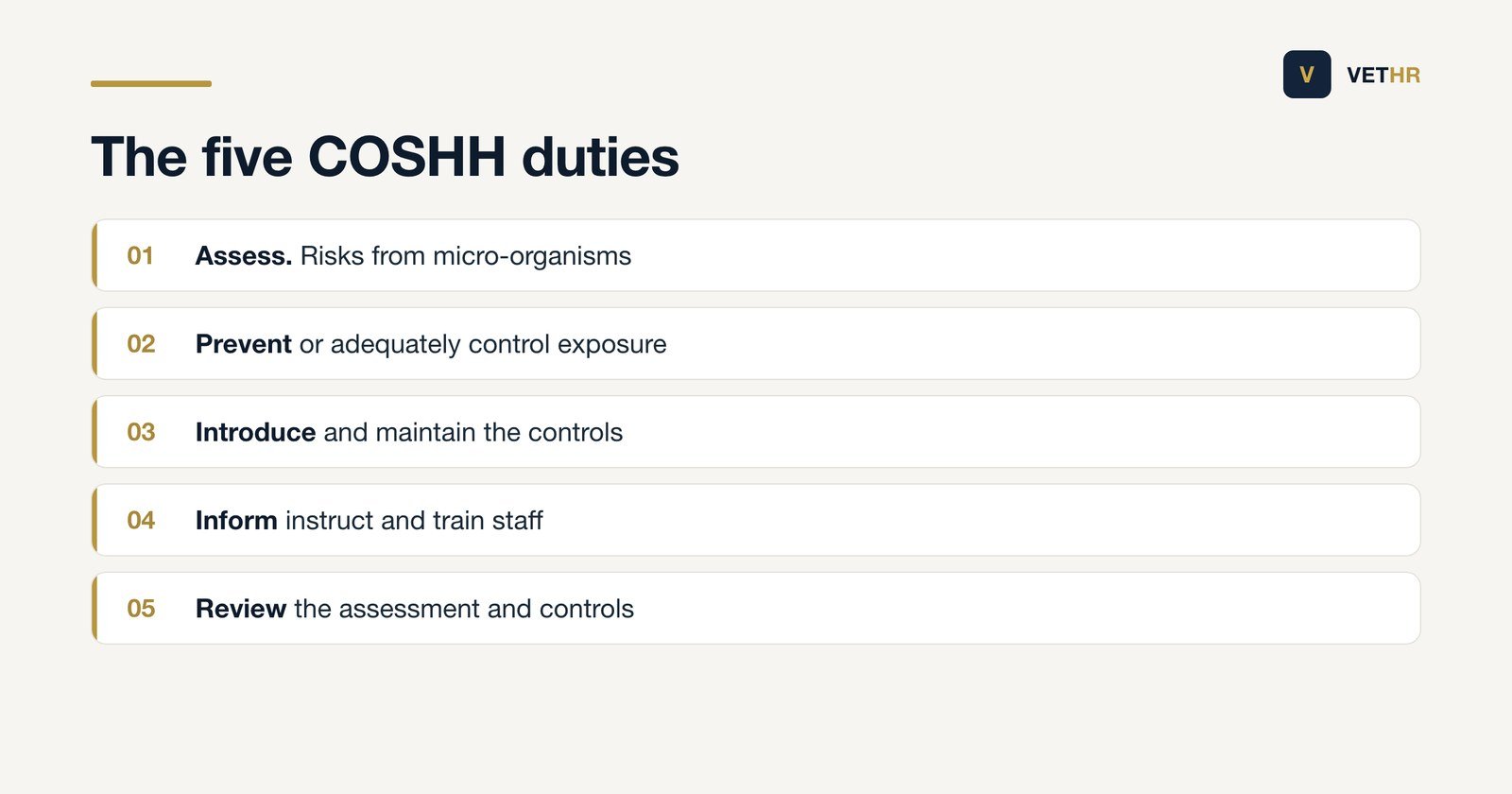
HSE sets out what COSHH requires of employers and the self-employed, and all five apply to zoonoses.
Maintain is the word practices trip over. A control measure that existed in 2019 and has since had its sink relocated, its gloves changed and its trained staff replaced is not being maintained.
Write it by activity, the same way you would a manual handling assessment. Handling an unvaccinated stray, cleaning a kennel after a diarrhoea case, taking a faecal sample, assisting a farm calving and dealing with a bite wound are five distinct exposures with five different answers, and a single generic paragraph about zoonoses covers none of them properly.
Keep it short enough to be read. One page per activity, with the hazard, who is exposed, the controls and the person responsible, beats a thirty page document that nobody opens after the inspection.
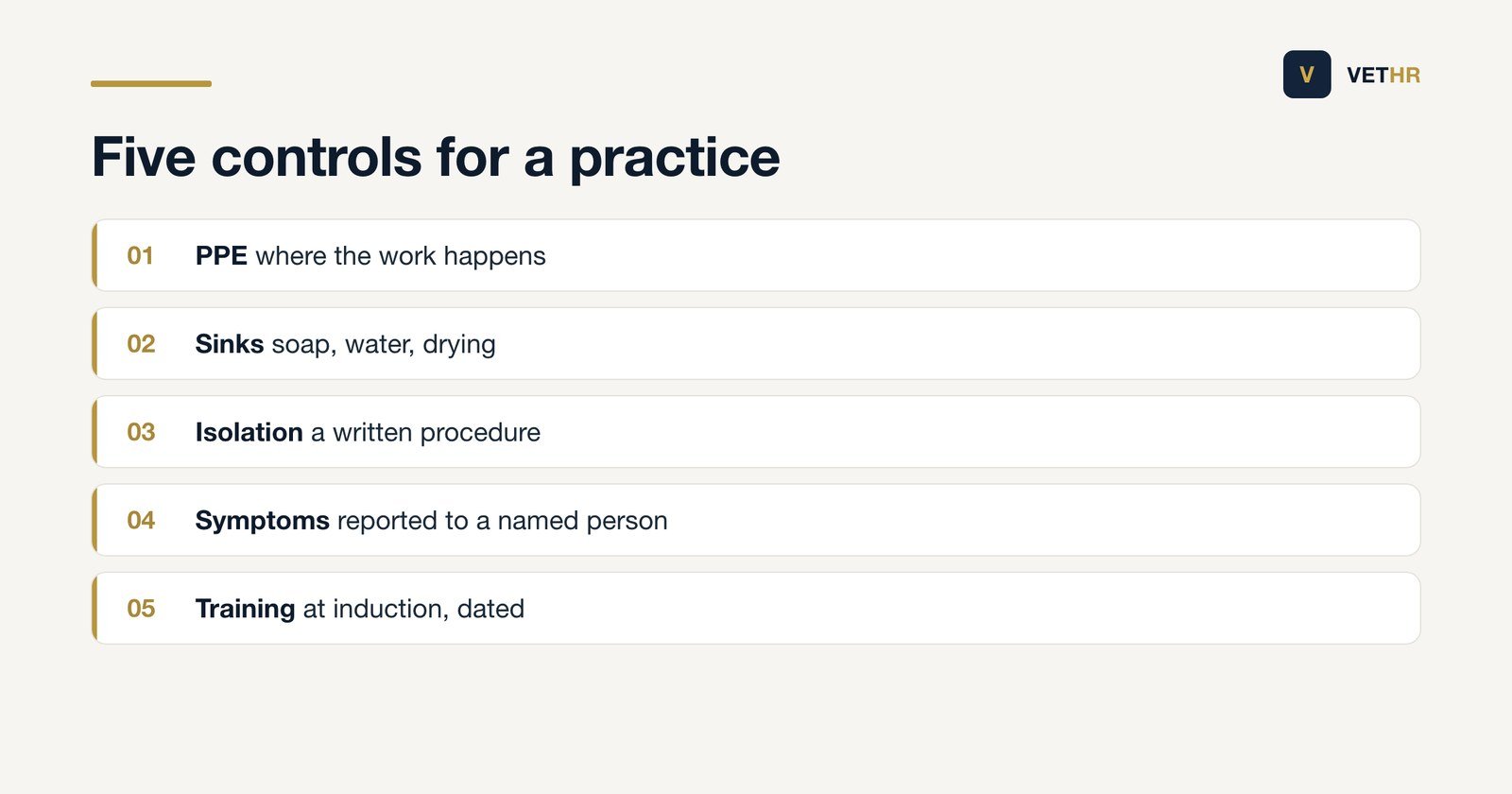
Five measures cover most of the exposure in a small animal practice, and none of them is expensive.
The fourth is the one that changes outcomes. Staff who feel they will be sent home without pay do not report symptoms, and a practice that learns about ringworm from the fourth case has lost control of it. Our note on absence trigger points covers how to avoid a policy that punishes honesty.
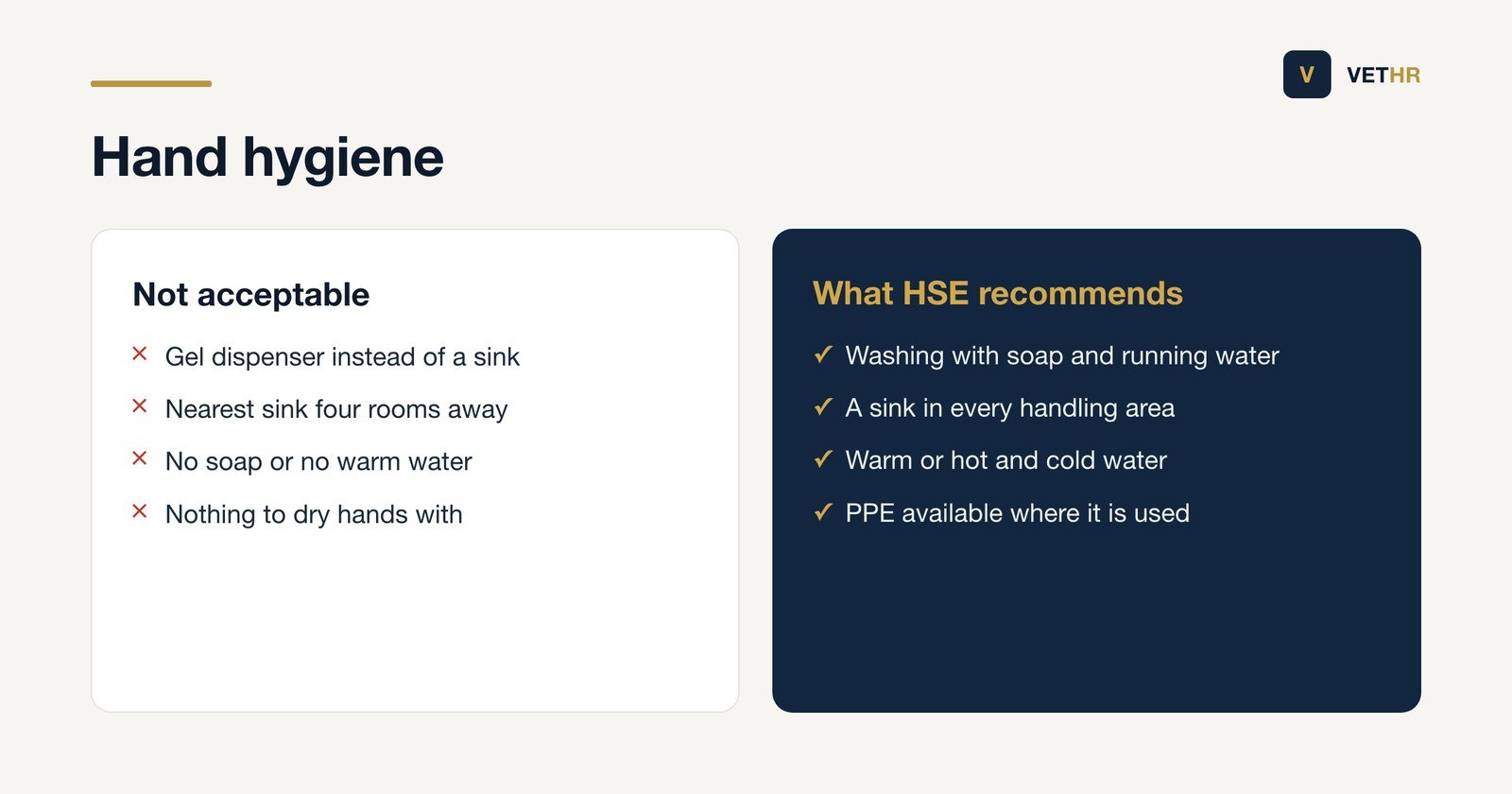
HSE is explicit on this point. Its recommended occupational hygiene practices include using personal protective equipment and efficient hand washing techniques using warm or hot and cold running water with soap, and it states that hand gels should not be used as an alternative for cleaning hands.
Worth knowing, because gel dispensers are cheap and sinks are not. A practice that installed gel at every door during the last few years may have quietly substituted it for washing.
Check that every area where animals are handled has a usable sink with soap, warm water and a way of drying hands. Then check that people are not standing at a sink four rooms away.
Tell clients what you need from them too. Asking on the phone whether a kitten came from a rescue, or whether a dog has had diarrhoea, changes which room the animal goes into and who handles it. Reception is the first control measure in the chain, and briefing them properly costs nothing.
Some zoonoses carry particular risks in pregnancy, and the assessment has to take account of the individual as well as the task. This is a conversation to have as soon as a member of staff tells you she is pregnant.
The same applies to anyone who is immunosuppressed, on certain medication, or has a condition that changes their risk. They do not have to tell you why; they only have to tell you that an adjustment is needed.
Handle it as a written review of the risk assessment, so the adjustment survives the next rota. Our guides to the pregnancy risk assessment and reasonable adjustments in a veterinary practice cover both situations.
Vaccination is worth a line in the policy. Where the practice recommends or funds a vaccination for staff, say which one, who pays and whether it is a condition of particular work, and keep the record in the health file rather than the personnel file.
Some do. Diseases attributable to occupational exposure to a biological agent appear on the HSE list of reportable occupational diseases, so a work acquired infection with a medical diagnosis can require a report.
An over seven day absence caused by a work related accident is reportable separately, within 15 days. Our guide to RIDDOR in a veterinary practice covers which route applies.
Log every case internally whether or not it is reportable, because the pattern is the useful thing. Three cases of the same infection in a year is a control failure, not bad luck, and our See It Report It system is where that becomes visible.
If your COSHH assessment has nothing in it about zoonoses, book a free 30-minute HR health check and we will look at it with you.
They need to be assessed, and the simplest way is within your COSHH assessment, because COSHH covers micro-organisms. A separate document is fine if you prefer, as long as it is reviewed on the same cycle as everything else.
No. HSE guidance on zoonoses recommends efficient hand washing using warm or hot and cold running water with soap, and states that hand gels should not be used as an alternative for cleaning hands.
You can ask them to report specified symptoms, such as skin lesions or persistent diarrhoea, to a named person. Make the route simple and make clear it is about protecting the team, not about triggering an absence process.
Treat them as staff for these purposes. Student veterinary nurses and school placements need the same information, instruction and training, and they are often the least likely to know what to look out for.
COSHH requires regular review of the assessment and the effectiveness of the controls. Annually is a sensible default, plus a review whenever a procedure, product or premises layout changes, or after any case of infection in the team.
Zoonoses do not need a manual. They need a page in your COSHH assessment, PPE where the work happens, a proper sink in every handling area, a written isolation procedure, a no questions route for reporting symptoms, and a dated training record.
That is an afternoon, and it is the difference between one case of ringworm and four. We build health and safety document sets for independent practices through HR consultancy for veterinary practices and the policy document set.
The Vet HR Team provides HR consultancy and white-labelled staff systems exclusively to UK veterinary practices.
Contracts, rotas, holiday, a difficult conversation. Tell us what you are dealing with and we will come back within one working day. Nothing to sign up to.
Got it. We will come back to you within one working day. If you do not see a reply, please check your spam folder.
