Last updated: 29 September 2026
TL;DR: RIDDOR requires deaths, specified injuries, certain occupational diseases, dangerous occurrences and injuries keeping someone off normal work for more than 7 consecutive days to be reported to the HSE. Over seven day injuries must be reported within 15 days. Injuries causing more than 3 days away must be recorded, but not reported.

A nurse is bitten through the hand restraining a collie for a blood sample. She goes to A and E, gets antibiotics, and is off for nine days. The bite went in the accident book on the day. Nobody made a RIDDOR report, because nobody in the building knew that nine days off crosses a legal threshold. That is the most common reporting failure in veterinary practice.
The Reporting of Injuries, Diseases and Dangerous Occurrences Regulations. It places a duty on the responsible person, which in a veterinary practice means the employer, to report certain work related incidents to the Health and Safety Executive.
It is not the same as your accident book. The accident book records everything. RIDDOR is the smaller set of incidents that has to go to the regulator, and the two are often confused.
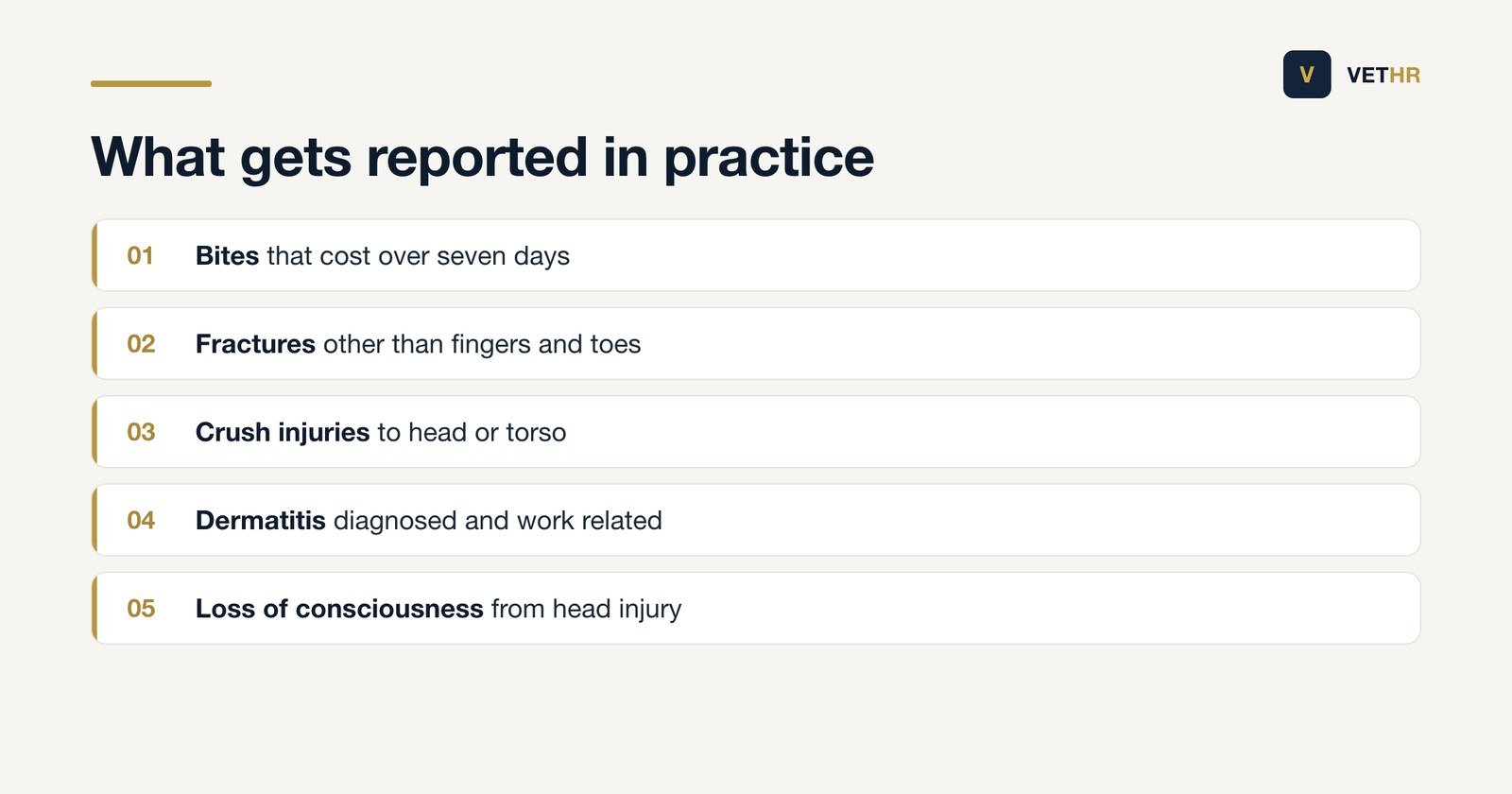
Five categories are reportable: deaths, specified injuries to workers, over seven day injuries, certain occupational diseases and dangerous occurrences. Injuries to members of the public that result in someone being taken to hospital for treatment are also covered.
The HSE publishes a defined list of specified injuries to workers. These are reportable regardless of how much time someone has off.
Read that list against a large animal practice and the relevance is immediate. A kick that fractures a forearm is a RIDDOR report. A crushed foot in a cattle crush is a RIDDOR report. So is any loss of consciousness after a head injury.
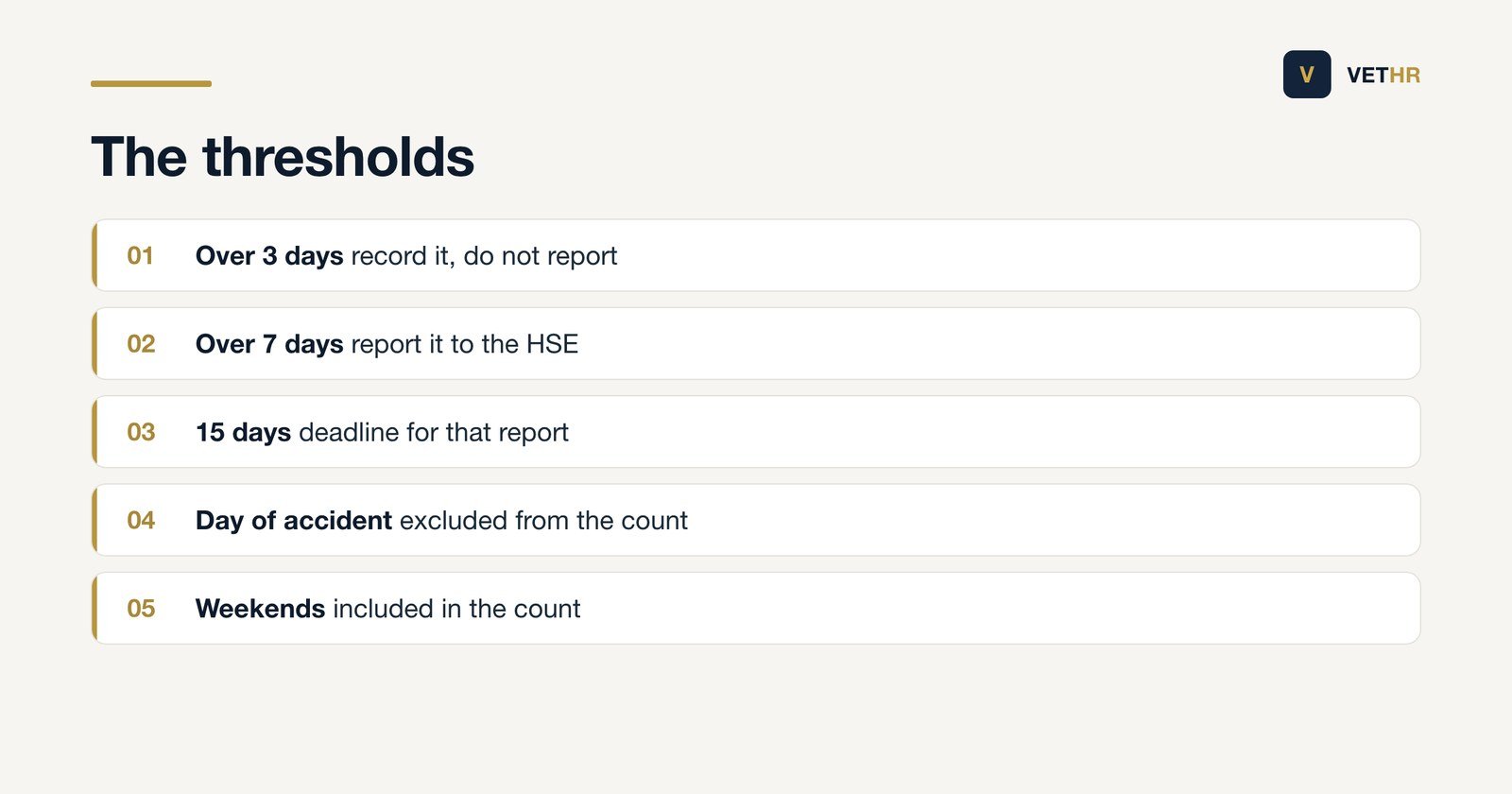
This is the one practices miss. HSE guidance states that work related accidents must be reported where they result in an employee or self-employed person being away from work or unable to perform their normal duties for more than 7 consecutive days, and that the report must be made within 15 days of the accident.
Two details matter. The seven days do not include the day of the accident, and they do include days the person would not normally have worked, such as weekends and rest days.
Unable to perform normal duties counts as well as being off entirely. A nurse who cannot restrain, handle or scrub for eight days because of a hand injury is in scope even if she is on reception the whole time. That is where most missed RIDDOR reports come from.
Dangerous occurrences are the category practices rarely think about. They are defined near misses: an incident that did not injure anyone but could have. In a practice that can include the failure of a lifting device, an unintended release of a harmful substance, or a fire or explosion that stops work for more than 24 hours.
A RIDDOR report is not an admission of fault. It is a notification, and the HSE receives thousands every week without following any of them up. Practices that treat it as a confession end up under reporting, which is the position that actually creates risk.
Injuries that leave someone unable to do their normal work for more than 3 consecutive days must be recorded, but they do not have to be reported to the HSE. The accident book entry is the record.
Practically, that means every injury has a clock running against two thresholds: three days for the record, seven for a report. Diary the check rather than relying on someone noticing.
Our See It Report It incident reporting system timestamps the original report and prompts the follow up, which is the mechanism most practices are missing rather than the knowledge.
Certain diagnosed conditions are reportable when they are linked to work. The HSE list includes occupational dermatitis, carpal tunnel syndrome, hand arm vibration syndrome, occupational asthma, tendonitis or tenosynovitis of the hand or forearm, and cramp of the hand or forearm.
Dermatitis is the one that turns up in veterinary practice, usually from repeated scrubbing, glove use and disinfectants. It is reportable under RIDDOR where a doctor has diagnosed it and the work is the cause.
Diseases attributable to occupational exposure to a biological agent are also in scope, which is the route by which a work acquired zoonotic infection can become reportable. Our note on COSHH assessments in a veterinary practice covers the underlying controls.
In fifteen years of practice records, the same handful comes up.
Our guides to needlestick injuries and first aid at work in a veterinary practice cover the immediate response. RIDDOR is the step after that, and the two get confused because the same person usually handles both.
Keep the clinical detail out of the RIDDOR record and in the confidential health file. The report needs the facts of the accident, not a member of staff’s medical history, and mixing the two creates a data protection problem on top of a safety one.
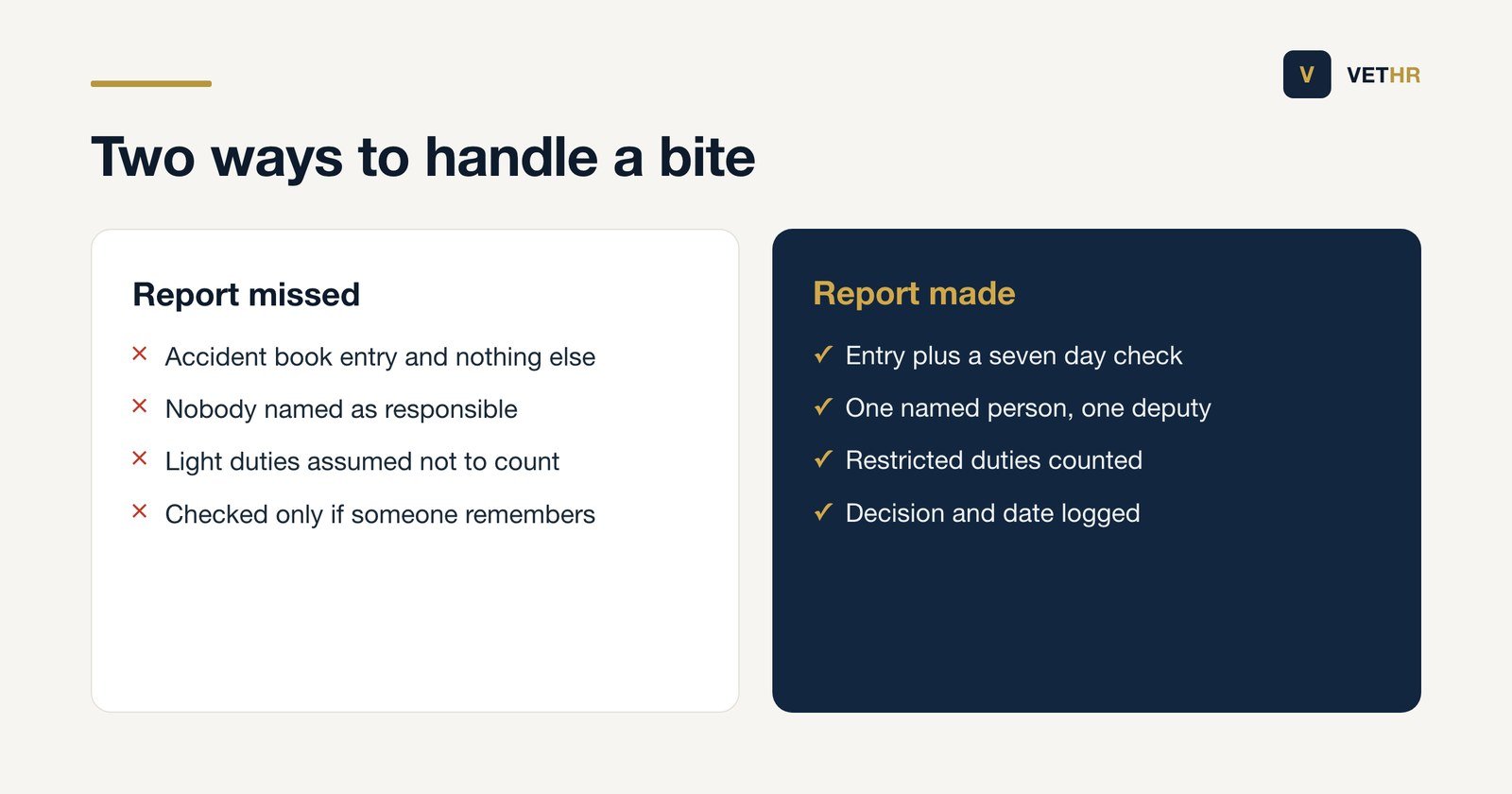
Name one person as responsible for RIDDOR decisions, and a deputy. In most practices that is the practice manager, with a partner as deputy. Without a name it becomes everyone’s job and therefore nobody’s.
Add a seven day check to every accident book entry involving time off or restricted duties. One line in the log: date of accident, date of the check, decision, who made it.
Reports are made online through the HSE reporting forms. Keep a copy of the submission with the incident record, because the report and the internal investigation are separate documents and you will want both if anyone asks. Our note on incident reporting for veterinary practices covers how the two fit together.
If nobody in your practice can say who makes the RIDDOR call, book a free 30-minute HR health check and we will help you set it up.
Not automatically. It becomes reportable if it causes a specified injury, or if it keeps the person away from work or unable to do their normal duties for more than 7 consecutive days. Most bites are neither, and a few are both.
Yes. The count is of consecutive days and includes days the person would not have worked anyway. It excludes the day of the accident itself, which is the detail most often got wrong.
Being unable to perform normal duties counts the same as being absent. A nurse doing reception because she cannot restrain animals is still unable to do her normal work, and the seven day clock is running.
Over seven day injuries must be reported within 15 days of the accident. Deaths, specified injuries and dangerous occurrences should be reported without delay, with the written report following promptly.
People on work experience are treated as your employees for these purposes, so yes. Student veterinary nurses on placement, and school students spending a week with you, are covered by the same duty.
Practices do not miss RIDDOR reports because they do not care. They miss them because the injury was dealt with kindly on the day and nobody looked again on day eight.
One named person, a seven day check on every entry, and one log. We build that into practice systems through HR consultancy for veterinary practices and the Vet HR staff systems.
The Vet HR Team provides HR consultancy and white-labelled staff systems exclusively to UK veterinary practices.
Contracts, rotas, holiday, a difficult conversation. Tell us what you are dealing with and we will come back within one working day. Nothing to sign up to.
Got it. We will come back to you within one working day. If you do not see a reply, please check your spam folder.
