Last updated: 5 September 2026
TL;DR: The law requires employers to provide adequate and appropriate equipment, facilities and personnel so employees receive immediate attention if injured or taken ill at work. There is no fixed minimum number of first aiders. What is adequate comes from a first aid needs assessment, and the regulations apply even to workplaces with fewer than five employees.
A veterinary practice is full of people trained to deal with a bleeding patient and considerably less clear on what happens when the person bleeding is a colleague. Add a dog bite at 6pm on a Saturday with two people on site, and the gap between clinical competence and workplace first aid becomes obvious.
First aid at work requires adequate and appropriate provision, defined by your own circumstances. HSE states that employers must provide adequate and appropriate equipment, facilities and personnel to ensure their employees receive immediate attention if they are injured or taken ill at work.
There is no prescribed number of first aid at work personnel. The legislation does not set a minimum quantity of first aiders, so the answer comes from an assessment of your workplace rather than from a rule you can look up.
The first aid at work regulations apply universally, including workplaces with fewer than five employees and the self-employed. A two person branch surgery is inside the same duty as a twelve person hospital.
What varies is what adequate first aid at work means. HSE is explicit that this depends on the specific circumstances of the workplace, which is why the assessment is the whole exercise rather than a preliminary to it.
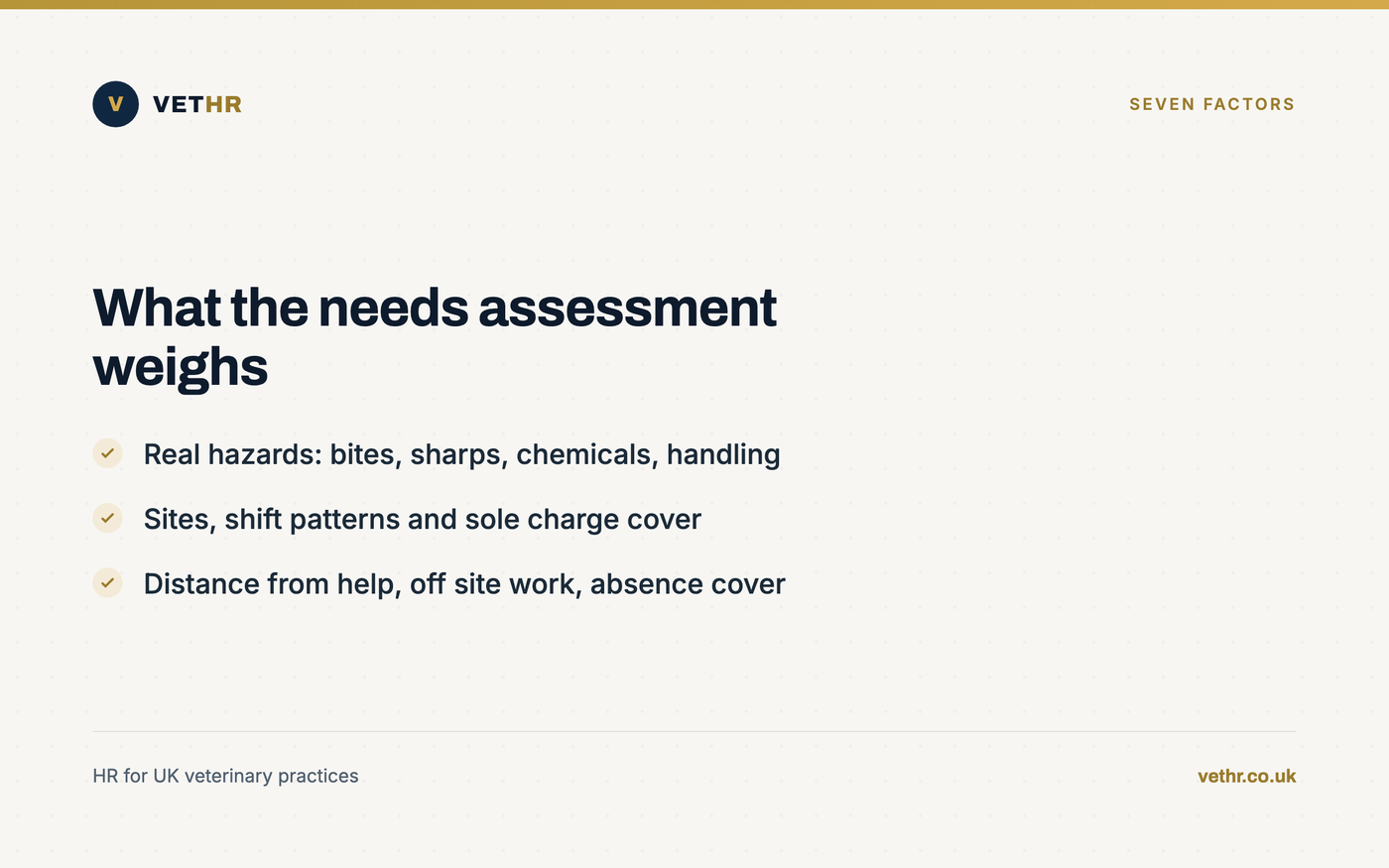
The hazards, the people and the circumstances that shape first aid at work in your building. HSE requires employers to carry out an assessment of first aid needs considering workplace hazards, the size of the organisation and other relevant factors.
Point seven is the one that fails in practice. A single trained first aider means no trained first aider for six weeks of the year, and the assessment should say what happens then.
Write the assessment down even though there is no prescribed format. An undocumented judgement about first aid at work is indistinguishable from never having made one, and it is the first thing anyone asks for after an incident.
Point three is where veterinary work diverges most. Cover that is adequate at 11am on a Tuesday is often nothing like adequate at 2am with one nurse and a hospitalised patient, which is why this sits alongside your lone working arrangements.
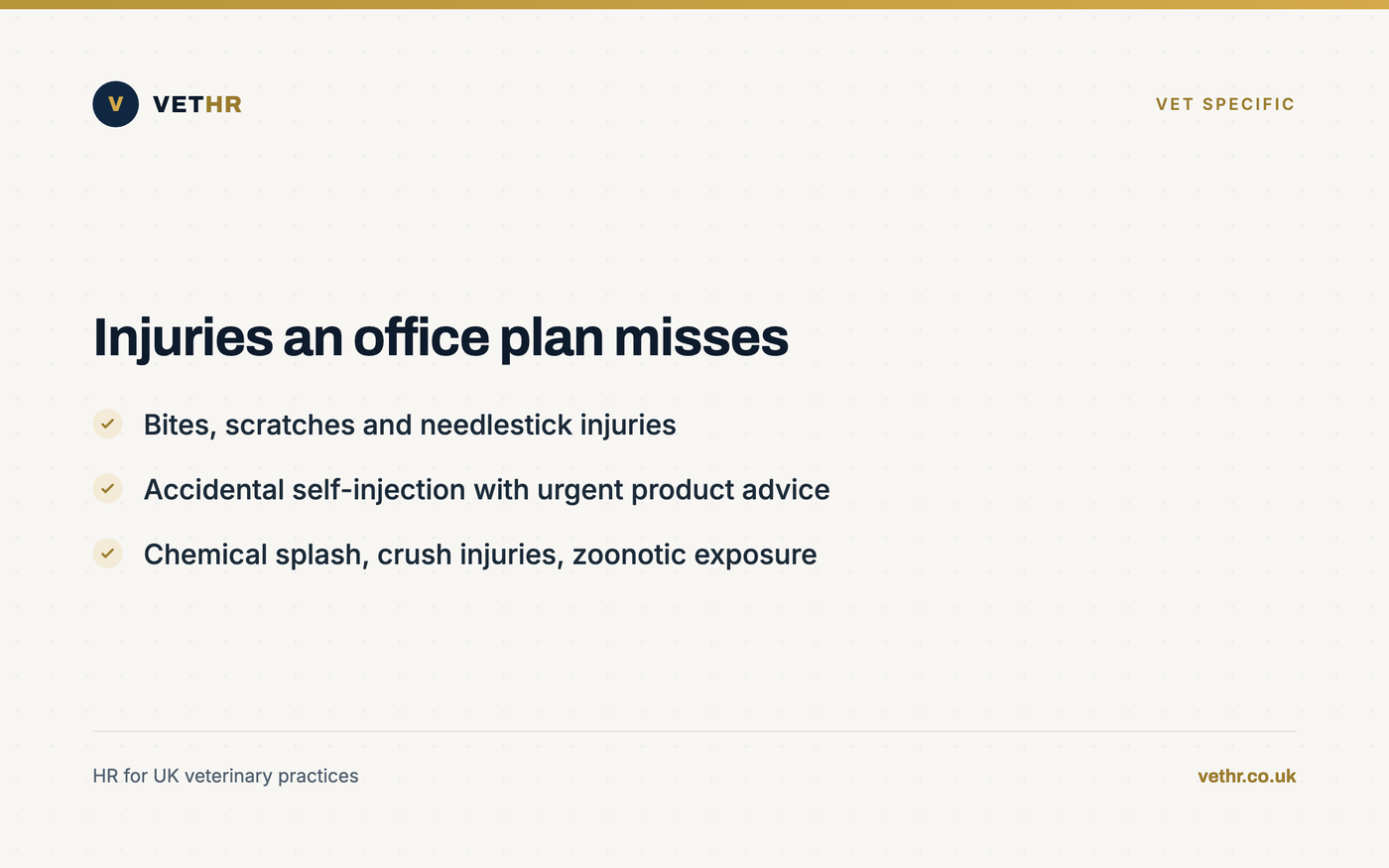
The injuries are predictable and unusual at the same time, which is why generic first aid at work planning fails here. A generic office assessment will not name any of them, which is exactly why generic assessments fail here.
Self-injection deserves its own written procedure. Some products carry specific and urgent medical instructions, and the moment to find them is not while somebody is holding their hand under a tap.
Do not assume clinical staff know human first aid at work procedures. A vet is not trained in human resuscitation by virtue of being a vet, and assuming otherwise is one of the most common gaps in a practice assessment.
Whichever your first aid at work assessment justifies. HSE guidance is that whether trained first aiders are needed depends on the individual workplace assessment rather than on a fixed rule.
An appointed person takes charge of the first aid at work arrangements, looks after the equipment and calls the emergency services. That is the minimum position in a low risk workplace with few staff.
Trained first aiders hold a current qualification and can give treatment. Given the hazard profile of a practice, most assessments land here rather than on appointed persons alone.
Build the qualification into your training budget rather than treating it as an extra. First aid at work certificates expire, refreshers are due periodically, and a practice that only funds the initial course discovers three years later that nobody’s certificate is current.
Train more than one, across roles and sites. Concentrating the qualification in a single practice manager who works Monday to Friday leaves your weekend team covered by nobody, which is the exact shift where bites happen.
Whatever the assessment identifies, kept accessible and in date. There is no legally mandated list, which surprises practices expecting a specification to follow.
Human first aid supplies should be separate from clinical stock and clearly labelled. A kit that has been raided for a patient is not a kit, and in a busy practice that happens constantly unless it is physically separated.
Give the monthly check to a named person with a date, not to the team in general. Our guide to the HR compliance checklist covers building these small recurring tasks into a rhythm.
Only one trained first aider, and they work weekdays? A free 30-minute HR health check will map the gaps. Book your HR health check.
Every incident internally, and certain ones to the authorities. The internal record matters most day to day, because it is what turns single events into a visible pattern.
HSE sets out the wider framework, including what must be reported, in its first aid at work guidance, which is worth reading alongside your own assessment.
Near misses are the useful half and the half that goes unreported. A near miss reporting habit is what gives you the chance to change something before the injury, which our See It Report It system is built around.
Review the first aid at work arrangements after any significant incident, not only annually. The incident tells you what the assessment assumed and what actually happened, and that gap is the most useful information you will get all year.
Treat injury records as special category data, stored securely with limited access, as our guide to GDPR and staff records sets out.
There is no fixed minimum in law. HSE requires adequate and appropriate equipment, facilities and personnel, with the number determined by your first aid needs assessment. Given the hazards in a practice, most assessments justify more than one trained first aider across shifts and sites.
Yes. The regulations apply universally, including to workplaces with fewer than five employees and to the self-employed. A small branch still needs adequate provision, and the assessment should consider the times when only one or two people are on site.
No. Veterinary qualifications do not confer human first aid competence, and assuming they do is a common gap. If your assessment concludes trained first aiders are needed, they need a current human first aid qualification regardless of their clinical role.
Have a written procedure and keep product information accessible. Some veterinary medicines carry specific and urgent instructions for accidental human exposure, and staff should know before an incident where that information is and who to call.
There is no mandated list. Contents should reflect the findings of your needs assessment, which for a practice usually means dressings for bites and lacerations, eyewash where splash risk exists, and separate provision in vehicles used for visits. Keep it separate from clinical stock.
First aid at work is one of the few areas where a veterinary practice is likely to be worse prepared than an office, because everyone assumes the clinical skills transfer. They do not, and the hazards here are considerably higher.
Write the needs assessment around your real hazards and shifts, train more than one person across sites, separate the human kit from clinical stock and review incidents monthly. Our See It Report It system and HR consultancy support all of it, and the free HR health check is where to start.
The Vet HR Team provides HR consultancy and white-labelled staff systems exclusively to UK veterinary practices. Health and safety decisions should be checked against current HSE guidance.
Contracts, rotas, holiday, a difficult conversation. Tell us what you are dealing with and we will come back within one working day. Nothing to sign up to.
Got it. We will come back to you within one working day. If you do not see a reply, please check your spam folder.
