Last updated: 1 October 2026
TL;DR: Radiation protection under the Ionising Radiations Regulations 2017 applies to every practice with an X-ray set. HSE operates a three tier system of notification, registration and consent, and veterinary X-ray devices sit in the registration tier. The practice also needs an adviser, a supervisor, local rules and trained staff.
A practice has had the same X-ray set for eleven years. The local rules on the wall name a nurse who left in 2021. Nobody can find the registration paperwork, the dosimetry badges are in a drawer, and the newest vet has never been shown where the controlled area starts. None of that is unusual, and all of it is a radiation protection problem.
The Ionising Radiations Regulations 2017, usually shortened to IRR17. The HSE publishes an Approved Code of Practice, L121, which helps employers comply with their duties under the regulations and is written for employees who work with ionising radiation, radiation protection advisers and radiation protection supervisors.
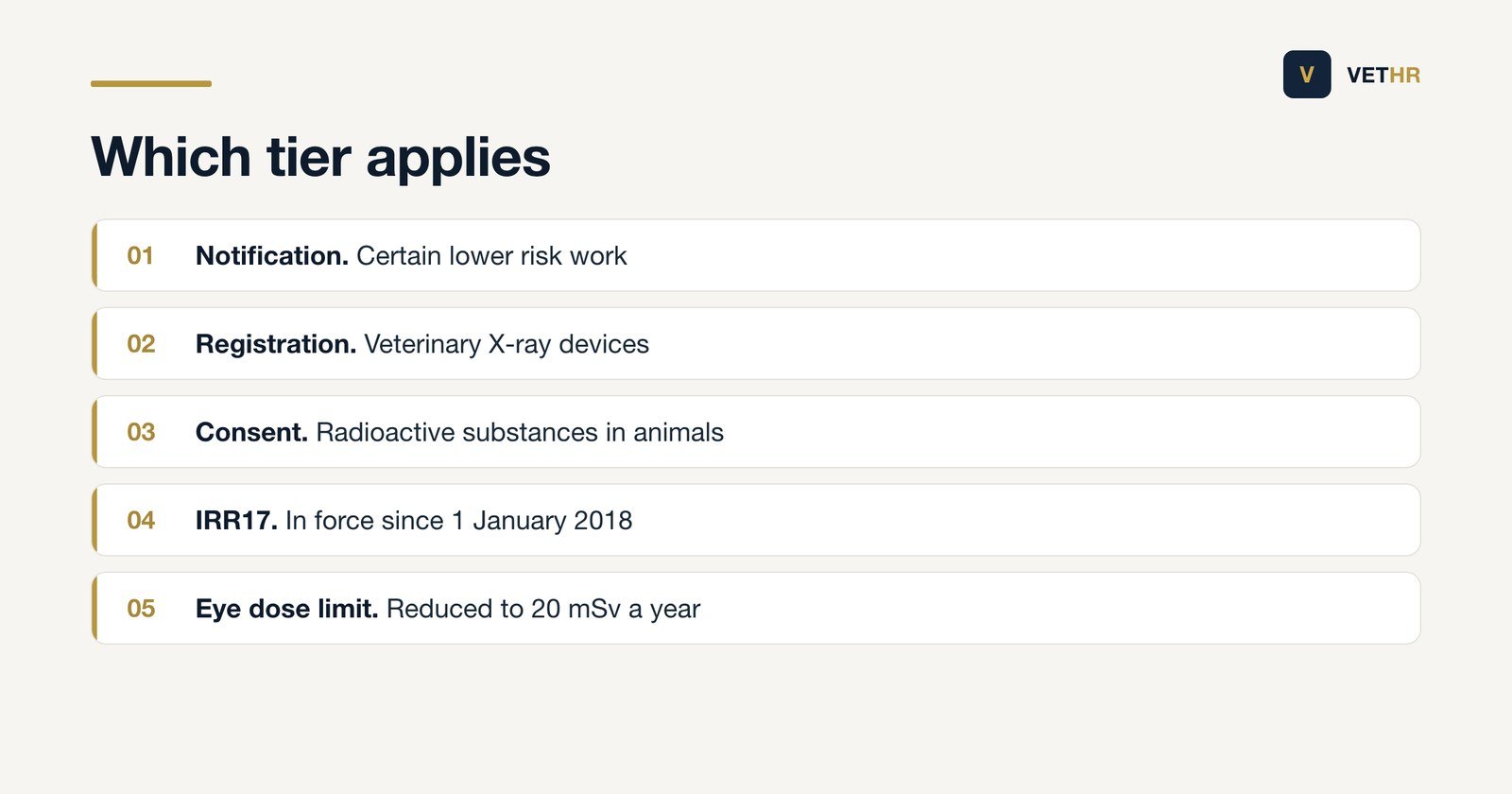
Two changes introduced with IRR17 are worth knowing. The dose limit for the lens of the eye came down from 150 mSv to 20 mSv a year, and the old authorisation arrangements were replaced with a three tier system of regulatory control.
This is health and safety law, not RCVS guidance, which means the enforcement route is the HSE and the duty sits with the employer.
Three tiers, and most practices only need one of them. HSE guidance on work requiring registration lists work with radiation generators, and gives dental and veterinary X-ray devices as examples.
So a general practice with a standard X-ray set needs to be registered. A referral centre doing nuclear scintigraphy needs consent as well, because it is administering radioactive substances to animals.
Check yours rather than assuming. Registration was a new requirement when IRR17 came into force on 1 January 2018, and practices that had been running an X-ray set for decades before that are the ones most likely to have missed it.
HSE guidance states that an employer who works with ionising radiations is required to consult, and where necessary appoint, a radiation protection adviser on the matters set out in Schedule 4 of IRR17, and to select one with the knowledge and experience suitable for that particular line of work.
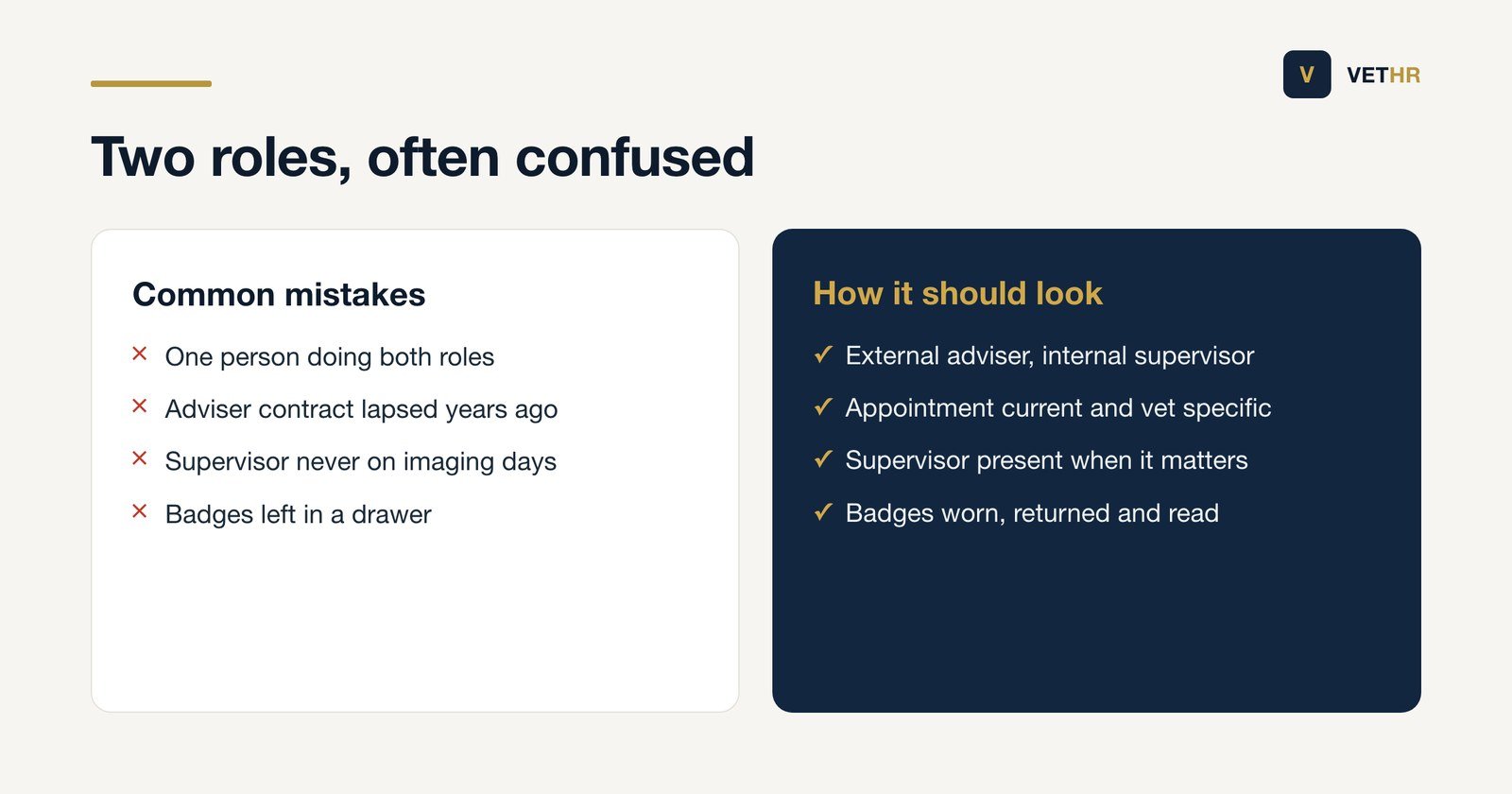
In practice this is an external specialist on a service contract, not a member of your team. They advise on the controlled area, equipment testing, dose assessment and the local rules.
Two things to check today: that the appointment is current rather than lapsed, and that the adviser’s scope actually covers veterinary work. A contract signed in 2016 with nobody named on it is not an appointment.
Keep the adviser’s reports. A radiation protection adviser will produce a written assessment after each visit, often with actions attached, and those actions are the practice’s to complete rather than the adviser’s. A folder of reports with nothing done against them is a worse position than no reports at all, because it shows the risk was identified and left.
The supervisor is internal. This is the person who makes sure the work is done in accordance with the local rules, and it is usually a vet or a senior nurse who is actually present when radiographs are taken.
The role needs three things to work: appropriate training, real authority to stop unsafe work, and enough presence in the building to notice. Appointing someone who works Tuesdays while most imaging happens on Fridays does not achieve radiation protection.
Name the supervisor and a deputy in writing, record the training each has had, and review the appointment whenever either leaves. Our note on job descriptions in a veterinary practice covers how to put a named safety role into a job description so it survives a handover.
Local rules are the practice’s own written procedures for the radiation work it does, covering the controlled area, who may be present, restraint arrangements, protective equipment, contingency arrangements and the name of the supervisor.
They need to be current, displayed where the work happens, and read by everyone who works in the area. Rules naming a nurse who left five years ago tell an inspector exactly how the system is running.
Put a review date on them, tie it to your annual policy review, and make signing them part of induction. Our page on policies for veterinary practices covers how to keep a document set like this alive rather than archived.
Restraint deserves a sentence of its own, because it is where radiation protection meets daily reality. Chemical restraint and positioning aids are the answer; a queue of people holding a wriggling patient is not. If your local rules say nobody is in the room during exposure, the practice has to be equipped to make that true on a busy Friday as well as on the day the adviser visits.
Everyone who works with or near the X-ray set needs information, instruction and training proportionate to what they do. That includes reception staff if the controlled area passes anywhere near them, and it certainly includes students on placement.
Dosimetry badges only do their job if they are worn, returned and the results read. Badges left in a drawer are worse than no badges, because they create a record suggesting nobody was exposed.
Add radiation protection to the new starter checklist alongside fire, first aid and COSHH. Our new starter checklist for veterinary practices covers the week one items, and the COSHH assessment guide covers the neighbouring duty.
Every part of radiation protection that fails in a practice fails for an HR reason rather than a technical one. Someone left. Someone was never inducted. Nobody owns the review date. The supervisor is not on shift.
Four fixes cover almost all of it: named roles with deputies, an induction item, a review date in the annual calendar, and a leaver checklist that asks whether the person held a named safety role.
Pregnancy needs its own note. A pregnant member of staff working with ionising radiation needs the risk assessment revisited, and that conversation should happen as soon as the practice is told. Our guide to the pregnancy risk assessment in a veterinary practice covers it.
If nobody can currently say who your supervisor is, book a free 30-minute HR health check and we will go through your named roles with you.
HSE guidance on registration lists work with radiation generators and gives veterinary X-ray devices as an example, so yes. Size does not change the duty, and practices that had equipment before IRR17 came into force are the likeliest to have missed the step.
No. They are different roles. The adviser is an appropriately qualified external specialist you consult and appoint; the supervisor is an internal member of staff who makes sure the work follows the local rules day to day.
The practice’s own written procedures for its radiation work, covering the controlled area, who may be present, protective equipment, contingency arrangements and the supervisor’s name. They should be displayed where the work happens and reviewed on a set date.
If the controlled area affects where they work or walk, they need information and instruction proportionate to the risk. It is quicker to include everyone at induction than to work out who is close enough to matter.
Two things practices notice most. The dose limit for the lens of the eye fell from 150 mSv to 20 mSv a year, and a three tier system of notification, registration and consent replaced the previous arrangements. The regulations came into force on 1 January 2018.
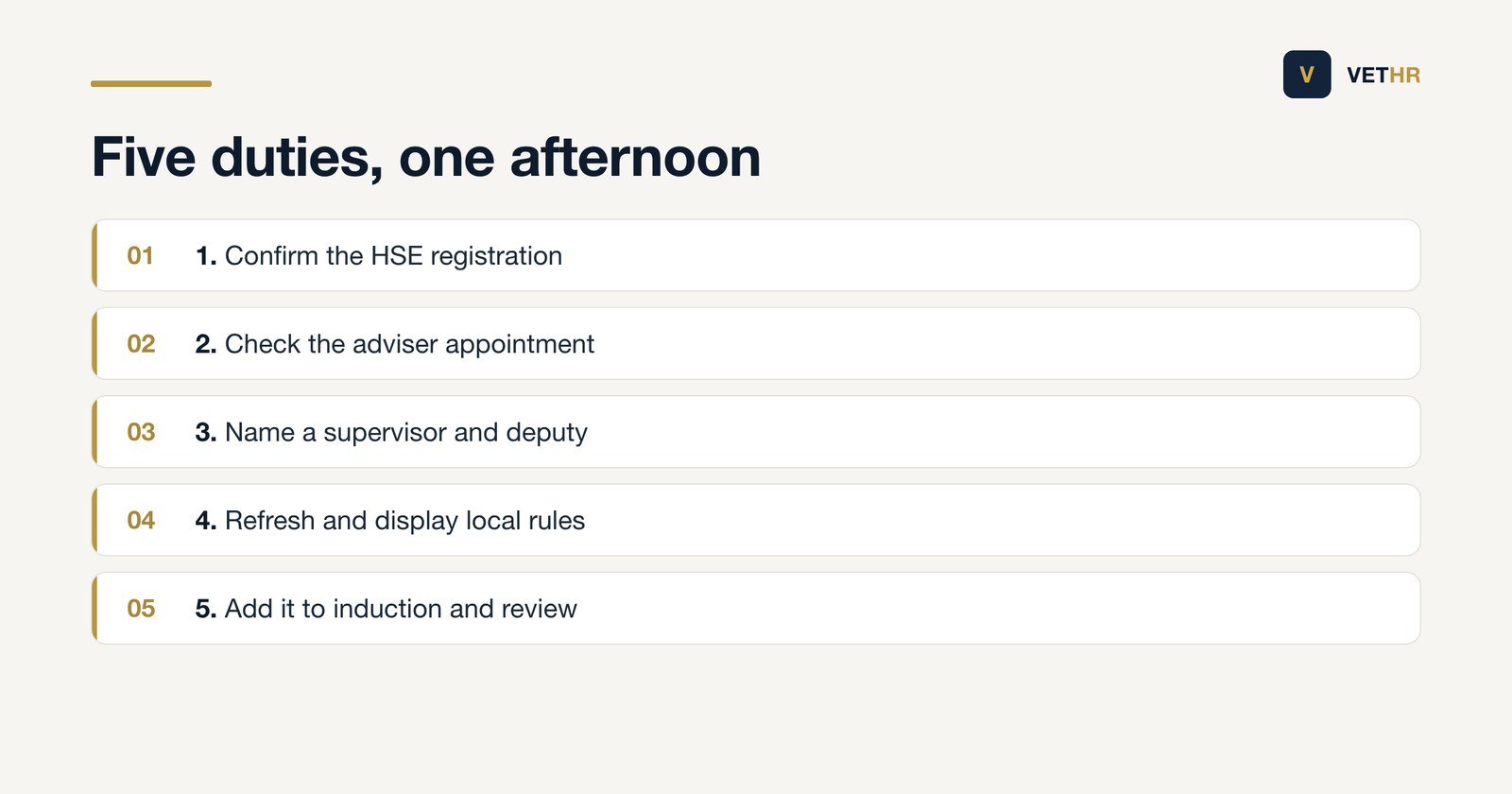
Confirm the registration. Check the adviser appointment is current and covers veterinary work. Name a supervisor and a deputy in writing. Refresh the local rules and display them. Put radiation protection on the induction list and in the annual review calendar.
That is an afternoon of work protecting a room your team stands beside every day. We help independent practices keep named safety roles current through HR consultancy for veterinary practices and ongoing HR support on subscription.
The Vet HR Team provides HR consultancy and white-labelled staff systems exclusively to UK veterinary practices.
Contracts, rotas, holiday, a difficult conversation. Tell us what you are dealing with and we will come back within one working day. Nothing to sign up to.
Got it. We will come back to you within one working day. If you do not see a reply, please check your spam folder.
