Last updated: 2 October 2026
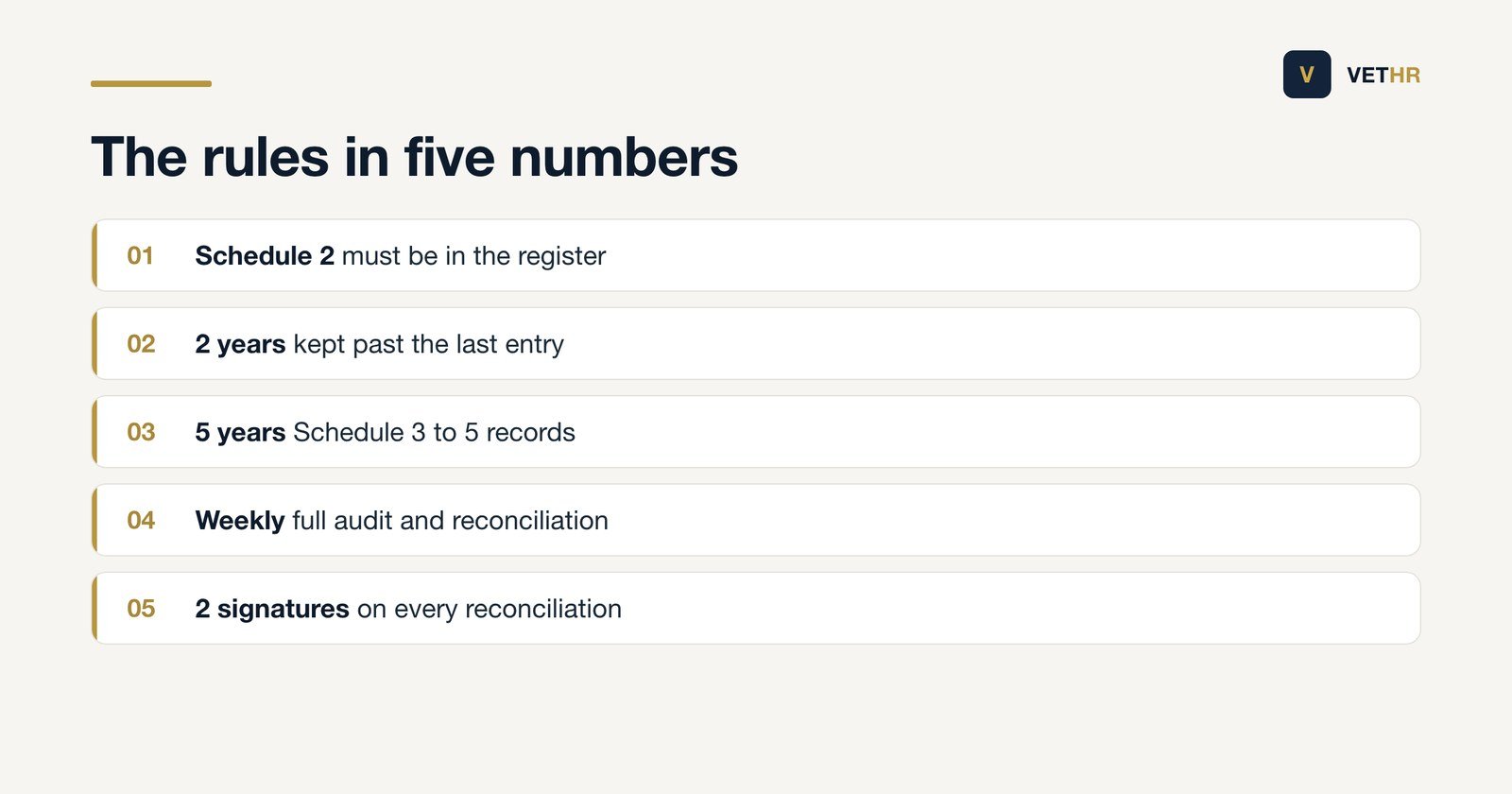
TL;DR: Anyone who purchases or supplies a Schedule 2 controlled drug must maintain a controlled drugs register, and it must be kept for at least two years after the date of the last entry. It can be maintained by a suitably trained person such as a veterinary nurse, but ultimate responsibility stays with the veterinary surgeon. RCVS expects a full audit at least weekly.
A practice manager opens the CD cabinet on a Monday and the methadone balance is 4ml out. The last four weeks of entries are in three different hands, two of them unreadable, and nobody has reconciled the cabinet since August. Nothing has been stolen. What has failed is the system around the controlled drugs register, and that failure is an HR problem as much as a clinical one.
Schedule 2. RCVS guidance states that any person who purchases or supplies any product containing a Schedule 2 controlled drug must maintain a controlled drugs register. Schedules 3 to 5 are handled by retaining invoices and usage records for five years instead.
So the register covers the drugs that practices worry about most: methadone, fentanyl and ketamine among them.
Keeping a voluntary record for some Schedule 3 items is common and sensible, particularly for anything with a history of going missing. Just do not confuse a voluntary log with the statutory controlled drugs register, and do not keep them in the same book.
At least two years after the date of the last entry, according to the same RCVS guidance. That is the register itself; the five year retention applies to Schedule 3 to 5 invoices and usage records.
Two years from the last entry, not from the date the book was opened. A register closed in March 2026 with entries going back to 2022 is retained until at least March 2028, and the practical answer is to keep them longer.
Store closed registers somewhere findable, with a date on the spine. A practice that cannot produce last year’s controlled drugs register during an inspection has a problem that is entirely administrative.
RCVS guidance is helpful and precise here: the register can be maintained by a suitably trained person, for example a veterinary nurse, but ultimate responsibility lies with the veterinary surgeon.
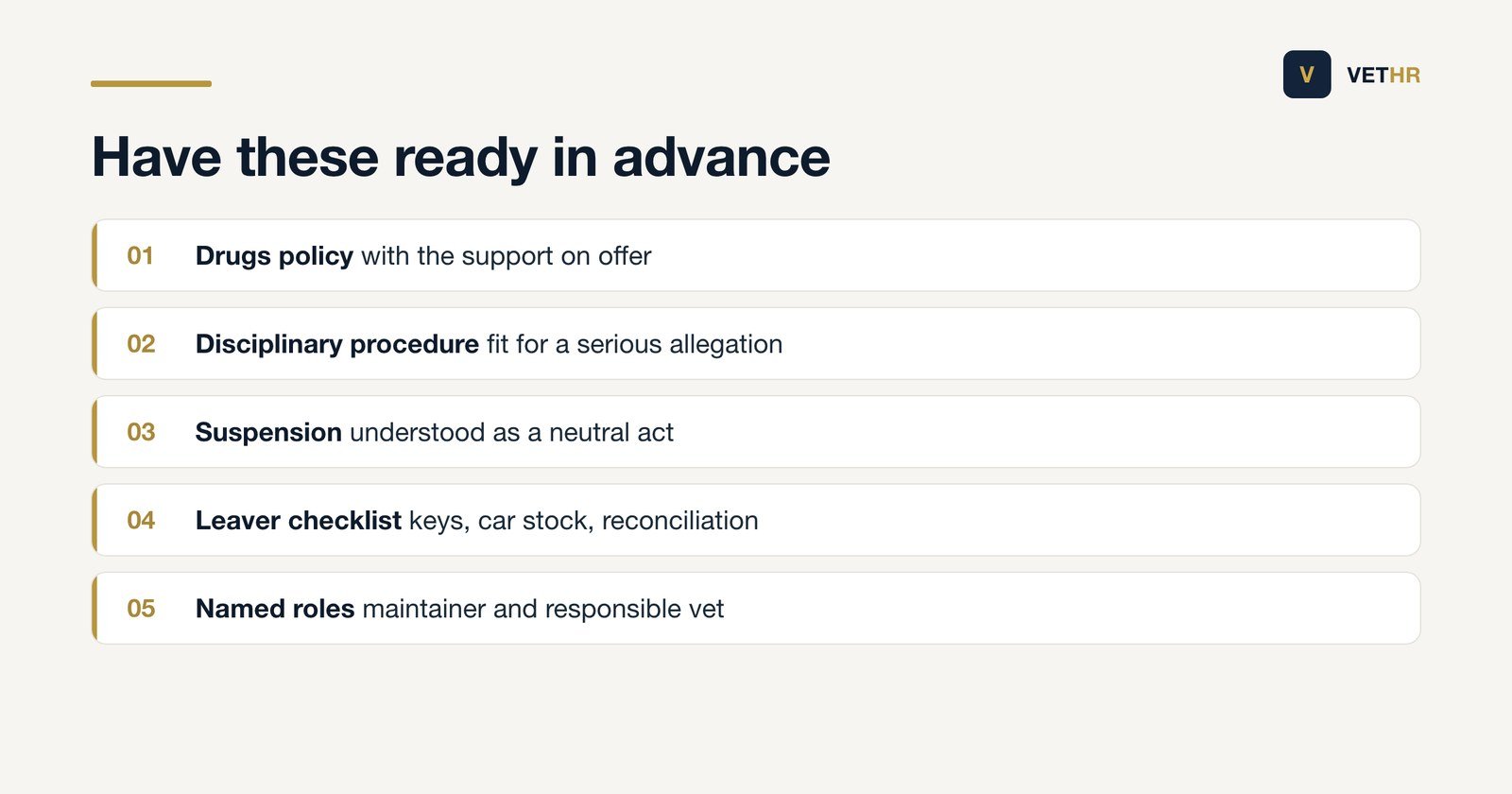
That splits neatly into two HR tasks. Name the people who maintain the controlled drugs register and record the training each has had. Then name the veterinary surgeon who carries the responsibility, and make sure that name changes when the person leaves.
Put both into job descriptions rather than into a conversation. Our note on job descriptions in a veterinary practice covers how to attach a named responsibility to a role so it survives a handover.
RCVS treats this as a core standard. Its guidance states that practices must carry out a full audit and reconciliation of all Schedule 2 controlled drugs, meaning the register and the balance of drugs in stock, and that it is expected all controlled drugs are audited regularly, at least weekly.
It also sets out how: record supply, use and wastage, keep a running total in the register, and have a system for reconciling that total against the stock in the cabinet.
Weekly is the part practices drop first when they are short staffed, and it is the one that finds problems while they are still small. Put it on the rota as a named task with a named person, not as something to do if there is time.
Two people should sign the weekly reconciliation. It protects the practice and, far more importantly, it protects the individual who would otherwise be the only person who ever touched the cabinet.
RCVS guidance states that Schedule 2 controlled drugs, such as methadone, fentanyl and ketamine, are subject to safe custody requirements and legally must be kept in a secure cabinet to prevent unauthorised access, and that it is an RCVS requirement that all Schedule 3 controlled drugs be securely locked away.
Which turns into a staffing question: who holds the key, who holds the spare, and what happens on a Sunday night when neither of them is in the building.
Write the answer down. Named key holders, a named deputy, a stated route for out of hours access, and a rule that the key does not go home in a coat pocket. Our guide to lone working in a veterinary practice covers the shifts where this matters most.
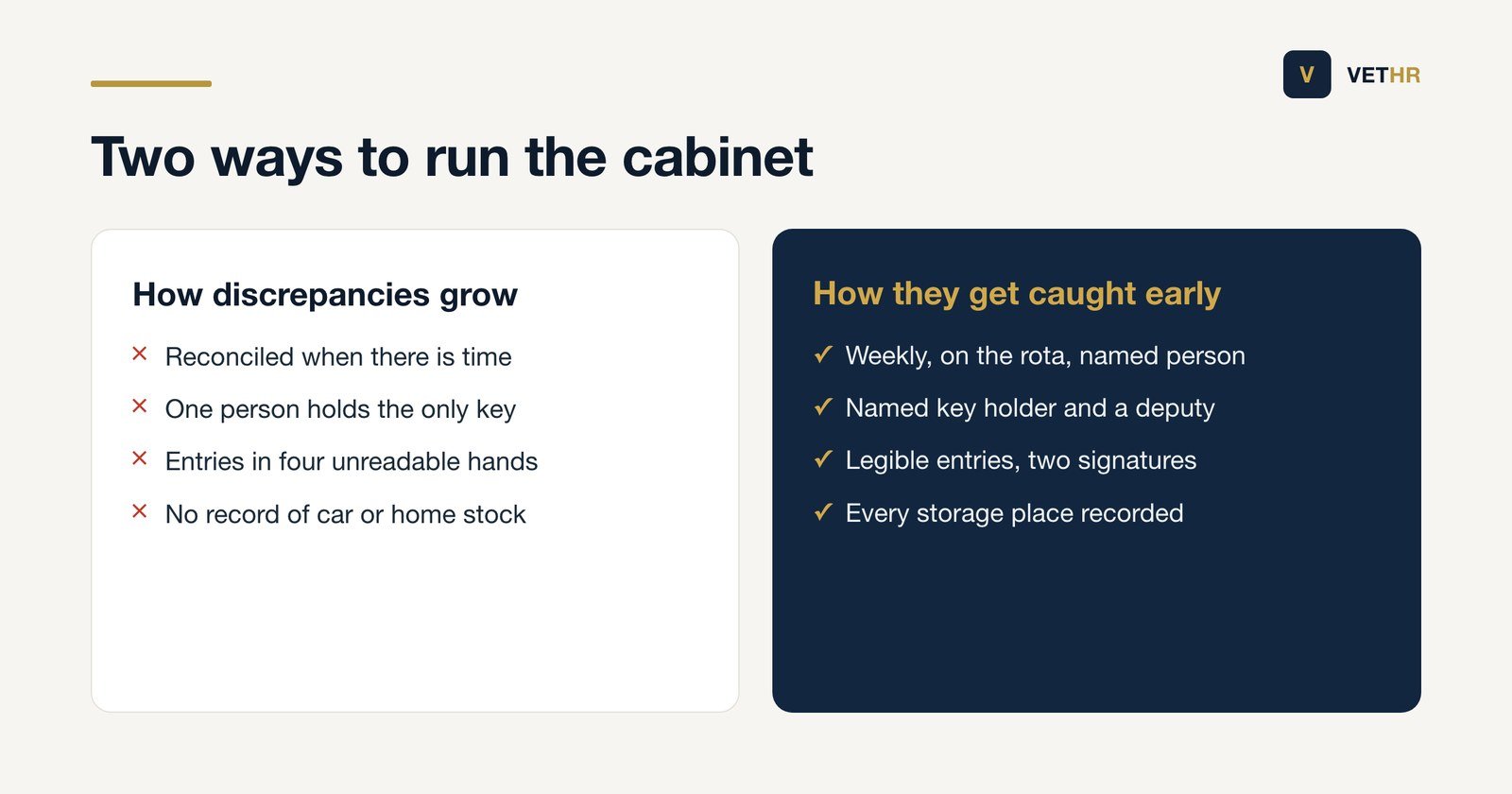
RCVS guidance requires veterinary surgeons to keep a record of premises and other places where they store or keep medicinal products, for example practice vehicles and homes where medicinal products are kept for on-call purposes, and says the record should be held at the practice’s main veterinary practice premises in accessible form.
Large animal and mixed practices need to read that twice. If a vet keeps controlled drugs in a car or at home for on-call work, the practice needs a record of where those places are.
Add it to the leaver checklist too. When an on-call vet resigns, somebody has to retrieve the drugs, the keys and the car stock, and reconcile all of it against the controlled drugs register before the final day. Our note on notice periods for veterinary staff covers the rest of that handover.
One more record worth keeping is a list of who has been shown how to use the controlled drugs register, and when. New graduates, returning staff and freelance vet cover all arrive needing that walkthrough, and it takes five minutes at the cabinet rather than an hour in a classroom.
Keep the controlled drugs register itself somewhere fixed. A book that travels between the dispensary, the prep room and somebody’s desk is a book that will eventually be written in from memory, and entries written from memory are how a 4ml discrepancy is born.
Every practice hopes never to need this section. Plan it anyway, because an unexplained discrepancy involving controlled drugs is one of the hardest situations a practice manager will face.
Three things to have in place before it happens. A drugs and alcohol policy that says what the practice will do and what support exists. A disciplinary procedure that can handle an allegation of this seriousness. And a clear position on suspension, which is a neutral act and not a sanction.
Our guides to a drugs and alcohol policy, a workplace investigation and suspension in a veterinary practice cover the process. Get them in place while nothing is wrong.
Remember that a discrepancy is most often an error in the controlled drugs register rather than a missing drug. Investigate the record first, calmly, and say so to the team while you do it.
If your named roles and key holders are not written down anywhere, book a free 30-minute HR health check and we will help you set them out.
Yes. RCVS guidance says the register can be maintained by a suitably trained person, giving a veterinary nurse as the example, while ultimate responsibility remains with the veterinary surgeon. Record who is trained and who carries the responsibility.
RCVS expects a full audit and reconciliation of all Schedule 2 controlled drugs regularly, at least weekly. That means comparing the running total in the register against the physical stock in the cabinet, not just reading the book.
A minimum of two years after the date of the last entry. Invoices and usage records for Schedule 3 to 5 drugs are retained for five years. Label closed registers with their date range and store them where they can be found.
Investigate first, because most discrepancies are recording errors. Where a genuine loss or diversion is suspected, the practice should take advice and involve the appropriate authorities, including its Controlled Drugs Liaison Officer.
RCVS guidance indicates destruction of Schedule 2 controlled drugs requires witnessing by an authorised person such as an independent veterinary surgeon, a VMD inspector or a Controlled Drugs Liaison Officer. Record who witnessed it and when.
Schedule 2 goes in the register. Keep it two years past the last entry. Name who maintains it and which vet is responsible. Reconcile weekly, signed by two people. Lock it away and name the key holders. Record every place drugs are kept, including cars and homes.
Put those six lines on a card by the cabinet. We help independent practices turn clinical duties like this into named roles that survive staff changes, through HR consultancy for veterinary practices and the policy document set.
The Vet HR Team provides HR consultancy and white-labelled staff systems exclusively to UK veterinary practices.
Contracts, rotas, holiday, a difficult conversation. Tell us what you are dealing with and we will come back within one working day. Nothing to sign up to.
Got it. We will come back to you within one working day. If you do not see a reply, please check your spam folder.
