Last updated: 3 September 2026
TL;DR: Statutory minimums are short. An employee with more than a month’s service must give at least a week. An employer must give a week for service between one month and 2 years, then a week for each year up to a 12-week maximum. Contracts can improve on that, and for a veterinary practice a longer notice period is often the difference between an orderly handover and a rota crisis.
A resignation letter arrives and the first question is always the same: when is their last day, and how are we covering it? The answer sits in two places, the law and your contract, and most practices discover the gap between them at the worst possible moment. This guide sets out how notice works for veterinary staff.
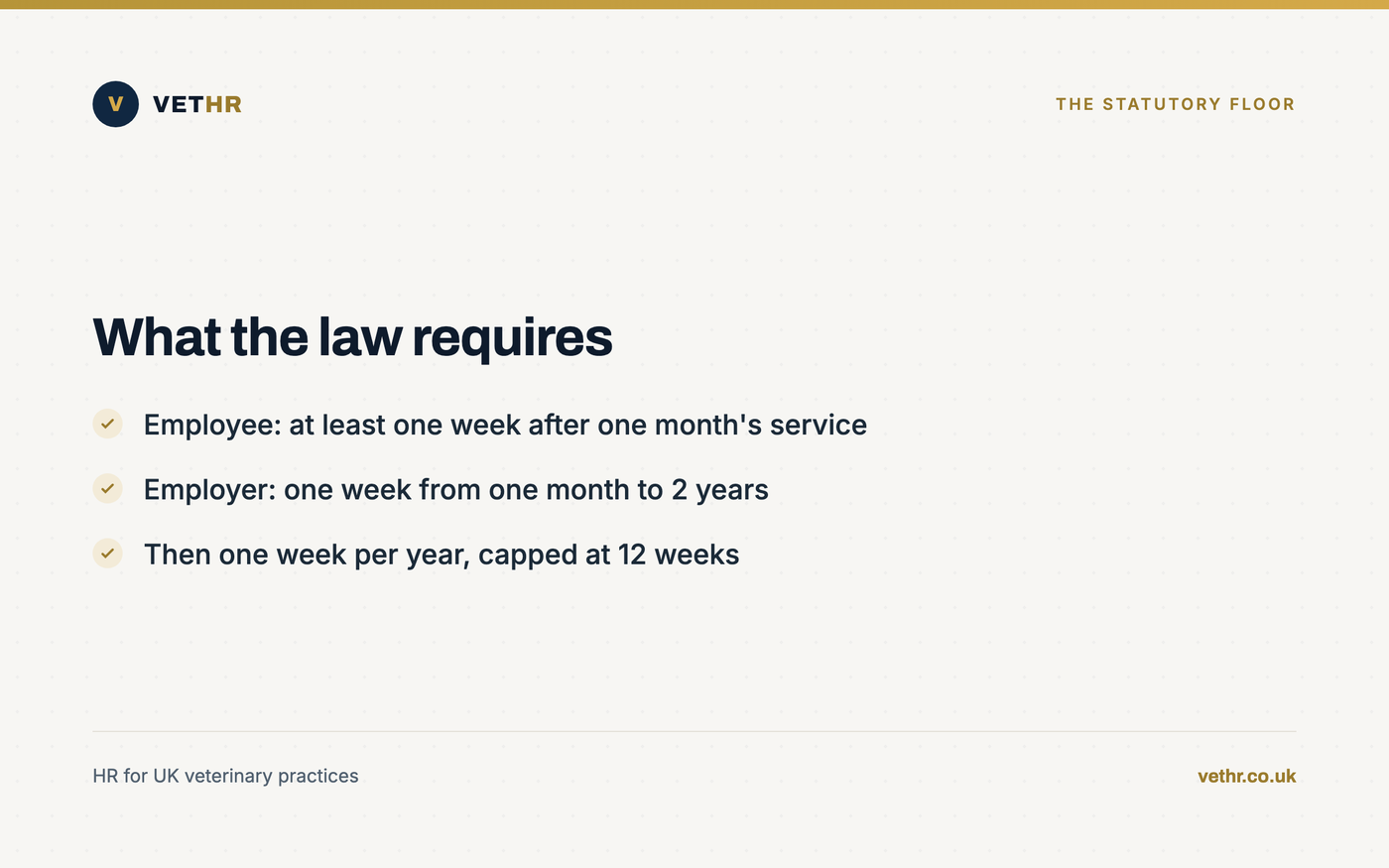
Short, and asymmetric. GOV.UK states an employee must give at least a week’s notice if they have been in the job for more than a month. The employer’s obligation scales with service instead.
Those employer figures come from GOV.UK’s guidance on notice periods. Read them next to the employee’s one week and the imbalance is obvious. A vet with eight years’ service can leave on a week’s notice unless the contract says otherwise, while you would owe her eight weeks.
This is the single most common surprise in a resignation conversation. The statutory notice period is a floor, not the normal position, and a practice relying on it has effectively chosen the weakest possible protection for its rota.
Long enough to recruit a replacement, and no longer than you would realistically enforce. In veterinary practice that usually means a graded approach: shorter for support roles where cover is easier to find, longer for clinical roles where the market is tight.
A workable pattern for an independent practice looks like one month for receptionists and support staff, one to two months for RVNs, and two to three months for veterinary surgeons and the practice manager. Make it mutual, because a notice period that binds only the employee reads badly and is harder to defend.
Be realistic about enforcement. If someone walks out mid-notice you cannot compel them to attend, and pursuing a departing RVN for breach of contract is rarely worth the relationship damage. The value of a longer notice period is that most people honour it, not that you can force them to.
Set it during probation too. Many practices use a shorter notice period during the probationary period on both sides, which keeps early exits clean. See our guide to probation periods in a veterinary practice.
Paying someone for the notice period instead of having them work it. It is only safe where the contract contains an express clause allowing it. Without one, ending employment immediately and paying the money is technically a breach of contract by the practice, even though the person is no worse off financially.
That technicality has a real consequence. A practice in breach may lose the ability to rely on post-termination restrictions, so a departing vet could be released from the very clauses you were counting on. Our guide to restrictive covenants explains why that matters.
Check every contract has the clause. It is one line, it costs nothing to include at the drafting stage, and it is impossible to add once the resignation is on the desk.
When you want the person away from clients but still bound by the contract. On garden leave they remain employed and paid, keep their duties of confidentiality and loyalty, and simply do not attend. GOV.UK notes that an employer can require an employee to stay away from work during their notice.
For a practice, the honest use case is narrow. A senior vet leaving for a competitor two miles away, with a three-month notice period and strong client relationships, is the classic scenario. A receptionist moving to a supermarket job is not.
Weigh the cost. Garden leave means paying a salary for no clinical output while also paying for cover, which for a small independent is a significant sum. It buys client protection without any argument about enforceability, and that is sometimes worth it.
The notice period still runs. Sickness does not pause it, and holiday taken during notice counts as notice served. What changes is the pay position, and that is where practices make errors under time pressure.
Two points to get right. Accrued untaken holiday must be paid on termination, so calculate it properly for part-time and irregular-hours staff. And since 6 April 2026 employers must keep records of annual leave and holiday pay, which Acas says must be kept for at least 6 years, so the final calculation needs to be documented rather than estimated.
Our holiday calculation system handles the accrual maths and leaves the audit trail behind it, which is exactly what a final pay dispute turns on.
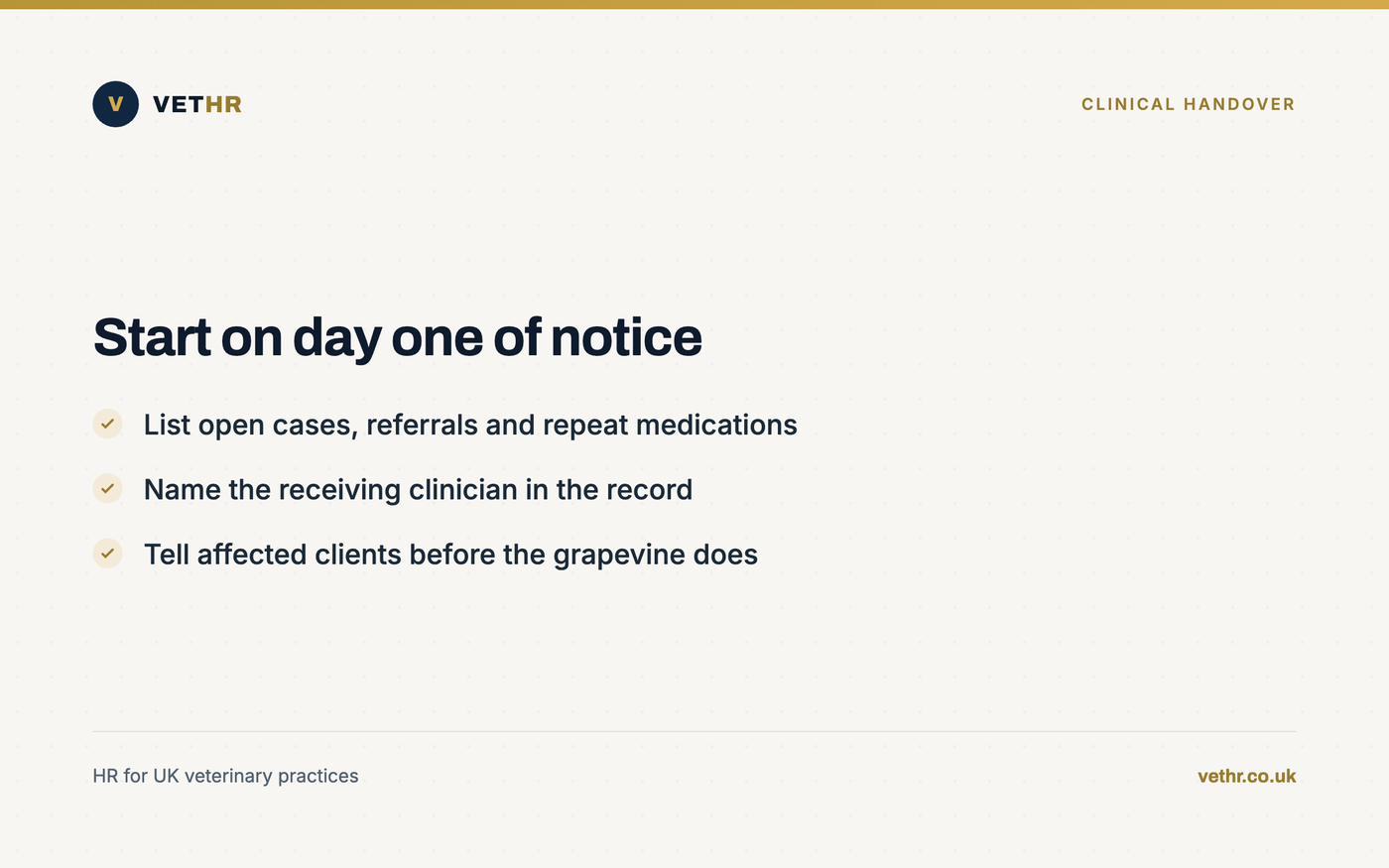
Deliberately, and starting on day one of the notice period rather than in the final week. In veterinary practice a departure is a continuity of care question as well as a staffing one, because ongoing cases, referrals and long-term medications all sit with an individual.
Schedule the handover into the rota as protected time. If it competes with a full consulting list, it will not happen, and the cost lands on whoever inherits the caseload.
Team first, in person, on the day you accept the resignation. Nothing destabilises a small practice faster than colleagues learning about a departure from a client at the front desk, and in a veterinary team that news travels within an hour of the first person hearing it.
Agree the wording with the leaver before you say anything. She may prefer her next move not to be discussed, and that is her right. What the team needs is the leaving date, who is picking up the caseload, and what the plan is for cover during the notice period. Speculation fills any gap you leave.
For clients, be proactive rather than reactive. Owners with ongoing cases should hear from the practice, ideally naming the clinician taking over, rather than discovering it when they book. Handled well, this is a reassurance exercise. Handled late, it is the moment clients start looking around.
And give the person a proper send-off. It costs almost nothing, the team notices, and departing staff who left warmly are the ones who recommend you to candidates later. Our guide to exit interviews covers the conversation that should happen before the last day.
Resignation on your desk this week? A free 30-minute HR health check will confirm the notice, the final pay and the handover plan. Book your HR health check.
No. A resignation is a unilateral act and does not require your agreement. What you can do is agree a different leaving date, either shorter or longer, and confirm it in writing. Where the resignation was clearly given in the heat of the moment, allowing a short period to reconsider is sensible.
Only by agreement. The contractual notice period is the maximum you can require, and asking for more is a negotiation rather than an instruction. Some practices offer a retention payment for an extended handover, which is legitimate provided it is documented.
Treat it as unauthorised absence and follow your procedure rather than assuming they have resigned. Write to them, ask for an explanation and give a deadline. Do not process a termination on assumption alone, and take advice before treating the conduct as a resignation.
The same statutory minimums apply, and the contract applies if it is more generous. Redundancy also carries its own consultation and selection obligations, which are separate from notice. Our guide to redundancy in a veterinary practice covers the process.
That depends on the terms of engagement rather than employment law, and genuine freelance vet cover is usually arranged assignment by assignment. Put the cancellation terms in writing on both sides, because short-notice cancellation cuts both ways and is a frequent source of friction.
How a practice handles a leaver is watched closely by everyone staying. A calm, organised notice period with a proper handover and a warm send-off tells the team what would happen to them. A resentful one tells them something else entirely, and it travels.
Get the clauses right before you need them. Our contract service covers notice, pay in lieu and garden leave for each role, and the free HR health check will tell you what your current contracts actually say.
The Vet HR Team provides HR consultancy and white-labelled staff systems exclusively to UK veterinary practices.
Contracts, rotas, holiday, a difficult conversation. Tell us what you are dealing with and we will come back within one working day. Nothing to sign up to.
Got it. We will come back to you within one working day. If you do not see a reply, please check your spam folder.
