Last updated: 27 August 2026
TL;DR: Restrictive covenants start from a position of being unenforceable, and only hold when a practice can show a legitimate interest and a restriction no wider than necessary. For most veterinary practices, a tight non-solicitation clause protects more than a broad radius ban ever will. Government reform options currently on the table include a 3-month statutory limit on non-competes.

Almost every veterinary employment contract carries a restriction on what a departing vet can do next. Very few of them have been looked at since they were copied from a template. This guide explains what restrictive covenants can and cannot do for a practice, and how to write ones that would survive being tested rather than merely look serious.
They are clauses limiting what an employee can do after leaving. GOV.UK describes them as terms saying you cannot work for a competitor or have contact with customers for a period of time after you leave, and warns that a company could take you to court for breaching them.
The important part is the starting position. The government’s own working paper on reform states that under UK law non-compete clauses are unenforceable unless the employer can demonstrate reasonableness. The burden sits with the practice, not the leaver. A broad clause is not a strong clause. It is usually a void one.
That said, the same paper notes a behavioural effect worth understanding: even where a clause is unlikely to be enforceable, workers may perceive it as binding and comply for fear of legal repercussions. Practices sometimes rely on that quietly. It is a fragile strategy, and an unattractive one to defend if it ever reaches a hearing.
Three things, and naming them precisely is what makes restrictive covenants defensible. Client connection, built at the practice’s expense over years of consults. Confidential information, including pricing, client lists and supplier terms. And workforce stability, meaning a departing vet should not empty your nursing team on the way out.
What a practice is not entitled to protect is competition itself. Stopping a good vet from practising within 15 miles for a year is not protection of a legitimate interest. It is an attempt to remove a competitor, and that is precisely the ground on which such clauses fall.
The test is proportionality. A new graduate two years into their first job has a very different client connection from a senior surgeon who has run referrals for a decade. Identical restrictive covenants across every contract in the practice signal that nobody assessed the interest at all.
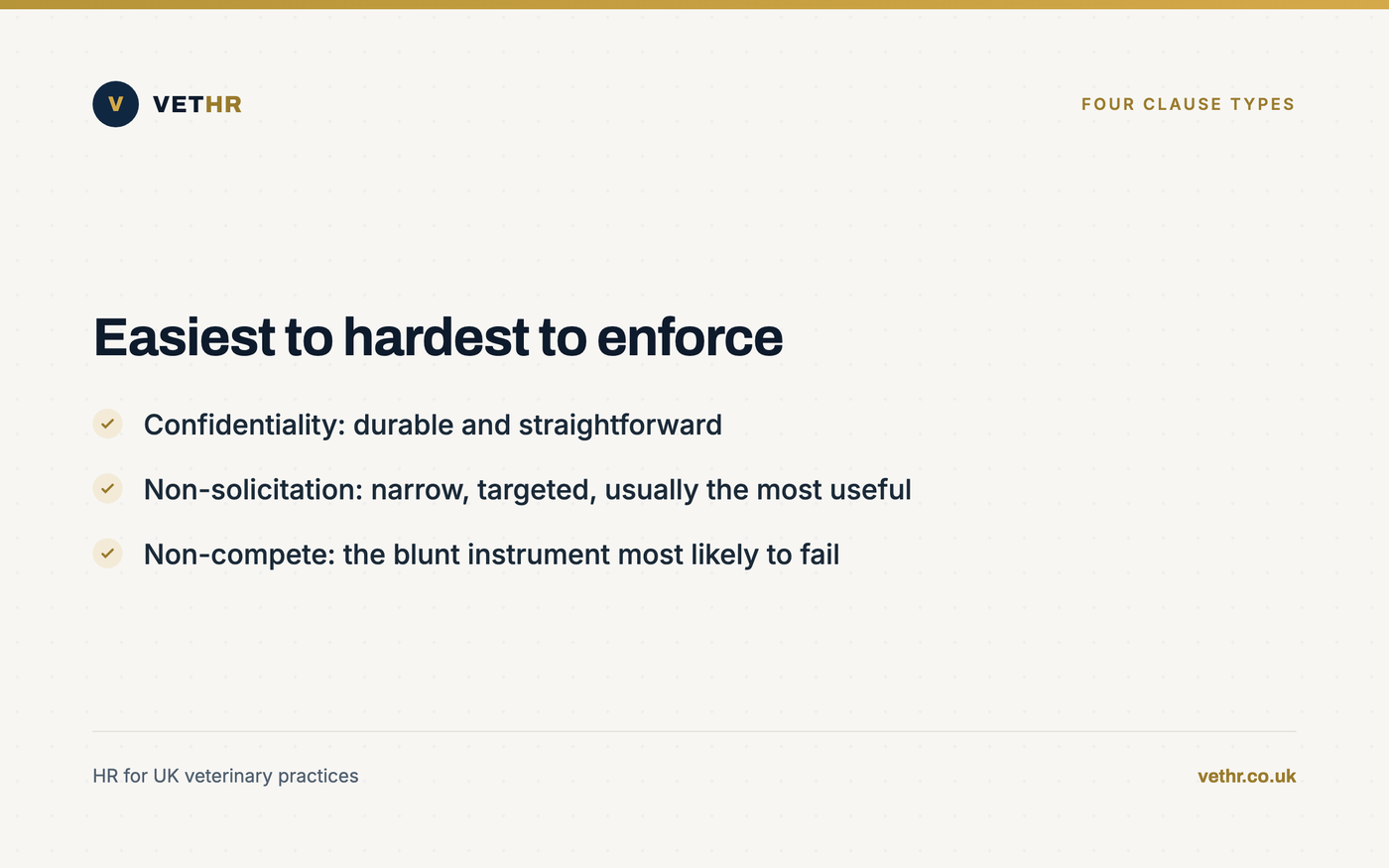
Four types do the work, and they are not interchangeable. Ranked from easiest to hardest to enforce, they run from confidentiality through non-solicitation and non-dealing to the full non-compete. Most practices reach for the last one first, which is the wrong way round.
For a small animal practice, well drafted non-solicitation restrictive covenants protect the thing you actually care about: the client who has been coming for nine years does not get a message saying “I have moved down the road”. You cannot stop that client leaving. You can stop them being asked.
No fixed statutory limit exists today, but the direction of travel is clear. The government’s working paper on reform of non-compete clauses, published in November 2025 and updated in February 2026, sets out options including a statutory limit of 3 months and an outright ban.
The same paper reports that around 5 million UK employees work under contracts containing a non-compete clause, that the typical duration is around 6 months, and that 71% of such clauses are longer than 3 months, with some running to 24 months.
For a practice writing contracts now, the practical reading is this. A 12-month non-compete was always ambitious. If reform lands, it may become unlawful as well. Restrictive covenants of 3 to 6 months, tightly drafted, sit in far safer territory and are much more likely to be worth enforcing.
Your actual catchment, not a round number. A city centre practice draws clients from two or three miles. A rural mixed practice may cover 30. Copying “10 miles” from a template produces a clause that is either useless in the countryside or wildly excessive in a town.
Work it out from your own data. Take the postcodes of clients seen in the last 12 months and find the radius that captures the large majority. That number is defensible because it describes your business rather than your anxiety.
Bear in mind the human effect too. A 20-mile restriction in a rural area can mean a nurse or vet has to move house to work at all. Courts notice that, candidates notice it at offer stage, and it costs you hires. Our guide to the veterinary job advert covers how contract terms shape recruitment.

Usually nothing legal, and that surprises owners. Clients are free to go where they wish, and a vet is entitled to tell people they have moved on. What the practice can act on is solicitation, misuse of confidential client data, and approaches made during employment or notice.
This is why exit process matters more than clause wording. Confirm the restrictions in the leaver’s exit letter, remove access to the practice management system on the last day, and record what was said in the exit conversation. Restrictive covenants you never reminded anyone of are far harder to enforce.
Then look inward. A vet taking clients is a symptom; the cause is usually that the relationship sat with the individual rather than the practice. Rotating continuity of care, shared clinical notes and a consistent team reduce that exposure more reliably than any clause. See our guide to exit interviews.
Because a buyer is purchasing the client base, and the client base walks on two legs. During due diligence, an acquirer will read every employment contract and ask a simple question: what stops your senior vets opening up nearby the week after completion? Weak restrictions show up as a price adjustment.
This is one of the few moments when restrictive covenants are read carefully by someone other than a lawyer, and it is usually too late to fix them. New restrictions cannot be imposed mid-employment without agreement and something given in return, and asking a team to sign fresh clauses during a sale process rarely goes quietly.
The fix is timing. Introduce sensible restrictions at natural moments, on promotion, on a pay review, on a genuine change of role, so that by the time a sale is on the table the contracts already say what they should. Our guide to HR due diligence when buying a veterinary practice looks at the same question from the other side of the table.
Even if you never sell, the discipline is worth it. A contract set that has been reviewed role by role is a contract set you could actually rely on in a dispute.
Not sure whether your contracts would survive being tested? A free 30-minute HR health check will tell you. Book your HR health check.
Only by agreement, and usually only with something given in return. Imposing new post-termination restrictions mid-employment without consideration is a common reason clauses fail. A promotion, a pay rise or a genuine change of role is the natural moment to introduce them properly.
They can, but the legitimate interest is usually narrower. A receptionist rarely holds the client relationship that justifies a non-compete, though confidentiality and non-solicitation of staff may still be appropriate. Applying identical clauses across every role weakens all of them.
Not necessarily. If the practice itself breaches the contract, for example by dismissing without proper notice, the employee may be released from post-termination restrictions altogether. That is a strong practical argument for following a proper process even when a dismissal feels obvious.
Often, yes, for senior roles. Garden leave keeps the person employed and paid while they are away from clients, so their information goes stale without any argument about enforceability. It costs money, which is exactly why it tends to be used proportionately.
Not yet. The 2025 working paper sets out options, including a 3-month limit, a size-based limit, a full ban and a salary threshold, and states it was intended to support discussion rather than as a formal consultation. Contracts written now should assume shorter restrictions are safer.
The best protection a practice has is not a clause. It is being somewhere people do not want to leave, with client relationships that belong to the practice rather than to one person. Restrictive covenants are a backstop for the day that fails, and backstops work best when they are narrow enough to use.
If your contracts have not been reviewed in the last two years, this is a good week to look. Our contract service and HR consultancy handle exactly this, and the free HR health check is a straightforward place to start.
The Vet HR Team provides HR consultancy and white-labelled staff systems exclusively to UK veterinary practices. We are not a law firm, and enforcement of a specific clause is a matter for legal advice.
Read next: Getting a Sponsor Licence and Fixed Term Contracts in a Veterinary Practice.
Contracts, rotas, holiday, a difficult conversation. Tell us what you are dealing with and we will come back within one working day. Nothing to sign up to.
Got it. We will come back to you within one working day. If you do not see a reply, please check your spam folder.
