Last updated: 5 September 2026
TL;DR: A veterinary job advert works when it answers the three questions candidates scan for first: pay, rota and out of hours. State a salary range, describe the real working pattern, keep the wording inside discrimination law, and never advertise a term the contract will not honour. This guide covers what candidates look for, the legal pitfalls, a structure that works and a checklist to run before you post.
Hiring in veterinary practice is a seller’s market: good vets and RVNs choose between adverts, not the other way round. This guide is about writing a veterinary job advert that respects that reality. Honest about money and rotas, lawful in its wording, and specific enough that the right person recognises the job as theirs.
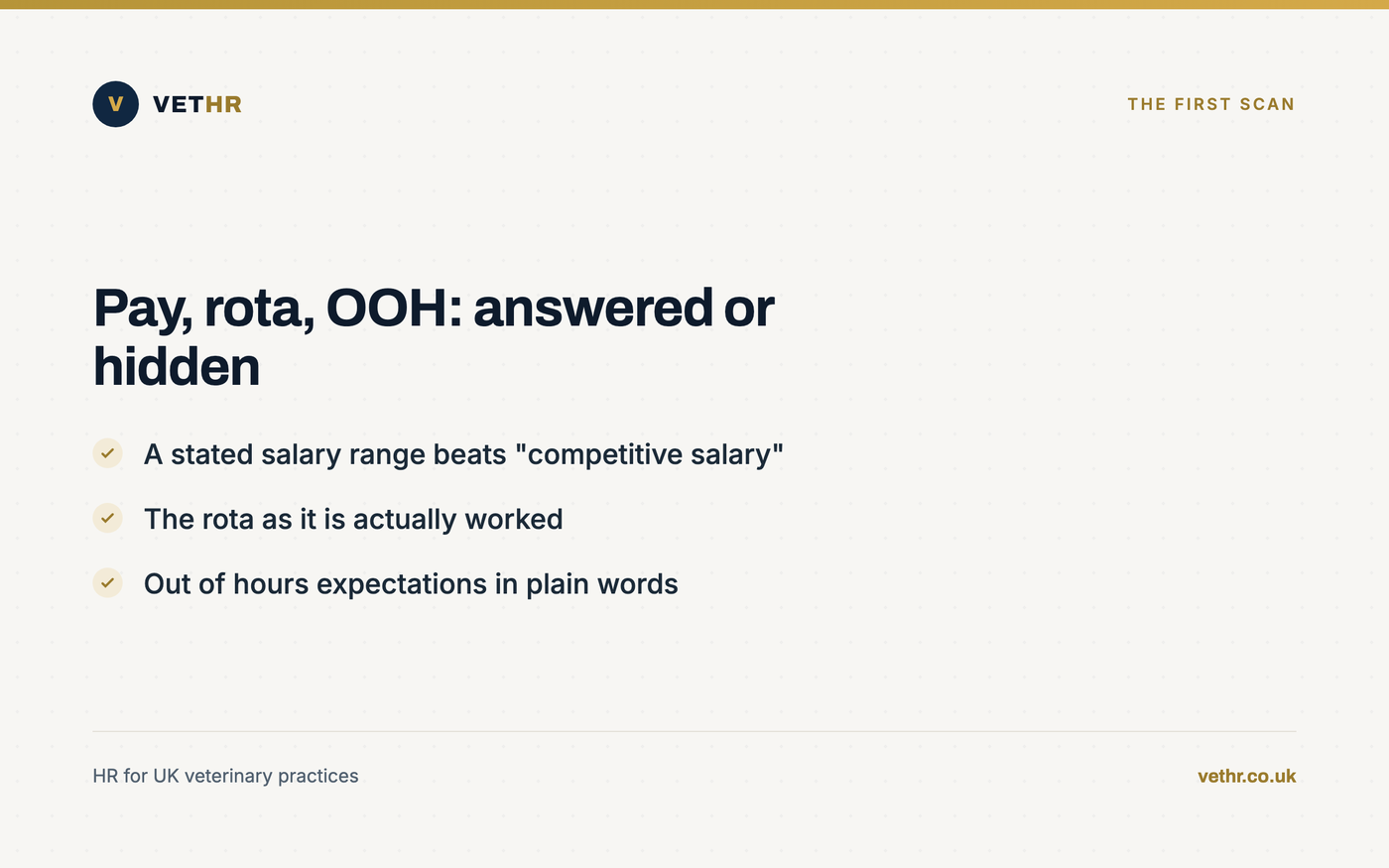
Three things before anything else: the money, the rota and the out of hours position. Candidates in a tight market filter fast, and an advert that hides any of the three reads as if the answer is bad. State the salary range, describe the real working pattern and say plainly what OOH involves.
The market backs that up. In the RCVS 2024 Surveys of the Professions, the top reason given by respondents who intended to leave the profession was poor work-life balance, at 56 percent, ahead of chronic stress at 54 percent. An advert that says nothing about hours is being read by somebody who is counting theirs.
Picture how adverts are actually read: on a phone, between consults, in a queue of similar listings. The candidate is not studying your practice history. They are scanning for the salary line, the shape of the rota and the letters OOH, and deciding in seconds whether the rest deserves a proper read.
Rota reality means the pattern as it is worked, not as it was designed. If Saturdays come round one in three, say so. If the finish time slips on operating days, say that too. A candidate who discovers the real pattern in month one does not conclude the advert was optimistic. They conclude it was dishonest, and they quietly restart the job search you thought you had finished.
The stakes are practical. Every week a role sits open, the rest of the team absorbs the gap and the practice pays for freelance vet cover. An advert that filters honestly fills the role once. It is also where retention begins: the promises in the advert are the standards your new colleague will measure the practice against, a theme we cover in our guide to veterinary staff retention.
Because it transfers work and risk to the candidate. A vet or RVN weighing several adverts cannot compare yours, has to guess whether applying is worth an awkward conversation, and often moves to the advert that answered the question. A stated range filters in the people you can afford and filters out silent mismatches.
Think about what the phrase asks of the reader. To learn the single most important fact about the job, they must apply, interview and open a negotiation blind. Many will not bother. The strongest candidates, the ones with the most options, are precisely the ones least willing to invest that effort on a guess.
Vague pay lines usually protect the wrong thing. Owners withhold the range to preserve negotiating room, or to keep internal pay differences out of sight. Both problems surface later anyway, at offer stage or in the tea room. Stating a range forces the pay question to be settled before the advert goes out, which is where it belongs.
None of this needs a statistic to be believable. Stand in front of two adverts for similar roles, one with a range and one with “competitive salary”. One answered your first question and one did not. Candidates do the same arithmetic, in seconds, every day.
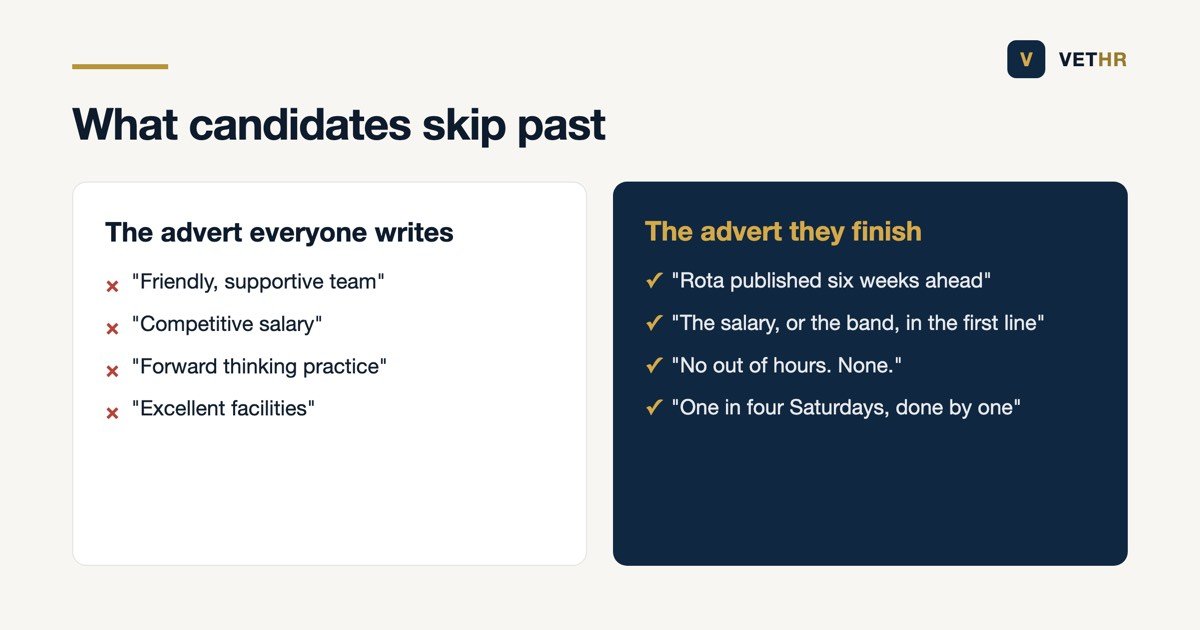
Every practice in the country describes itself as friendly, supportive and forward thinking. The sentences that actually move a candidate are almost always about time, and they are the ones nobody writes down:
Any one of those in the first three lines will outperform a paragraph about your values. If none of them are true, that is useful information about why the vacancy is open.
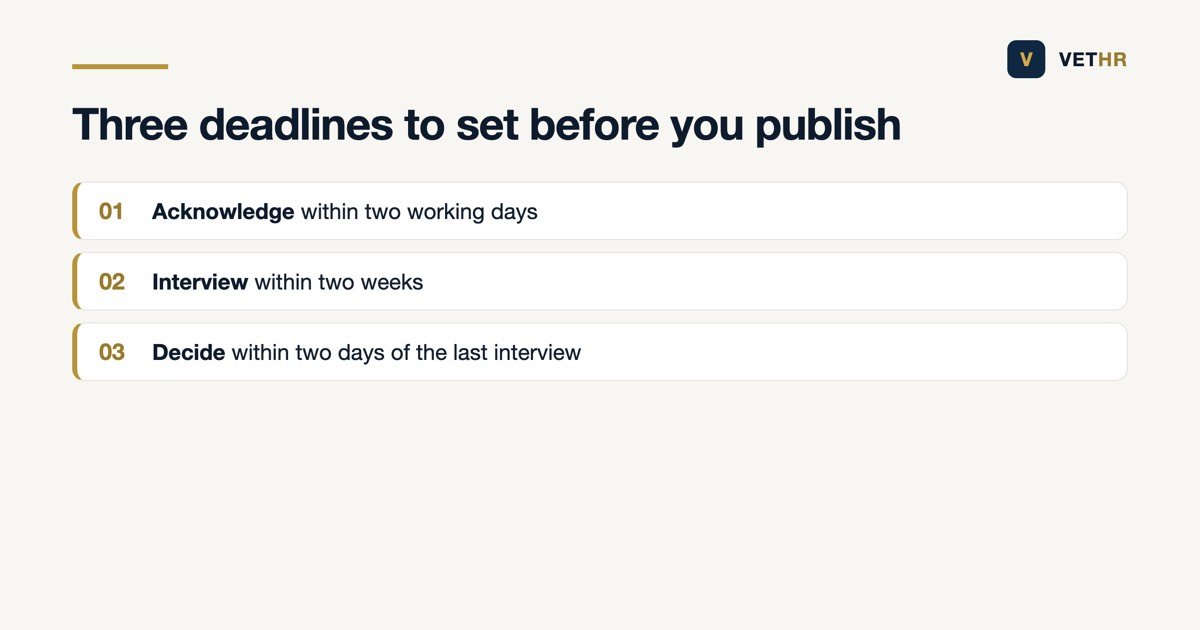
In a candidate short market the practice that replies first often wins, regardless of which job is objectively better. A great advert followed by ten days of silence loses to an average one that came back the same afternoon. Set three deadlines before you publish and hold them: acknowledge within two working days, interview within two weeks, decide within two days of the last interview. Put the first one in the advert so you are publicly committed to it.
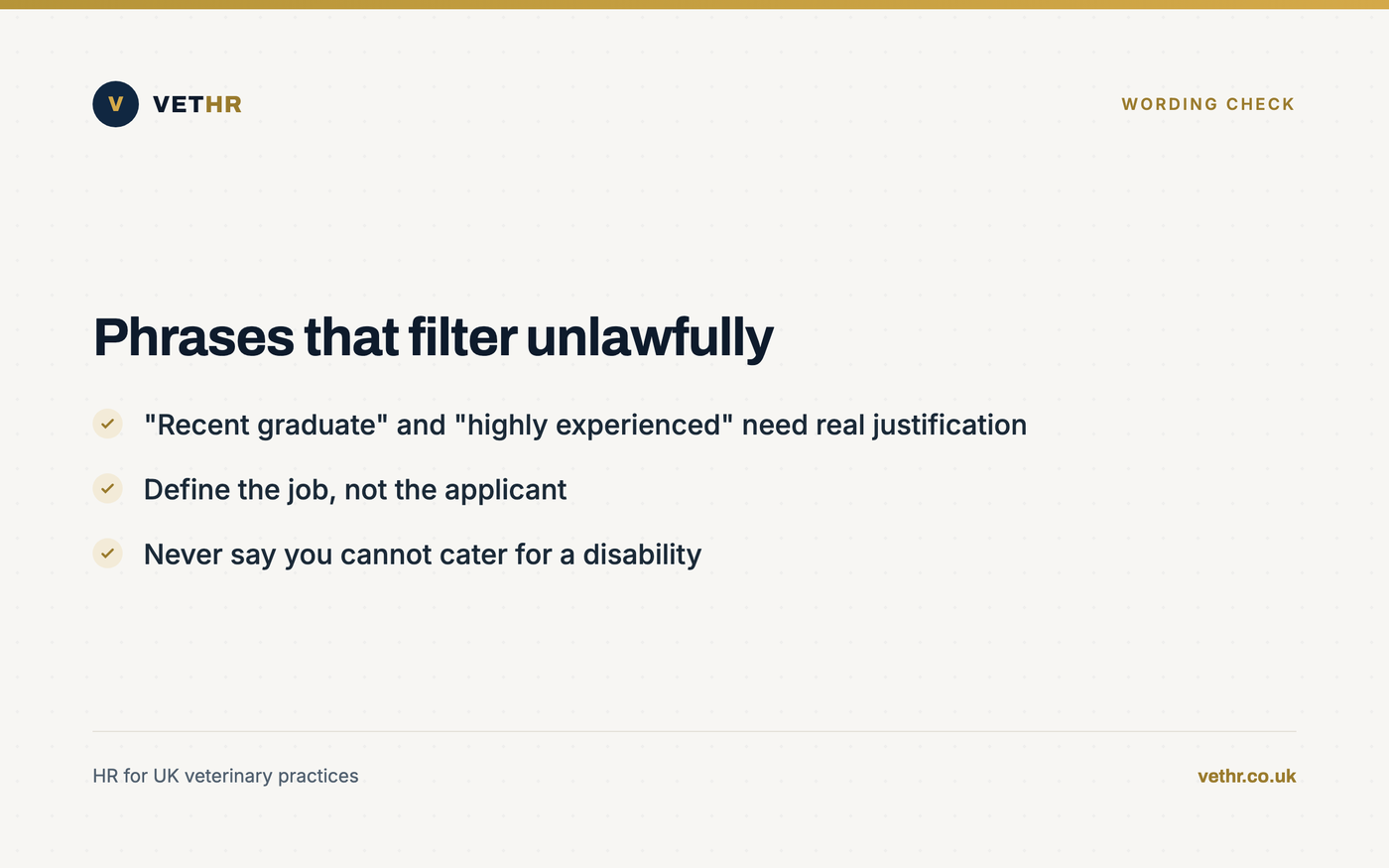
You must not state or imply in an advert that you will discriminate against anyone, according to GOV.UK guidance for employers on recruitment. That covers wording that quietly filters by age, sex or disability, and it extends to where you advertise. Phrases like “recent graduate” or “highly experienced” are only safe when they are genuine requirements of the job.
Acas guidance on advertising a job gives concrete examples. Age-loaded phrases such as “recent graduate” and “highly experienced” need a provable justification. Gendered job titles imply a preferred applicant, so use language that defines the job, not the person. Even neutral-looking requirements can discriminate: insisting application forms are handwritten can disadvantage people with dyslexia or arthritis.
Translate that to a practice. “A young, energetic team looking for a like-minded vet” is an age preference in casual clothing. “Must have ten years in sole charge” needs a genuine reason, not a habit. And GOV.UK is explicit that you must not say you are unable to cater for workers with a disability. If the building has access problems, the answer is reasonable adjustments, not a warning in the advert.
Where you advertise matters as much as the wording. GOV.UK gives advertising only in men’s magazines as an example of indirect discrimination, and Acas advises using at least 2 different ways or places so the advert reaches a diverse range of people. Health questions are restricted too: before offer, you may generally ask about health or disability only in limited situations, such as checking whether an applicant needs adjustments for an interview.
Recruiting soon and not certain your advert, contract and paperwork line up? Book a free HR health check. In 30 minutes we will look at what you are about to publish, what the law expects, and where the advert and the contract disagree. Straight answers, nothing sold for the sake of it.
Lead with the role and the location, then the salary range, the rota and OOH position, then the practice as it really is, the work itself, the few genuine requirements, what you offer beyond pay, and exactly how to apply. Short paragraphs, concrete nouns, no adjectives you cannot evidence.
Acas also suggests giving applicants a fuller pack alongside the advert: a job description, a person specification and information about the organisation. And it flags two legal practicalities worth building into your process: you could be fined if you do not check the person you hire is allowed to work in the UK, and you must tell applicants how you will use their personal information.
The same structure works for every role in the building. Only the stakes change. When the vacancy is the person who will run the rota, the paperwork and half your HR, see our guide to hiring a veterinary practice manager.
The advert is a promise the contract has to keep. From day one, staff must receive a written statement covering pay, hours, holiday and more, per GOV.UK, and a new starter will read it against the advert that brought them in. Never advertise a salary, rota or benefit you are not prepared to put in writing.
The written statement is not a formality to sort out later. GOV.UK guidance on the written statement of employment particulars says the principal statement must be given on the first day of employment and must cover pay, hours and days of work and if and how they may vary, holiday entitlement and more. If the advert promised a four-day week and the statement says hours may vary at the practice’s discretion, day one opens with a contradiction.
Mismatches cost more than embarrassment. The new colleague recalibrates everything else you told them, probation starts on the wrong foot, and if the relationship later sours, the advert becomes the first document anyone reads about what was really agreed. Honest adverts are cheap insurance.
The fix is sequencing. Write the advert and the contract as one exercise, so every advertised term has a home in the paperwork. Our veterinary contracts service does exactly that: contracts and written statements that match what the practice genuinely offers, so the advert can be honest without being risky.
Run seven checks before you post: the salary range is stated and true, the rota and OOH are described as worked, the wording filters nobody unlawfully, the advert appears in at least two places, every term matches the contract, the legal practicalities are covered, and a named human replies by a named date.
The last item is quietly powerful. Veterinary communities are small, and candidates talk. A practice that replies to everyone, on time, builds a reputation that outlives any single vacancy.
Acas guidance on advertising a job sets no requirement to state pay. The case for a range is practical rather than legal: it answers the candidate’s first question, saves both sides a blind interview, and forces the practice to settle the pay question before publishing rather than at offer stage, when it is hardest.
No. Wording that signals an age preference risks discriminating against older candidates, just as “highly experienced” can discriminate against younger ones. GOV.UK says such phrases are only usable when they are actual requirements of the job, and Acas advises language that defines the job rather than the applicant. Describe the work, not the person you imagine doing it.
Only in limited situations before an offer. GOV.UK guidance for employers says questions about health or disability are permitted for purposes such as checking whether an applicant needs adjustments for an interview or test, where a job requirement cannot be met with reasonable adjustments, or for positive action in recruiting disabled candidates.
In at least 2 different ways or places, per Acas, because a single channel may only reach specific groups of people. Channel choice can discriminate indirectly: GOV.UK’s example is advertising only in men’s magazines. For a practice, mix the obvious veterinary job boards with your own site and networks, and check who each channel actually reaches.
State your range anyway. A hidden number persuades nobody, and a candidate choosing an independent practice is buying the whole job: the rota that is actually respected, the caseload, the CPD support, the absence of a head office. Make those concrete in the advert and let the candidate weigh the full offer honestly.
A veterinary job advert is not marketing copy. It is the first document in an employment relationship, and it sets the standard for every promise that follows. Answer the three questions candidates scan for, keep the wording inside the law, and never publish a term the contract will not honour.
Before your next vacancy goes out, make sure the advert and the paperwork agree. Our veterinary contracts service gets the two telling the same story, and a free HR health check will tell you plainly, in 30 minutes, whether what you are about to publish will help you hire or haunt you later.
The Vet HR Team provides HR consultancy and white-labelled staff systems exclusively to UK veterinary practices.
Contracts, rotas, holiday, a difficult conversation. Tell us what you are dealing with and we will come back within one working day. Nothing to sign up to.
Got it. We will come back to you within one working day. If you do not see a reply, please check your spam folder.
