Last updated: 27 June 2026
TL;DR: Veterinary staff retention rarely turns on pay alone. People stay when rotas are fair, out-of-hours load is shared, the work is recognised, contracts and progression are clear, and the workload is manageable. The RCVS data points to the same causes again and again: poor work-life balance, chronic stress and feeling undervalued. This guide ties each of those back to a concrete action a practice owner or manager can take, and the systems that keep it consistent.
Every practice owner knows the cost of a resignation: the recruitment scramble, the freelance vet cover, the morale dip across a team already stretched. Keeping good people is cheaper and calmer than replacing them. This is a practical, evidence-led look at what moves the needle, and what is mostly noise.
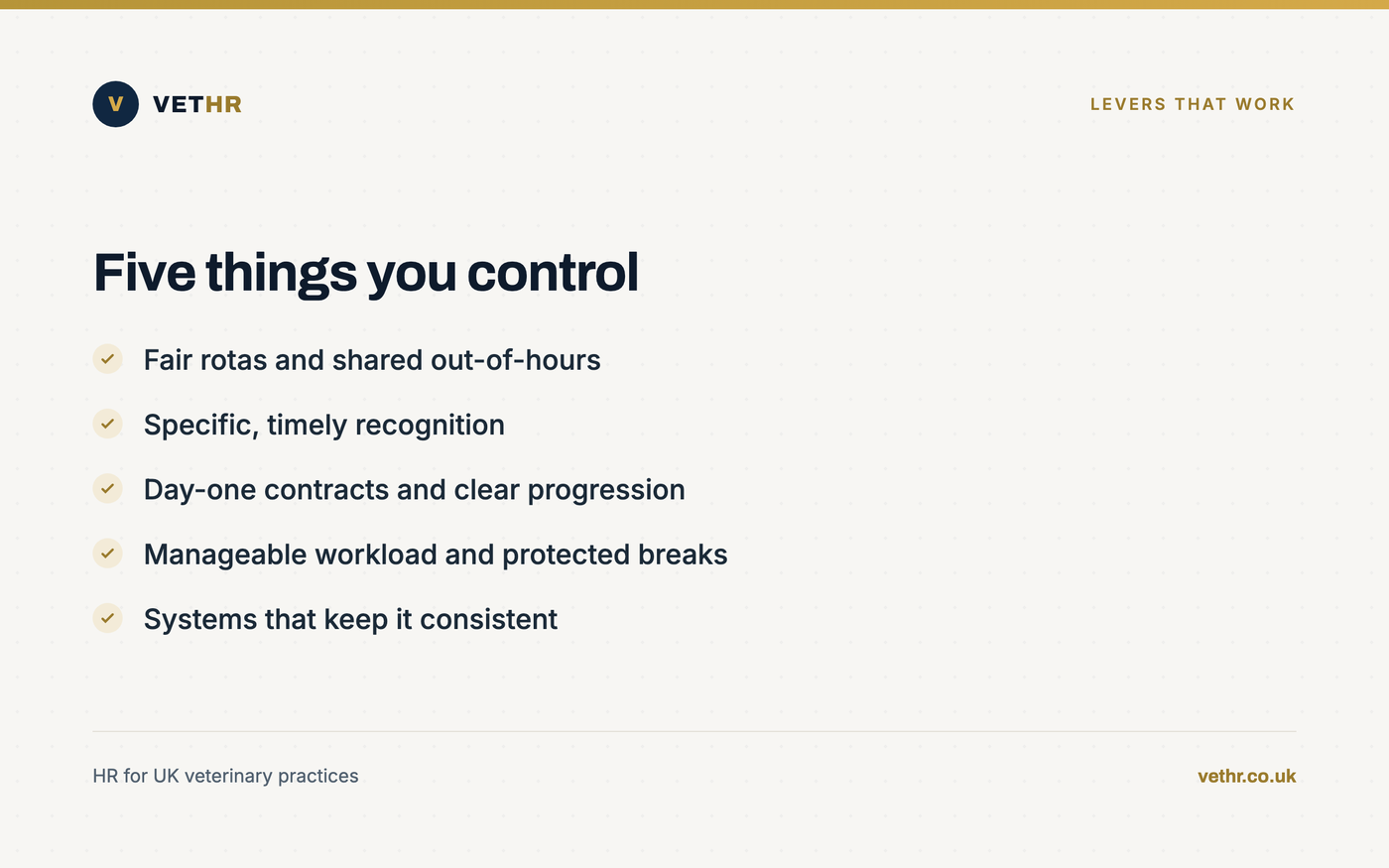
Veterinary staff retention is driven less by salary than by how the working week feels: fair rotas, a shared out-of-hours load, genuine recognition, clear contracts and progression, and a workload people can sustain. Get those right and pay becomes one factor among many. Get them wrong and no salary fully compensates for a week that grinds people down.
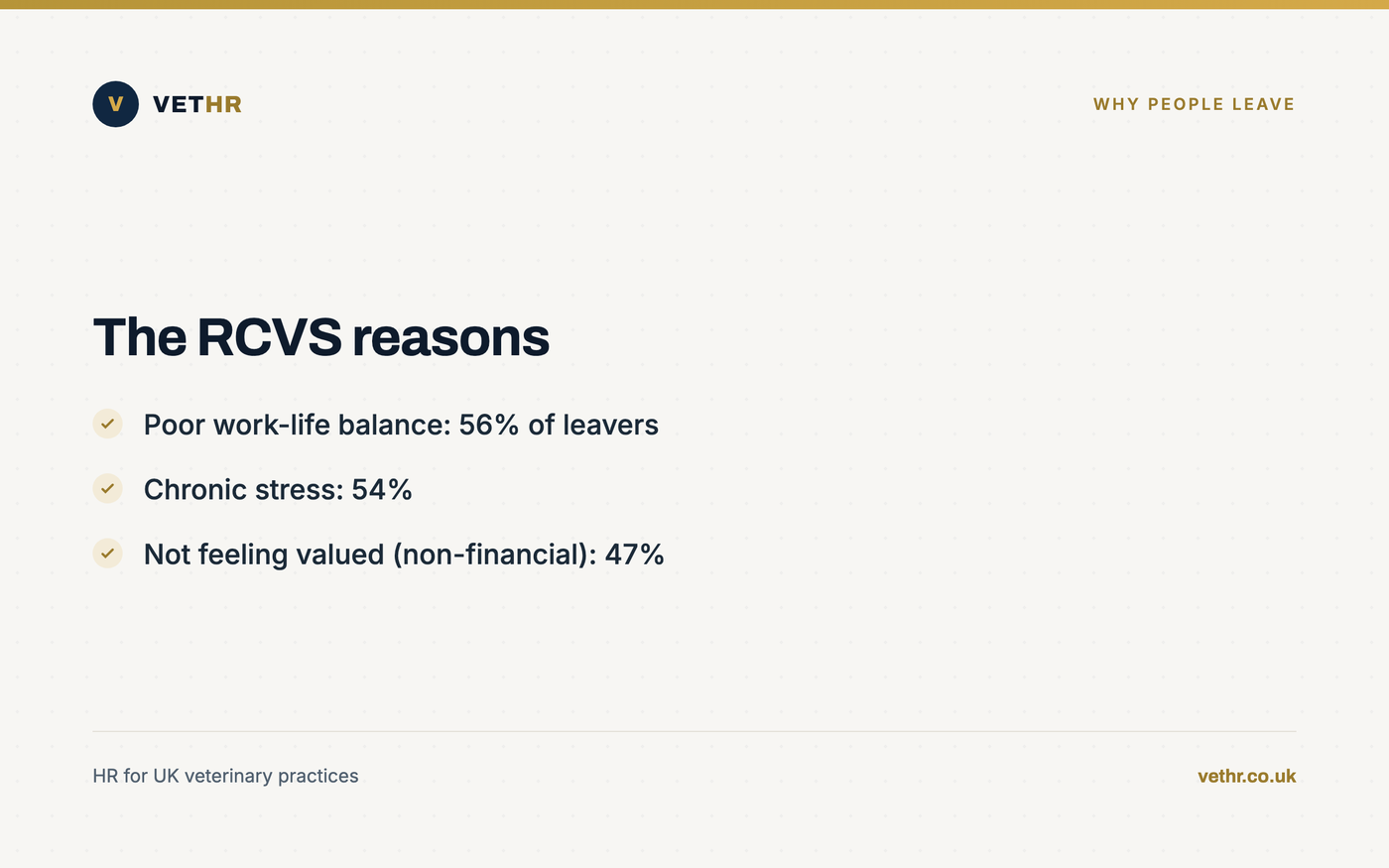
The evidence backs this. In the RCVS Surveys of the Professions 2024, the leading reasons vets gave for intending to leave were poor work-life balance at 56 percent, chronic stress at 54 percent, and not feeling rewarded or valued in a non-financial sense at 47 percent, as reported by the RCVS. Pay matters, but it sits behind all three.
That is good news for a practice owner, because work-life balance, stress and recognition are things you can change locally. You do not need a national pay review to fix a rota that keeps catching people out, or a recognition habit that costs nothing. Retention is mostly built from the inside.
Vets and nurses leave for overlapping reasons: unsociable hours, chronic stress, the weight of clinical responsibility, and the sense that the effort is not seen or rewarded. The RCVS frames it as a workforce challenge across recruitment, retention and return, with veterinary staff retention the part most within a single practice’s control.
The headline number is a slow drift toward the door. In 2024, the share of vets intending to stay in the profession for five or more years fell to 75 percent, down from 79 percent in 2019, again per the RCVS. A few points sound small until you place them against a sector already short of vets and nurses.
Nurses carry their own version of the strain. The RCVS Exit Survey 2022 to 2024 found that free-text responses from departing registered nurses were dominated by financial stress, with burn-out and the weight of responsibility close behind, according to the RCVS Exit Survey. Vet nurse retention, then, is partly a recognition problem dressed as a pay problem.
There is one encouraging signal. The same 2024 survey found 88 percent of recent graduates intended to stay five or more years, well above the 75 percent average. People often arrive committed. What happens in the first few years of rotas, workload and recognition decides whether they stay.
Rotas are where retention is quietly won or lost. A fair, predictable rota that shares out-of-hours load evenly protects work-life balance, the single biggest reason people gave for leaving. An unfair one, where the same staff always cover the hard shifts, breeds resentment long before anyone hands in notice.
Out-of-hours is the pressure point. The RCVS found that 35 percent of vets and 16 percent of veterinary nurses did on-call hours, per its 2024 survey. On-call is exactly where a rota turns unfair if nobody is watching the distribution, so it deserves the most deliberate planning, not the least.
The law sets the floor here, and respecting it is a retention act in itself. Acas states that workers must get at least 11 hours’ uninterrupted rest between finishing and starting work, plus a 20-minute break when a shift runs over six hours, in its guidance on working time and rest. A rota that protects rest is a rota that protects people.
Practical moves that work: publish rotas well ahead so people can plan their lives; rotate the unpopular shifts rather than defaulting them to the willing; and make swaps easy and visible. A purpose-built veterinary rota system does this far more reliably than a shared spreadsheet that lives in one person’s head.
Yes, and the data says so plainly. Not feeling rewarded or valued in a non-financial sense was cited by 47 percent of vets intending to leave in the RCVS 2024 survey. Recognition is not a soft extra; it is one of the three biggest retention levers, and the cheapest to pull.
Recognition fails when it is vague, rare or reserved for vets while nurses and receptionists go unseen. It works when it is specific, timely and spread across the whole team. “Thank you for staying late with that GDV” lands; “great work everyone” does not. Name the act, name the person.
Build it into the rhythm of the practice rather than leaving it to mood. A short, regular one-to-one where someone is heard is worth more than an annual review nobody enjoys. Recognition that is structured survives a busy month; recognition that depends on a good day does not.
Not sure where your team is fraying? A 30-minute conversation usually surfaces it. Book a free HR health check and we will look at how you run rotas, out-of-hours, recognition and progression today, then tell you honestly which one to fix first. No jargon, nothing sold for the sake of it.
Clear contracts and a visible path forward remove the quiet uncertainty that pushes people to test the market. When someone knows their hours, their entitlements and how they grow here, they have less reason to wonder whether the grass is greener. Ambiguity is what makes people look elsewhere.
Start with the contract, because the law already requires it. GOV.UK states that employers must give a written statement of the main employment particulars on the first day of work, covering pay, hours, holiday and more, in its guidance on the written statement of employment particulars. A day-one contract sets a tone of fairness from the start.
Progression is the other half. Nurses in particular leave when they cannot see a future: the RCVS Workforce Summit flagged lack of career progression among the stressors driving vet nurses out. A simple development framework, with named steps and the training that unlocks them, answers the unspoken question of “what next” before someone answers it by leaving.
None of this needs to be elaborate. Up-to-date contracts, a short progression map per role, and an honest conversation about it once or twice a year cover most of the ground. Our HR consultancy helps practices put both in place without turning it into a paperwork project.
Manageable workload means consults that are not booked back to back with no recovery, admin that has time set aside for it, and cover that does not collapse the moment one person is off. Chronic stress, cited by 54 percent of leavers in the RCVS 2024 survey, is usually a workload problem in disguise.
The honest test is whether a normal week leaves any slack at all. If every day depends on nothing going wrong, the team is running on goodwill, and goodwill is the first thing burn-out spends. Building small buffers into the day is not inefficiency; it is what stops a busy week from becoming a resignation.
Protect breaks as non-negotiable, not as the first thing sacrificed when it gets busy. The same Acas working time rules that set the 11-hour rest also confirm the right to a 20-minute break on a shift over six hours. When the practice treats those as real, staff read it as respect, and respected people stay.
Watch the data, not just the mood. Repeated late finishes, unused holiday and shifts that always overrun are early-warning signs. A clock in and out record turns a vague sense that “we are slammed” into something you can actually act on before it costs you a nurse.
Good intentions slip under pressure; systems hold. The practices with strong veterinary staff retention are not the ones that care more on a good day, but the ones that made fairness automatic: rotas that balance themselves, records that are always current, and recognition built into the calendar rather than left to chance.
The point of a system is consistency, not control. Acas notes that working time records must be kept for two years from the date they were made, in its guidance on working time and rest. A practice that records hours properly protects both compliance and the fairness that keeps people, in one move.
You can run these tools yourself or have them run for you. Our staff systems and monthly support are built around the same workflows your team uses each day, so the fair rota and the clean record are not a project you maintain, but a default you rely on.
Work-life balance, which the RCVS 2024 survey put as the leading reason for leaving at 56 percent. In practice that means fair, predictable rotas and a shared out-of-hours load. Pay matters, but it sits behind work-life balance, stress and recognition. Fix how the week feels and you address the cause most people actually leave over.
Recognition and a visible career path. The RCVS Exit Survey found departing nurses’ comments were dominated by financial stress and the weight of responsibility, and the Workforce Summit flagged lack of progression. Naming nurses’ contribution, mapping clear development steps and protecting their breaks addresses the specific frustrations that push registered nurses out of practice.
Focus on the non-pay drivers, which the data ranks highest. Share the out-of-hours load fairly, publish rotas early, protect breaks and rest, recognise good work specifically, and give people a clear contract and progression path. These cost little and directly target work-life balance, stress and feeling undervalued, the three reasons most cited for leaving.
It is a major pressure point. The RCVS found 35 percent of vets and 16 percent of nurses did on-call hours, and out-of-hours is where rotas turn unfair fastest. It is not on-call itself that drives people out so much as on-call that is unevenly shared, poorly recorded or stacked on the same few people month after month.
Some effects are fast. A fairer, earlier-published rota and protected breaks can lift morale within weeks, because people feel the change in their own week immediately. Recognition and progression work over months. The compounding benefit is that good systems prevent the slow build-up of resentment that leads to a resignation no one saw coming.
Veterinary staff retention is not won with a single grand gesture. It is the cumulative effect of fair rotas, shared out-of-hours, real recognition, clear contracts and progression, and a workload people can sustain. The RCVS data keeps pointing at the same causes, and every one of them is something a practice can act on this quarter.
If you want a straight read on where your team is most at risk, start there. Browse our staff systems, see how we work in HR consultancy, or simply book a free HR health check and we will tell you the one change most likely to keep your next leaver from leaving.
The Vet HR Team provides HR consultancy and white-labelled staff systems exclusively to UK veterinary practices.
Read next: The Veterinary Staff Handbook.
Contracts, rotas, holiday, a difficult conversation. Tell us what you are dealing with and we will come back within one working day. Nothing to sign up to.
Got it. We will come back to you within one working day. If you do not see a reply, please check your spam folder.
