Last updated: 5 September 2026
TL;DR: Fixed term employees have the right not to be treated less favourably than comparable permanent staff unless the difference is objectively justified. Anyone employed on fixed term contracts for four or more years automatically becomes permanent unless the employer can show a good business reason. Ending one is a dismissal, so it needs a fair reason and a proper process.

A practice takes on a vet for twelve months to cover maternity leave. The returning vet then asks to come back part time, so the cover is extended. Two years later she is still there, on her fourth extension, and nobody has looked at the paperwork since the first one. That is where the problems start.
Fixed term contracts are employment contracts that end on a particular date, or on completion of a specific task or project. GOV.UK describes it as a contract that ends on a particular date, or on completion of a specific task, like a project.
The person is an employee throughout. Fixed term is a description of duration, not a lesser category of employment, and that single misunderstanding causes most of the errors in this area.
Be honest about why you are using one. Fixed term contracts used to avoid committing to a role, rather than to cover a genuinely temporary need, tend to produce both a legal problem and a recruitment one.
Staff on fixed term contracts have the same rights as comparable permanent colleagues, unless a difference can be objectively justified. Fixed term employees have the right in principle not to be treated less favourably than permanent employees of the same employer doing similar work, enforceable at an employment tribunal.
Number five is the one practices skip. Cutting the CPD budget for a maternity cover vet saves very little, interferes with a registration requirement and is difficult to justify, as our guide to CPD requirements explains.
Number six is easy and often missed. Tell fixed term staff about permanent vacancies at the same time as everyone else, and keep a note that you did.
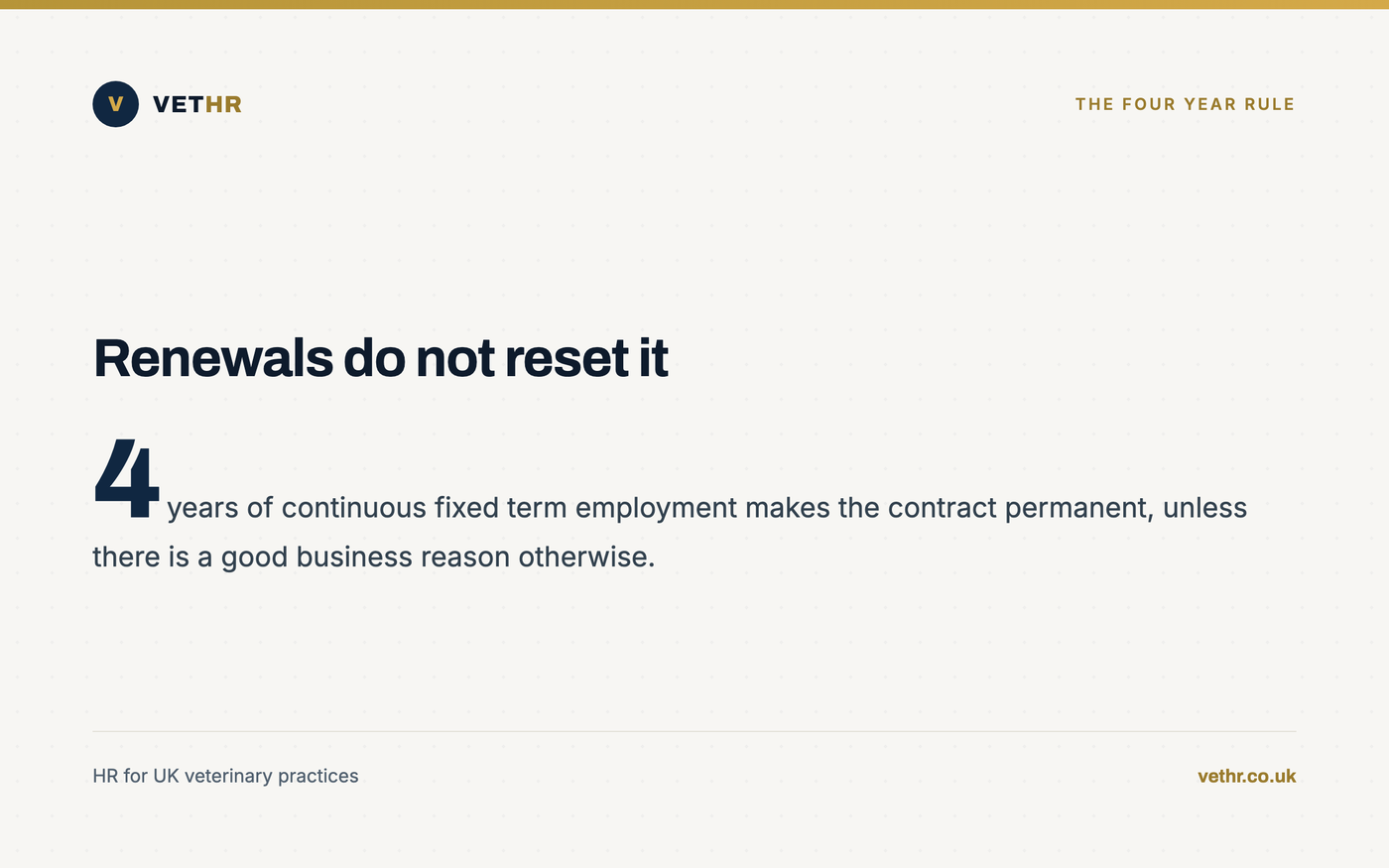
Continuous service on fixed term contracts converts to permanent employment at four years. GOV.UK states that any employee on fixed term contracts for 4 or more years will automatically become a permanent employee, unless the employer can show there is a good business reason not to do so.
Renewals do not reset the clock. Four successive one year contracts with no genuine break in continuity reach the same point as one four year contract, which is precisely how practices arrive there without noticing.
The conversion is automatic in law, not a decision you make. If continuity has run for four years and there is no objective justification for a further fixed term, the person is permanent regardless of what the latest contract says.
Audit the fixed term contracts you already hold. List every one, the original start date, every extension and the current end date, and you will usually find at least one arrangement that has run considerably longer than anybody involved believed.
Diary each end date when the contract is issued. A reminder ninety days before expiry gives you time to decide, consult and either convert the role or run a fair process.
As a dismissal, because ending fixed term contracts is exactly that. Expiry without renewal is a dismissal in law, so it needs a fair reason and a fair process, and employees with sufficient service can claim unfair dismissal.
Where the role is genuinely disappearing, redundancy may apply and employees with two years of service can be entitled to a statutory payment. Our guide to redundancy in a veterinary practice covers the process.
Do not simply let the date pass in silence. A contract that expires with no letter and no conversation is how a practice loses the paper trail it will later need, as our guide to notice periods sets out.

State the reason in the contract and keep the end open to reality. Maternity cover produces the most common of all fixed term contracts in veterinary practice and the one most likely to drift, because the returning vet’s plans often change.
Write the contract to end on the return of the named employee, or on a date, whichever the situation genuinely requires. A rigid twelve month end date meets an employee who returns at nine months or at fifteen, and neither fits.
Keep the returner’s rights intact throughout. Someone on maternity leave has protections around their role, and cover arrangements must not quietly become a reorganisation, as our guide to maternity leave covers.
Then decide early if you want to keep the cover vet. Good maternity cover in a tight market is a recruitment opportunity, and practices that wait until the final month usually lose the person to someone offering permanence.
Cover contract on its third extension? A free 30-minute HR health check will tell you where you stand. Book your HR health check.
All five fixed term contracts traps are administrative, and all five are avoidable with a diary reminder and a template. None of them require legal spending to prevent.
There is a sixth worth naming, which is silence about the future. People on fixed term contracts spend the final quarter of the term applying elsewhere unless somebody tells them what is likely, and practices routinely lose good cover staff they had every intention of keeping.
Trap five bites hardest in practices that use the same familiar vet for repeated blocks of cover. Continuity can survive short gaps, and the accumulated service brings unfair dismissal and redundancy rights with it.
Yes, on the same basis as comparable permanent employees, pro rata to the period they work. Statutory entitlement is 5.6 weeks, and any contractual leave above that should also be applied unless a difference can be objectively justified.
After four years of continuous employment on fixed term contracts, yes, unless the employer can show a good business reason not to make it permanent. Successive renewals count towards those four years; a new contract does not restart the clock where continuity is unbroken.
Yes. Non-renewal at the end of a fixed term is treated as a dismissal, so there must be a fair reason and a fair process. Employees with sufficient qualifying service can bring an unfair dismissal claim, and redundancy may apply where the role has genuinely ceased.
Not simply because the contract is temporary. Less favourable treatment on the ground that the employee is fixed term is unlawful unless objectively justified. Differences based on genuine factors such as experience or scope of role are a different matter, and should be recorded.
For maternity or adoption cover, tying the end to the return of the named employee is usually more accurate than a fixed date, because return dates change. Whichever you choose, state it clearly in the contract and confirm the actual end date in writing when it is known.
Fixed term contracts are useful and low risk when they are used for a genuine temporary need, written properly and diarised. They become expensive when they drift, because nothing about the drift is visible until somebody counts up the years.
Write the reason into the contract, diary every end date, treat the person as an equal member of the team and decide early whether you want to keep them. Our contract service and HR consultancy handle the paperwork, and the free HR health check will flag any contract already past its useful life.
The Vet HR Team provides HR consultancy and white-labelled staff systems exclusively to UK veterinary practices. Dismissal and continuity questions are legal matters; take advice where the position is unclear.
Contracts, rotas, holiday, a difficult conversation. Tell us what you are dealing with and we will come back within one working day. Nothing to sign up to.
Got it. We will come back to you within one working day. If you do not see a reply, please check your spam folder.
