Last updated: 14 June 2026
TL;DR: Buying a veterinary practice means inheriting its whole team: contracts, terms, holiday balances and any simmering disputes usually transfer with the business under TUPE. This guide covers what actually transfers, the staff documents to demand before completion, the inherited terms you cannot simply change, how a share sale differs from an asset sale, and what your first 90 days as the new owner should look like.
The purchase agreement gets months of attention. The people who will actually deliver the goodwill you are paying for often get an afternoon. This checklist redresses the balance: what transfers with the business, what to demand from the seller, what you cannot change afterwards, and how to land the first 90 days.
In most purchases the team transfers with the business. Under TUPE, the Transfer of Undertakings (Protection of Employment) regulations, employees’ jobs, their existing terms and conditions and their continuity of employment usually move to you automatically when the business changes owner, whatever the size of the practice.
GOV.UK guidance on business transfers and TUPE is blunt about the scope: jobs usually transfer over to the new company, terms and conditions go with them, continuity of employment is maintained, and the size of the business does not matter. A four vet independent is covered exactly as a forty branch group is.
Continuity is the part buyers underestimate. A head nurse who joined in 2014 walks through the door on completion day with her original start date intact, and every service linked right that flows from it. You are not hiring a team on fresh terms. You are stepping into a set of existing promises, and the law expects you to keep them.
The seller has duties before completion too. Staff must be told that the transfer is happening, when it is happening and why, and how it will affect them. For transfers on or after 1 July 2024, GOV.UK guidance on consulting and informing confirms an employer can consult employees directly where it has fewer than 50 employees or is transferring fewer than 10, which covers most independent practice sales. For the mechanics in full, our guide to TUPE for veterinary practices walks through the process step by step.
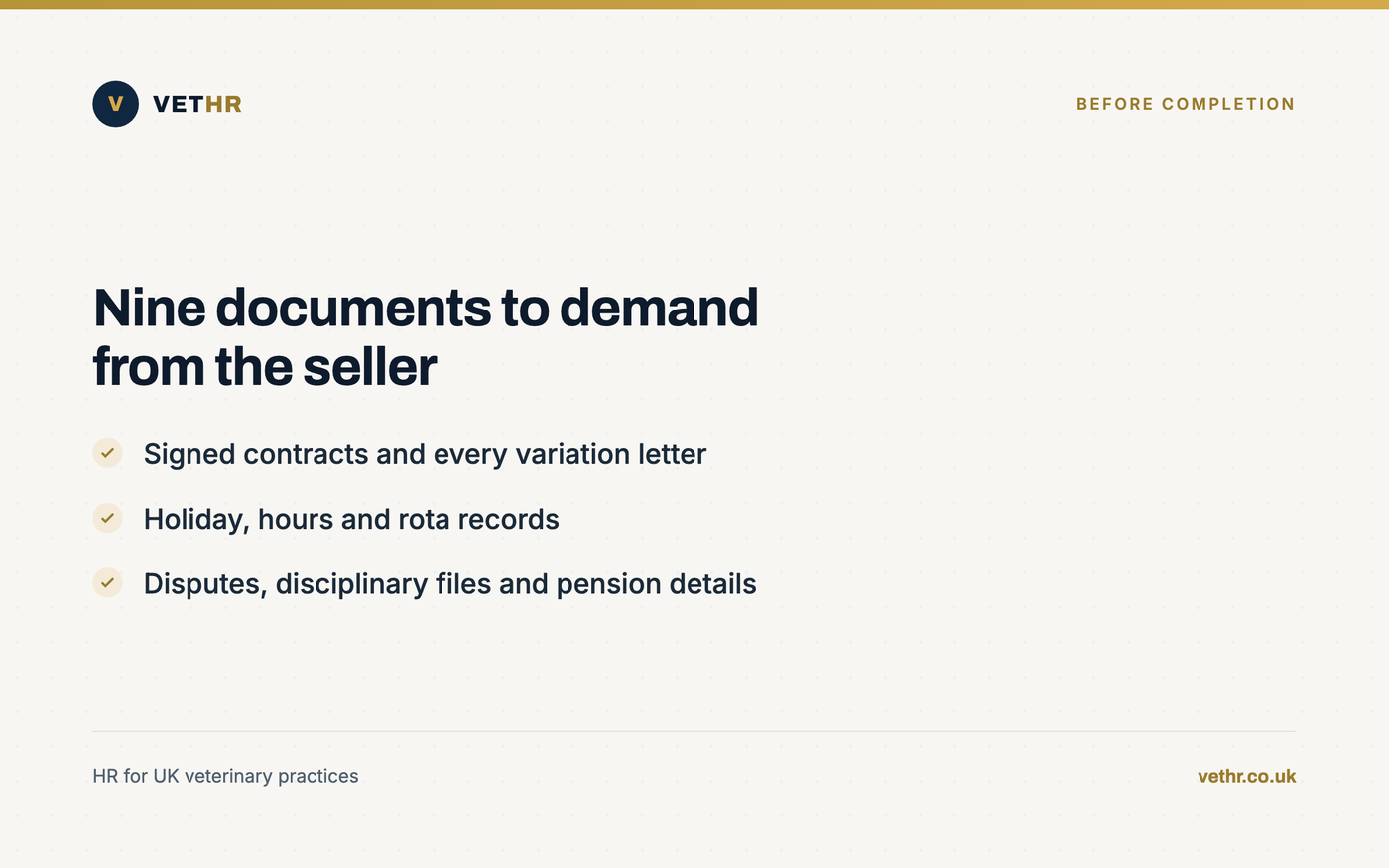
Nine things: signed contracts for every employee, any variation letters, holiday and hours records, current rota patterns, pay and benefits details, disciplinary and grievance history, live or threatened disputes, pension scheme details and contributions, and the status of any freelance vet cover. If the seller cannot produce them, price that in.
TUPE gives you a legal floor here. The seller must hand over employee liability information at least 4 weeks before the transfer, covering each person’s name, age and main employment details, plus disciplinary action, grievances and legal action from the last 2 years, according to GOV.UK guidance on information about employees during transfers. Useful, but nowhere near enough to run a practice on.
Treat the legal minimum as a starting point and ask for the full file behind it:
Gaps tell you as much as documents do. An unsigned contract does not mean no terms exist; promises made in conversation years ago may still be relied on. Ask the seller to confirm in writing that nothing material sits outside the paperwork, and have our veterinary contracts service review the pile before you commit.
Almost all of them, at first. GOV.UK is explicit that the new employer takes over all the previous terms and conditions of employment, and that a change is not valid if the reason for it is the transfer itself, even where the employee agrees to it. Lawful change needs a genuine reason and agreement.
The detail sits in GOV.UK guidance on transfers of employment contracts. A change is void where the reason for it is the transfer, and that includes changes agreed before completion. Change becomes possible where there is an economic, technical or organisational reason involving changes in the workforce, agreed with the employee. Improvements the employee consents to are fine.
The classic trap is harmonisation. You already own one practice, you buy a second, and you want everyone on the same contract. Aligning inherited terms with your existing ones is, on its face, a change made because of the transfer. Done casually it invites claims. Done properly it is a careful, consulted project months down the line.
Dismissals carry the same logic. An employee dismissed because of the transfer will usually have a strong claim, while a genuine restructure for an economic, technical or organisational reason involving workforce changes remains possible under the normal fairness rules. If a seller quietly trims staff before completion at your request, that risk lands on you.
Pensions have their own wrinkle. GOV.UK states that company pension rights earned up to the time of a transfer are protected, but the new employer does not have to continue an identical pension. What you must provide going forward is a question for your accountant or pensions adviser, so ask it before completion rather than after.
Partway through a purchase and not sure what to ask for? Book a free HR health check. In 30 minutes we will look at what the seller has disclosed, flag the gaps that would worry us, and tell you plainly what to demand before you sign. Straight answers, nothing sold for the sake of it.
In an asset sale you buy the practice out of the selling company, the employer changes, and TUPE moves the team to you with their terms intact. In a share sale you buy the company itself, the employer named on every contract stays the same, and employment simply continues. Different mechanics, different risks.
An asset purchase is the classic TUPE scenario, and all of the machinery above applies: the duty to inform and consult, the employee liability information, the protection of terms and the limits on change. The transfer is a legal event with a date, and both sides have jobs to do before it.
A share sale looks simpler on the surface. There is no transfer moment, no consultation trigger and no liability information deadline, because the employer never changes. The catch is that nothing is left behind either. Every historic people liability, the old grievance, the miscalculated holiday, the claim nobody mentioned, sits inside the company you now own.
Which structure suits you is a legal and tax question, and Vet HR is an HR consultancy, not a law firm. Take structural advice from your solicitor and accountant. Our job is the people layer: making sure you know exactly which obligations you are stepping into, whichever route the deal takes.
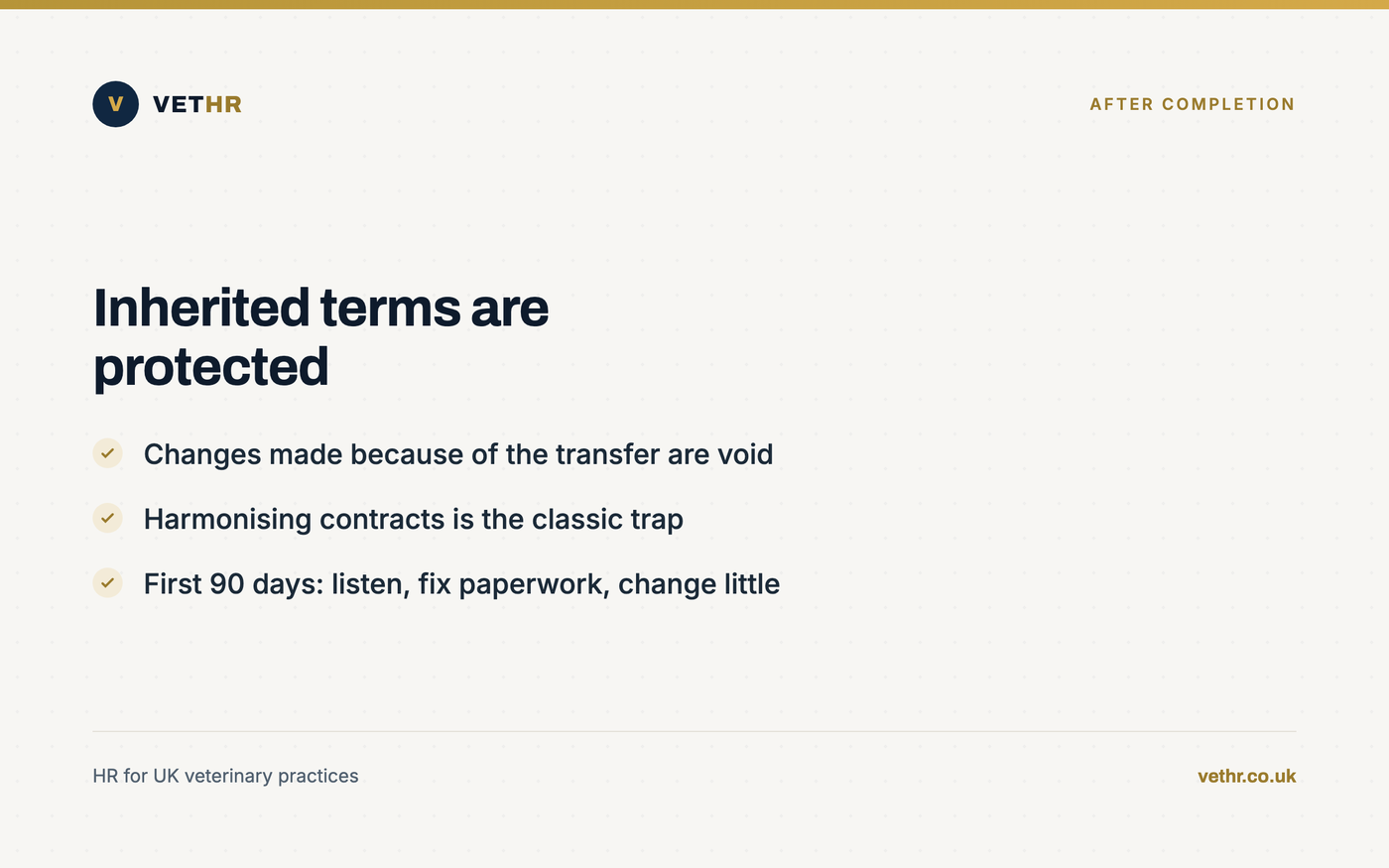
Slow, visible and mostly listening. The first 90 days set the tone for your ownership: meet every member of staff one to one, honour the terms that transferred, fix the paperwork gaps your due diligence found, and resist the urge to reorganise anything until you understand why the practice runs the way it does.
In the first month, be present and change nothing. Introduce yourself in person on day one, follow up in writing, and confirm the things people are silently worrying about: pay dates, rotas and jobs are unchanged. Book a one to one with every member of staff, from the senior vet to the Saturday receptionist, and mostly listen.
In the second month, fix the paperwork. Turn your due diligence findings into a register: missing contracts, unrecorded variations, holiday balances that do not add up. Reissue documents carefully, stating that terms are unchanged, so nobody reads a tidy up as a quiet variation. Get records out of the filing cabinet and into one system.
In the third month, build the rhythm you want to run: rota publication dates, how absence is reported, how concerns are raised. Give any new hires a structured start using our veterinary new starter checklist. The habits you set now are the culture the team will describe in a year.
Usually, yes, where you buy the practice as a business and the employer changes, whatever the size of the team. GOV.UK confirms that jobs, terms and conditions and continuity of employment transfer to the new owner. In a share sale the employing company itself changes hands, so the employer usually stays the same and the TUPE transfer machinery is generally not triggered.
Not because of the purchase itself. A change is not valid if the reason for it is the transfer, even where the employee agrees. Changes need an economic, technical or organisational reason involving changes in the workforce, plus agreement, and improvements need the employee’s consent. Harmonising inherited terms with your other contracts is the change most likely to go wrong.
The staff information the seller must provide at least 4 weeks before the transfer: each employee’s name, age and main employment details, plus disciplinary action, grievances and legal action from the last 2 years, and any legal action the seller expects. Treat it as a legal floor and demand the full staff file on top of it.
Not identically. GOV.UK states that pension rights earned up to the time of the transfer are protected, but the new employer does not have to continue an identical pension. Your ongoing workplace pension duties are a separate question, so confirm the position with your accountant or a pensions adviser before completion.
An employee can object to transferring, which normally takes effect as a resignation with no unfair dismissal claim. The exception is where working conditions are significantly worse because of the transfer, in which case they can object, or resign and claim unfair dismissal. Early, honest communication is the cheapest way to stop objections happening at all.
Buying a veterinary practice is a people transaction with premises attached. The clinical kit depreciates and the goodwill walks out of the door each evening; whether it walks back in tomorrow depends on how you handle the team you inherit. TUPE decides what you owe them. Due diligence decides whether you knew.
If a purchase is on your horizon, start the people work early. Our veterinary HR consultancy runs the full due diligence and first 90 days alongside your solicitor, or book a free HR health check and we will tell you plainly what to ask for before you sign.
The Vet HR Team provides HR consultancy and white-labelled staff systems exclusively to UK veterinary practices.
Contracts, rotas, holiday, a difficult conversation. Tell us what you are dealing with and we will come back within one working day. Nothing to sign up to.
Got it. We will come back to you within one working day. If you do not see a reply, please check your spam folder.
