Last updated: 5 September 2026
TL;DR: HSE states employers have a legal duty to protect employees’ health, safety and welfare, and identifies misuse as covering illegal drugs and the misuse of alcohol, medicines and substances such as solvents. In a veterinary practice the stakes include patient safety and controlled drug stocks, so the policy needs a support route as well as a disciplinary one.

A drugs and alcohol policy is the document practices most want to avoid writing, usually because writing it feels like an accusation. It is the opposite. Without one, a manager who has a genuine concern at 8am on a Saturday has no route, no wording and no idea whether they are allowed to send someone home.
Because the health and safety duty is engaged and the clinical risk is real. HSE states that employers have a legal duty to protect employees’ health, safety and welfare, and misuse at work sits squarely inside that.
HSE defines misuse as covering the use of illegal drugs and the misuse of alcohol, medicines and substances such as solvents, and draws a distinction between misuse and dependence. Both distinctions matter for how a practice responds.
A veterinary drugs and alcohol policy carries two factors an office version does not. Patients under anaesthetic depend on judgement being intact, and the building contains controlled drugs that are attractive to someone struggling.
Read it alongside your stress and wellbeing work. HSE is equally clear that employers have a legal duty to protect employees from stress at work by doing a risk assessment and acting on it, and the two subjects are more closely connected than most policies acknowledge.
There is also a professional dimension. Concerns about a registered professional’s fitness to practise sit alongside the employment question, and the two need handling in parallel rather than as one process.
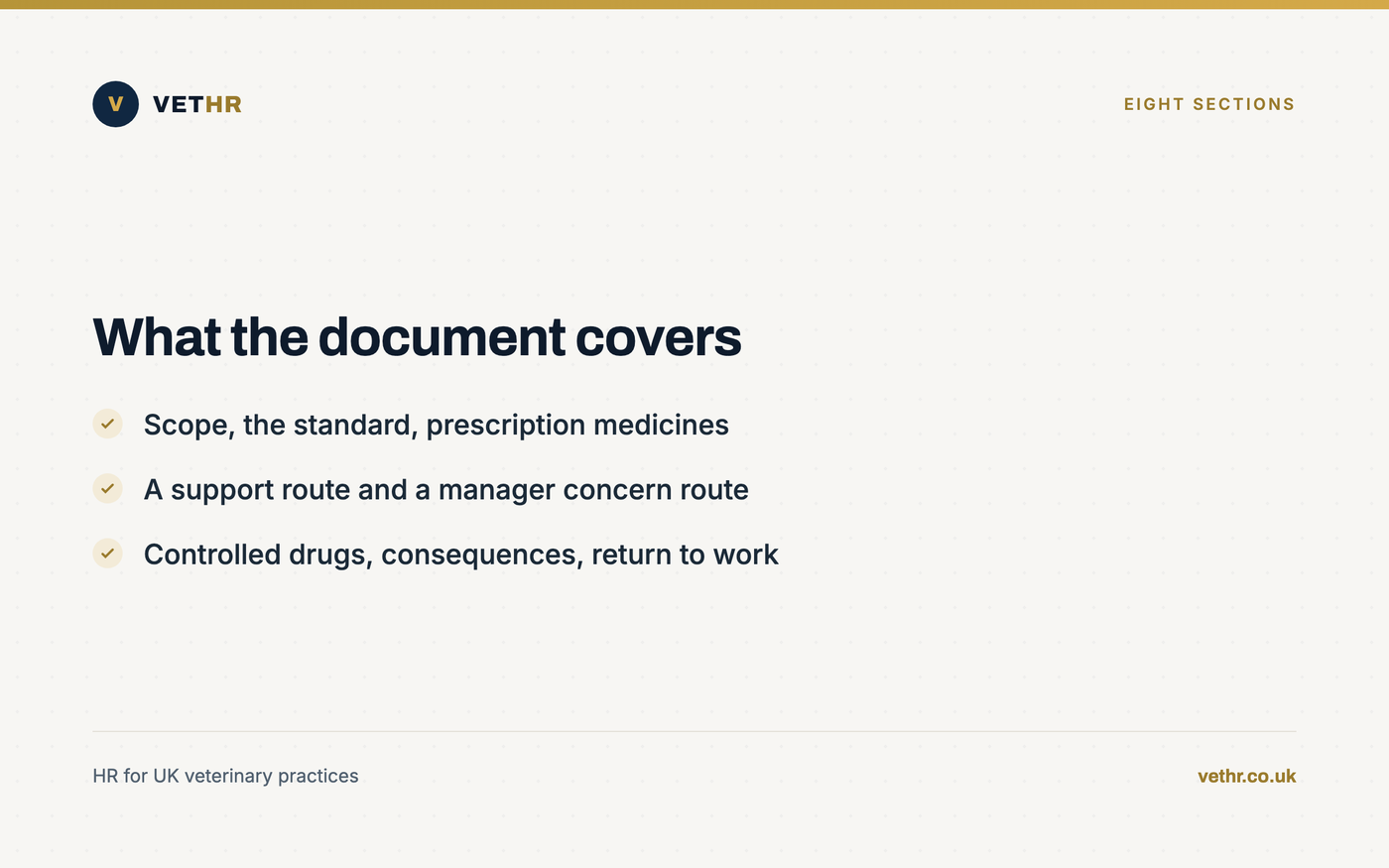
The drugs and alcohol policy needs eight sections, written so a stressed manager can follow them at speed. The tone should make it easier to ask for help than to hide a problem.
Section three is the one the average drugs and alcohol policy omits. A nurse on new medication that causes drowsiness needs a route to say so without it becoming a disciplinary matter, and that route has to be written down.
Keep the drugs and alcohol policy non-contractual in the handbook, alongside health and safety and disciplinary, as our guide to the staff handbook covers.
Patterns rather than incidents. HSE identifies unexplained absences, behavioural changes, reduced productivity, increased accidents or near misses, and performance or conduct issues as indicators of possible misuse.
None of these prove anything on their own. Each has entirely innocent explanations, which is why the correct response is a supportive conversation rather than a conclusion, as our guide to absence trigger points covers.
Train managers on what the drugs and alcohol policy asks of them before they need it. Most managers have never had this conversation and will avoid it entirely unless they know the words, the steps and that they have permission to act.
Watch for the veterinary-specific version too. This is a profession under considerable pressure, and misuse frequently follows burnout rather than preceding it, as our guide to managing burnout discusses.
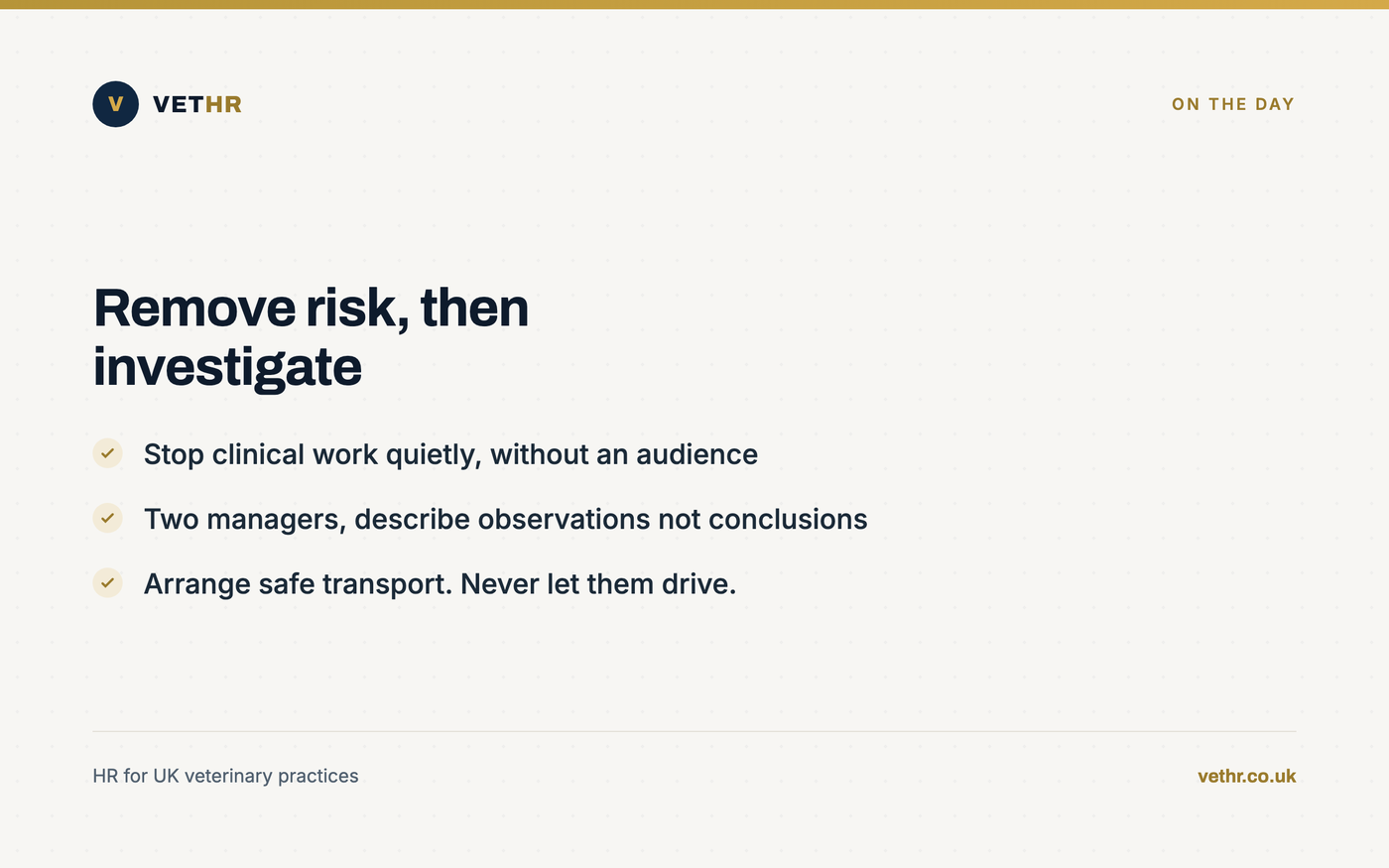
Remove the risk first, investigate second. Whatever the explanation turns out to be, someone who may be impaired should not be anaesthetising a patient while the conversation happens.
Step four is a genuine liability point. Sending someone home to drive when you believed they were impaired is a decision that will be examined closely if anything happens.
Tell the person what happens next before they leave the building. Uncertainty after a conversation like this is its own harm, and a sentence confirming that you will be in touch within two working days costs nothing.
Then run any formal process properly rather than acting on the day’s impression, as our guide to disciplinary procedures sets out.
Treat stock discrepancies as a separate and serious matter with its own procedure. This is where a veterinary drugs and alcohol policy diverges sharply from a generic template.
Your controlled drugs standard operating procedure should already cover storage, witnessing, recording and reconciliation. The people policy should cross-reference it rather than duplicate it.
Reconcile regularly and by more than one person. Controls that depend on a single individual checking their own records are not controls, and that is true regardless of how much everyone trusts each other.
Where a discrepancy appears, take advice before acting. This engages regulatory and potentially criminal territory alongside the employment process, and our guide to HR consultant or employment lawyer covers where that line sits.
No policy and a concern you are not sure how to raise? A free 30-minute HR health check will help you plan it. Book your HR health check.
Rarely, and only with a proper contractual basis. HSE’s guidance covers screening and testing as one area of the subject, but testing is not a shortcut and it carries significant legal and practical complexity.
Consider what happens at practice social events too, and say it in the drugs and alcohol policy. The Christmas party is a work event, alcohol is usually present, and the practice retains responsibilities that do not stop at the door of the venue.
Take legal advice before introducing testing. It is one of the few areas where getting the paperwork slightly wrong makes the entire exercise unusable, and the same is true of the data handling that follows, as our guide to GDPR and staff records explains.
The policy itself is not, but the underlying duty is. HSE states employers have a legal duty to protect employees’ health, safety and welfare, and a written policy is how a practice evidences that it has considered and managed this particular risk.
Yes, and you should where patient or personal safety may be affected, provided your policy sets that out. Remove them from clinical duties, speak privately with a second manager present, arrange safe transport home rather than letting them drive, and record the facts the same day.
Often both, in sequence. HSE distinguishes misuse from dependence, and a policy that offers only a disciplinary route guarantees nobody ever discloses a problem early. Provide a support route with confidentiality, while being clear about conduct that will always be treated seriously.
Include it explicitly. HSE’s definition of misuse covers medicines as well as illegal drugs and alcohol. Staff should have a straightforward route to tell you where medication may affect safe working, so adjustments can be made without it becoming a disciplinary issue.
Possibly. Controlled drug discrepancies and concerns about a registered professional’s fitness to practise may engage obligations beyond employment law. Take advice promptly rather than deciding internally, because these run in parallel with, not instead of, your own process.
A drugs and alcohol policy is not a statement about your team. It is the document that lets a manager act quickly and fairly on a Saturday morning when something is wrong, without improvising a response that later turns out to have been unlawful.
Write the eight sections of the drugs and alcohol policy, include prescription medicines, give people a support route, cross-reference your controlled drugs procedure and take advice before contemplating testing. Our policy library and HR consultancy will draft it around your practice, and the free HR health check is where to start.
The Vet HR Team provides HR consultancy and white-labelled staff systems exclusively to UK veterinary practices. This is HR guidance, not legal or medical advice; take advice on any live case.
Contracts, rotas, holiday, a difficult conversation. Tell us what you are dealing with and we will come back within one working day. Nothing to sign up to.
Got it. We will come back to you within one working day. If you do not see a reply, please check your spam folder.
