Last updated: 27 June 2026
TL;DR: Managing burnout in a veterinary practice is mostly structural, not personal. Burnout grows from rota load, out-of-hours, understaffing and emotional toll, so the fix lives in how you plan hours, share cover and check in, not in a wellbeing poster. Spot the early signs early, ease the workload, protect rest, run fair rotas and meet your duty of care. This guide covers the signs, the causes and the day-to-day levers a practice can actually pull.
Burnout rarely announces itself. It builds quietly through a run of hard weeks until a good nurse hands in a notice that surprises nobody who was paying attention. This is a calm, practical look at the signs to watch for, the structural causes underneath them, and the levers a practice can pull before it reaches that point.
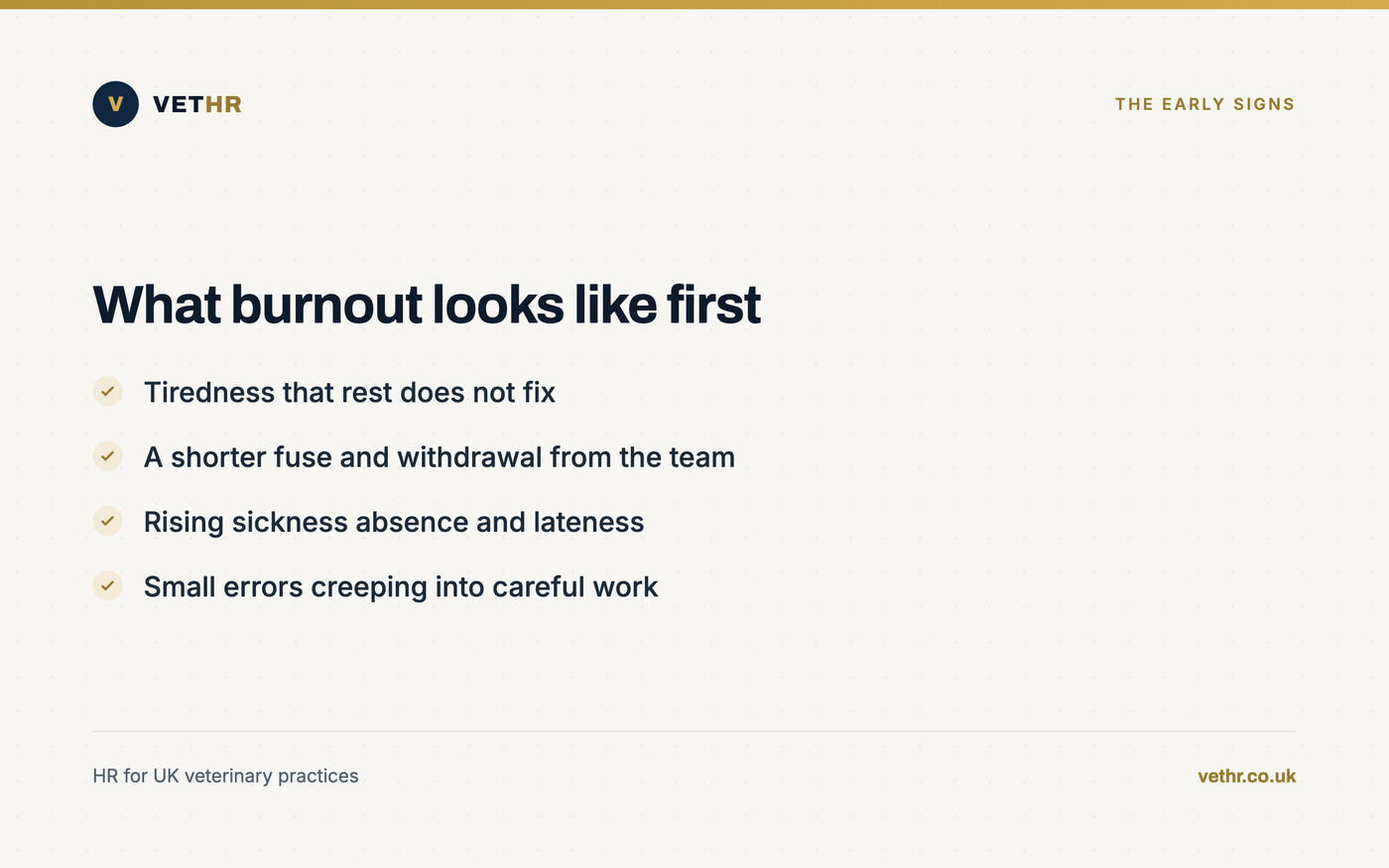
The early signs of burnout are changes in someone who used to be steady: tiredness that rest does not fix, a shorter fuse, withdrawal from the team, and small mistakes creeping into careful work. Acas lists appearing tired, anxious or withdrawn, and a rise in sickness absence or lateness, among the common workplace indicators of a mental health problem.
In a practice these show up in specific ways. A vet who used to chat at the start of a shift goes quiet. A nurse who never called in sick starts taking the odd Monday. Consults that ran smoothly begin to overrun, not from complexity but from a flat kind of fatigue. None of these is proof on its own, and that is the point: the signs are subtle precisely because the person is still turning up and still coping, right up until they are not.
Acas advises managers to regularly ask workers how they are doing and to help them be open about how they are feeling, because early awareness is what makes early support possible, as set out in its guidance on supporting mental health at work. The practical version of that is a manager who notices the change and asks a quiet question, rather than waiting for a resignation to explain it.
Burnout in veterinary teams is driven by the structure of the work, not a lack of resilience in the people doing it. The main causes are heavy and unpredictable workload, out-of-hours and on-call demands, chronic understaffing, and the emotional toll of clinical and client work. These are practice-level pressures, which means they respond to practice-level changes.
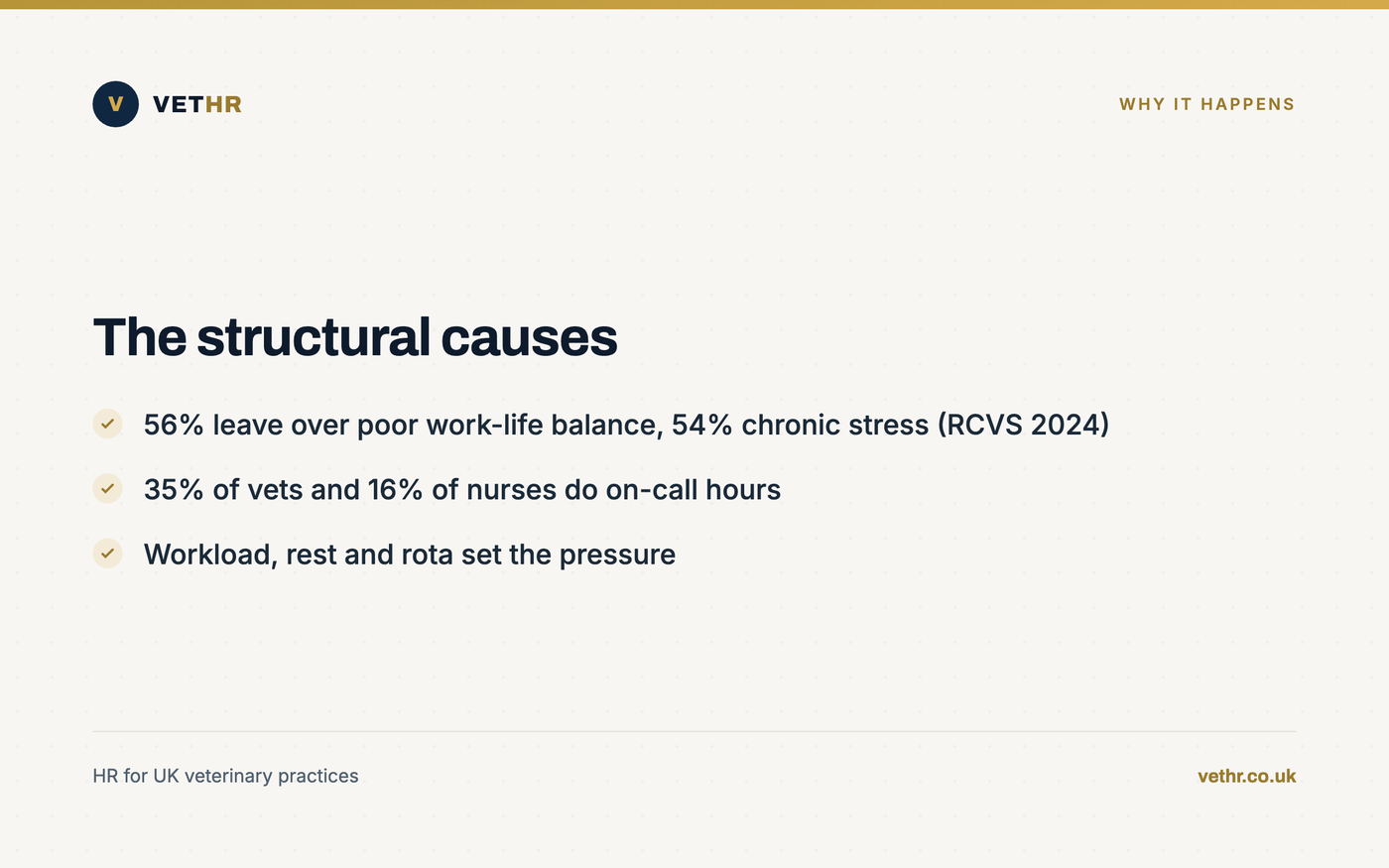
The profession’s own data points the same way. In the RCVS Surveys of the Professions 2024, the leading reasons people gave for intending to leave were poor work-life balance at 56 percent, chronic stress at 54 percent, and not feeling rewarded or valued in a non-financial sense at 47 percent, according to the RCVS. Every one of those is a workplace condition before it is a personal feeling.
Out-of-hours work sits at the centre of it. The same RCVS research found that 35 percent of vets and 16 percent of veterinary nurses did on-call hours. On-call is where the week turns unpredictable, where rest gets eaten in fragments, and where the gap between a fair rota and an unfair one becomes a wellbeing issue rather than an admin one.
The emotional load is real and measurable too. RCVS data shows 29 percent of veterinary nurses and 17 percent of vets reported a mental or physical health condition affecting their daily activities. Add client-facing strain, where 34 percent of vets and 39 percent of nurses reported harassment or bullying from clients in the last year, and the picture is of a workforce carrying weight that no single person can be coached out of.
They overlap but they are not the same. Burnout is exhaustion from sustained workload and lack of control. Compassion fatigue is the specific erosion that comes from repeated emotional labour, hard euthanasias, distressed owners, cases that do not end well. In a veterinary practice both tend to arrive together, and the response to each begins in the same place: the structure of the work.
The distinction matters less for diagnosis than for honesty. A practice cannot remove the emotional weight of the job, and pretending otherwise helps nobody. What it can do is stop stacking avoidable pressures on top of the unavoidable ones. When someone has just managed a difficult end-of-life consult, the rota should not also be asking them to cover an unplanned on-call gap that evening. The job is hard enough on its own without the structure making it harder.
This is why managing burnout in a veterinary practice is framed here as an employer task rather than a personal one. The emotional toll is part of the work, but the workload, the rest, the rota and the support around it are choices the practice makes. Those choices are where the leverage sits.
If you are not sure where your team’s pressure points are, a short conversation usually surfaces them. Book a free HR health check and we will look honestly at how you run rotas, hours, cover and check-ins today, then tell you where small changes would take real weight off your people. No jargon, nothing sold for the sake of it.
A practice can do a great deal, and most of it is unglamorous. The answer is to work the structural levers: easing workload, protecting genuine rest, running fair and predictable rotas, holding regular manager check-ins, and building real support around hard cases. These are operational decisions, not perks.
Acas frames the employer’s role plainly: do all you reasonably can to support workers’ health, safety and wellbeing, treat mental and physical health as equally important, and make reasonable adjustments such as more rest breaks where they help. None of that requires a grand wellbeing programme. It requires the day-to-day running of the practice to take pressure off rather than add to it.
The pattern worth noticing is that almost every lever above is something a practice manager already touches every week. Managing burnout in a veterinary practice is not a separate project bolted on to the work. It is the same rota, the same one-to-ones and the same workload decisions, made with the team’s sustainability in mind.
The rota is the single biggest structural lever you have. It decides how heavy each week feels, how predictable life around the job is, and how fairly the hard shifts are shared. A rota that quietly loads the same people, ignores recovery after on-call, or changes at short notice is a slow-acting cause of burnout, even when every individual shift looks reasonable on paper.
The HSE backs this up. Its Management Standards for work-related stress name demands as the very first area, defined as workload, work patterns and the work environment, alongside control, how much say a person has over the way they work, in its overview of the standards. A rota is precisely where demands and control are set, which is why it carries so much weight.
Practically, that means a few habits. Share out-of-hours evenly and visibly. Build genuine recovery time after on-call rather than rolling people straight into a full day. Give enough notice that people can plan around shifts, and a clear, fair way to swap when life happens. A veterinary rota system that shows the whole picture in one place makes unfairness visible early, while it is still easy to fix, instead of after someone has quietly decided to leave.
An employer’s duty of care is a legal obligation, not a goodwill gesture. Employers must do all they reasonably can to protect their staff’s health, safety and wellbeing, and that explicitly includes mental health. For work-related stress, this means assessing the risk and acting on what the assessment finds.
The HSE is direct about it: employers have a legal duty to protect employees from stress at work by doing a risk assessment and acting on it. Its Management Standards give a ready-made framework for that assessment, covering demands, control, support, relationships, role and change, the six areas where work-related stress is created or contained. Using them is recognised as a sufficient way to meet the duty.
Acas adds the day-to-day expectation: treat mental and physical health as equally important, ask people how they are doing, and make reasonable adjustments where they help. Meeting the duty is rarely about grand gestures. It is about being able to show that you noticed the pressure, took it seriously, and changed something real in response.
This is where structure and compliance meet. Fair rotas, recorded hours, protected breaks and regular check-ins are both the practical answer to burnout and the evidence that you took your duty of care seriously. Our HR consultancy and ongoing support are built around exactly these structural levers, so wellbeing is something the practice runs, not something it hopes for.
Watch for change in a steady person: tiredness that rest does not fix, a shorter temper, withdrawal from the team, and small errors creeping into careful work. Acas also names rising sickness absence and lateness as common signs. A quiet check-in when you notice the change is what turns spotting into support.
Burnout is exhaustion from sustained workload and a lack of control over the work. Compassion fatigue is the specific erosion from repeated emotional labour, such as hard euthanasias and distressed owners. In a veterinary practice they usually arrive together, and the response to both starts with the structure of the work: workload, rest, rota and support.
Employers have a legal duty of care for staff health, safety and wellbeing, including mental health. The HSE states employers must protect employees from work-related stress by carrying out a risk assessment and acting on it. That does not make every case of burnout an employer’s fault, but it does mean you are expected to assess the pressure and respond to it.
Yes, because the rota sets workload, predictability and how fairly hard shifts are shared, which the HSE identifies as core drivers of work-related stress. Sharing out-of-hours evenly, protecting recovery after on-call and giving enough notice all take real weight off a team without changing the clinical work itself.
Keep it simple and genuine. Ask how the person is doing, listen without rushing to fix, and ask what would take pressure off their week. Acas advises managers to regularly ask workers how they are and help them be open about how they are feeling. The aim is to catch the early signs while they are still small.
Burnout in a veterinary practice is not a sign that your people are weak. It is usually a sign that the structure around them has been asking too much for too long. The emotional weight of the work is real and cannot be removed, but the workload, the rest, the rota and the support can all be designed to take pressure off rather than add to it.
Start with the levers you already touch every week. To put fairness and visibility into the rota, see our veterinary rota system; to build the wider structure around it, read how we work in HR consultancy; or simply book a free HR health check and we will give you an honest read on where your team is carrying too much. Nothing sold that you do not need.
The Vet HR Team provides HR consultancy and white-labelled staff systems exclusively to UK veterinary practices.
—Read next: The Stress Risk Assessment Your Veterinary Practice Is Legally Required to Have.
Contracts, rotas, holiday, a difficult conversation. Tell us what you are dealing with and we will come back within one working day. Nothing to sign up to.
Got it. We will come back to you within one working day. If you do not see a reply, please check your spam folder.
