Last updated: 27 June 2026
TL;DR: Disciplinary procedures in a veterinary practice should follow a fair, written process: investigate first, hold a disciplinary meeting, give the statutory right to be accompanied, decide the outcome, apply a proportionate sanction, and offer an appeal. Follow the ACAS Code, deal with minor issues informally, and keep dated records. Get it wrong and a tribunal can raise an award by up to 25 percent.
Disciplining a colleague is one of the hardest things a practice manager does, especially in a small team where everyone knows everyone. The aim of this guide is calm and practical: a fair process you can trust on a bad week, grounded in the ACAS Code and tidy records, so a difficult conversation never becomes a tribunal claim.
Disciplinary procedures in a veterinary practice are the fair, written steps an employer follows to address conduct or performance that falls below the standard expected, such as repeated lateness, a serious clinical error or unprofessional behaviour. They cover investigation, a meeting, a decision, a proportionate sanction and an appeal, and they exist to be fair to the employee and to protect the practice.
This is the employer-initiated side of HR. It is the mirror image of a grievance, which is when a staff member raises a concern with you. Both run on the same principles of fairness, but a disciplinary starts with the practice acting on something a team member has done or failed to do.
Every UK employer should have written disciplinary rules and procedures and tell staff about them. GOV.UK is explicit: your rules and procedures “should follow the Acas Code of Practice on disciplinary and grievance procedures”, as set out in its guidance on taking disciplinary action. For a practice, that usually starts with clear, signed staff policies everyone has actually read.
A quick but important note. Vet HR provides HR consultancy and documentation support, not legal advice. We are not a law firm. This guide explains the process and points you to the official sources, and for a specific case we will help you run it correctly and, where needed, point you to qualified legal advice.
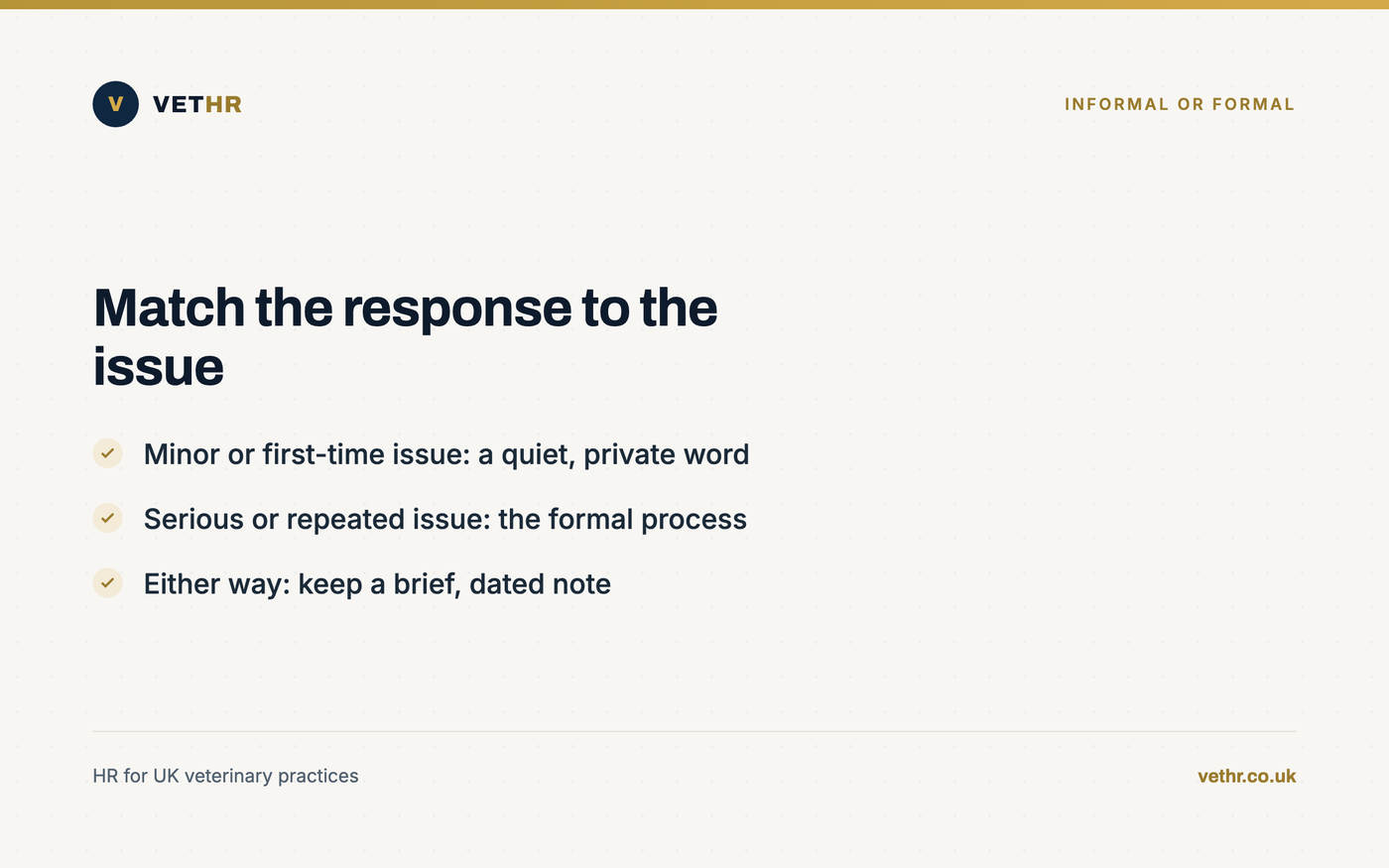
Not every issue needs a formal disciplinary process. Minor or first-time problems are often best handled informally, with a quiet, private word and a clear note of what was agreed. Formal action is for serious matters, repeated issues, or where an informal approach has already been tried and has not worked. Matching the response to the problem is itself part of being fair.
ACAS advises employers to try to resolve issues informally first where possible, by privately talking with the person and listening to their point of view, before reaching for the formal process, as set out in its step-by-step disciplinary guidance. In a practice, a missed clean-down or a one-off late start is usually an informal conversation, not a hearing.
The line moves when conduct repeats, when patient safety is at stake, or when the behaviour is serious in itself. A pattern of unexplained absence that leaves a shift short, or a dispensing error hidden rather than reported, points toward formal action. The honest test is whether an informal chat could reasonably fix it.
Keep records either way. An informal word is not a warning, but a brief, dated note of what was discussed protects everyone if the issue returns. It shows you addressed it early and fairly, which matters far more than how informal the conversation felt at the time.
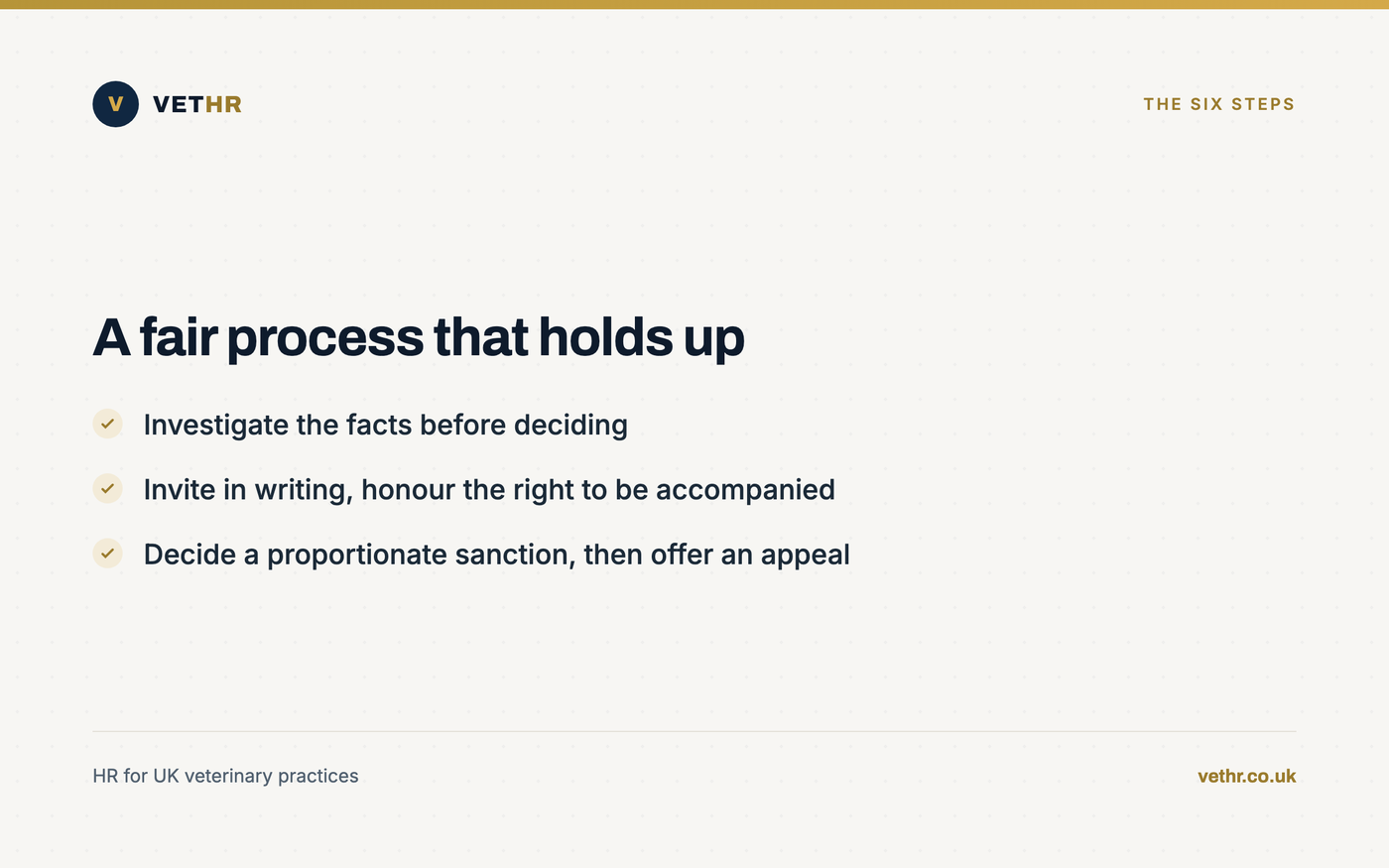
A fair disciplinary process has six clear stages: understand your options, investigate the facts, invite the employee to a disciplinary meeting in writing, hold the meeting and let them respond, decide a proportionate outcome, and offer an appeal. ACAS sets these out plainly, and following them is the single best protection a practice has if a case is ever challenged.
The investigation is where most practices either protect themselves or trip up. Investigate before you judge: collect rotas, clock-in records, incident logs and statements, and separate the person who investigates from the person who decides where the practice is large enough to allow it. A clean incident log turns “I think it was a Tuesday” into a dated fact.
This whole structure is why the ACAS Code carries weight. A failure to follow it does not by itself make you liable, but tribunals take the Code into account, and they “will also be able to adjust any awards made in relevant cases by up to 25 per cent for unreasonable failure to comply with any provision of the Code”, per the ACAS Code of Practice. Skipping a step is a costly shortcut.
Facing a difficult case and not sure your process is watertight? Book a free HR health check and we will look at your disciplinary policy, your records and the situation in front of you, then tell you honestly where you stand and what a fair next step looks like. Calm, specialist and on your side, with no jargon.
Run the disciplinary meeting calmly and fairly: give written notice with the allegations and evidence, explain the right to be accompanied, set out the concern, then let the employee respond fully before you decide anything. Take notes, keep an open mind, and do not announce an outcome you settled on beforehand. The meeting is a genuine chance to be heard, not a formality.
The right to be accompanied is a statutory one, and getting it wrong undermines an otherwise fair process. Workers have a statutory right to be accompanied by a companion where the disciplinary meeting could result in a formal warning or other disciplinary action, according to the ACAS Code of Practice. The companion can be a colleague, a trade union representative, or a union official.
Notice and reasonableness matter too. ACAS guidance explains that if the chosen companion is not available, the employer should postpone to a time proposed by the worker, provided it is reasonable and within five working days of the original date, as covered in the ACAS hearing guidance. A short, sensible delay is far cheaper than a procedural challenge.
For a single-site practice with one manager, this can feel awkward, because the same person often investigates, hears and decides. That is permitted where resources are limited, but it raises the bar on fairness. This is exactly the kind of case where our HR consultancy sits alongside you, so the process holds up and you are not making heavy decisions alone.
The usual sanctions run from a first written warning, to a final written warning, to dismissal, and the outcome must be proportionate to the misconduct and consistent with how you have treated similar cases. A first, minor lapse rarely justifies dismissal. Repeated or serious conduct, or a breach after a final warning, may. Proportionality and consistency are what a tribunal looks for.
Confirm every outcome in writing. Set out what was decided, why, what needs to change and by when, how long the warning stays live, and the right to appeal. A warning with no clear improvement target and no review date is hard to act on later and easy to challenge. Clarity now saves arguments down the line.
Consistency is the quiet trap. If two nurses commit a similar breach and one is dismissed while the other gets a warning, the difference must be explainable on the facts, not on who you like. This is where written policies earn their keep, because they set the standard before anyone breaks it.
Gross misconduct is behaviour so serious that it can justify dismissal without notice for a first offence, such as theft, violence, serious breaches of health and safety, or conduct that puts patients or people at real risk. Even then, you must still investigate and follow a fair process. “Serious” never means “skip the procedure”.
The ACAS Code states that “some acts, termed gross misconduct, are so serious in themselves or have such serious consequences that they may call for dismissal without notice for a first offence”, in its Code of Practice. The key word is “may”: it permits summary dismissal, it does not remove the need for a fair investigation and meeting first.
In a veterinary setting, examples might include falsifying clinical or controlled-drug records, working under the influence, or a deliberate act that endangers patients, colleagues or clients. Your policy should list examples of gross misconduct so the standard is known in advance, while making clear the list is not exhaustive.
Suspension is sometimes appropriate while you investigate a serious allegation, but it is a neutral act, not a punishment, and should be on full pay and kept as short as possible. Reaching for instant dismissal without investigating is the fastest route to an unfair dismissal finding, however clear the facts seem on the day.
The records that protect a practice are dated and contemporaneous: the investigation notes and evidence, the written invitation, who attended and accompanied, the meeting minutes, the outcome letter with reasons, and the appeal. Together they show a fair process was followed. If it is not written down, in a dispute it effectively did not happen.
Keep these securely and limit access to the people who genuinely need it, since they hold sensitive personal data. A tidy, retrievable file is also what lets you answer a tribunal or a subject access request without a frantic search. Our monthly HR support keeps these templates current and your records audit-ready, so a difficult month does not turn into an exposed one.
You are not automatically liable for failing to follow the ACAS disciplinary code, but tribunals take it into account and can adjust awards by up to 25 percent for an unreasonable failure to comply. In practice, following the Code is the simplest way to keep disciplinary procedures in a veterinary practice fair and defensible, so it is wise to treat it as the standard.
Yes. Workers have a statutory right to be accompanied at a disciplinary meeting that could result in a formal warning or other disciplinary action. The companion can be a colleague, a trade union representative or a union official. If your proposed time does not suit the companion, you should reschedule to a reasonable time within five working days.
No. Gross misconduct can justify dismissal without notice, but only after a fair investigation and a disciplinary meeting where the employee can respond. The seriousness of the allegation does not remove the need for a fair process. Skipping the procedure is the most common reason a dismissal that felt justified is later found to be unfair.
A disciplinary is employer-initiated: the practice acts on a staff member’s conduct or performance. A grievance is employee-initiated: a staff member raises a concern with the practice. Both follow the ACAS Code and the same fairness principles, but they start from opposite directions, and a single situation can sometimes involve both at once.
Keep disciplinary records for as long as you have a lawful reason to, then delete them. A warning should have a stated live period, after which it usually no longer counts against the employee, though the underlying file may be retained longer for legitimate purposes. Hold everything securely, limit access, and be ready to justify what you keep.
A disciplinary is never comfortable, but a fair, written process makes it manageable and keeps the practice safe. Investigate before you judge, hold a proper meeting, honour the right to be accompanied, keep the sanction proportionate, offer an appeal, and write it all down. Do that, and a hard conversation stays a hard conversation rather than a claim.
If you want a second pair of hands on a live case or a process you can rely on, explore our HR consultancy, see how ongoing monthly support keeps your policies and records current, or simply book a free HR health check and we will give you a straight, specialist view of where you stand.
The Vet HR Team provides HR consultancy and white-labelled staff systems exclusively to UK veterinary practices.
Read next: Settlement Agreements in a Veterinary Practice.
Contracts, rotas, holiday, a difficult conversation. Tell us what you are dealing with and we will come back within one working day. Nothing to sign up to.
Got it. We will come back to you within one working day. If you do not see a reply, please check your spam folder.
