Last updated: 1 September 2026
TL;DR: An HR consultant builds and runs the process: contracts, policies, procedures, difficult conversations and the records behind them. An employment lawyer advises on legal risk and represents you when a dispute becomes a claim. Most veterinary practices need consultancy continuously and legal advice occasionally, and calling them in the wrong order is expensive.
Something has gone wrong with a member of staff and you need help today. The instinct is to phone a solicitor, because that feels like the serious option. Sometimes it is right. Often it is expensive and premature. This guide sets out what an HR consultant does, what a lawyer does, and how a veterinary practice should choose between them.
Builds the system and runs it with you. That means contracts and a handbook that match how the practice really works, policies that are current, disciplinary and grievance procedures that follow the Acas Code, and the day to day guidance that stops small issues from becoming formal ones.
The distinguishing feature is continuity. An HR consultant who works with your practice knows that the Saturday rota is contentious, that one branch has a retention problem, and that your last practice manager left mid-process. That context is what makes advice usable rather than generic.
A good consultant also does the unglamorous work: sitting in on the difficult meeting, drafting the invitation letter, checking the notes, chasing the appeal deadline. Practices rarely fail because they did not know the law. They fail because nobody had time to run the process properly.
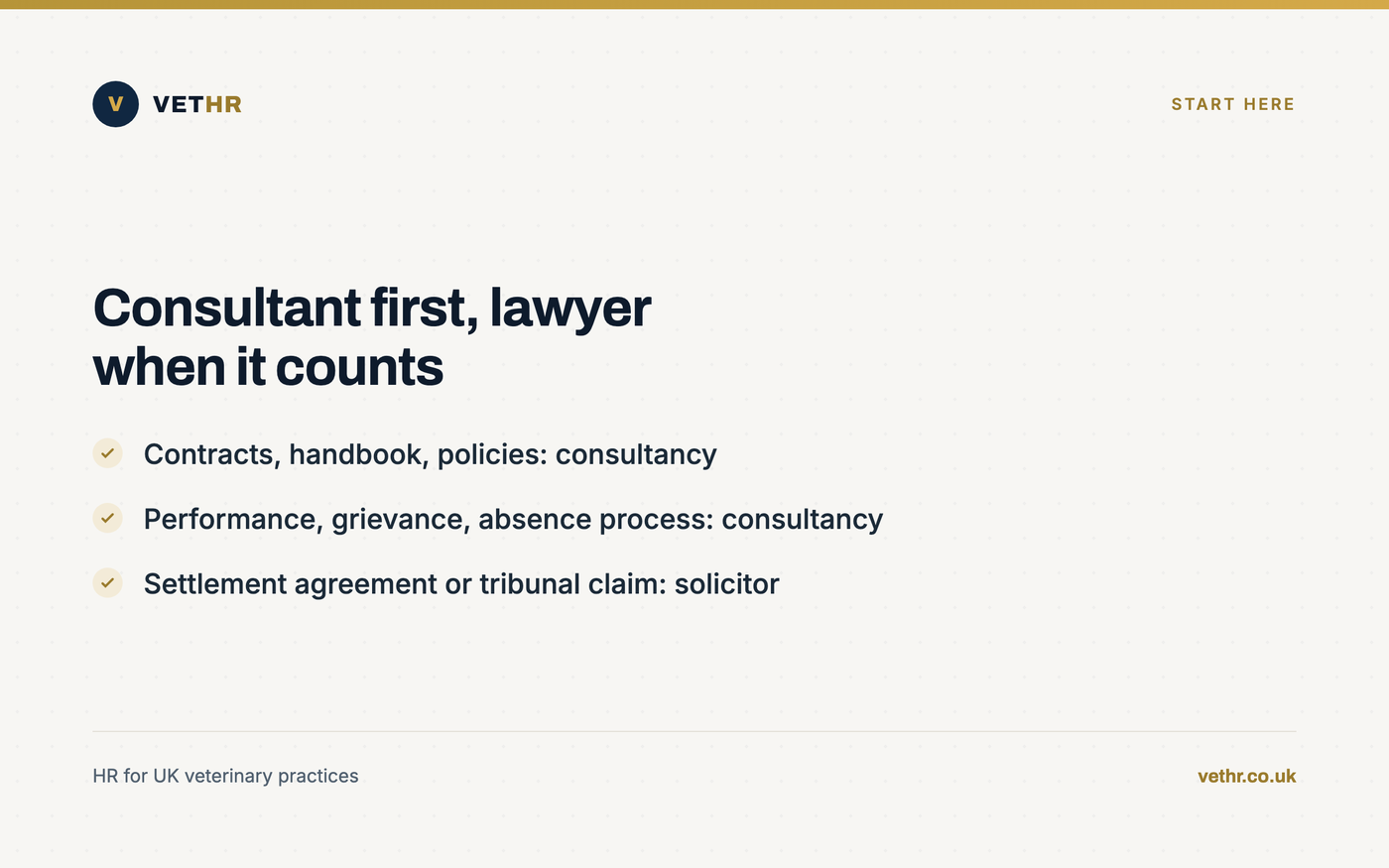
Three things. Give formal legal advice you can rely on, draft and advise on settlement agreements, and represent the practice in tribunal proceedings. Acas sets out that for a settlement agreement to be valid the worker must get advice from a relevant independent adviser, that adviser must be insured, and the agreement must name them, so a solicitor is unavoidable there.
Lawyers also earn their fee on genuinely novel or high-risk questions: a complex TUPE transfer, a discrimination allegation with real substance, a dismissal where the facts are contested and the stakes are large. That is legal risk, not process, and it deserves legal advice.
What a lawyer will not usually do is build your handbook, sit with your practice manager through an appraisal cycle, or notice that your rota is generating the grievances in the first place. Different job, different tool.
Use it, and use it early. Acas provides free, impartial advice to employers and employees, and its published guidance on discipline, grievance, absence and contracts is the reference point most tribunals will measure your conduct against.
What Acas cannot do is act for you. It is impartial by design, which means it will not draft your handbook, attend your hearing, or tell you what commercial risk to accept. Treat it as an authoritative second opinion rather than as a replacement for an HR consultant or a lawyer.
Acas also runs early conciliation, a required step before most tribunal claims proceed, and many disputes settle there for a fraction of the cost of a hearing.
Differently in shape, not just in size. Legal advice is usually charged by the hour or by the matter, so cost rises with the length of the problem. HR consultancy is more often a fixed-price project or a monthly retainer, so cost is predictable and the incentive is to prevent problems rather than to process them.
That difference matters most for the small stuff. A practice with a retainer asks the awkward question on day one, when it is still cheap to answer. A practice paying by the hour tends to wait, hope, and call once the situation has already become formal.
We quote per practice rather than publishing a price list, because a two-vet branch and a 40-person hospital do not have the same needs. Our guide to what HR consultancy costs a veterinary practice explains how the pricing is built.
The rule of thumb: if the question is about running a process well, start with an HR consultant. If the question is about legal exposure or representation, start with a lawyer. These seven cover most of what actually happens in practice.
Notice how many start with the HR consultant. Most of what damages a veterinary practice is procedural, and procedural problems are cheapest to fix before they acquire a legal shape.
More often than people expect, and the combination works best when roles are clear. The lawyer sets the boundary of acceptable legal risk. The HR consultant runs the process inside that boundary and produces the evidence the lawyer will eventually need.
Practically, that looks like this. The consultant gathers the file, drafts the correspondence and manages the meetings. The lawyer reviews the position at the decision points, advises on the exposure, and takes over if a claim is issued. Nobody pays solicitor rates for chasing a rota record.
The failure mode is the reverse: a practice that calls a lawyer for everything and ends up with excellent advice about a situation that better process would have prevented, or a practice that calls nobody until an employment tribunal claim lands.
Money, in a way that is easy to measure once you know where to look. The Acas Code of Practice on disciplinary and grievance procedures states that tribunals will be able to adjust any awards made in relevant cases by up to 25 per cent for unreasonable failure to comply with any provision of the Code.
A quarter of an award is a large number to lose because an invitation letter was never sent or an appeal was never offered. Running the Code properly is not legal work. It is administrative discipline, and it is exactly what an HR consultant is for.
The same discipline shortens legal bills later. A solicitor handed a complete file with dated letters, meeting notes and a documented appeal spends their hours on strategy. A solicitor handed a shoebox spends them on archaeology, at the same rate.
That is the practical case for keeping an HR consultant on retainer rather than calling one in a crisis: the file is being built before anyone needs it.
Not sure which one your situation needs? Tell us in a free 30-minute HR health check and we will say so plainly, including when the answer is a solicitor. Book your HR health check.
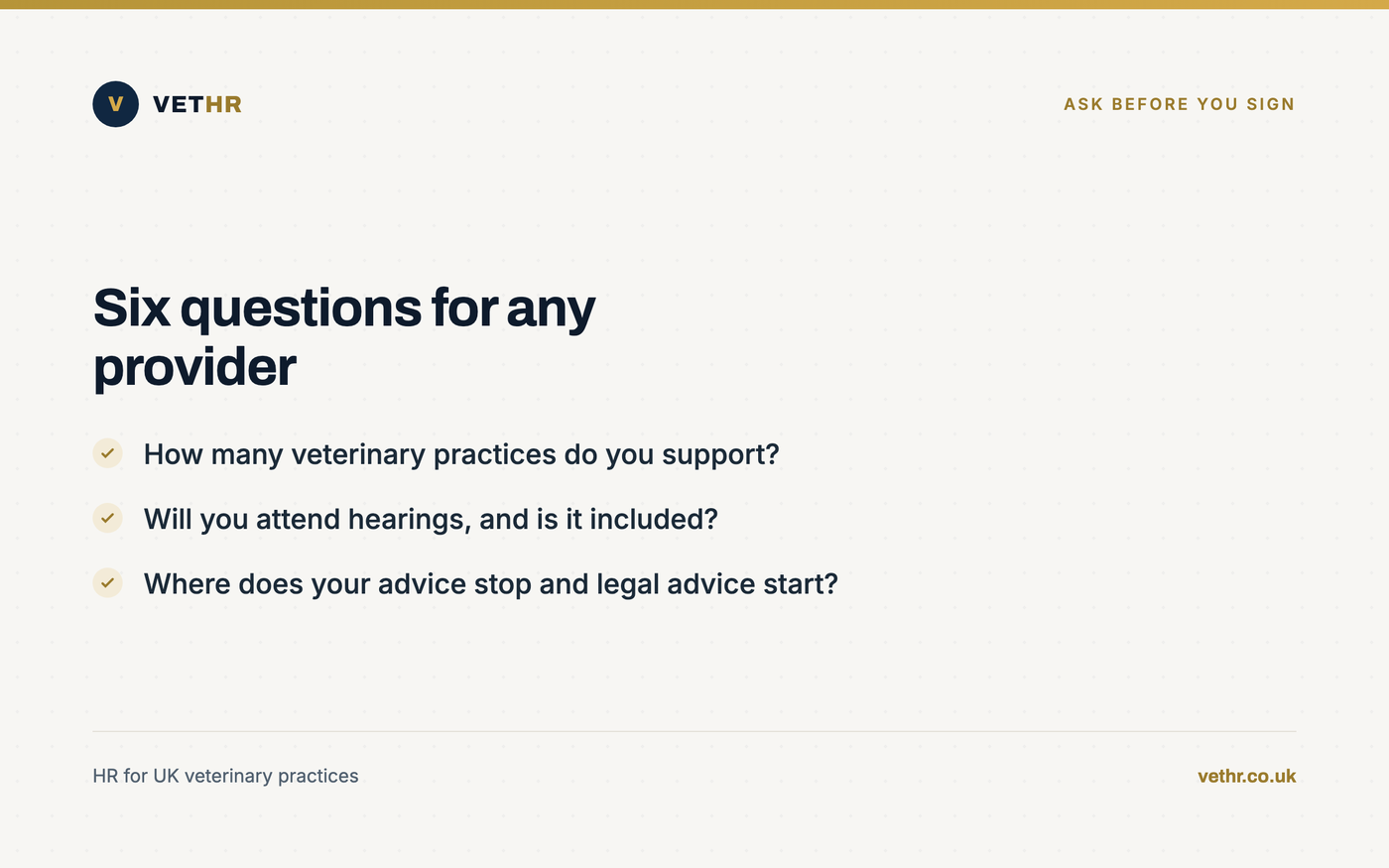
Ask harder questions than most practices do. Generic small business HR support will hand you a template handbook that says nothing about out of hours rotas, RVN registration, sole charge shifts or freelance vet cover, and you will spend your own time translating it.
That last question is the important one. An HR consultant who is clear about the boundary is a safer partner than one who is vague about it. Our guide to HR support options for veterinary practices compares the models side by side.
Representation at a hearing is work for a solicitor or barrister. What a consultant contributes is the file: contracts, process records, meeting notes and correspondence, assembled and ordered. That preparation reduces legal hours considerably, which is where the saving actually sits.
Legal professional privilege attaches to advice from qualified lawyers, not to HR consultancy. If a matter is genuinely contentious and you need privileged advice, take it from a solicitor. Being clear about that distinction early is part of what a good consultant does.
Employment law applies from the first employee, so the obligations are the same. What differs is capacity. A six-person practice has no HR department, so the choice is between the owner absorbing it between consults or buying a few hours of expertise a month.
It can cover payroll-adjacent basics well. Where it tends to thin out is the sector-specific and the situational: sole charge cover, out of hours rotas, RVN progression, and sitting with you through a grievance. Ask what is genuinely included before relying on it.
Keep it, and read the conditions. Many policies require you to follow the insurer’s advice line before acting, and can decline cover where a proper process was not followed. Insurance responds to disputes; an HR consultant is there to stop them arising.
The honest summary is that these are complementary rather than competing services. Practices that use an HR consultant continuously call a lawyer less often, and when they do call one, the file is ready and the bill is smaller.
We work exclusively with UK veterinary practices, through fixed-price consultancy or a monthly subscription, and we will tell you when something needs a solicitor rather than us. The free HR health check is 30 minutes and there is no obligation attached to it.
The Vet HR Team provides HR consultancy and white-labelled staff systems exclusively to UK veterinary practices. We are not a law firm and do not provide legal advice.
Contracts, rotas, holiday, a difficult conversation. Tell us what you are dealing with and we will come back within one working day. Nothing to sign up to.
Got it. We will come back to you within one working day. If you do not see a reply, please check your spam folder.
