Last updated: 31 August 2026
TL;DR: An employment tribunal claim costs a practice management time, legal fees, team morale and months of distraction, whatever the outcome. Tribunals received 50,000 single claims in 2025/26 and ended March 2026 with a 64,000 open caseload, so cases run long. Awards can be adjusted by up to 25% for unreasonable failure to follow the Acas Code.
Nobody plans for an employment tribunal claim. It arrives as an envelope on a Tuesday, usually from someone who left months ago, and it lands in the middle of a working week that was already full. This guide sets out what an employment tribunal claim actually costs a veterinary practice, and what reduces both the risk and the damage.
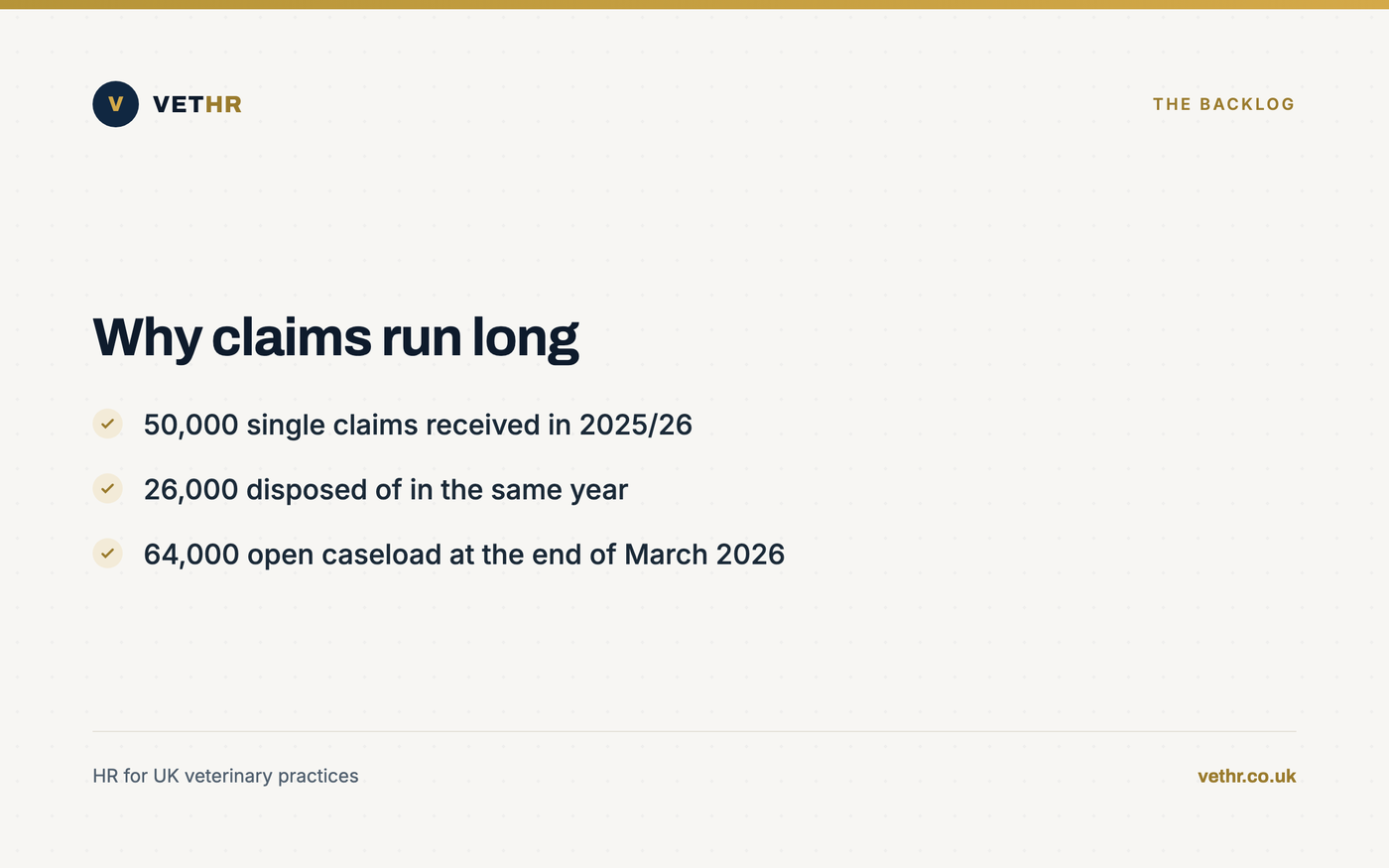
Common enough that the system cannot keep up. Ministry of Justice figures for 2025/26 record 50,000 single claim receipts against 26,000 disposals, leaving a 64,000 single claim open caseload at the end of March 2026.
Read those three numbers together. Claims are arriving at nearly twice the rate they are resolved, and the backlog is more than double a year’s throughput. Whatever the merits of any individual case, the system itself guarantees a long wait.
Veterinary practices are not unusually litigious workplaces. They are, however, small workplaces with close relationships, informal processes and very little management time, which is a combination that produces disputes when something goes wrong.
Longer than most owners expect, and the backlog above is why. A claim issued this autumn may not be heard for many months, during which the practice must preserve records, keep witnesses available, and carry the uncertainty through two budget cycles.
That duration is itself a cost. Staff who witnessed the events move on. Memories fade. The practice manager who ran the process leaves, taking the context with her, and what remains is whatever was written down at the time.
Which is the whole argument for contemporaneous records. An employment tribunal will weigh a dated note made at the time far more heavily than a recollection assembled 14 months later.
Only one of them is the award. Practices budget for the possible compensation and are then surprised by everything else, most of which is incurred whether they win or lose.
Costs 2 to 4 are the ones practices systematically undercount. A single hearing day can remove a vet, a nurse and the practice manager from the rota simultaneously, which for a small independent is close to a lost day of trading.
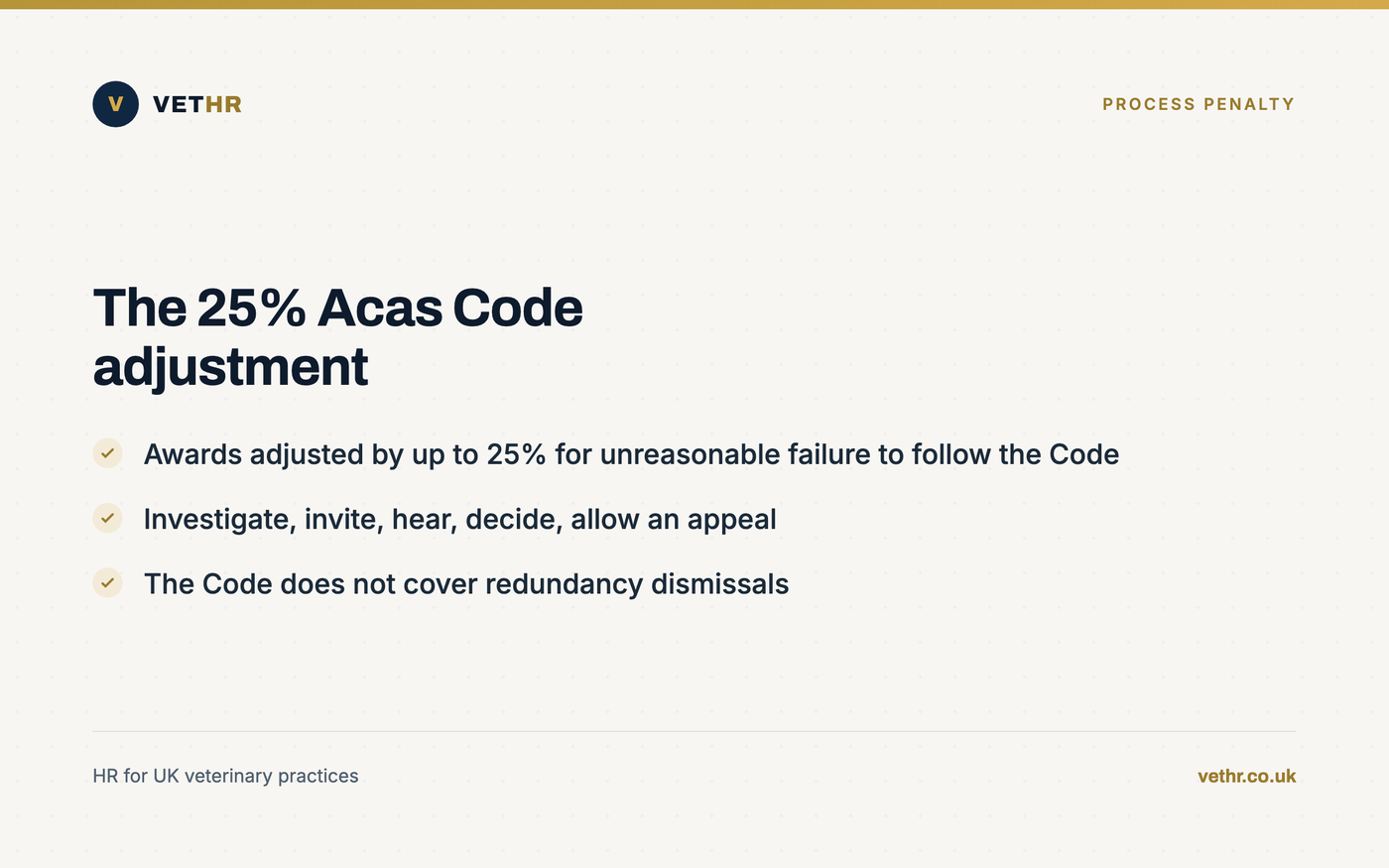
A penalty for poor process. The Acas Code of Practice on disciplinary and grievance procedures states that tribunals will be able to adjust any awards made in relevant cases by up to 25 per cent for unreasonable failure to comply with any provision of the Code.
It cuts both ways. An employee who unreasonably fails to follow the Code can see their award reduced by up to a quarter. But the practice is the party expected to run the process, so in practice the uplift is the risk that sits with the employer.
The Code does not apply to redundancy dismissals or the non-renewal of fixed-term contracts on expiry. For everything else, following it is the cheapest insurance a practice can buy: an investigation, a letter setting out the allegations, a hearing, the right to be accompanied, a decision and an appeal.
Our step-by-step guides to disciplinary procedures and handling a grievance follow that sequence for a practice-sized team.
Rarely a single dramatic event. Far more often a sequence: an informal warning nobody recorded, a rota change that felt punitive, a grievance answered verbally, and a dismissal that arrives without a documented process behind it.
Four patterns recur in small practices. Pay and hours disputes where the records do not match what people believed. Sickness absence handled inconsistently between team members. Requests for flexible working refused without a stated business reason. And harassment or bullying reports that were heard sympathetically but never written down.
Each of those is a documentation failure before it becomes an employment tribunal problem. That is encouraging, because documentation is fixable in an afternoon, while a claim is not.
Because the two-year buffer disappears. Acas confirms that from 1 January 2027, employees will have the right to claim unfair dismissal after 6 months and the limit on compensation for unfair dismissal will be removed.
For a veterinary practice this changes two things at once. The pool of people who can bring an unfair dismissal claim widens dramatically, and the ceiling on what such a claim can cost comes off. Employment tribunal exposure that was previously bounded becomes open ended.
The response is not to stop hiring or to stop managing performance. It is to make the process you already believe you follow visible in writing: a real probation review, notes from one to ones, and a documented reason whenever someone leaves.
Speed, honesty and a written trail. Most claims are brought by people who felt unheard rather than by people determined to litigate, so the single most effective prevention is answering a concern properly the first time it is raised, in writing, within days rather than weeks.
Four habits do most of the work in a small practice. Acknowledge every grievance in writing within 48 hours. Put the outcome of every informal conversation in a short note and copy it to the person. Never change someone’s hours, pay or duties without confirming it in writing. And run an exit conversation for every leaver, however amicable the departure appears.
None of that is legalistic. It is the same courtesy you would extend to a client whose treatment plan changed. The difference is that with staff, the confirmation gets skipped because everyone sees each other every day.
Practices that adopt those four habits report fewer disputes reaching a formal stage at all, which is the only genuinely cheap outcome an employment tribunal process offers. Our guide to return to work interviews shows the same principle applied to absence.
Worried a past dismissal was handled loosely? A free 30-minute HR health check will tell you where your exposure sits, confidentially. Book your HR health check.
Everything you would want in front of you if a claim arrived tomorrow, filed as you go rather than reconstructed later. For each member of staff, a practice should be able to produce the following within an hour.
Practices running digital staff records answer that list in minutes. Practices with three filing cabinets and a departed manager’s inbox usually cannot, and an employment tribunal draws its own conclusions from missing records.
Early conciliation through Acas is a required step before most claims proceed, and it is a genuine opportunity. Many disputes settle at that stage for a fraction of the cost of a hearing, and settling early is not an admission that the practice did anything wrong.
Rarely. Employment tribunal costs orders are exceptional rather than routine, so a practice that successfully defends a claim usually still carries its own legal fees, management time and cover costs. Winning is better than losing, but it is not free.
Many practices hold legal expenses cover, often bundled with other insurance. Check the conditions carefully. Policies frequently require you to take the insurer’s advice before acting and can decline cover where a proper process was not followed, which is another reason process discipline pays.
Sometimes, and it is a commercial decision rather than a moral one. Weigh the likely award against legal fees, lost clinical days and months of distraction. A settlement agreement reached early, with proper advice, is frequently the cheapest outcome available to a small practice.
Size does not change the law, but it does change capacity. Larger groups have HR departments to run processes correctly; an independent practice has an owner between consults. That is precisely the gap outsourced HR support exists to fill.
Almost every employment tribunal claim we hear about started as something small that was handled kindly but informally. The kindness was not the problem. The absence of a written record was, because two years later kindness leaves no evidence and the informal conversation may as well not have happened.
Good process protects everyone, including the person on the other side of the table. Our HR consultancy and monthly subscription give practices someone to call before the decision rather than after, and the free HR health check costs nothing but half an hour.
The Vet HR Team provides HR consultancy and white-labelled staff systems exclusively to UK veterinary practices. We are not a law firm, and defending a live claim requires legal advice.
Contracts, rotas, holiday, a difficult conversation. Tell us what you are dealing with and we will come back within one working day. Nothing to sign up to.
Got it. We will come back to you within one working day. If you do not see a reply, please check your spam folder.
