Last updated: 27 June 2026
TL;DR: Handling a grievance in a veterinary practice means following a fair, written process even when everyone knows everyone. Try the informal route first, then if it goes formal, follow the same five steps: raise, investigate, meet, decide, appeal. Keep it confidential, keep the decision-maker impartial, and follow the ACAS Code so the practice is protected and working relationships survive afterwards.
In a close-knit practice, a grievance feels personal before it feels procedural. The vet raising it shares a kettle with the nurse named in it. That closeness is exactly why a calm, consistent process matters, and why getting it right protects both the person and the team. Here is how to do it fairly.
A grievance is any concern, problem or complaint that a member of staff raises about their work, their treatment or a colleague. In a practice it might be a rota that always lands the worst shifts on one nurse, a comment that crossed a line, or a feeling of being overlooked for development. If someone is unhappy enough to raise it formally, it is a grievance.
The label matters less than the response. ACAS guidance defines a grievance broadly as problems or concerns that employees raise with their employers, and stresses that issues should be raised and dealt with promptly, without unreasonable delay to meetings or decisions, in the ACAS Code of Practice. In a small team, prompt also means before it festers over the lunch table.
What separates a practice from a large employer is proximity. There is no anonymous corridor to disappear into. The person complaining, the person complained about and the person deciding often work the same floor. That does not change the law. It just raises the bar on how carefully you handle the human side.
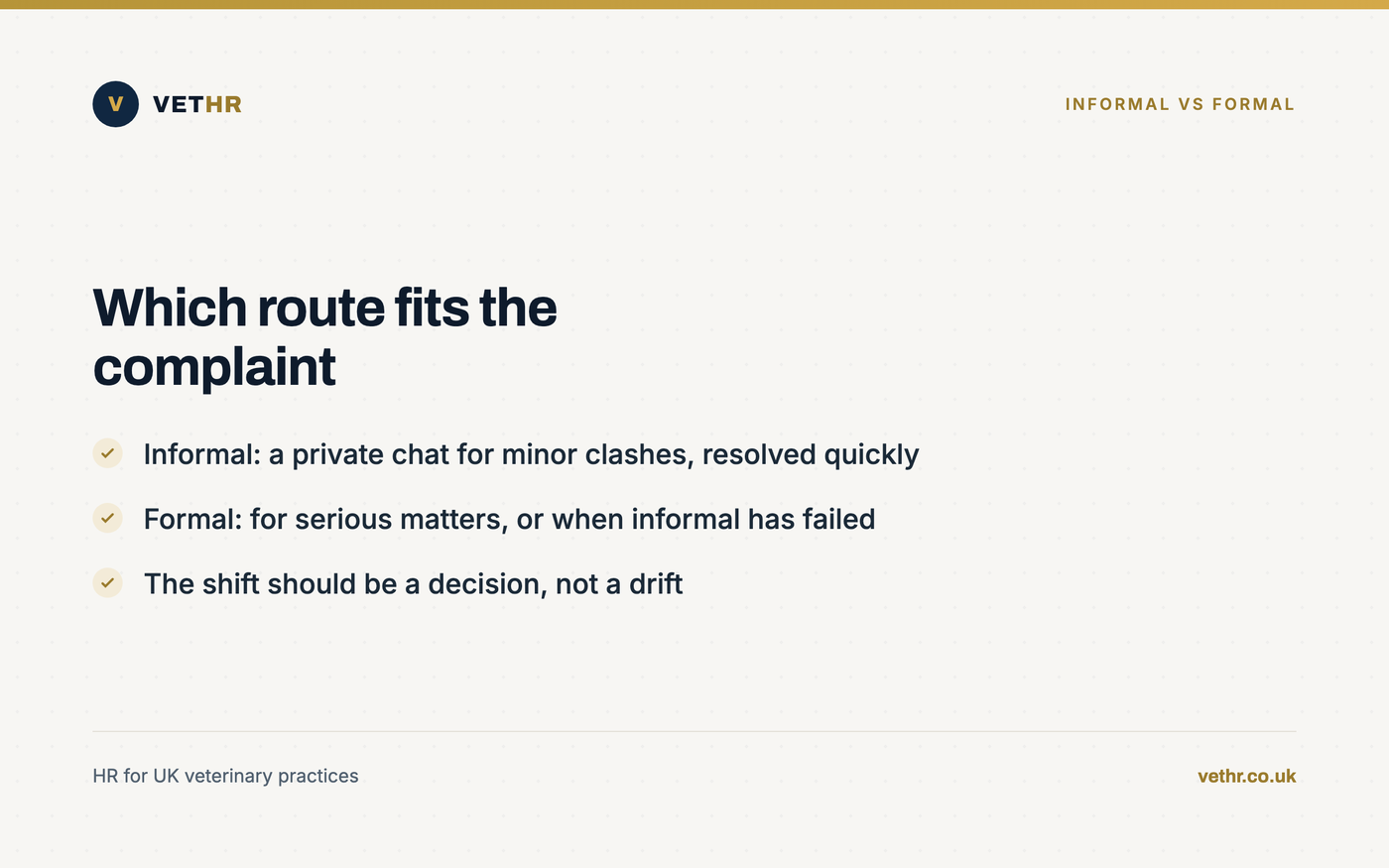
Try the informal route first whenever it is appropriate. Many concerns in a practice can be resolved by a quiet, honest conversation before anything is written down. ACAS recommends that where possible, issues are dealt with informally and quickly, reserving the formal procedure for when informal resolution has not worked or the matter is serious.
Informal does not mean casual. It means a private chat, a note of what was agreed, and a genuine attempt to fix the cause rather than silence the symptom. For a clash over shift swaps or a misread tone, that is often enough, and it keeps two colleagues working side by side without a paper trail hanging between them.
Go formal when the matter is serious, when the employee asks to, or when the informal attempt has failed. Serious means anything touching bullying, harassment, discrimination, safety or a breach of contract. At that point the written procedure protects everyone, because it gives the complaint a fair hearing and the practice a defensible record. The shift from kitchen-table to formal should be a decision, not a drift.
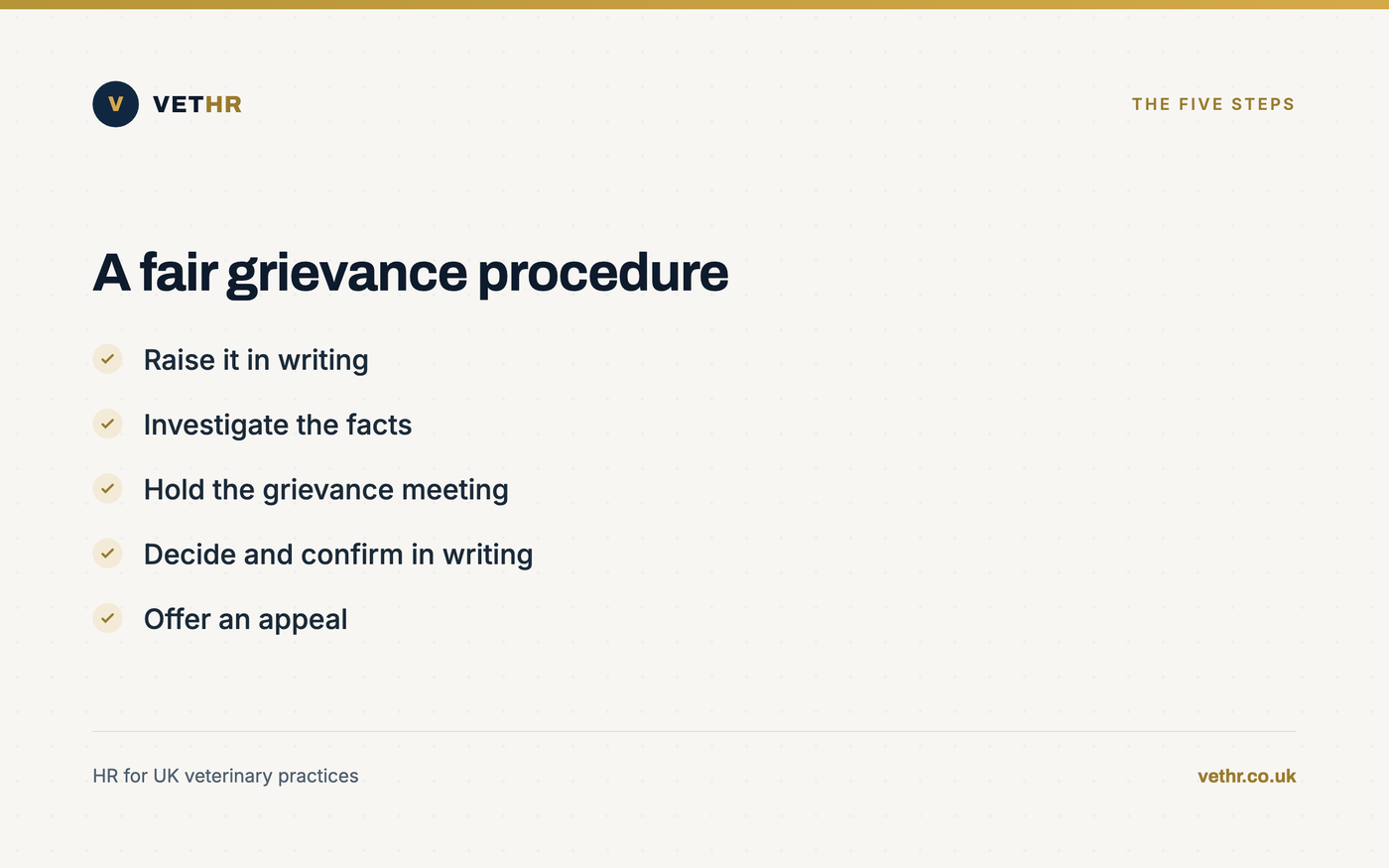
A fair veterinary grievance procedure follows five steps in order: raise, investigate, meet, decide, appeal. ACAS sets out this shape so that every grievance gets a consistent, full and fair hearing. The detail flexes to fit a small practice, but skipping a step is where employers come unstuck, so treat all five as load-bearing.
The grievance meeting carries one duty worth naming. Workers have a statutory right to be accompanied by a companion at a grievance meeting that concerns a duty owed by the employer, confirmed in the ACAS Code of Practice. That companion can be a fellow worker or a trade union representative. In a small practice this still applies, even if the only available colleague also knows everyone involved.
The appeal is not a formality either. GOV.UK guidance on handling a grievance confirms that an employee can appeal the decision if they are not happy with it, and that businesses should have a written grievance procedure in place, on its handling an employee grievance guidance. Wherever possible, a different person should hear the appeal, which is harder but not impossible in a small team.
You keep it confidential by sharing it strictly on a need-to-know basis and saying so out loud. Tell everyone involved that the matter stays private, store notes securely away from general staff files, and resist the corridor update. In a practice where news travels fast, your discipline about who knows what is the confidentiality.
Be honest about the limits. You cannot promise total secrecy, because investigating a complaint fairly usually means putting it to the person it concerns. What you can promise is that information goes no wider than the process requires, and that gossip is treated as a separate problem. Set that expectation at the very first conversation, before assumptions fill the gap.
Records help here more than people expect. A simple, dated log of who was told what and when, kept securely, protects both the complainant and the practice. It is the same principle behind structured HR policies and a clear grievance procedure: when the process is written down, you are not improvising confidentiality under pressure on a busy clinic day.
Worried your grievance process would not hold up if it were tested next week? A 30-minute conversation usually shows where the gaps are. Book a free HR health check and we will look at your current policies, your last tricky case and your records, then tell you honestly what to tighten. No jargon, nothing sold for the sake of it.
You stay impartial by separating the roles and naming your own bias. The person who investigates should ideally not be the person who decides, and neither should be directly caught up in the complaint. In a five-person practice that is genuinely hard, so the next best thing is to be transparent about the limits and lean on outside support.
Impartial does not mean pretending you have no relationship with either person. It means deciding on the evidence, not the friendship. Write down the facts you relied on and the reasoning that took you from facts to outcome. If you could not explain that reasoning to a stranger, it is not yet impartial enough to stand.
This is the moment many owners reach for help. Bringing in an outside specialist to investigate or hear the appeal removes the conflict that proximity creates, which is exactly why our HR consultancy and monthly support exist. To be clear, Vet HR provides HR consultancy and documentation support, not legal advice. For a binding legal opinion you need a solicitor; for a fair, defensible process you usually need a steady hand and a written procedure.
The ACAS Code of Practice on disciplinary and grievance procedures is the minimum standard a UK employer should follow when handling a grievance in a veterinary practice or anywhere else. It is not optional good manners. An employment tribunal will weigh whether you followed it, and that has a direct financial edge for the practice.
Here is the part that focuses minds. Tribunals can adjust any award made in a relevant case by up to 25 per cent for an unreasonable failure to comply with the Code, as stated plainly in the ACAS Code of Practice. Cut a corner on the process and a winnable case can cost you a quarter more than it should have.
The Code itself is short and humane. It asks employers to act promptly, act consistently, investigate properly, let the employee put their case, allow them to be accompanied, and give them a right of appeal. None of that is exotic. It is simply the difference between a process you can defend and a decision you made in the heat of a hard week.
You protect relationships by closing the loop deliberately rather than hoping it heals on its own. Once the outcome is confirmed, both people need to know where they stand, what changes, and that the matter is closed. In a close team, an unspoken ending is worse than a clear one, because everyone fills the silence with their own version.
Follow through on whatever you decided. If a rota changes, change it. If behaviour was addressed, check it has shifted. A grievance that is upheld and then ignored teaches the team that raising things is pointless, and the next complaint goes underground instead of through your process. The outcome only counts if the practice acts on it.
Where feelings are still raw, a facilitated conversation or a short period of practical separation on the rota can give people room to settle. Keep an eye on the whole team, not just the two involved, because a grievance handled badly ripples outward. Handled well, the process can actually build trust: people see that concerns are taken seriously and dealt with fairly.
Yes. The ACAS Code of Practice applies regardless of how small the team is. There is no exemption for close-knit practices. A tribunal can adjust an award by up to 25 per cent for unreasonable failure to follow it, so the process protects you as much as the employee. Size changes how you handle the human side, not whether the rules apply.
Ideally not, because separating the roles keeps the process impartial. In a very small practice it is not always possible, so the next best step is transparency about the limits and, where you can, bringing in an outside specialist to investigate or hear the appeal. The aim is a decision based on evidence rather than friendship.
Workers have a statutory right to be accompanied at a grievance meeting that concerns a duty owed to them by the employer. The companion can be a fellow worker or a trade union representative. This right still applies in a small practice, even when the only available colleague also knows everyone involved in the case.
This is where proximity bites hardest, because the person complained about may be the one who would normally decide. The fair answer is to bring in someone independent to investigate and hear it, so the employee gets a genuine hearing. An outside HR specialist or a different partner can hold that role and keep the process credible.
No. Vet HR provides HR consultancy and documentation support to UK veterinary practices, not legal advice. We help you run a fair, defensible grievance process, write the policies behind it and stand alongside you on tricky cases. For a binding legal opinion on a specific dispute, you should also take advice from a qualified solicitor.
A grievance in a close team is never just paperwork, but the paperwork is what keeps it fair. Try informal first, follow the five steps when you go formal, keep it confidential, stay honest about impartiality, and follow the ACAS Code so the practice is protected. Do that and most grievances end with the team stronger, not split.
If you want a process you can trust on your worst week, start with the foundations. Browse our staff systems, see how we work in HR consultancy, or simply book a free HR health check and we will give you a straight read on where your grievance process stands today. Nothing sold that you do not need.
The Vet HR Team provides HR consultancy and white-labelled staff systems exclusively to UK veterinary practices.
Read next: Workplace Mediation in a Veterinary Practice.
Contracts, rotas, holiday, a difficult conversation. Tell us what you are dealing with and we will come back within one working day. Nothing to sign up to.
Got it. We will come back to you within one working day. If you do not see a reply, please check your spam folder.
