Last updated: 6 July 2026
TL;DR: A return to work interview is a short, private conversation with a staff member on their first day back after sickness absence. Run well, it confirms they are ready, surfaces anything the practice should adjust, and creates a fair dated record. Run badly, it feels like an interrogation and people stop being honest. This guide covers why the conversation matters, how to run it, what to record, the patterns to watch for and how a phased return works.
A nurse comes back after three days off and the shift simply swallows her. No conversation, no note, no idea whether she is actually well. This guide is about the ten minutes that should happen instead, and how to make them feel like support rather than scrutiny.
A return to work interview is a brief, informal, private conversation between a manager and a staff member on the day they come back from sickness absence. It checks the person is well enough to work, catches up on anything they missed, agrees any support or adjustments, and produces a short dated record. It is a welfare conversation with a paper trail, not a disciplinary step.
It is also not a legal obligation. Acas is explicit that it is not a legal requirement to have a return to work meeting, in its guidance on returning to work after absence. Practices run them anyway because they work: absence gets acknowledged instead of ignored, problems surface early, and every absence is treated the same way regardless of who was off.
The word interview does the process no favours. In practice it is ten minutes with a cup of tea in the office, not a panel across a desk. Some practices call it a return to work chat or a check-in, and that framing is closer to the point.
The conversation matters because a veterinary practice runs on a small, tightly rostered team, so one absence stretches everyone and an unmanaged return stretches them again. It confirms the person is genuinely ready, protects them from walking straight back into a full consult list, and tells the practice whether the absence points at something bigger.
Think about what a first day back looks like in a clinic. Full waiting room, a surgical list, an OOH handover, and a colleague who may still be at half strength. Without a conversation, the only signal a manager gets is whether the person turned up. With one, you learn whether they can lift, stand for a full theatre list, or face a difficult euthanasia consult that day.
There is a money angle too. Statutory Sick Pay is up to £123.25 per week and is paid by the employer for up to 28 weeks, according to GOV.UK guidance on Statutory Sick Pay. Absence that drifts or repeats is a direct cost, before you count the freelance vet cover booked to fill the gap. A consistent return conversation is the cheapest absence management tool a practice has.
And it matters for fairness. When only some absences get a conversation, staff notice. When every absence gets the same calm ten minutes, nobody feels singled out and the record shows it.
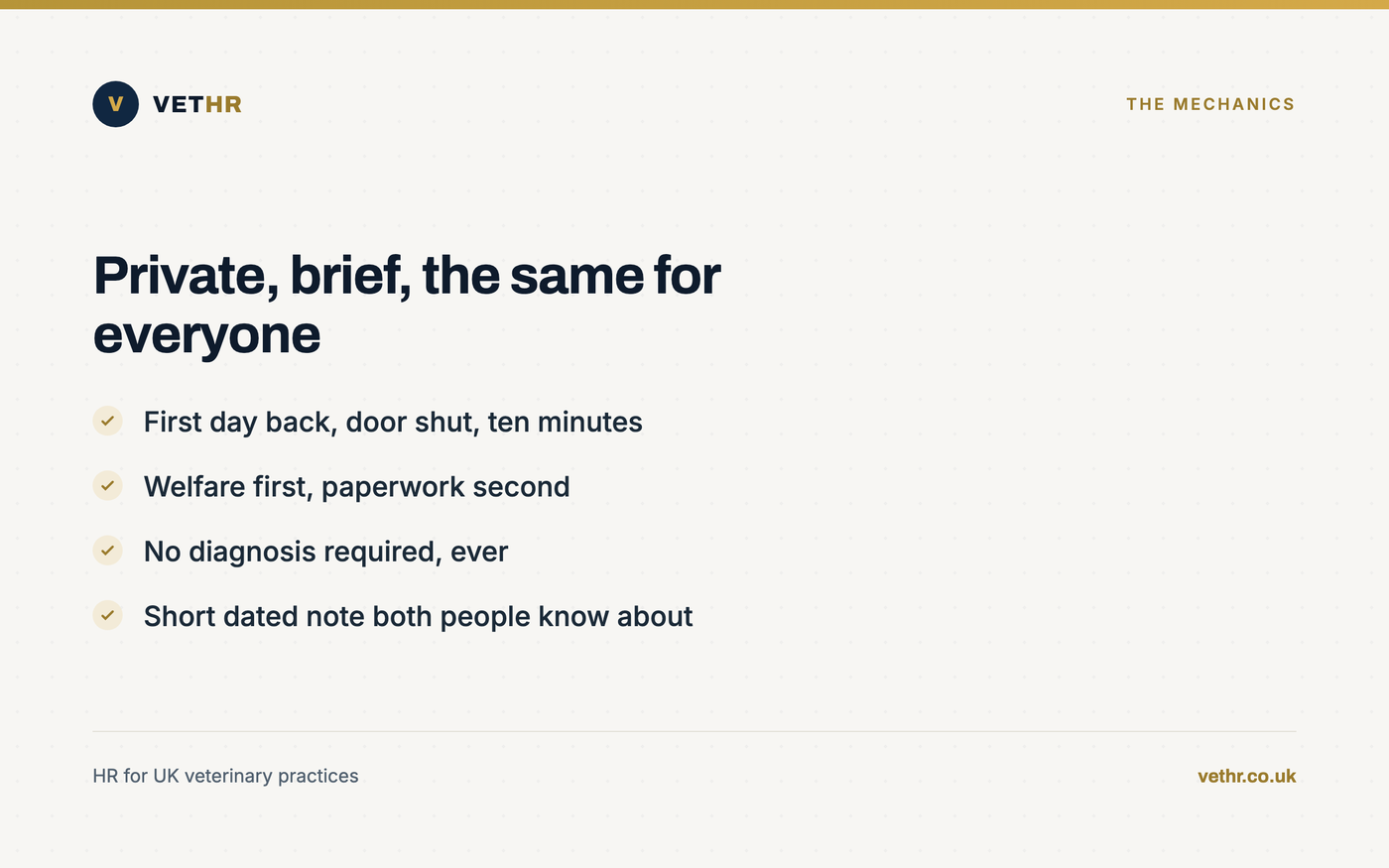
Hold the conversation on the first day back, in private, and open with welfare rather than paperwork. Ask how they are, whether they are ready to be back, and what would help. Let them lead on detail. The tone you want is a colleague checking in, not a manager checking up.
Privacy is the first mechanic. Acas guidance says the chat should be private and confidential, whether it is face to face or online. In a practice that means the office with the door shut, not the prep room mid-morning. It also means agreeing what, if anything, colleagues are told about the reason for absence.
The second mechanic is restraint. The employee does not have to disclose their medical history, and Acas notes an employee does not have to tell their employer anything. You need enough to support them safely, not a diagnosis. If someone says personal reasons, take it and move on to what support looks like.
A simple shape that works:
Keep it to ten or fifteen minutes. If the conversation uncovers something heavier, such as work-related stress or a long-term condition, book a separate, longer conversation rather than forcing it into the first morning back.
Not sure your absence process would hold up if someone challenged it? Book a free HR health check and we will walk through how your practice handles absence and returns today, what a fair record looks like, and where the gaps are. Thirty minutes, plain answers, nothing sold for the sake of it.
Record the essentials, factually and briefly: the dates of absence, the reason as the employee gave it, whether a fit note or self-certification covers it, anything agreed such as adjusted duties or a phased return, and the date of the conversation. Both people should know the note exists. Keep it in the personnel file, visible only to those who need it.
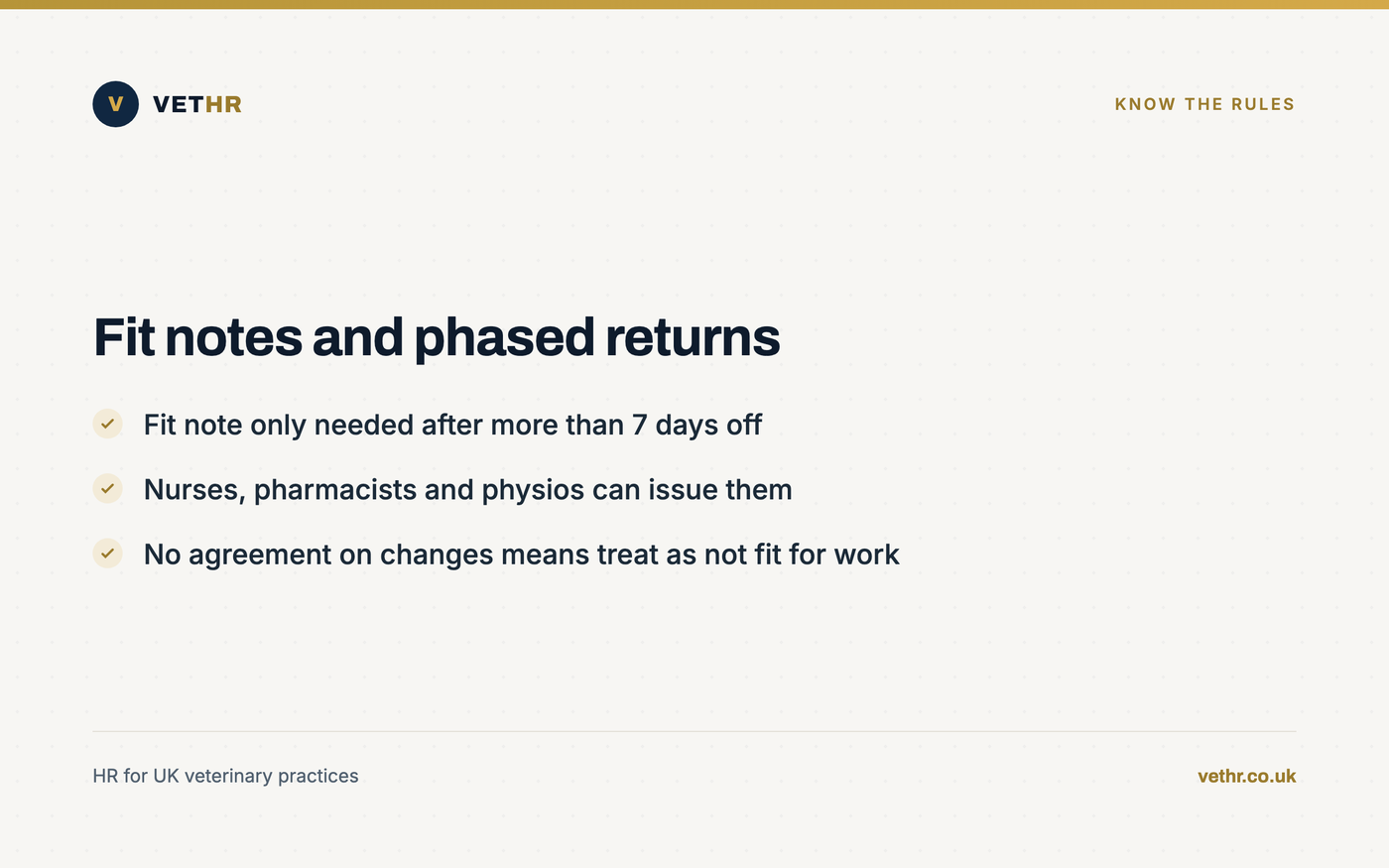
The fit note question is where practices most often guess. Under GOV.UK guidance on taking sick leave, an employee only needs a fit note if they are off sick for more than 7 days, including non-working days. Seven days or fewer is covered by self-certification, in whatever form you and the employee have agreed. Your record should show which applies.
Worth knowing: fit notes are no longer only a GP’s job. GOV.UK lists a GP or hospital doctor, a registered nurse, an occupational therapist, a pharmacist and a physiotherapist as able to issue them. So a note signed by a physiotherapist is as valid as one from the surgery.
Confidentiality is the other half of recording. The reason for absence is sensitive information. It belongs in the personnel file, not in the rota notes, the practice WhatsApp or the tea room. A written absence policy should say who records what, where it lives and who can see it. If your practice does not have one, our HR policies for veterinary practices cover absence and return to work as standard documents, written for clinics rather than adapted from an office template.
Watch for frequency, shape and clustering: short absences that recur, absences that always touch the same day or shift, and absences that follow the same trigger such as a rota change or a particular duty. One episode is life. A pattern is information, and the return conversation is where it gets noticed early and kindly.
The point of spotting a pattern is to understand it, not to ambush someone with it. Raise it plainly and kindly: you have had four short absences since March, is there something going on that we can help with? Often the answer is a fixable rota or workload issue you would never have heard about otherwise.
Patterns also only show up if the conversations are consistent and written down. Ad hoc chats with no record cannot reveal a trend. This is the same discipline covered in our guide to managing sickness absence in a veterinary practice, which sits one step upstream of this one.
A phased return is a temporary, agreed arrangement where someone comes back on reduced hours or lighter duties and builds up to their normal role over a set period. It is planned at or before the return conversation, reviewed weekly, and given an end date. Acas guidance names a phased return as one of the options to agree at a return to work meeting.
The fit note often starts the discussion. A clinician can mark a fit note may be fit for work with suggested changes. GOV.UK says employers should discuss changes that might help the employee return, such as different hours or tasks, and that if no agreement is reached the employee must be treated as not fit for work. That last point matters: a phased return is an agreement, not an instruction.
In a clinic, phasing is concrete. A vet might come back to consults but no surgery for two weeks. An RVN might do shorter shifts with no lone OOH duty. A receptionist recovering from surgery might sit rather than stand and skip the busiest sessions. Write down what was agreed, when it will be reviewed and when normal duties resume, and check in each week rather than assuming the plan is working.
For longer absences the stakes rise. GOV.UK treats absence of more than 4 weeks as long-term, and expects employers to consider options like flexible working, part-time hours or different duties before anything more serious is contemplated. A well-run phased return is usually how a long absence ends well.
No. Acas states that a return to work meeting is not a legal requirement. It is good practice: it confirms the person is ready, surfaces support needs, and creates a dated record that protects both sides. Most practices make it a standard step in their absence policy so every absence is handled the same way.
No. GOV.UK guidance says an employee only needs a fit note if they are off sick for more than 7 days, including non-working days. Absences of seven days or fewer are covered by self-certification in the form you have agreed. A fit note can be issued by a doctor, registered nurse, occupational therapist, pharmacist or physiotherapist.
Avoid anything that demands medical detail. The employee does not have to disclose a diagnosis, and Acas is clear they do not have to tell you anything. Ask whether they are well enough to work and what support would help, not what exactly was wrong. Never discuss the reason for absence in front of colleagues.
Yes, briefly. A two-minute version of the same conversation keeps the process consistent, which is what makes it fair. It also means patterns of short absences become visible early. If only long absences get a conversation, frequent one-day absences, often the more disruptive kind for a rota, go unexamined.
A phased return is agreed between the employer and the employee, often prompted by a fit note marked may be fit for work. You can decline specific suggested changes if they genuinely cannot work in your practice, but GOV.UK says that without an agreement the employee must be treated as not fit for work, so refusal has consequences worth thinking through.
The return conversation is ten calm minutes that most practices skip and then pay for later, in patterns nobody spotted, adjustments nobody agreed and records nobody kept. It costs almost nothing to run well. The whole method is tone plus consistency: kind in the room, identical for everyone, written down afterwards.
If you want the process on paper, our HR policies for veterinary practices include absence and return to work documents written for clinics. For the wider picture, read our guide to managing sickness absence in a veterinary practice. Or start with a conversation of your own: book a free HR health check and we will tell you, plainly, whether your current approach would stand up.
The Vet HR Team provides HR consultancy and white-labelled staff systems exclusively to UK veterinary practices.
Read next: Statutory Sick Pay for Veterinary Staff.
Contracts, rotas, holiday, a difficult conversation. Tell us what you are dealing with and we will come back within one working day. Nothing to sign up to.
Got it. We will come back to you within one working day. If you do not see a reply, please check your spam folder.
