Last updated: 5 September 2026
TL;DR: A staff handbook collects your practice policies in one place and is normally kept non-contractual so you can update it without varying every contract. It sits alongside the written statement of employment particulars, which is a legal requirement due on the first day. Twelve sections cover most veterinary practices.
Ask a practice manager where the sickness reporting rule lives and you get one of three answers. In the contract. In an email from 2021. In someone’s head. A staff handbook is what turns those three answers into one, and it is the single cheapest piece of HR infrastructure a practice can build.
A staff handbook is the collected set of policies telling your team how the practice runs. The handbook itself is not legally required, but much of what goes in it is, and the document it supports absolutely is.
Every employee and worker must get a written statement of employment particulars. GOV.UK confirms the principal statement is due on the first day, with the wider written statement within 2 months of the start of employment.
That statement must cover pay, hours, holiday entitlement, place of work, probation, training provision and more. Some items, including sick pay, notice, pension and disciplinary and grievance procedures, may be supplied in a separate accessible document, and the handbook is exactly that document.
So the honest answer is that a practice without a handbook is not automatically breaking the law, but it is almost certainly failing to give staff information it is required to give them somewhere.
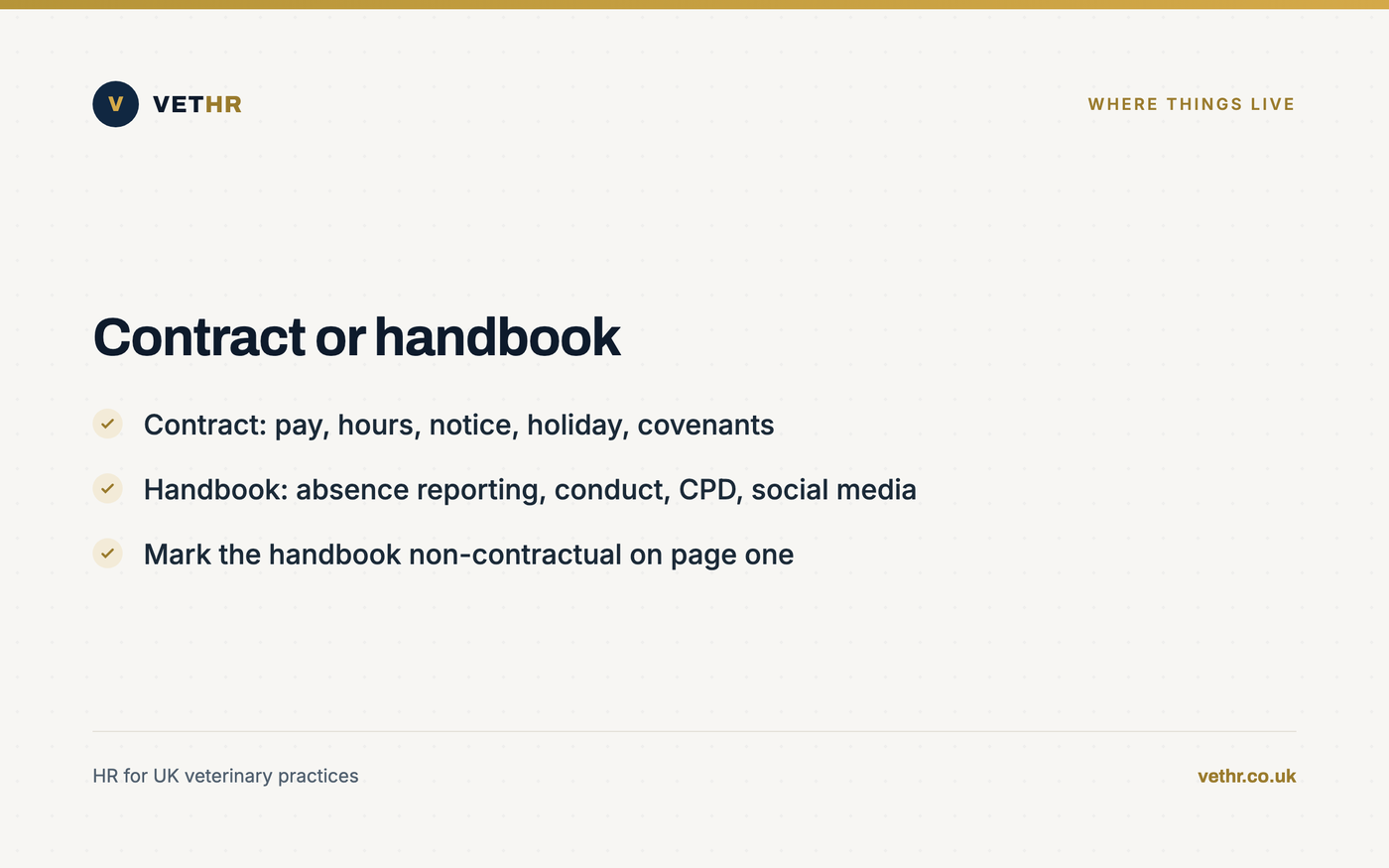
Contractual terms go in the contract. Everything you may want to change without asking every employee to agree goes in the staff handbook, marked clearly as non-contractual. That single line is the whole reason the handbook exists as a separate document.
Get this wrong and an enhanced sick pay scheme you meant to be discretionary becomes a term you cannot withdraw. Get it right and you can update your absence reporting rule in an afternoon. Our guide to employment contracts for veterinary staff covers the contractual half.
State the position explicitly on the first page of the handbook. A document that says nothing about its own status invites the argument that everything in it is binding.
These twelve staff handbook sections cover the ground for a typical independent or small group practice. Each should be short enough to read in a couple of minutes and specific enough that two managers reach the same decision.
Two of those twelve carry extra weight. The Acas Code of Practice on disciplinary and grievance procedures sets out the minimum an employer should follow for handling these issues at work, and Acas is clear that the procedure an employer follows will be taken into account if a case reaches an employment tribunal. Your staff handbook is where that procedure lives.
Twelve is a target, not a rule. A single site practice of eight people can run a very good handbook of twenty pages, and a three site group will need more on branch working and delegation. Our policy library is built around this structure.
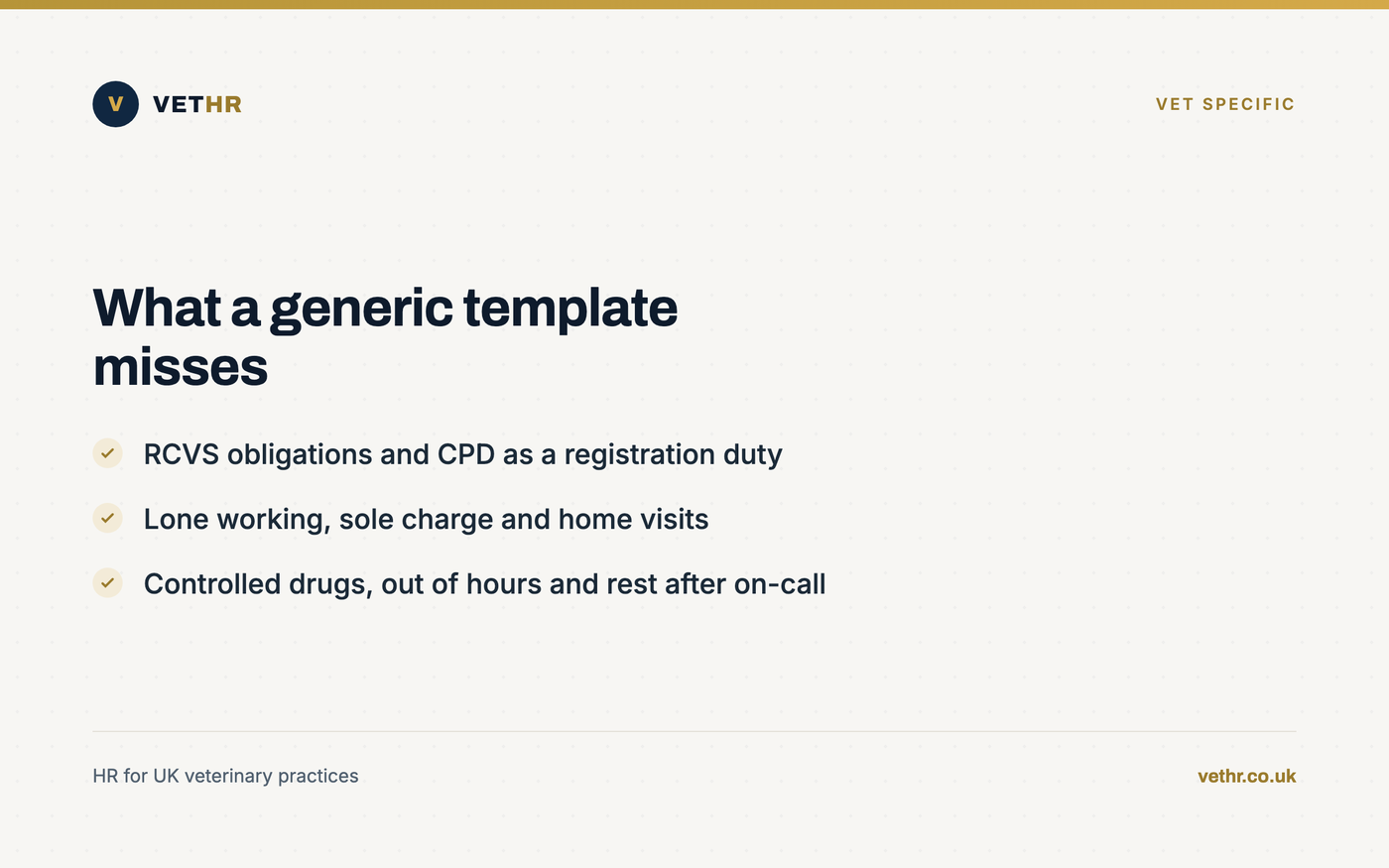
Four things that a generic staff handbook template will not contain, and they are the four that matter most when something goes wrong in a practice rather than in an office.
Add euthanasia and client aggression to the staff handbook wellbeing section. These are ordinary features of veterinary work, and a handbook that treats staff support as a line about an employee assistance programme misses what actually wears people down.
Cross reference rather than repeat. Your lone working arrangements and social media policy can live as their own documents with a paragraph in the handbook pointing at them.
By recording who received which version and when. A staff handbook that nobody can prove was issued is worth very little at a disciplinary hearing, and a printed folder in the staff room proves nothing about any individual.
This is where digital systems earn their place. Our digital onboarding approach exists so that acknowledgements are captured automatically rather than chased by a practice manager in February.
Handbook last updated before 2024? A free 30-minute HR health check will tell you what has changed since. Book your HR health check.
Once a year as a minimum, plus whenever the law moves. Employment law has changed substantially in recent years, and a staff handbook written before those reforms will be quietly wrong in several places at once.
Diary the review for the same month every year, ideally just after April when statutory rates change. Assign it to a named person, because an annual task owned by everyone is owned by nobody and resurfaces two years later during a tribunal claim.
Keep the review light. A full rewrite every year produces a handbook nobody re-reads, whereas a short annual pass that updates statutory figures, checks the four most used sections and records a new version number takes a morning and keeps the document credible.
Trigger an out of cycle review whenever you have used a policy in anger. The disciplinary procedure you have just run, the grievance you have just heard and the absence you have just managed will all show you exactly which paragraph was ambiguous. Our HR compliance checklist covers what to look at each year.
The handbook itself is not, but the written statement of employment particulars is, and it is due on the first day of employment. Several items, including sick pay, notice, pension and disciplinary and grievance procedures, may be provided in a separate accessible document, which is what a handbook is for.
Non-contractual for most practices, stated explicitly on the first page. That lets you update policies without seeking each employee’s agreement to a contract variation. Genuinely contractual terms such as pay, hours and notice belong in the contract itself rather than in the handbook.
As a skeleton, sometimes. As a finished document, no. Generic handbooks omit professional regulation, controlled drugs, lone working, out of hours and clinical incident reporting, and they often contain outdated statutory references that make the whole document look unreliable.
Long enough to answer the questions staff actually ask and short enough that they will look. Twenty to forty pages suits most independent practices. Length is less important than structure: clear headings, plain language and a contents page beat a comprehensive document nobody can navigate.
Yes. Workers as well as employees are entitled to a written statement, and bank staff are often the people least clear on absence reporting and incident procedures because they are in the building least often. Issue it at induction and record the acknowledgement in the same way.
A staff handbook does not prevent problems. What it does is make the answer the same whoever is asked and whenever they are asked, which in a practice of twenty people covering seven days is worth more than any single policy in it.
Write the staff handbook once, mark it non-contractual, issue it with acknowledgements and review it every April. If yours is a folder nobody has opened since the last practice manager left, our policy library and HR consultancy will rebuild it, and the free HR health check will tell you what is missing first.
The Vet HR Team provides HR consultancy and white-labelled staff systems exclusively to UK veterinary practices. Policy content should be checked against current GOV.UK and Acas guidance at each review.
Read next: The Veterinary Staff Handbook.
Contracts, rotas, holiday, a difficult conversation. Tell us what you are dealing with and we will come back within one working day. Nothing to sign up to.
Got it. We will come back to you within one working day. If you do not see a reply, please check your spam folder.
