Last updated: 6 July 2026
TL;DR: A veterinary staff handbook collects the working rules of the practice in one place: conduct, absence reporting, health and safety, disciplinary and grievance routes and more. It sits alongside the employment contract and is usually kept non-contractual, so it can be updated without renegotiating terms. This guide covers what a handbook is for, the nine core sections for a vet practice, what to leave out, and why a hosted, acknowledged policy library beats a PDF.
Every practice already has a handbook of sorts. It is just scattered across email threads, a shared drive and whatever the last practice manager left behind. This guide explains what a proper veterinary staff handbook is for, what goes in it, what stays out, and how to stop it going stale the month after you write it.
A veterinary staff handbook is the single document that sets out how your practice runs day to day: conduct, absence reporting, health and safety, grievance routes and the rest. It sits alongside the employment contract, turns your policies into plain rules everyone can find, and gives new starters one place to learn how the practice actually works.
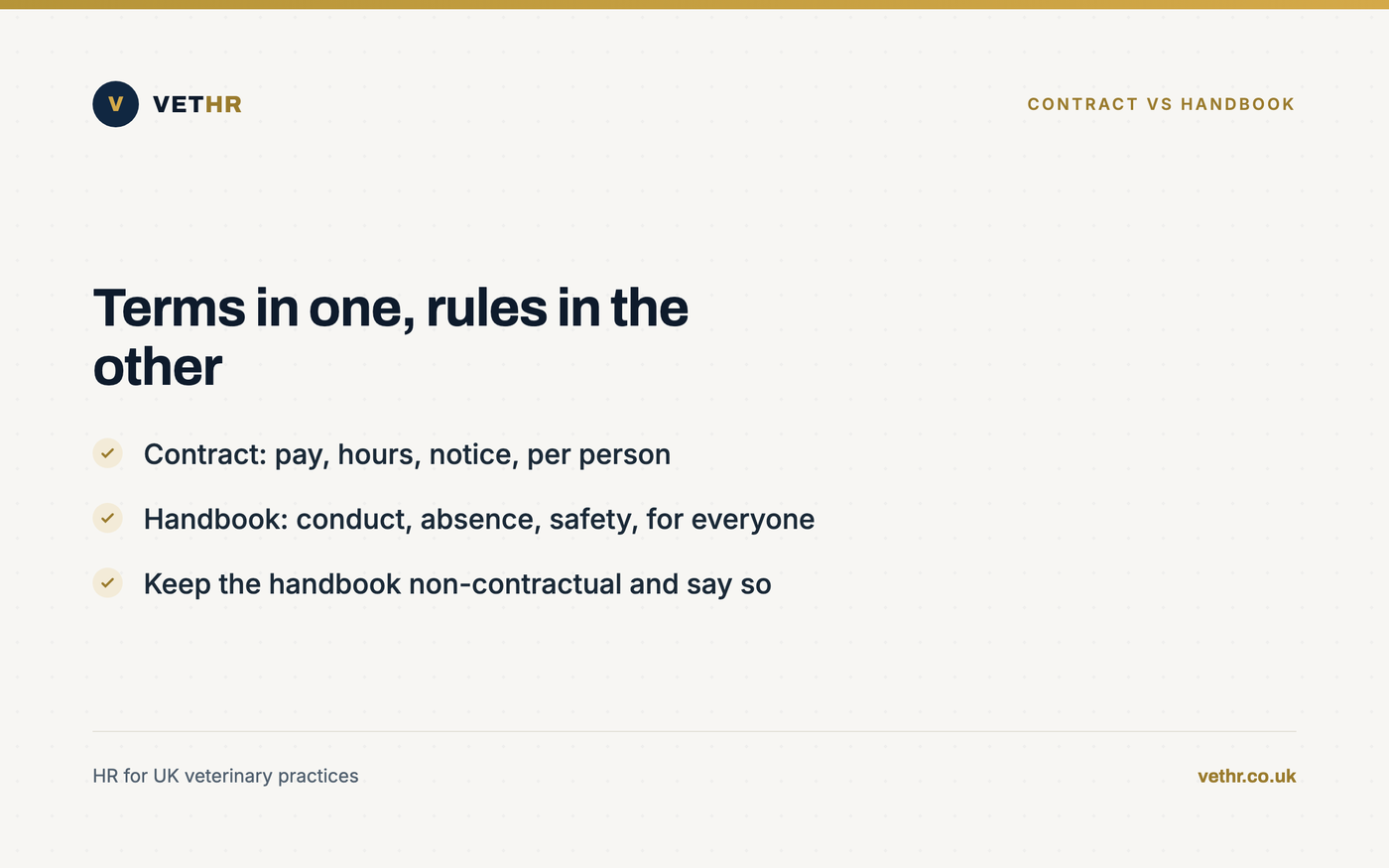
The simplest way to think about it: the contract says what each person has agreed to, and the handbook says how the practice operates for everyone. Pay, hours and notice belong to the individual. Sickness reporting, phone use in consults and what happens when someone raises a grievance are the same for the whole team, so they live in one shared document.
Consistency is the quiet payoff. When the rules are written down and findable, the RVN, the receptionist and the new graduate vet are held to the same standard, and a manager under pressure does not have to improvise. A rule applied from memory drifts. A rule applied from the page does not.
The handbook also earns its keep on the bad day. When a dispute arises, the first questions are what the rule was and whether the person could reasonably have known it. A current handbook that staff have acknowledged answers both. A folder of half-remembered policies answers neither.
Usually not, and usually on purpose. Most practices keep the handbook non-contractual so policies can be updated without renegotiating every contract. The contract holds the individual terms such as pay, hours and notice. The handbook holds the working rules. Whether a specific policy is contractual depends on its wording and how it is incorporated, so the drafting matters.
The line is easy to blur by accident. Acas guidance on employment contracts notes that contract terms can arise through conversations, letters and emails, and through conduct, and that a contract can include an organisation’s code of conduct and policies. A handbook that reads like a promise can become one. A clear statement that the handbook is non-contractual, and careful wording throughout, keeps the flexibility you wrote it for.
Some content sits in a required document of its own. Employees and workers must receive a written statement of the main terms on the first day of employment, and a wider written statement within 2 months covering, among other things, disciplinary and grievance procedures, according to GOV.UK guidance on the written statement of employment particulars. Some of that information can be provided in a separate document the employee has reasonable access to. In practice, that separate document is the handbook, which is exactly why it needs to be current and findable.
If your contracts and your handbook were written years apart, by different people, they will contradict each other somewhere. Our veterinary contracts service gets the two documents saying the same thing, with the terms in the contract and the rules in the handbook.
A veterinary staff handbook needs nine core sections: an introduction to the practice, working patterns, absence and leave, pay administration, conduct and standards, disciplinary and grievance procedures, health and safety, equality and dignity at work, and confidentiality and data protection. Each one should be short, specific to your practice and written in plain English.
Health and safety carries a legal weight of its own. If you have five or more employees you must have a written health and safety policy, according to HSE guidance on preparing a health and safety policy. Almost every practice crosses that threshold, and a clinic has hazards a generic office policy never mentions.
Be clear about scope. Most policies apply to employed staff. Some, such as health and safety and confidentiality, should extend to anyone working in the building, including students on placement and freelance vet cover. Say so explicitly rather than leaving it to be inferred.
Leave out anything individual, anything copied wholesale from legislation, and anything you do not actually do. Individual terms belong in the contract. Recited law goes stale the day the law changes. And a written policy you do not follow is worse than no policy, because it documents the gap between what you say and what you do.
Individual terms first. Pay rates, personal working hours, notice periods and anything negotiated per person sit in the contract and the written statement, not the handbook. Putting them in a shared document invites comparison at best and a contractual argument at worst.
Recited legislation second. You do not need three pages summarising employment law. You need one paragraph saying what someone in your practice should do, with a link to the current official guidance for anyone who wants the detail. The law can move. Your handbook should point at it, not restate it.
Aspirational policies last. If the handbook says every incident gets a written review within a week and none ever has, the handbook is now evidence against you. Write down the standard you genuinely run, then raise it deliberately when you are ready to hold it.
Not sure whether your handbook would survive contact with a real dispute? Book a free HR health check. In 30 minutes we will look at what you have, where it contradicts your contracts, and which gaps actually matter for a practice your size. Straight answers, nothing sold for the sake of it.
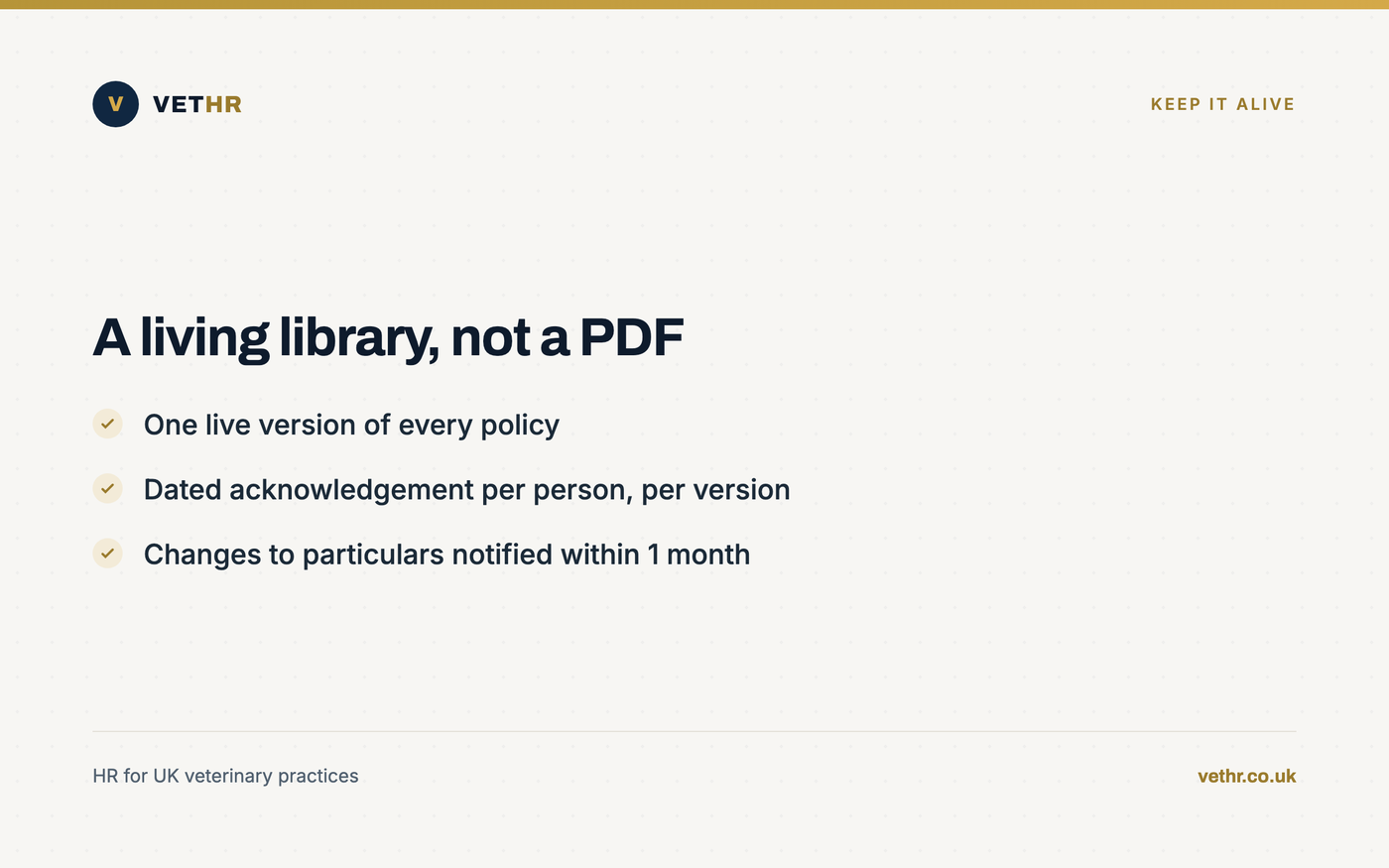
Because a PDF cannot tell you who has read it. A hosted policy library keeps one live version of every policy, lets staff search it in seconds, updates one policy at a time, and records a dated acknowledgement from each person for each version. The PDF handbook does none of that, and it starts going out of date on the day it is exported.
The failure pattern of the PDF is familiar. Version three is on the shared drive, version two is attached to an old email, and a printed version one is in the staff room. Nobody is sure which is current, so nobody trusts any of them. The document that was meant to settle questions now creates them.
Acknowledgement is the part that matters most when things go wrong. If a decision is ever challenged, the question becomes whether the person knew the rule. A dated record showing they acknowledged that exact version of that exact policy answers it cleanly. “We emailed the handbook to everyone in 2023” does not.
This is why we built our policies system as a hosted, acknowledged library rather than a document. Each policy is a page staff can find from their phone, each update is tracked, and each acknowledgement is recorded per person and per version. The handbook stops being a file and becomes a working part of the practice.
Give it an owner, a review rhythm and a change log. One named person, usually the practice manager, owns the handbook. Every policy gets a review date, and anything touched by a law change, an incident or a new service gets updated when the trigger happens rather than at the next annual tidy-up.
Timing is not entirely up to you. Where a change affects the particulars in the written statement, employers must tell staff within one month of making the change, per the same GOV.UK guidance on the written statement of employment particulars. Treat that as the outer limit for everything: if a rule has changed, the team hears about it within the month, in writing.
Re-acknowledgement closes the loop. When a policy changes materially, staff should confirm they have seen the new version, and the record should show it. In a hosted library this is a prompt and a click. With a PDF it is a round of chasing that usually does not happen.
Finally, prune. Once a year, read the handbook against reality. Retire policies you no longer enforce, merge duplicates, and rewrite anything a new starter could not follow unaided. A short handbook people use beats a long one they avoid.
No single law requires a document called a staff handbook. But pieces of it are required. Employees and workers must get a written statement of particulars, starting on day one, and information on disciplinary and grievance procedures within 2 months, per GOV.UK. With five or more employees you must also have a written health and safety policy, per HSE. The handbook is simply the sensible place to keep those pieces together.
Most practices keep it non-contractual, stated plainly at the front, so policies can be updated without renegotiating contracts. Individual terms such as pay, hours and notice stay in the contract. Because terms can be incorporated through wording and conduct, the handbook should be drafted carefully so it guides rather than promises.
A principal statement of the main terms on the first day of employment, and a wider written statement within 2 months covering matters including pensions and disciplinary and grievance procedures, according to GOV.UK. Some information can sit in a separate document staff have reasonable access to, which is the role a well-kept handbook plays.
Review the whole handbook once a year, and update individual policies whenever a trigger fires: a law change, an incident, a new service or a change to how the practice runs. Where a change affects written statement particulars, staff must be told within one month of the change, so build your process around that limit.
With a dated acknowledgement per person, per policy, per version. A signature on a starter form covers the version that existed on their first day and nothing after. A hosted policy library records each acknowledgement as policies change, which is the record you want if a decision is ever challenged.
A veterinary staff handbook is not a compliance ornament. It is the operating manual for the team: the contract holds each person’s terms, the handbook holds everyone’s rules, and the two should never contradict each other. Written well and kept current, it makes decisions faster, fairer and easier to defend.
If yours is a PDF from a few managers ago, start there. See how a hosted, acknowledged policy library keeps every policy current and signed for, check that your contracts and handbook tell the same story, or book a free HR health check and we will tell you plainly what needs fixing first.
The Vet HR Team provides HR consultancy and white-labelled staff systems exclusively to UK veterinary practices.
Contracts, rotas, holiday, a difficult conversation. Tell us what you are dealing with and we will come back within one working day. Nothing to sign up to.
Got it. We will come back to you within one working day. If you do not see a reply, please check your spam folder.
