Last updated: 27 June 2026
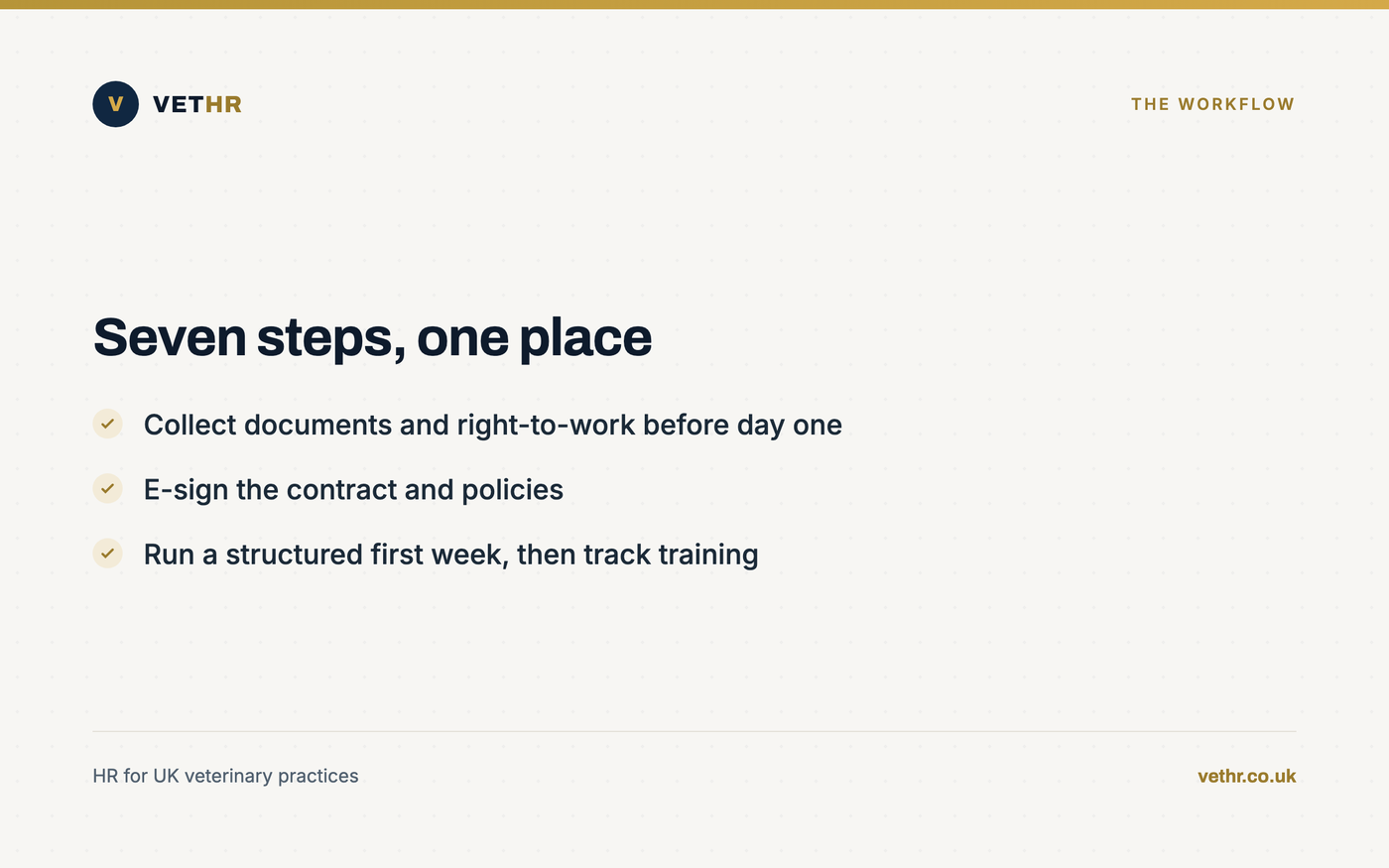
TL;DR: Digital onboarding for veterinary practices replaces the paper folder with one workflow that collects documents and right-to-work before day one, e-signs contracts and policies, and runs a structured first week. Done well, a new nurse or vet arrives with everything signed, their logins ready and a clear plan, instead of a clipboard and a guess. A smooth, paperless start is also one of the cheapest things you can do to keep the people you just hired.
The first fortnight tells a new starter whether they made the right choice. A scrambled, paper-heavy start quietly undoes a good hire. This is a calm, practical look at the onboarding workflow that gets it right, and the legal steps you cannot skip along the way.
Digital onboarding for veterinary practices is a single, paperless workflow that moves a new starter from offer to settled team member: collecting documents and right-to-work before day one, e-signing the contract and policies, then running a structured induction with training and registration tracked in one place. It replaces the folder, the chasing emails and the half-remembered induction.
The point is not the technology. It is that nothing falls through the gap between accepting the job and the first shift. A paper process leaves details scattered across drawers, inboxes and someone’s memory. A digital workflow gives every new nurse, vet or receptionist the same complete start, and gives the practice manager a record they can produce later without a hunt.
It also fits how a clinic actually runs. Onboarding software built for offices assumes a flat nine-to-five. A veterinary new starter workflow has to handle out-of-hours rotas, registered nurses, freelance vet cover and registrations that must be current before anyone touches a patient. The right system treats those as normal, not exceptions to work around.
A smooth onboarding workflow matters because the first weeks decide whether a hire stays. In a tight veterinary labour market, losing a new starter to a chaotic start is an expensive own goal. People judge the whole practice by how organised their arrival feels, and a confident, paperless start signals a workplace that has its house in order.
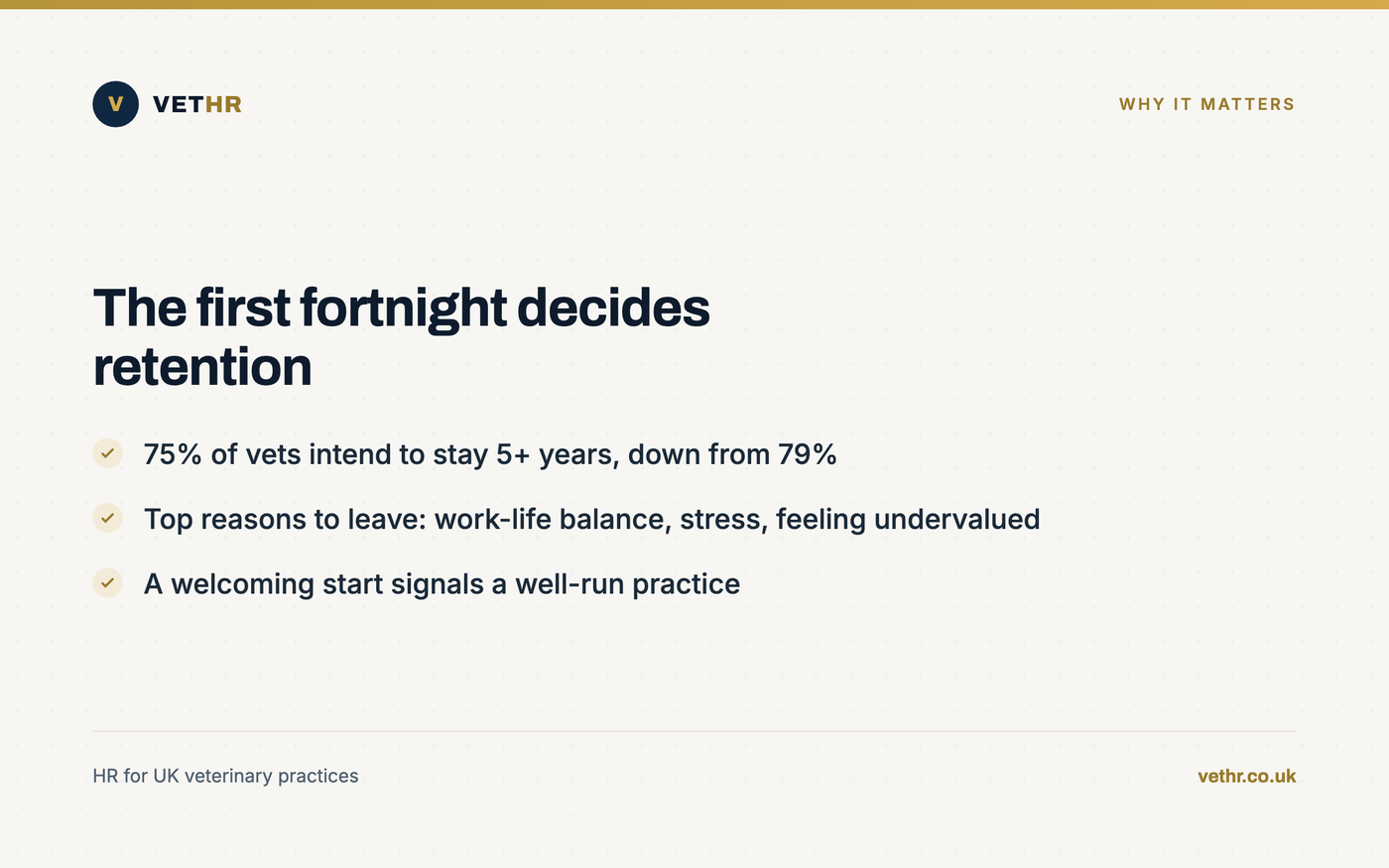
The retention pressure is real. In the RCVS Surveys of the Professions 2024, 75 percent of vets intended to stay in the profession for five or more years, down from 79 percent in 2019, according to the RCVS. When every hire is hard won, the cost of a first impression that fails climbs sharply.
Why people leave points straight at the early experience. The same RCVS research lists the leading reasons as poor work-life balance at 56 percent, chronic stress at 54 percent, and not feeling rewarded or valued in a non-financial sense at 47 percent. A new starter who is left unsure of their rota, their role and where to find anything is meeting all three on day one.
A structured induction process is the antidote. It tells the new person they were expected, their job is understood, and the practice is run with care. That feeling, more than any perk, is what makes someone decide to stay past the first hard week.
Before day one you should collect everything that makes the first shift productive rather than administrative: proof of right to work, bank and tax details, emergency contacts, professional registration, references and signed key documents. Gathering these in advance turns a wasted first morning of form-filling into a proper, welcoming start on the clinic floor.
Right to work is the one you cannot get wrong. GOV.UK is explicit: you must check that a job applicant is allowed to work for you in the UK before you employ them. A digital workflow makes that check a structured step with a dated record attached to the person, rather than a photocopy in a drawer that nobody can find when it is needed.
Collecting documents early also feeds your records duty later. Pay records must be kept and producible, and the system that gathers them at the start is the same one that retrieves them on request. For the detail on what to hold and for how long, see our guide to staff systems.
E-signing sends the contract and policies to the new starter digitally, captures a legally valid electronic signature and stores the signed copy with a timestamp. It removes the print, sign, scan and post loop, so documents come back faster and nothing is left unsigned in a drawer. For onboarding, that speed matters, because some documents are due on the first day.
The legal deadline drives the workflow. GOV.UK confirms the employer must provide the principal written statement of employment particulars on the first day of employment, with the wider statement within two months. E-signing the contract before the start date means that duty is met cleanly, not improvised on a busy morning.
Policies belong in the same flow. Health and safety, data protection, sickness and conduct policies should be issued and acknowledged digitally, so you have a dated record that each person read and accepted them. That record is what protects the practice if a question ever arises about what someone was told. See how we structure practice policies for new and existing staff.
Done as one step, e-signing contracts and policies replaces a fortnight of “did you sign that yet?” with a clean, complete file before the new starter even arrives.
Not sure where your onboarding leaks time or risk? A 30-minute conversation usually finds it fast. Book a free HR health check and we will walk through how you bring new starters on today, from right-to-work to the first week, and tell you honestly where a digital workflow would help. No jargon, nothing sold for the sake of it.
A structured first week gives the new starter a plan, not a guess: a named buddy, a clear rota, the systems they need access to, and a short daily focus that builds confidence. The aim is for them to leave Friday feeling useful and oriented, rather than overwhelmed and unsure who to ask.
A digital workflow makes this repeatable. The same template runs for every starter, so a new vet at a branch site gets the same considered start as a nurse at the main practice. Nothing depends on whoever happens to be on shift remembering what comes next. The plan lives in the system, not in someone’s head.
Part of week one is showing people the tools they will use daily, the rota and time records included. Working time matters here too: Acas confirms working time records must be kept for two years and that the 48-hour weekly average can only be exceeded with a written opt-out, in its guidance on the working time rules. Introducing clock-in early sets honest habits from the start.
You track training and registration by holding each requirement against the person, with a status and a renewal date the system can prompt you about. Onboarding is where this starts: confirming RCVS registration, recording mandatory training and noting what is still outstanding, so nothing lapses quietly six months later.
For clinical staff, registration is not optional and not a one-off. A nurse or vet must be registered before they work, and that status has to stay current. A paperless onboarding flow captures the registration number at the start and then keeps watching the renewal date, rather than relying on a calendar reminder someone set once and forgot.
Training tracking follows the same logic. Induction training, health and safety, data handling and role-specific skills each get a record and a date. When an inspection, an insurer or a tribunal asks what someone was trained to do and when, the answer is a clean export, not an afternoon of detective work.
This is also a records duty, not just good practice. GOV.UK guidance on enforcing the minimum wage states that, from 1 April 2021, employers must keep pay records for at least six years and be able to produce them for a worker in a single document on request. Onboarding that files cleanly is what makes that retrieval painless.
You move from paper to digital one step at a time, not in a single weekend. Map your current onboarding, find where it leaks time or risk, then digitise the highest-friction steps first: usually document collection, right-to-work and e-signing. The structured first week and tracking follow once the front end is clean.
Start by writing down what actually happens today, from offer accepted to end of probation. Most practices are surprised how many handoffs and chasing emails sit in there. Each one is a place a detail can drop, and each is a candidate for a single automated step in the new workflow.
Then standardise before you automate. A digital tool only helps if the underlying process is sound, so agree the steps, the templates and who owns each stage first. A consistent new starter workflow on paper beats an inconsistent one in software. Once it is agreed, the system simply makes it repeatable and hard to skip.
You do not have to build this alone. Our monthly HR support pairs the systems your team uses day to day with the human guidance to set them up properly, so onboarding becomes something that runs quietly rather than another job for the practice manager.
It is a paperless workflow that takes a new starter from offer to settled team member in one place: collecting documents and right-to-work before day one, e-signing the contract and policies, and running a structured first week with training and registration tracked. It replaces the paper folder, the chasing emails and the induction nobody quite remembers.
The principal written statement of employment particulars must be given on the first day of employment, with the wider statement within two months, according to GOV.UK. E-signing the contract before the start date is the cleanest way to meet that deadline, so it is signed and filed rather than improvised on a busy first morning.
Before employment begins. GOV.UK is clear that you must check a job applicant is allowed to work for you in the UK before you employ them. A digital onboarding workflow makes this a required step with a dated record attached to the person, so it is never skipped and never lost in a drawer when you need to show it.
Electronic signatures are widely used and accepted for employment contracts in the UK, provided the signer intends to be bound and the document is stored securely with a clear record. The practical benefit for onboarding is speed and certainty: documents come back before the start date and the signed copy is timestamped and easy to retrieve.
It makes the first weeks feel organised and welcoming, which is when many new starters quietly decide whether to stay. With retention under pressure across the profession, a smooth, paperless start that signals a well-run practice is one of the cheapest and most effective things you can do to keep a hard-won hire past their first hard week.
Onboarding is the first promise you make to a new starter, and a paper folder breaks it quietly. Digital onboarding is not about gadgets; it is about every new nurse, vet and receptionist arriving to a complete, signed, planned start. That start is also a legal duty done right, from right-to-work before day one to a contract signed on it.
If your current process leans on memory and chasing, fix the front end first. To see how the pieces fit, browse our staff systems, look at how we handle policies, or simply book a free HR health check and we will give you a straight recommendation for your practice. Nothing sold that you do not need.
The Vet HR Team provides HR consultancy and white-labelled staff systems exclusively to UK veterinary practices.
Read next: The Clinical Coach: Why Student Veterinary Nurses Leave.
Contracts, rotas, holiday, a difficult conversation. Tell us what you are dealing with and we will come back within one working day. Nothing to sign up to.
Got it. We will come back to you within one working day. If you do not see a reply, please check your spam folder.
