TL;DR: HSE says a pressure system is one that contains or is likely to contain a relevant fluid over 0.5 bar, and lists autoclaves, compressed air systems and boilers among examples. Steam at any pressure counts as a relevant fluid. Under the Pressure Systems Safety Regulations 2000 the user must provide safe equipment, know the operating limits, fit working protective devices, maintain it, train people, have it examined under a written scheme drawn up by a competent person and keep records. A written scheme of examination must be in place before qualifying equipment is used. Check each item with the manufacturer, your insurer and L122.
Last updated: 22 October 2026
A practice buys a second-hand benchtop autoclave from a group closing a branch. It arrives with a manual and a plug. The prep room has a compressor in the corner that feeds the dental unit, and there is a boiler cupboard upstairs. Nobody has been asked who examines any of them, when they were last examined or whether a written scheme exists. The equipment works every day, so everyone assumes it is fine.
Pressure equipment fails rarely and violently. HSE says when something goes wrong and a vessel bursts, the results can be devastating to people nearby, and the legal duty is aimed at preventing that. This guide explains what HSE counts as a pressure system, what the Regulations require of a practice that uses one, what a written scheme of examination is and what to keep on file. It is general information, not legal advice, so confirm the position for each piece of equipment with the manufacturer, your insurer or a competent person.
HSE says a pressure system is one that contains or is likely to contain a relevant fluid over 0.5 bar. A relevant fluid includes steam at any pressure, compressed gas or air above 0.5 bar over atmospheric, pressurised hot water above 110 degrees Celsius and dissolved acetylene. Hydraulic oils are excluded.
The HSE page on the Pressure Systems Safety Regulations 2000 defines a pressure system as a system comprising one or more pressure vessels of rigid construction, any associated pipework and protective devices, the pipework with its protective devices to which a transportable pressure receptacle is or is intended to be connected, or a pipeline with its protective devices.
HSE’s introduction to pressure equipment lists examples of hazardous equipment: boilers and steam heating systems, pressurised process plant and piping, compressed air systems both fixed and portable, pressure cookers, autoclaves and retorts, heat exchangers and refrigeration plant, valves, steam traps and filters, pipework and hoses, pressure gauges and level indicators, and steam coffee machines.
For a practice, the likely candidates are autoclaves and steam sterilisers, air compressors serving theatres, dental units or tools, boilers and hot water systems, and refrigeration plant. Not every small unit will be covered, because the Regulations have exceptions and the details depend on the pressure, the volume and the fluid. HSE says the Approved Code of Practice Safety of pressure systems (L122) helps you determine which regulations, if any, apply. If in doubt, ask your insurer’s engineering surveyor, who may already examine your equipment.
The employer, called the dutyholder, has them. That includes the user of an installed system, such as a boiler, and the owner of a mobile system, such as an air compressor taken from site to site. The user of hired or leased equipment should check that a written scheme is in place and the certificate of examination is current.
HSE’s PSSR page says a supplier of an installed system can assume responsibility in writing for the written scheme, the operation, the maintenance and the record keeping, under Schedule 2 of the Regulations. If a contractor or the manufacturer looks after your equipment under a service contract, check whether the contract says that, rather than assuming it.
In a practice group, work out who owns each piece of equipment and who is the user. A branch that borrows an autoclave from another site, or hires a compressor, needs to know whose scheme covers it. Put the answer in the equipment register.
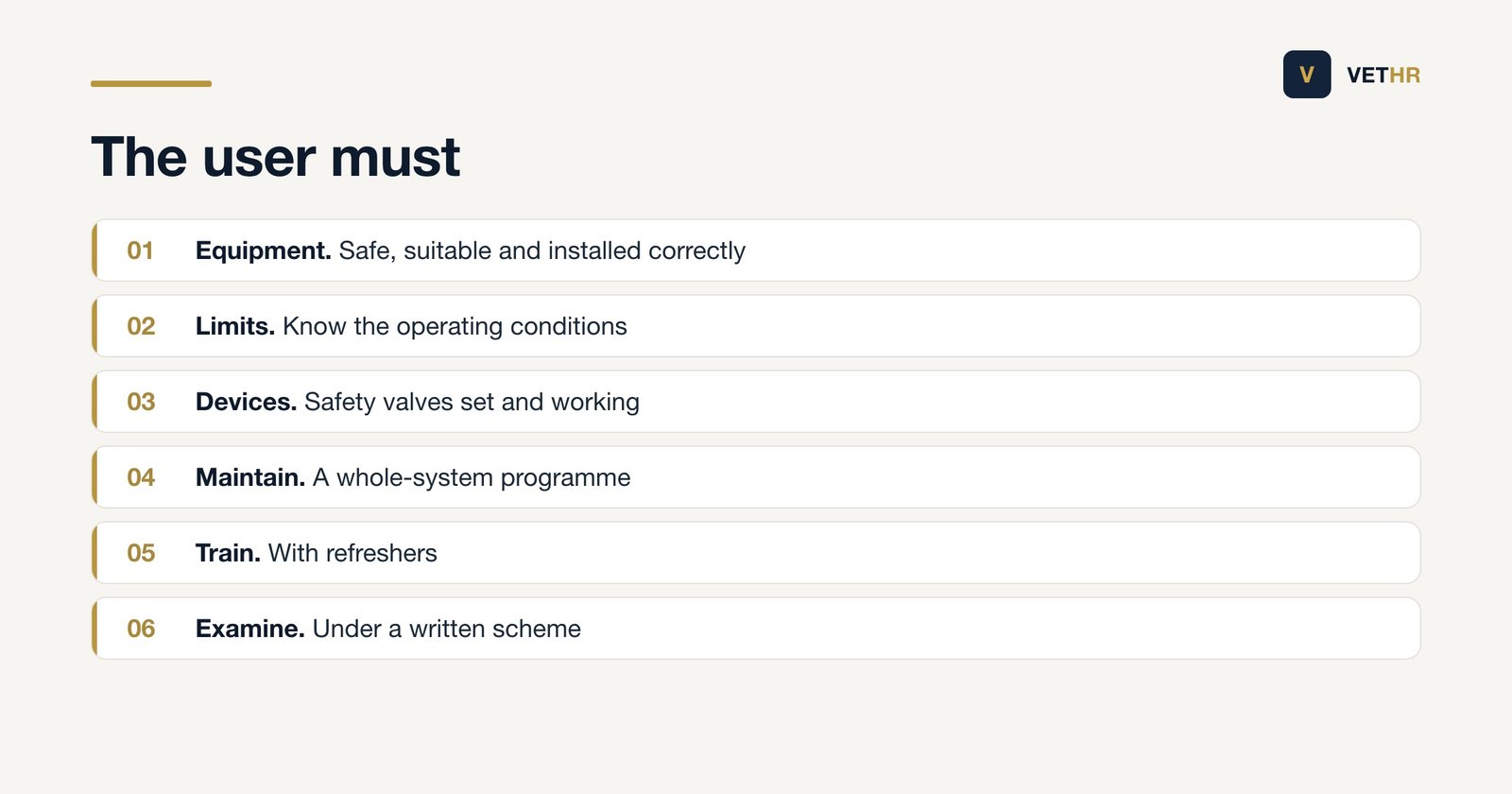
HSE’s list for users is: provide safe and suitable equipment, know the operating conditions, fit suitable protective devices that work properly, carry out suitable maintenance, provide training, have the equipment examined under a written scheme of examination and choose a competent person who has the knowledge, skills and independence to do the role.
The HSE page on using pressure systems expands each point. Safe equipment means equipment suitable for its purpose, installed correctly, with modifications and repairs carried out properly. Knowing the operating conditions includes the characteristics of the fluid and the safe operating limits. Protective devices such as safety valves, bursting discs and electronic appliances must be adjusted to the correct settings and kept in good working order.
Maintenance should be a whole-system programme that considers age, uses and the environment. Training should ensure anyone who operates, installs, maintains, repairs, inspects or tests the equipment has the skills and knowledge to do it safely, and refresher training should be included. HSE refers readers to INDG261, Pressure systems: a brief guide to safety, for more.
HSE adds some basic precautions. Make sure the system can be operated safely, without climbing or struggling through gaps in the pipework. Be careful with repairs and modifications, because after a major repair or modification you may need the whole system re-examined before it returns to use. Keep operating instructions for the equipment and the system as a whole, including in emergencies. Operate within the safe limits, and if the manufacturer has not given them, ask a competent person such as your employers’ liability insurer.
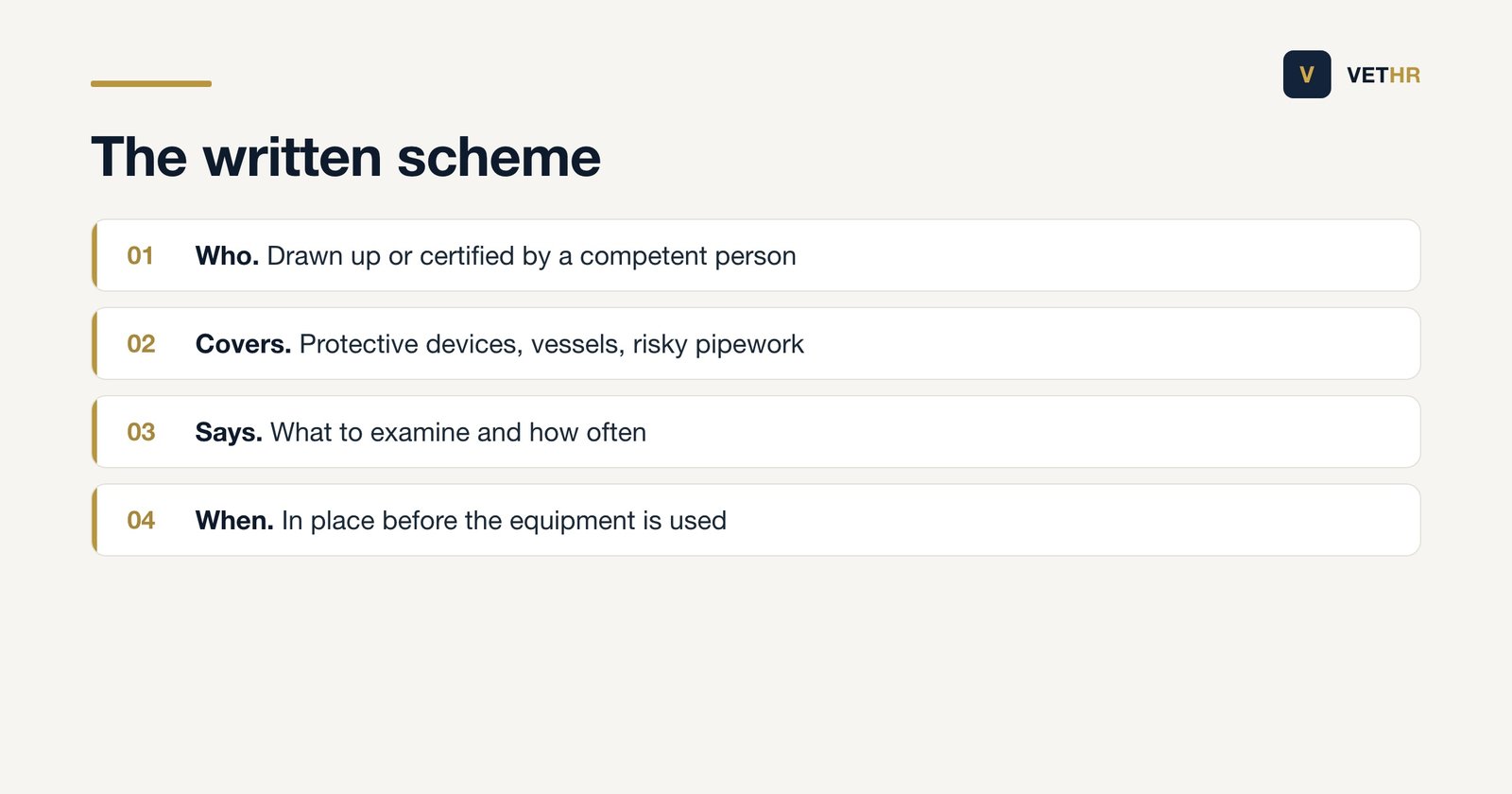
A written scheme of examination is a document, drawn up or certified as suitable by a competent person, that says what must be examined and how often. HSE says it must cover all protective devices, every pressure vessel and those parts of pipework which could be dangerous if they failed. It must be in place before qualifying equipment is used.
The HSE page says a written scheme is required for most pressure systems and must specify the nature and frequency of examinations and any special measures needed to prepare the system for a safe examination. A statutory examination under the scheme is designed to ensure the system is suitable for its intended use, and HSE is clear that it is not a substitute for regular and routine maintenance.
Before using any qualifying pressure equipment, new or otherwise, the Regulations require that a written scheme is in place and an examination undertaken. For second-hand equipment this is a practical test. Ask for the scheme and the last certificate of examination. If there is none, the equipment is not ready to use until a competent person has dealt with it.
The competent person writes a report for each examination, notifies the user of repairs required, identifies action in case of imminent danger and agrees postponements where appropriate. HSE says an in-house competent person should be independent of the operating functions of the organisation and have enough authority to stop the use of the equipment. For a practice, using an external engineer or the insurer’s surveyor is usually the simplest way to meet that.
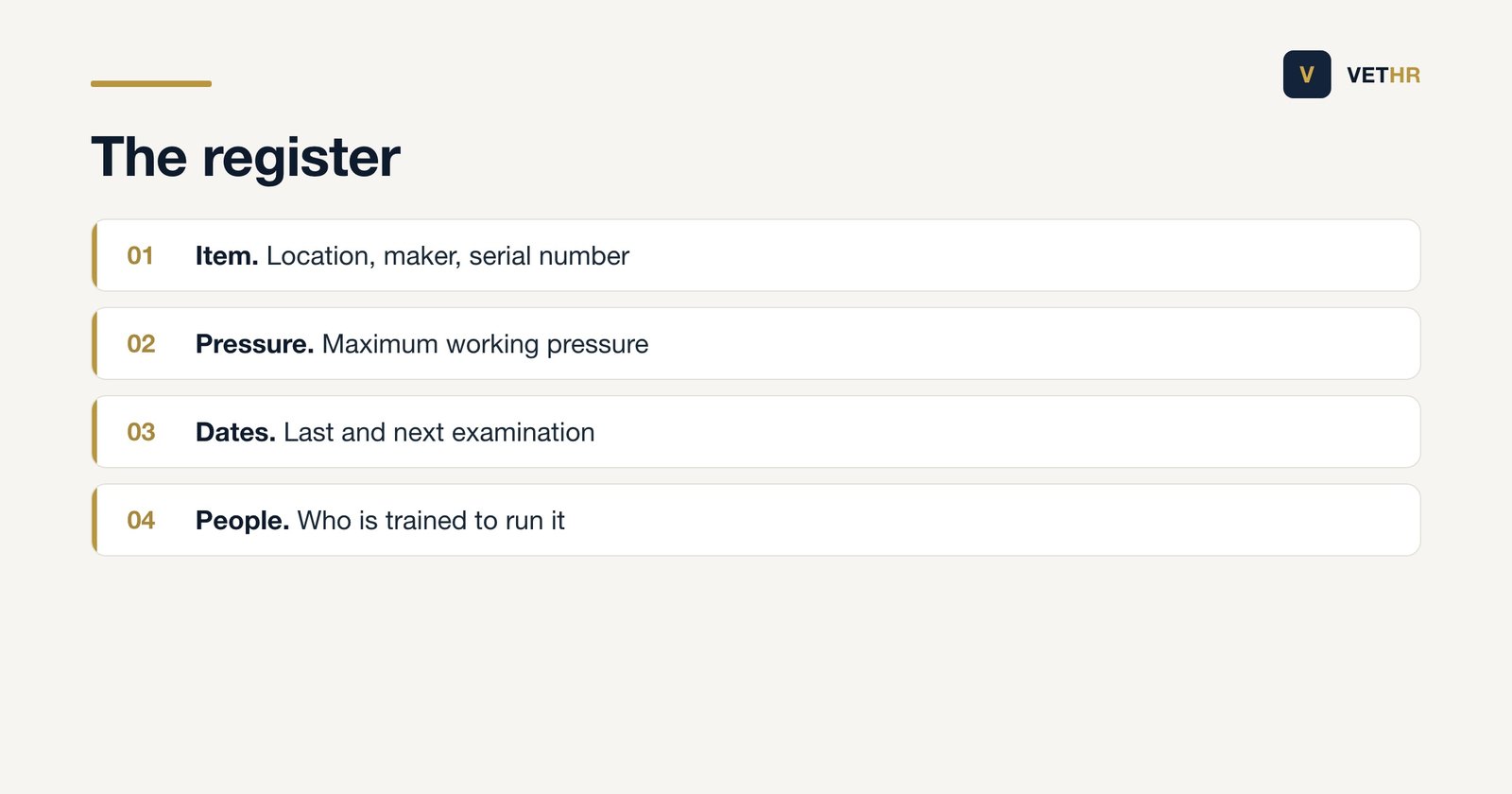
Keep an equipment register for your pressure systems that lists each item, its location, its maker and serial number, its maximum working pressure, who the user is, the written scheme, the date and result of the last examination, the due date of the next, the maintenance schedule and who is trained. Update it whenever equipment is bought, moved, repaired, hired or retired.
Useful records for each item are:
HSE says to ensure that any inspections needed have been completed by a competent person and the results recorded before using the equipment. Diary the next examination date, and do not use the equipment past it unless the competent person has agreed a postponement in writing.
Our guides to the training matrix and incident reporting show how to record training and near misses, such as a safety valve that lifted or a door that did not seal.
HSE says anyone who operates, installs, maintains, repairs, inspects or tests pressure equipment needs the skills and knowledge to do it safely, including what to do in an emergency, with refresher training. For a practice that means a short, practical briefing for everyone who loads and unloads the autoclave or uses the compressor.
A one-page instruction for each machine is usually enough. It should cover how to start and stop it, the normal operating cycle and pressure, what the gauges and alarms mean, what not to do (for example opening the door before the cycle completes or overriding an interlock) and who to call when something is wrong. Display it next to the machine, and include it in the induction for new starters and agency staff.
Make it clear that nobody should repair, modify or bypass a protective device. HSE lists poor repairs and modifications, poor maintenance, an unsafe system of work and operator error or poor training among the principal causes of pressure incidents, which are the things training and supervision can address.
Include emergency steps. If steam or compressed air escapes, who isolates the supply, who clears the room, where is the isolation valve and who contacts the engineer? Rehearse it once with the team.
HSE’s advice is to consider first whether the job can be done another way without pressure equipment, to use low pressure where it will do and to buy equipment suited to the task. Keep the number of items down, retire old units, and choose equipment that comes with a clear scheme and support from the supplier.
HSE’s example is using vacuum equipment for cleaning rather than compressed air. For a practice, the equivalent questions are whether a small steriliser would do instead of a large one, whether the compressor is bigger than the demand needs and whether an item that is rarely used should be removed instead of kept running and unexamined.
When buying, ask the supplier whether the equipment is a pressure system under PSSR, who will draw up the written scheme, what the examination frequency is, what the training is and what service support is included. When selling or disposing, tell the buyer what the scheme and examination history are.
HSE lists the main hazards as the blast from an explosion or the release of compressed liquid or gas, impact from parts of the equipment or flying debris, contact with released liquid or gas such as steam, and fire from escaping flammable liquids or gases. Plan for each: keep people clear of the equipment while it runs, keep doors and interlocks working, and make sure the emergency steps are known.
If a safety valve lifts, a gauge reads above the limit, a door will not seal or an alarm sounds, stop using the equipment and call the engineer. Do not reset or bypass a protective device to finish the day’s list. Record the event as a near miss, because it is often the first sign of a developing fault.
After any significant repair or modification, check with the competent person whether the system needs re-examination before it returns to use. HSE says this may be required following a major repair or modification, and the cost of asking is small compared with the cost of a failure.
The usual mistakes with pressure systems are not knowing which equipment is covered, no written scheme, missed examinations, treating the insurer’s visit as maintenance, buying second-hand equipment with no paperwork, letting untrained people run it and overriding safety devices.
HSE says it is one that contains or is likely to contain a relevant fluid over 0.5 bar, including steam at any pressure. Autoclaves, compressed air systems and boilers are among its examples.
If it is a qualifying pressure system under PSSR, yes. HSE lists autoclaves as an example of pressure equipment and says a written scheme must be in place before using qualifying equipment. Check each unit with the manufacturer, your insurer or L122.
Someone with the knowledge, skills and independence to carry out examinations, draw up or certify the written scheme and report on the results. HSE says an in-house competent person should be independent of operating functions and have authority to stop use.
No. HSE says a statutory examination is not a substitute for regular and routine maintenance.
The user should make sure the written scheme is in place and the certificate of examination is current.
If you want an equipment register, a written scheme tracker and an induction sheet for pressure equipment set up for your practice, book a free 30-minute HR health check through our contact page. See also our HR consultancy for veterinary practices and the policies and handbook system.
Sources: HSE: introduction to pressure equipment, using pressure systems, Pressure Systems Safety Regulations 2000.
Contracts, rotas, holiday, a difficult conversation. Tell us what you are dealing with and we will come back within one working day. Nothing to sign up to.
Got it. We will come back to you within one working day. If you do not see a reply, please check your spam folder.
