TL;DR: If your veterinary premises were built or refurbished before 2000, HSE says to assume they contain asbestos. The duty to manage asbestos covers all non-domestic premises and sits with the owner, landlord or whoever is responsible for maintenance and repair. The dutyholder must find out whether asbestos-containing materials are present, keep an asbestos register of their location and condition, assess the risk, write and review a management plan at least every 12 months, and tell anyone who might disturb the material, including contractors. A managing agent cannot take the legal duty on the dutyholder’s behalf.
Last updated: 22 October 2026

A veterinary group takes on a former dental surgery built in the 1970s and plans to knock through a wall for a new prep room. The builder starts on a Monday. Nobody has asked whether the ceiling tiles, the boiler cupboard lining or the old ducting contain asbestos, and there is no asbestos register in the landlord’s paperwork. Three days in, the builder finds a board that looks wrong and stops. The practice has just discovered it had a legal duty it did not know about.
This guide explains the duty to manage asbestos and the asbestos register for veterinary premises: who holds it, what a survey is, what the asbestos register and management plan must contain, who must be told and what to do when work is planned. It follows HSE’s guidance for dutyholders and is general information, not legal advice. Check the HSE pages and take specialist advice for your own building.
Probably, if you are responsible for maintaining the building. HSE says the duty covers all non-domestic premises, which includes clinics, surgeries and offices. The dutyholder is the owner, the landlord, or the person or organisation with clear responsibility for maintenance and repair, and the lease or contract can allocate it.
HSE’s page on checking whether you have the duty gives examples. If the owner keeps responsibility for maintenance and repairs and controls access by maintenance workers, the owner is the dutyholder. If tenants are responsible for alterations, repairs and maintenance of their part of a multi-occupied building, those tenants are dutyholders for their parts. Where several people share maintenance, each has the duty for the part they maintain.
Where there is no clear agreement about the asbestos register, or the premises are unoccupied, whoever has control of the premises or part of them is responsible, and often that is the owner. HSE says a managing agent can act on the owner’s behalf but does not take on the owner’s legal duties, so ultimate responsibility stays with the owner.
For a practice on a standard commercial lease, the first step is to read the repairing covenants. If the lease puts internal repair and maintenance on the tenant, the practice probably holds the duty for the inside of its unit. If the landlord keeps it, ask for the landlord’s asbestos register and management plan. Either way, get the answer in writing.
HSE also says dutyholders should assess their own competence, and that the responsible person should have the resources, skills, training and authority to do the job. In a small practice that may be the owner or practice manager, and they may need training or specialist help.
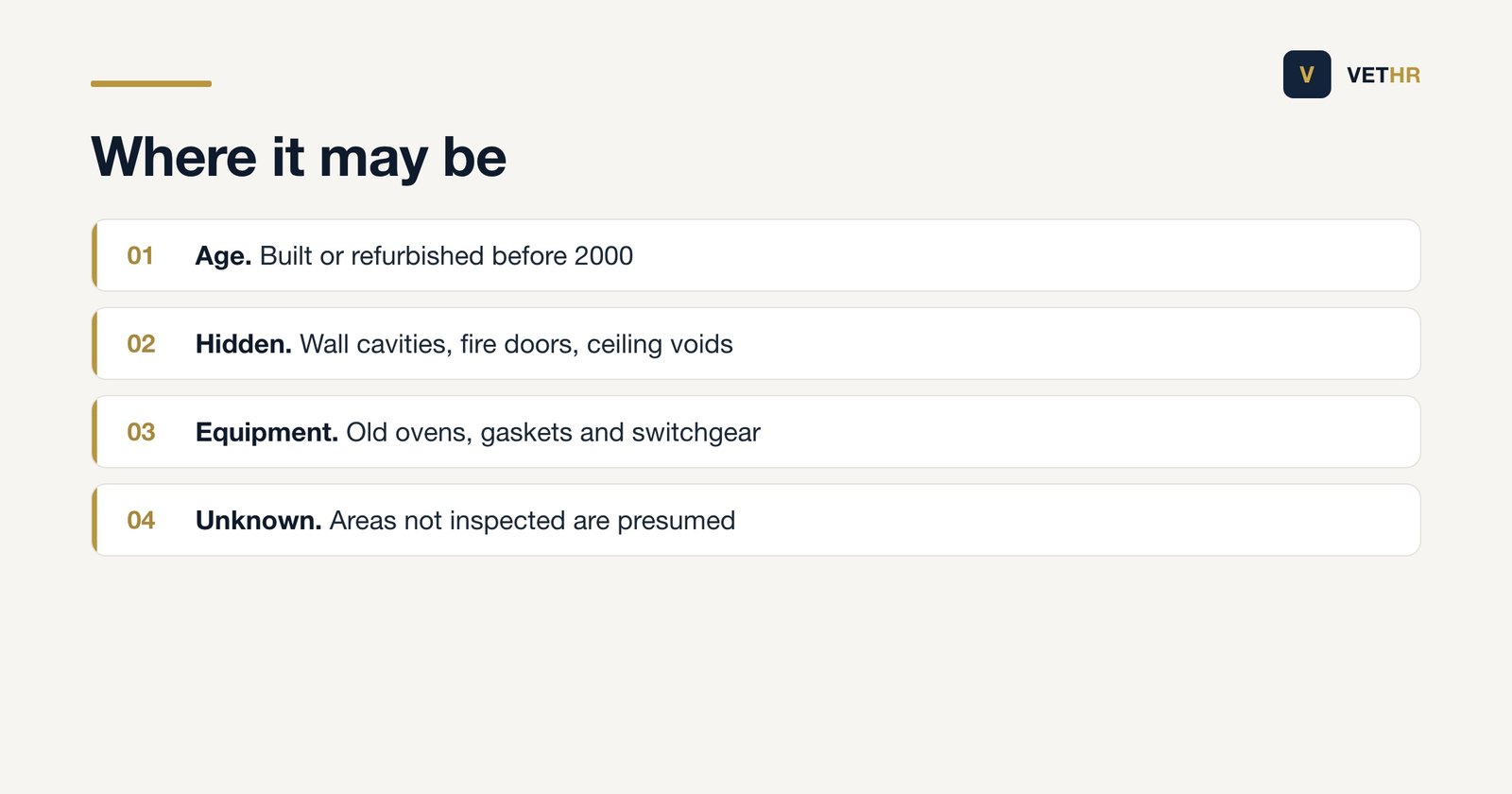
HSE says to assume there is asbestos in any building built or refurbished before 2000. It can be visible or hidden, for example inside wall cavities or fire doors. Check existing documents, consult people, inspect the building and arrange a management survey by a competent surveyor in most cases.
The HSE page on finding out if asbestos could be present says that for a building built after 2000 asbestos is unlikely, but you should think about old industrial machinery and equipment, such as ovens with rope seals and insulation, gaskets, electrical switchgear and heat-resistant panels. If you plan to maintain old equipment, find out if it contains asbestos, ask the manufacturer if possible and otherwise presume it does. Do not buy or sell equipment that contains asbestos.
A practice may inherit old autoclaves, sterilisers, ovens or heaters when it takes over a premises or buys secondhand equipment. Check the paperwork and ask before you accept it.
HSE suggests checking existing information first, such as plans, survey reports, a health and safety file or documents about previous removal work, and consulting workers, previous owners or tenants, a facilities management company, suppliers or the architect. If your premises are very simple, for example a roof with asbestos cement sheeting and no hidden asbestos, you may be able to inspect it yourself and must take care not to walk on fragile material. In most cases HSE says you will need a management survey by a competent surveyor.
A management survey locates asbestos-containing materials as far as reasonably practicable, assesses their condition and gives you what you need to build the register and the plan. HSE says it should inspect all rooms, ceiling voids, lofts, risers, ducts, roofs and other areas that maintenance could disturb.
The HSE page on arranging an asbestos survey says a survey aims to provide accurate information on the location, amount and condition of asbestos-containing materials, assess damage or deterioration and whether remedial action is needed, provide information to produce the register and the plan, and identify hidden materials to be removed before refurbishment or demolition. Both types of survey are likely to require sampling, because the only way to confirm that a suspect material contains asbestos fibres is to take a sample and analyse it.
HSE warns that restrictions on the scope of the survey undermine its value. If areas are not inspected, for example because there was no access, they must be presumed to contain asbestos and managed that way until they have been inspected.
There are two types of survey. A management survey is for normal occupation. A refurbishment or demolition survey is needed before major work and is intrusive, so the area must be vacated and then certified fit for reoccupation. HSE says there is a legal requirement for all asbestos-containing materials to be removed, as far as reasonably practicable, before major refurbishment or demolition. That is the survey the practice in the opening example needed before the wall came down.
HSE strongly recommends using accredited surveying organisations and says the United Kingdom Accreditation Service is the sole recognised accreditation body in Great Britain for asbestos inspection bodies carrying out surveys. You should still satisfy yourself that the surveyor is technically competent and has the resources for the job.
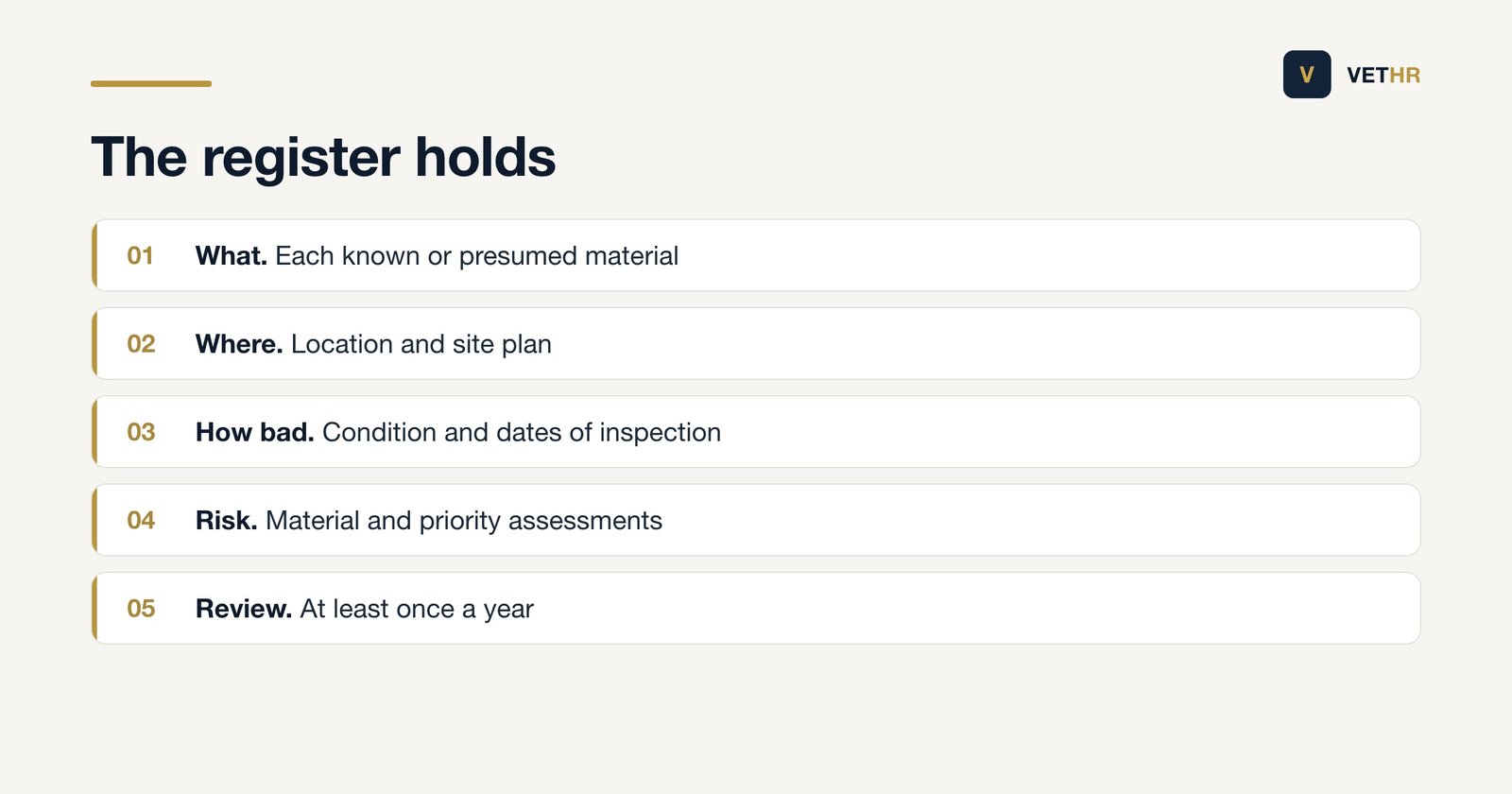
The asbestos register is a live record of all known and presumed asbestos-containing materials. At a minimum HSE says it must hold each material, its type, amount and condition with inspection dates, its potential to release fibres, the likelihood of disturbance, and any areas that could not be inspected and are presumed to contain asbestos.
The HSE page on making an asbestos register and assessing the risk lists the minimum content: all known and presumed asbestos-containing materials in your buildings, the type, how much there is and its condition including the dates of the original and last inspection, the potential of each material to release fibres (the material assessment) and the likelihood of disturbance in day-to-day running (the priority assessment), and the locations where asbestos is presumed because the surveyor could not gain access.
HSE says it would further help to include photographs, actions and due dates, evidence of actions being completed and a condition assessment due date. The register can be paper or electronic. It must be updated at least once a year as part of the management review, or earlier if anything changes the risk from a material.
The register must include a risk assessment. HSE says to consider the location, amount and condition, whether there is easy access, whether people work near it in a way that is liable to disturb it, the numbers of people in the area, and whether maintenance or refurbishment is likely where the material is. If the survey gives a priority assessment, validate it, because only you know what happens in your building.
A vet practice has some specific disturbance risks to think about: hooks and fixings for kennel partitions, drilling for new equipment or data cabling, ceiling access for lighting and extraction, and plant room work. Put those in the register’s priority assessment, not just the survey’s generic scoring.
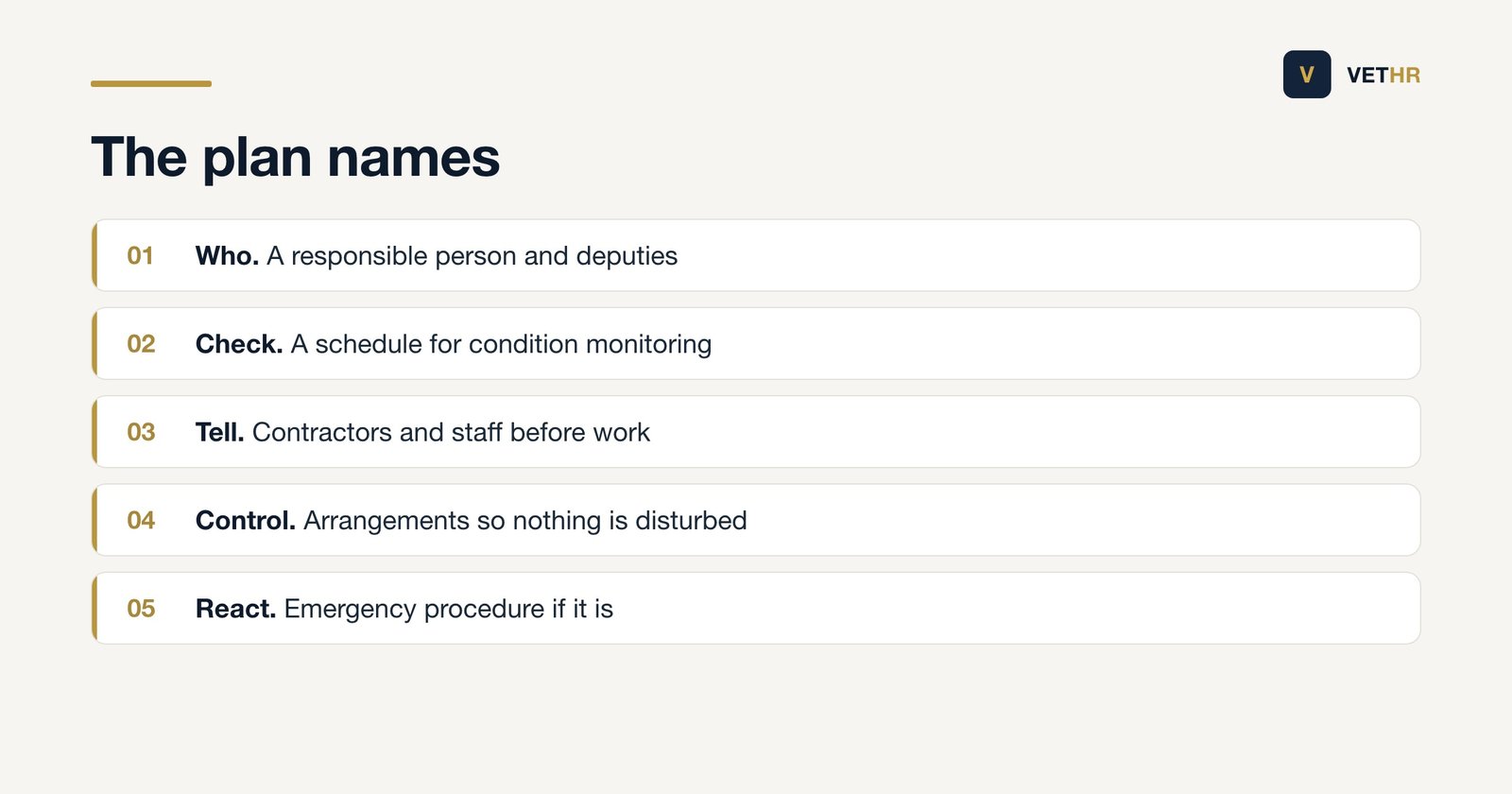
The asbestos register sits inside the plan, and HSE says the plan should name who is responsible, including deputies, hold the register and site plan, set a monitoring schedule, explain how the register is shared with workers and contractors, set control arrangements so materials are not disturbed and set emergency procedures. Give high priority to damaged materials and those likely to be disturbed.
The HSE page on writing your asbestos management plan says the plan should be site-specific and say who is responsible for each element. It can be written or electronic and should be easy to read, update and find.
HSE says that if materials are in good condition and unlikely to be disturbed, it is usually safer to leave them in place and manage them. All materials in good condition must be regularly inspected. Damaged materials must be repaired, protected, sealed or removed, depending on the extent of damage, and planned refurbishment or installation work may mean removal even of materials in good condition.
Review the plan at least every 12 months, and sooner whenever work affects the materials, staff with management responsibilities change, materials are inadvertently disturbed, or condition checks show a change. Our guide to training matrices helps you record who has had asbestos awareness training.
You must tell anyone who may work on or disturb the asbestos before they start, including employees, contractors, maintenance workers and the emergency services. HSE says to do it as early as possible, for planned work when you ask for a quote, and to share the register and site plan.
The HSE page on providing information lists the trades to include: builders, roofers, painters and decorators, joiners, plasterers, shop fitters, plumbers, gas fitters, electricians, phone, alarm and heating and ventilation engineers, maintenance engineers, and excavation and demolition contractors and surveyors. The information should say where the asbestos is and its condition, the arrangements for safe working such as permits to work or incident procedures, and arrangements for liaison during the work.
HSE also says you should tell staff who are unlikely to disturb asbestos but work in a building that contains it, such as teachers, the specific locations in the rooms they use, not to disturb them and what to do if there is accidental damage. The same applies to vets, nurses and receptionists. A one-page note and a labelled plan on the staff noticeboard meets the spirit of that.
Make the asbestos register part of your contractor induction. A simple rule is that no one without a signed acknowledgement of the register starts work on the fabric of the building. Our guide to health and safety on a practice site explains how to set up the reporting side.
HSE says some work with asbestos must be done by a licensed contractor, including any work on sprayed asbestos, most repair or removal of asbestos insulation and most work on insulating board. Licensed work needs 14 days’ notice to the relevant authority before it starts, and HSE recommends independent site clearance analysis.
The HSE page on putting your plan into action gives examples of licensed work: any work on sprayed asbestos, most repair or any removal of asbestos insulation such as lagging on pipes and vessels, and most work on asbestos insulating boards such as partition walls, linings and suspended ceilings. It also says there is a 14-day notification period before licensed work can begin under the Control of Asbestos Regulations, that the contractor’s method statement should cover all health and safety risks, and that you must use accredited contractors and testing laboratories.
HSE says the analyst for site clearance certification should be independently sourced and employed by the building owner or client in control of the premises. If you are unsure whether work is licensable, ask a surveyor, consultant or licensed contractor before anything is touched.
For a practice, the key habit is to stop and ask before any intrusive work on a pre-2000 building. A phone call to the surveyor costs far less than a closed building and a clearance.
The usual mistakes with an asbestos register are assuming the landlord has done it, having a survey but no register, filing the survey and never reviewing it, not telling contractors, restricting the survey scope, moving equipment that may contain asbestos and starting refurbishment without a refurbishment survey.
If the practice is a dutyholder for non-domestic premises that may contain asbestos, for example built or refurbished before 2000, HSE expects a register of known and presumed materials as part of the duty to manage asbestos.
It depends on the lease or contract. The owner, a tenant or both may hold the duty for different parts of the building. HSE says responsibility for maintenance and repair decides it, and a managing agent cannot take on the owner’s legal duty.
HSE says to update the register at least once a year, or sooner if anything changes the risk, and to review the management plan every 12 months or sooner.
HSE says in most cases you will need a management survey by a competent surveyor. For major refurbishment or demolition you need a refurbishment or demolition survey before work starts.
Employees, contractors, maintenance workers, site managers and the emergency services, before they work on or could disturb the material, and staff who work in the building about the locations and what to do if there is damage.
If you want a one-page health and safety register, a contractor induction sheet and a review calendar set up for your practice, book a free 30-minute HR health check through our contact page. See also our HR consultancy for veterinary practices and the policies and handbook system.
Sources: HSE: the duty to manage asbestos in buildings, check if you have the duty, find out if asbestos could be present, arrange an asbestos survey, make a register and assess the risk, management plan, put your plan into action, provide information.
Contracts, rotas, holiday, a difficult conversation. Tell us what you are dealing with and we will come back within one working day. Nothing to sign up to.
Got it. We will come back to you within one working day. If you do not see a reply, please check your spam folder.
