TL;DR: HSE defines work at height as work in any place where, without precautions, a person could fall a distance liable to cause injury. The Work at Height Regulations 2005 require employers and those who control the work to plan it, supervise it, use competent people and choose the right equipment. The steps are to avoid work at height where reasonably practicable, prevent falls, then minimise the distance and consequences of a fall, with collective protection before personal protection. Ladders are not banned, but suit only low risk, short duration tasks, up to 30 minutes at a time.
Last updated: 22 October 2026
A nurse is asked to swap a failed bulb in the kennel corridor. The only ladder in the building is a folding stepladder from the stock room with one cracked foot. She puts it on a wet floor, reaches sideways to get the bulb in and, for the sake of speed, carries the replacement in one hand. Nothing happens this time. A year later it happens to somebody else, who falls onto a concrete floor and is off for three months.
Falls from height are not only a building site problem. Veterinary premises have ladders and stepladders for stock rooms, light fittings, signs, extraction, flat roofs and gutters, and tasks that someone has always just done. This guide explains what HSE says counts as work at height, what the Regulations require of a practice, the three-step approach, what to do about ladders and contractors and how to record it. It is general information, not legal advice.
HSE says work at height means work in any place where, if there were no precautions in place, a person could fall a distance liable to cause personal injury. A fall through a fragile roof is its example, and it also says common cases include falls from ladders. There is no minimum height, so a short fall onto a hard floor can count.
The HSE introduction to working at height safely stresses that it remains one of the biggest causes of fatalities and major injuries. It also gives a helpful limit: walking up and down a permanent staircase in a building is not work at height, which HSE lists among the common myths.
For a practice, the usual work at height tasks are changing bulbs and tubes, accessing high shelves and mezzanines, cleaning windows and signs, working on extraction and ducting, checking roofs, skylights and gutters, and hanging notices or equipment. Contractors do much of it, but your own staff often do the small jobs, which is why the risk assessment must cover them.
Think about the surface as well as the height. HSE warns specifically about fragile surfaces, such as roof lights and some roof sheeting, and about resting ladders against weak upper surfaces such as glazing or plastic gutters. If a contractor is going on the roof, ask how they will avoid fragile areas.
The Work at Height Regulations 2005 aim to prevent death and injury from falls. Employers and those who control work at height must make sure it is properly planned, supervised and carried out by competent people, using the right equipment, and must first assess the risks. Employees must take reasonable care and co-operate.
HSE’s page on the law says the Regulations apply to employers and to people who control work at height, for example facilities managers or building owners who may contract others. That includes a practice owner who asks a handyman to clean the roof or hang a sign. Low-risk, straightforward tasks need less planning effort, and some low-risk situations may need no particular precautions, but that is a judgement you make by assessing the risk, not a default.
Employees have general legal duties to take reasonable care of themselves and others and to co-operate with their employer. Staff must follow the safe system you set, and must tell you if a ladder is damaged or a task seems unsafe. Make that part of the induction. Our guide to incident reporting explains how to capture near misses.
Competence is central. HSE says you must make sure work is carried out by people with the skills, knowledge and experience to do the job. Do not let anyone who is not competent work at height. For simple ladder tasks, competence can mean a short demonstration and a check, not a formal course.
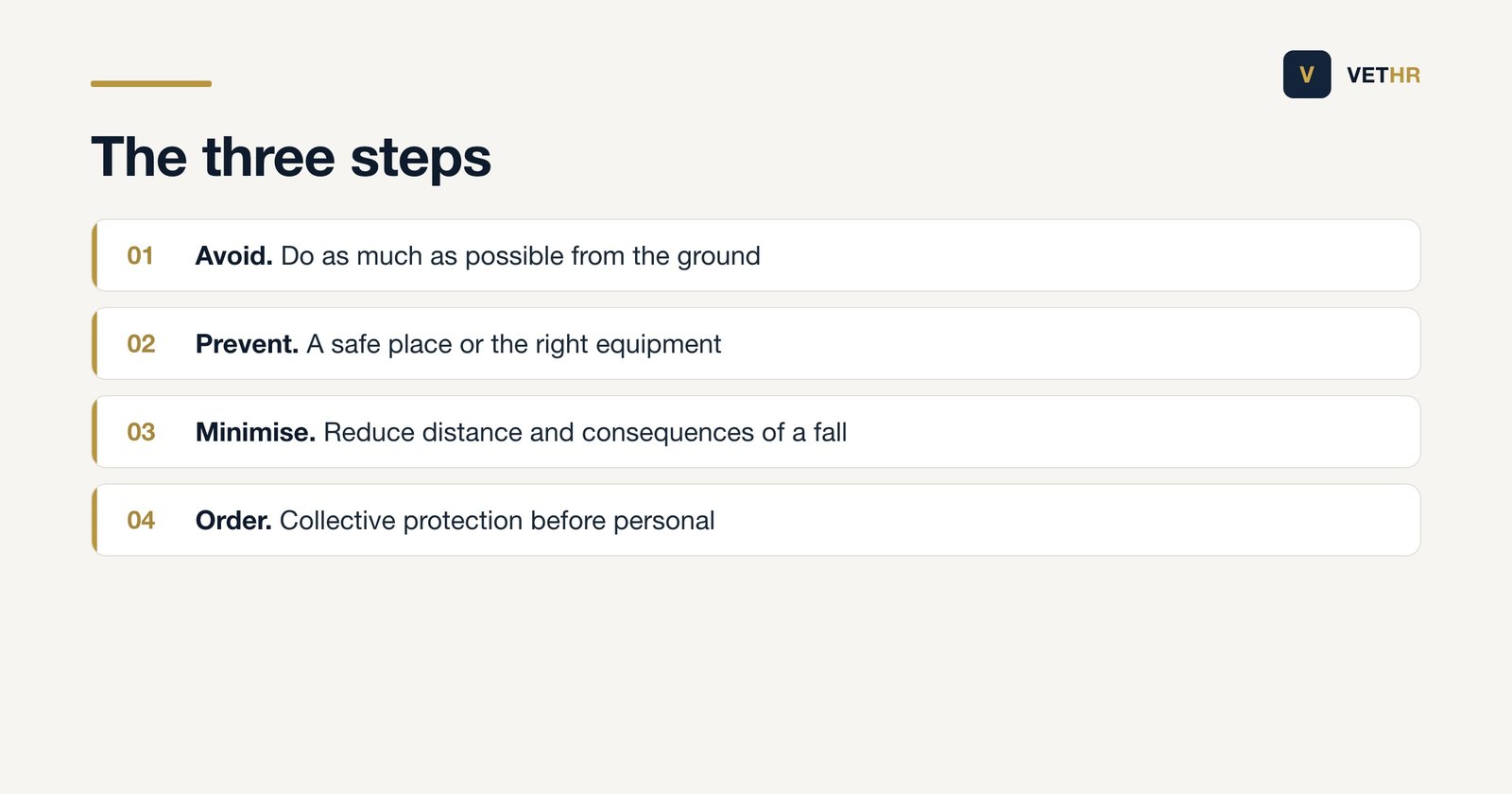
HSE’s steps are to avoid work at height where reasonably practicable, to prevent falls using an existing safe place or the right equipment where it cannot be avoided, and to minimise the distance and consequences of a fall where the risk remains. At each step consider collective protection before personal protection.
The HSE step-by-step guide gives practical examples. To avoid work at height, do as much work as possible from the ground, for example using extendable tools, installing cables at ground level or assembling edge protection on the ground. To prevent a fall, use an existing safe place of work, such as a non-fragile roof with a permanent perimeter guardrail, or equipment such as scissor lifts, mobile elevating work platforms and tower scaffolds. To minimise the consequences, use measures such as safety nets and soft landing systems, or personal protection such as a fall arrest system with a high anchor point.
Collective protection is equipment that works without the person having to act, such as guardrails, scissor lifts and tower scaffolds. Personal protection requires the individual to act for it to work, such as a harness correctly connected to a suitable anchor. HSE says to consider collective measures before personal ones, because they protect everyone and do not rely on one person getting it right.
Assess the risk first. HSE says to consider the height of the task, its duration and frequency, and the condition of the surface being worked on. A five-minute bulb change at two metres on a dry floor is a different risk from a roof inspection.
Yes. HSE says ladders are not banned and can be a sensible and practical option for low risk, short duration tasks, though they should not automatically be your first choice. Use the right type, make sure people are competent, and follow a safe system of work. Short duration means no more than 30 minutes at a time.
HSE’s page on the safe use of ladders and stepladders says the law calls for a sensible, proportionate approach. Its list of things not to do is a useful basis for a practice rule: do not overload ladders, so consider the equipment or materials being carried and check the pictogram or label on the ladder; do not overreach; do not rest a ladder against weak upper surfaces such as glazing or plastic gutters; do not use ladders or stepladders for strenuous or heavy tasks, only light work of short duration; and do not let anyone who is not competent work at height.
HSE’s list of myths clears up several points. You do not need to be formally qualified to use a ladder, you need to be competent, and training often takes place on the job. On a stepladder you need three points of contact at the working position when both hands are needed for a brief period, which can be two feet and your body supported by the stepladder, with a handhold available before and after. Ladders can be used to access scaffolds if they are the right type, in good condition and secured, and extend at least one metre above the landing point.
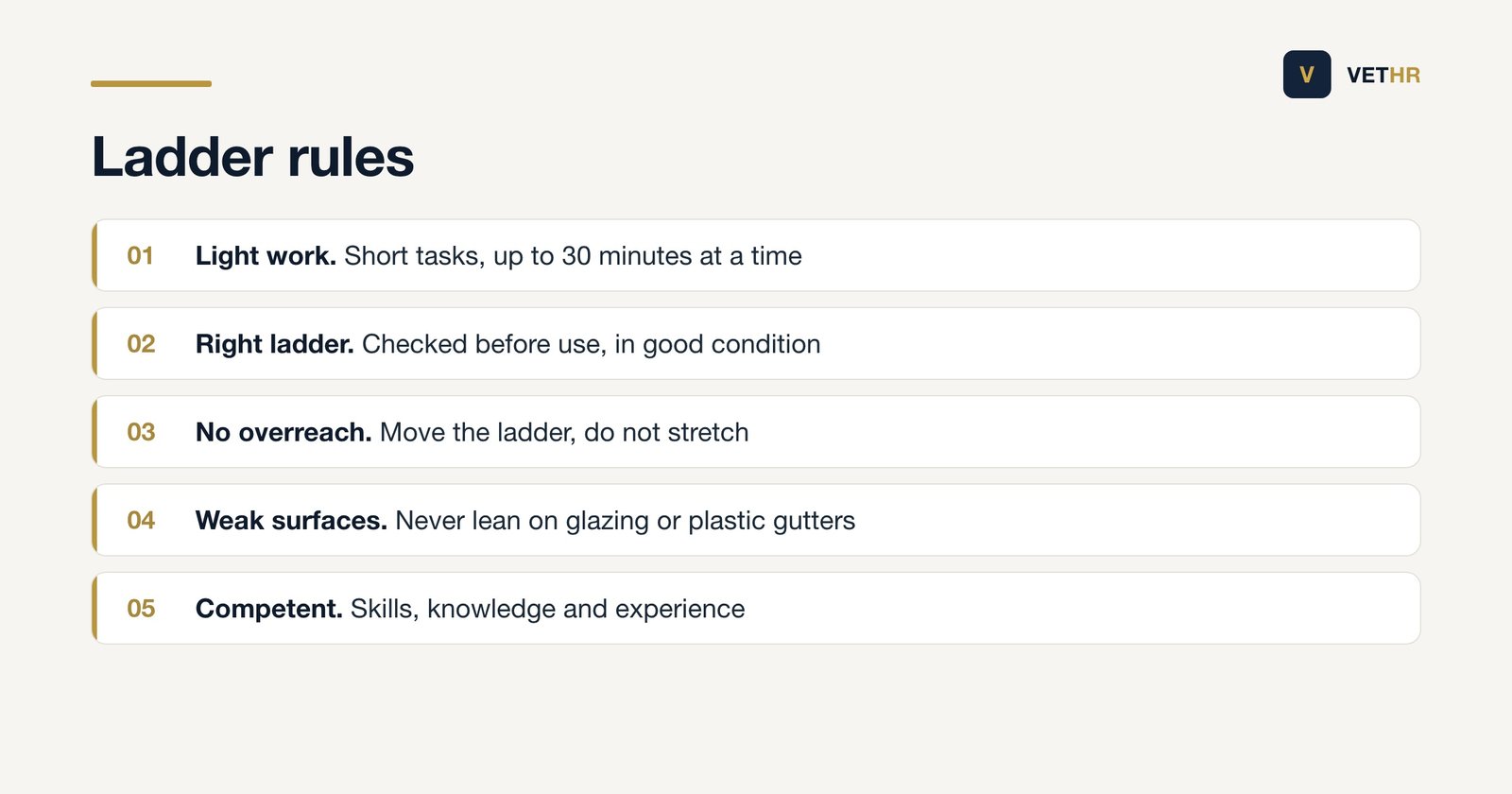
A practical rule set for a practice might be:
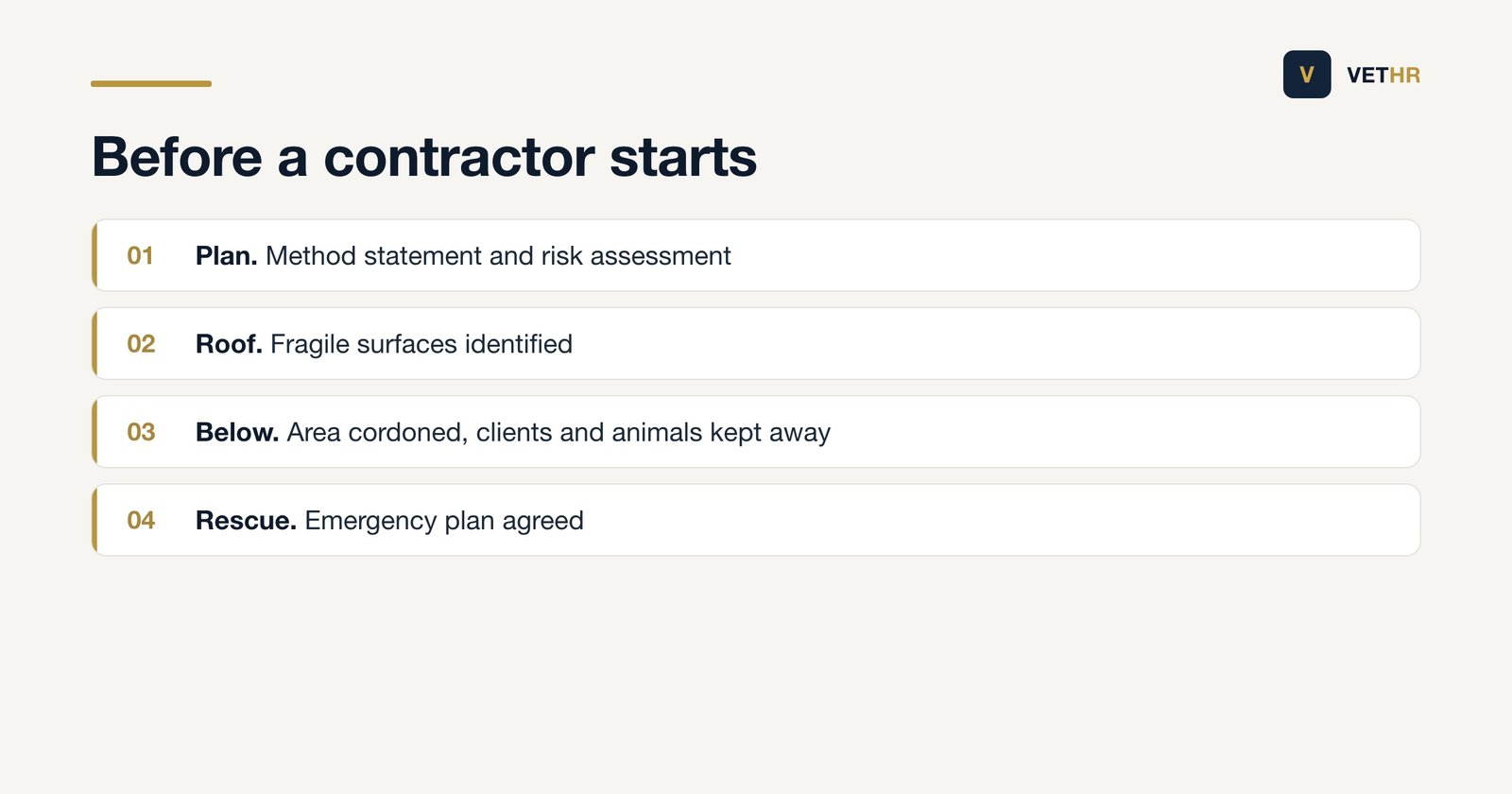
The Regulations apply to people who control work at height, so a practice that hires a contractor still has a duty to take sensible steps. Check that the contractor is competent, ask for a method statement and risk assessment for the task, agree where they will work and make sure your staff and clients are protected from falling objects.
HSE says to provide protection from falling objects and to consider emergency evacuation and rescue procedures. For a practice that means cordoning off the area below, keeping clients and animals away from it, and agreeing what happens if someone is injured on the roof, including who calls the emergency services and how they reach the person.
On older premises, roofs and ceilings can also hold asbestos, and roof lights are often fragile. Before any work above ceiling level, check your asbestos register and tell the contractor what it says. Our guide to the asbestos register explains the duty to share it.
Keep a short record for each job: who did the work, the date, what equipment was used and where, and any issues. That gives you something to show if a question is raised later, and it helps you spot jobs that keep recurring and could be designed out.
The best control is not to work at height. Store heavy and frequently used items at waist height, use long-reach tools for bulbs and signs, install lights that can be changed from the ground or are on a maintenance contract, and ask contractors to do roof and gutter work at set intervals instead of leaving staff to improvise.
HSE’s first step is to avoid work at height where reasonably practicable. Walk the building with that question: what are people climbing for, and can we remove the need? A stock room with the most used items on the top shelf creates a daily ladder task. Moving them lower, or reorganising the stock, removes it.
Think about the repeat jobs as well. If the same ladder task is done every week, a platform, a step with a handrail or a re-design may be better than a stepladder. Our guide to manual handling covers the related risks of lifting boxes on and off high shelves, and our fire safety guide covers keeping escape routes clear while you do it.
You must make sure people doing the work are competent. For ladders, that usually means a short briefing on the practice’s rules, a demonstration of the checks and a supervised first use, repeated when equipment or tasks change. Keep a record of who was briefed, and note ladder inspections.
HSE says competence is skills, knowledge and experience, and that training does not always have to take place in a classroom. What matters is that the individual can apply what they have learned. A record of the briefing date and a sign-off by a manager who has seen the person use the ladder correctly is enough for low-risk tasks. For anything higher risk, such as a roof, use a competent contractor.
Use the training matrix to track who has had the ladder briefing and when it is due to be refreshed, and review the risk assessment whenever the premises or the tasks change.
The usual mistakes are using any ladder that is to hand, standing on chairs or boxes, leaving jobs to whoever volunteers, letting contractors on fragile roofs, ignoring damaged equipment and having no record of inspections. HSE’s three steps and a simple rule sheet fix most of them.
HSE defines it as work in any place where, if there were no precautions in place, a person could fall a distance liable to cause personal injury. It includes ladders and fragile roofs, and there is no minimum height.
No. HSE says they are not banned and can be a sensible option for low risk, short duration tasks, but they should not automatically be the first choice.
HSE says short duration means working on a ladder for no more than 30 minutes at a time.
No. HSE says they need to be competent: the skills, knowledge and experience for the task, or supervised by someone who is. Training can happen on the job.
No. HSE says walking up and down a permanent staircase in a building is not work at height.
If you want a work at height risk assessment, a ladder rule sheet and a contractor checklist ready for your practice, book a free 30-minute HR health check through our contact page. See also our HR consultancy for veterinary practices and the policies and handbook system.
Sources: HSE: introduction to working at height safely, the law, step-by-step guide, common myths, safe use of ladders and stepladders.
Contracts, rotas, holiday, a difficult conversation. Tell us what you are dealing with and we will come back within one working day. Nothing to sign up to.
Got it. We will come back to you within one working day. If you do not see a reply, please check your spam folder.
