Last updated: 30 September 2026
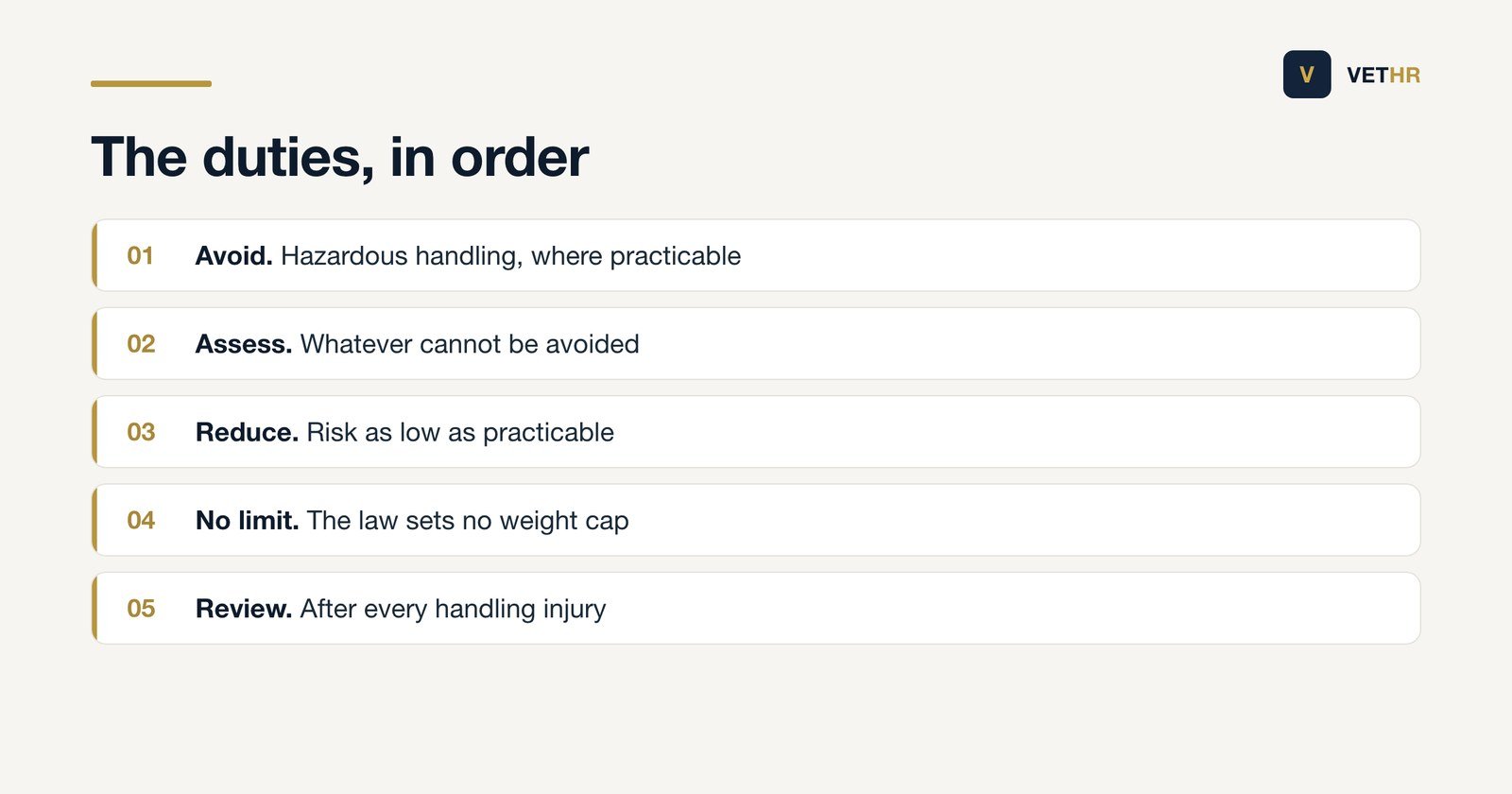
TL;DR: Manual handling law asks employers to do three things in order: avoid hazardous handling so far as reasonably practicable, assess what cannot be avoided, and reduce the risk as low as reasonably practicable. There is no legal weight limit. In veterinary practice the answer is usually a lifting table, not a training course.
Two nurses lift a 48kg Rottweiler off the floor and onto the prep table because the hydraulic table is in the other room and the dog is already sedated. They have both done manual handling training. Neither has been given anything that would let them avoid the lift, which is what the law actually asked the practice to do first.
Three duties, in a fixed order. The HSE sets them out as avoid hazardous manual handling so far as reasonably practicable, assess the risk of injury from any hazardous operations that cannot be avoided, and reduce the risk of injury to as low as reasonably practicable.
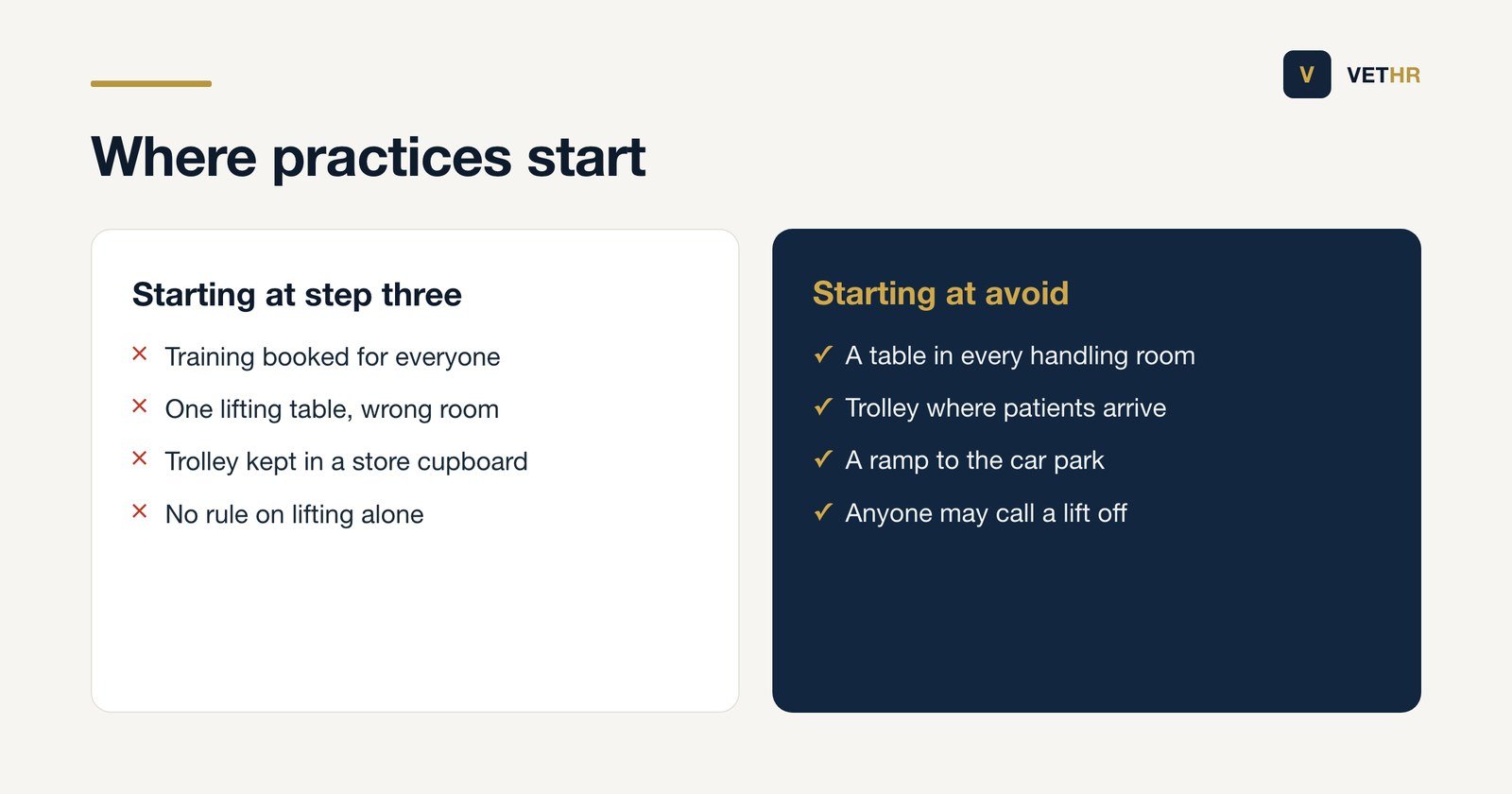
The order is the whole point. Training and technique sit inside the third duty, which means a practice that has only done training has started at step three.
That is not a technicality. Back and shoulder injuries are among the most common reasons veterinary staff lose time, and no amount of lifting technique makes a 48kg dog safe to lift from the floor.
No. The HSE states plainly that the weight of a load is important, though the law does not set specific weight limits. Anyone who tells you 25kg is the legal maximum is repeating a guideline figure from a risk filter, not a rule.
This matters in practice because weight is only one factor. The same dog is a different manual handling problem at floor level, on a trolley, awake, sedated, or thrashing.
So the question is never how heavy is it. It is what is the task, what is the load doing, what is the environment like, and who is doing the lifting.
Start by listing the lifts your practice does every week and asking which of them could stop happening. In most practices the answer covers more than half of them.
Equipment in the wrong room is equipment that does not get used. If your manual handling assessment says the table solves the problem, the table has to be in the room where the lift happens, at the time it happens.
Deliveries are the other half of the problem, and they get forgotten because they are not clinical. Sacks of dry food, boxes of fluids, gas cylinders and litter all arrive in quantities somebody has to move, usually in a corridor, usually in a hurry. Ask your supplier to deliver onto a shelf or a trolley rather than onto the floor, and a whole category of manual handling disappears from the week.
Whatever cannot be avoided gets assessed. Work through the task, the load, the working environment and the individual capability of the person doing it, and write down what you conclude.
In a veterinary practice, the load is often the hardest part, because it is alive. An anaesthetised patient is a dead weight; a conscious one moves unpredictably; a frightened one moves violently. The same dog can be three different assessments in an hour.
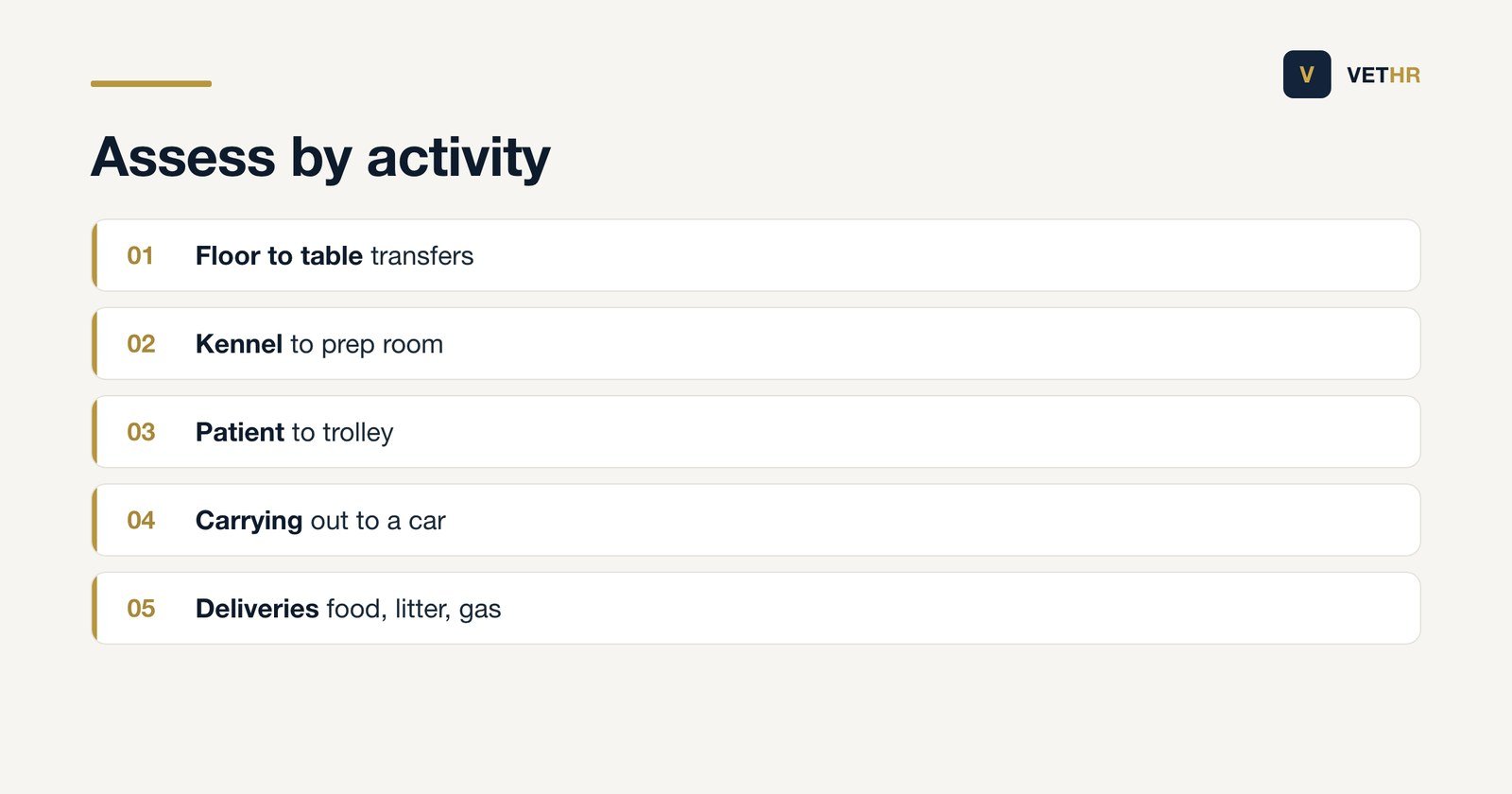
Assess by activity rather than by animal: lifting from floor to table, moving a patient from a kennel, transferring to a trolley, carrying to the car. Five or six activity assessments cover an entire practice, and they stay valid. Our note on COSHH assessments in a veterinary practice uses the same approach.
Now the familiar measures earn their place: two person lifts with a named lead, technique training, a rule that nobody lifts above a stated weight alone, and clear communication before the lift starts.
Add one rule that costs nothing. Anybody may call a lift off. If a nurse says she is not comfortable taking that dog, the lift does not happen, and there is no conversation about it afterwards.
Put the manual handling rules where the lifting happens, not in a folder. One laminated card by the prep table does more than a thirty page policy nobody has opened since induction.
Say who leads each lift before it starts. Most handling injuries in practice happen not because the weight was wrong but because two people moved at different moments. One person counts, everybody else follows, and the patient goes where it was meant to go.
Include new starters in the manual handling conversation during their first week, not at the next annual training date. A student veterinary nurse in week one will do whatever she sees the team do, so the habits she watches are the training that actually lands.
Log every handling injury, however minor. Then watch the clock, because an accident that leaves someone away from work or unable to perform their normal duties for more than 7 consecutive days has to be reported to the HSE within 15 days.
Back injuries are exactly the type that cross that threshold quietly, because the person is usually at work on restricted duties rather than absent. Restricted duties count. Our guide to RIDDOR in a veterinary practice covers the decision.
Use each injury to revisit the assessment. A second back strain from the same lift is not bad luck, it is evidence that the avoid step was never properly done. Our See It Report It system keeps the pattern visible.
Individual capability is part of the assessment, so it changes when the individual changes. Pregnancy, a recent injury, a musculoskeletal condition and a phased return after surgery all need the handling element looked at again.
Do it as a short written review rather than an informal understanding, so that the restriction survives the next rota and the next manager. Our guides to the pregnancy risk assessment and occupational health in a veterinary practice cover both situations.
If your practice has never done the avoid step properly, book a free 30-minute HR health check and we will look at where your lifts actually happen.
Training sits within the duty to reduce risk, so it is part of the answer rather than the whole of it. A practice that has trained everyone but provided no lifting equipment has not met the duty to avoid hazardous handling first.
There is no legal limit. HSE guidance is explicit that the law does not set specific weight limits, because weight is only one factor alongside the task, the environment and the individual. Your own practice rule can set a threshold, and it should.
Assess the operations you cannot avoid, and write down what you find. Assessments organised by activity, such as floor to table transfers, cover the whole practice and stay valid far longer than assessments written per patient.
Someone who understands both the work and the risks, usually the practice manager with an experienced nurse. The people doing the lifts should be involved, because they know which equipment is genuinely reachable during a procedure.
They can, and your rules should say so openly. Anybody being able to call a lift off, with no discussion afterwards, is one of the cheapest and most effective manual handling controls a practice can adopt.
Most veterinary manual handling programmes start at step three because training is easier to buy than a second lifting table. The law puts avoid first for a reason, and so do the injury records.
List your weekly lifts, remove the ones you can, assess what is left, and write down the rules where people can see them. We help independent practices do this through HR consultancy for veterinary practices and the policy document set.
The Vet HR Team provides HR consultancy and white-labelled staff systems exclusively to UK veterinary practices.
Contracts, rotas, holiday, a difficult conversation. Tell us what you are dealing with and we will come back within one working day. Nothing to sign up to.
Got it. We will come back to you within one working day. If you do not see a reply, please check your spam folder.
