Last updated: 12 November 2026
TL;DR: You need employers’ liability insurance as soon as you become an employer, and it must cover you for at least £5 million. GOV.UK states you can be fined £2,500 every day you are not properly insured, and £1,000 if you do not display the certificate where employees can access it. The insurer has to be authorised, which you check on the Financial Conduct Authority register.
Most practice owners buy employers’ liability insurance once, file the certificate somewhere sensible, and never think about it again. That is usually fine. It stops being fine the day the policy lapses quietly, the day the certificate is sitting in a drawer instead of on the wall, or the day somebody assumes the student on placement is covered by something else.
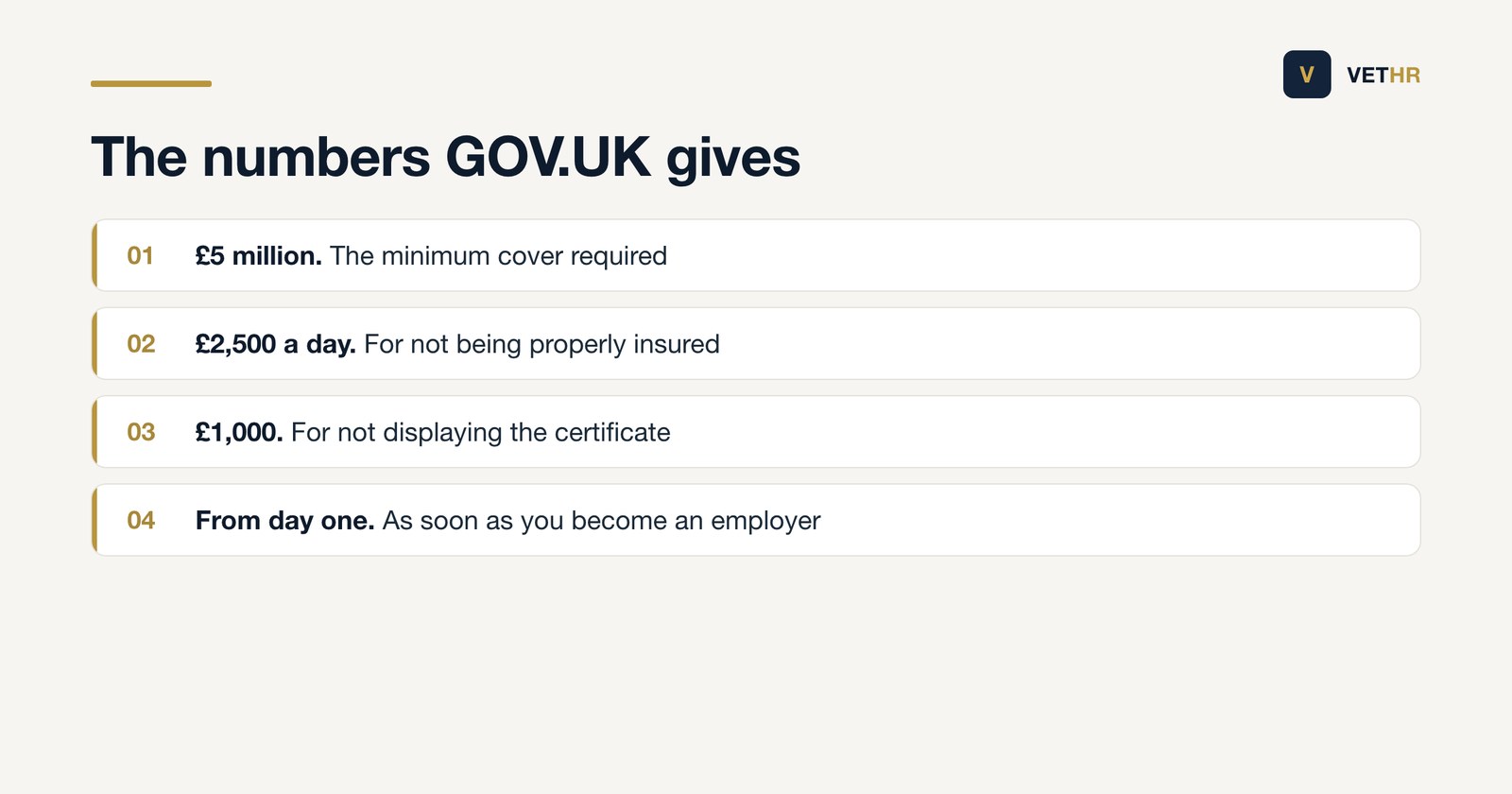
GOV.UK puts it simply. You need employers’ liability insurance as soon as you become an employer, and the policy must cover you for at least £5 million.
Not once you hit five staff. Not once you take on your first full-time vet. As soon as you become an employer, which for most practices is the day the first contract starts.
It also sits on the official list of things to do before anybody starts. GOV.UK’s guide to employing staff for the first time runs through the steps, and getting employers’ liability insurance is step five, alongside registering as an employer and setting up PAYE.
The penalty for having no employers’ liability insurance is not a one-off. GOV.UK states you can be fined £2,500 every day you are not properly insured.
Read that as a daily rate and the arithmetic becomes uncomfortable quickly. A lapse nobody noticed over a quiet August is not a paperwork slip, it is a number with several zeros on it.
The certificate carries its own penalty. If you do not display it where employees can access it, GOV.UK says you could be fined £1,000. Two separate failures, two separate fines, and both are avoidable in an afternoon.
GOV.UK says to display your EL certificate where employees can access it, for example at your workplace, on your website or on a work intranet, and to show it to inspectors when they ask.
That is more flexible than the old poster-on-the-wall assumption, and it suits a practice with branches. An intranet copy that every site can open beats a laminated sheet in one staff room that nobody else ever sees.
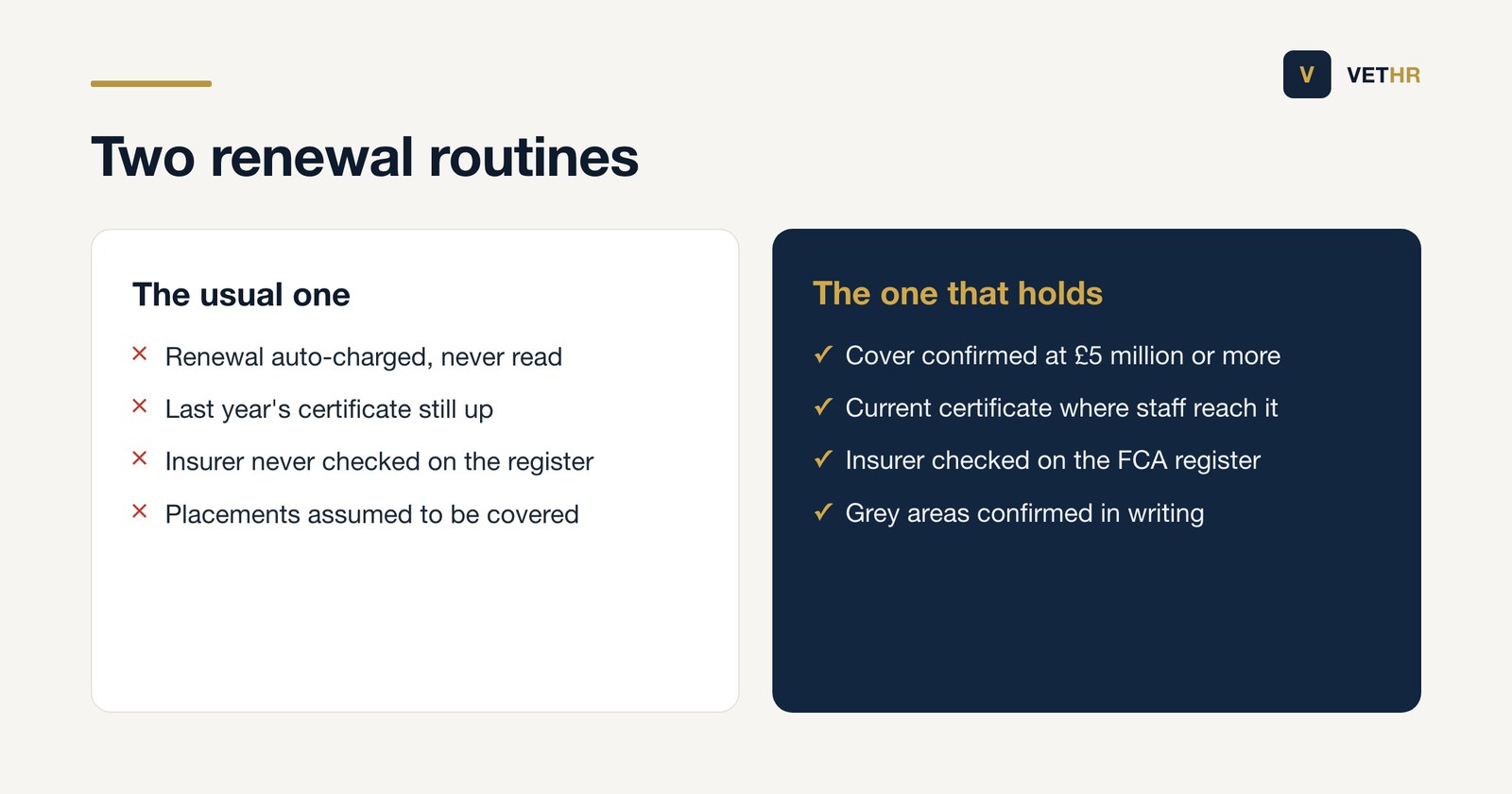
Whichever route you take, make sure it is the current certificate. A renewal that never replaced last year’s copy is the single most common finding when we audit this, and it is indistinguishable from not displaying one at all.
Employers’ liability insurance only counts if it comes from an authorised insurer. GOV.UK tells you to check by looking at the Financial Conduct Authority register, or by contacting the Financial Conduct Authority.
This takes two minutes and almost nobody does it. If you buy through a broker, ask which insurer is actually carrying the risk, then check that name rather than the broker’s.
Put the check in the same annual routine as the renewal itself, so it happens once a year without anyone having to remember.
Narrow, and narrower than people hope. GOV.UK says you do not need employers’ liability insurance if you only employ either a family member, or someone who is based outside of England, Scotland and Wales.
Note the word only. A single-handed practice where the owner’s spouse does the books and nobody else is employed may sit inside that exemption. Add one part-time receptionist and it does not.
GOV.UK also flags that the rules are different for other employment statuses, such as agency staff, freelancers, consultants and contractors. If your practice runs on a mix of employed and self-employed people, read our guide to employment status in a veterinary practice before assuming anyone falls outside the policy.
Nobody cancels employers’ liability insurance on purpose. It goes in three ordinary ways, and all three are worth knowing because the daily fine does not care how it happened.
A card expires and the renewal payment fails, with the notice going to an inbox belonging to somebody who left. A practice changes its legal entity, from a sole trader to a limited company or into a partnership, and the policy stays in the old name. Or the business is bought and the buyer assumes the seller’s cover came with the building.
Fix it the dull way. Put the renewal date in the practice compliance calendar rather than only in an insurer’s reminder email, point the policy correspondence at a shared practice address rather than a personal one, and make employers’ liability insurance an explicit line on the checklist any time the ownership or legal structure changes.
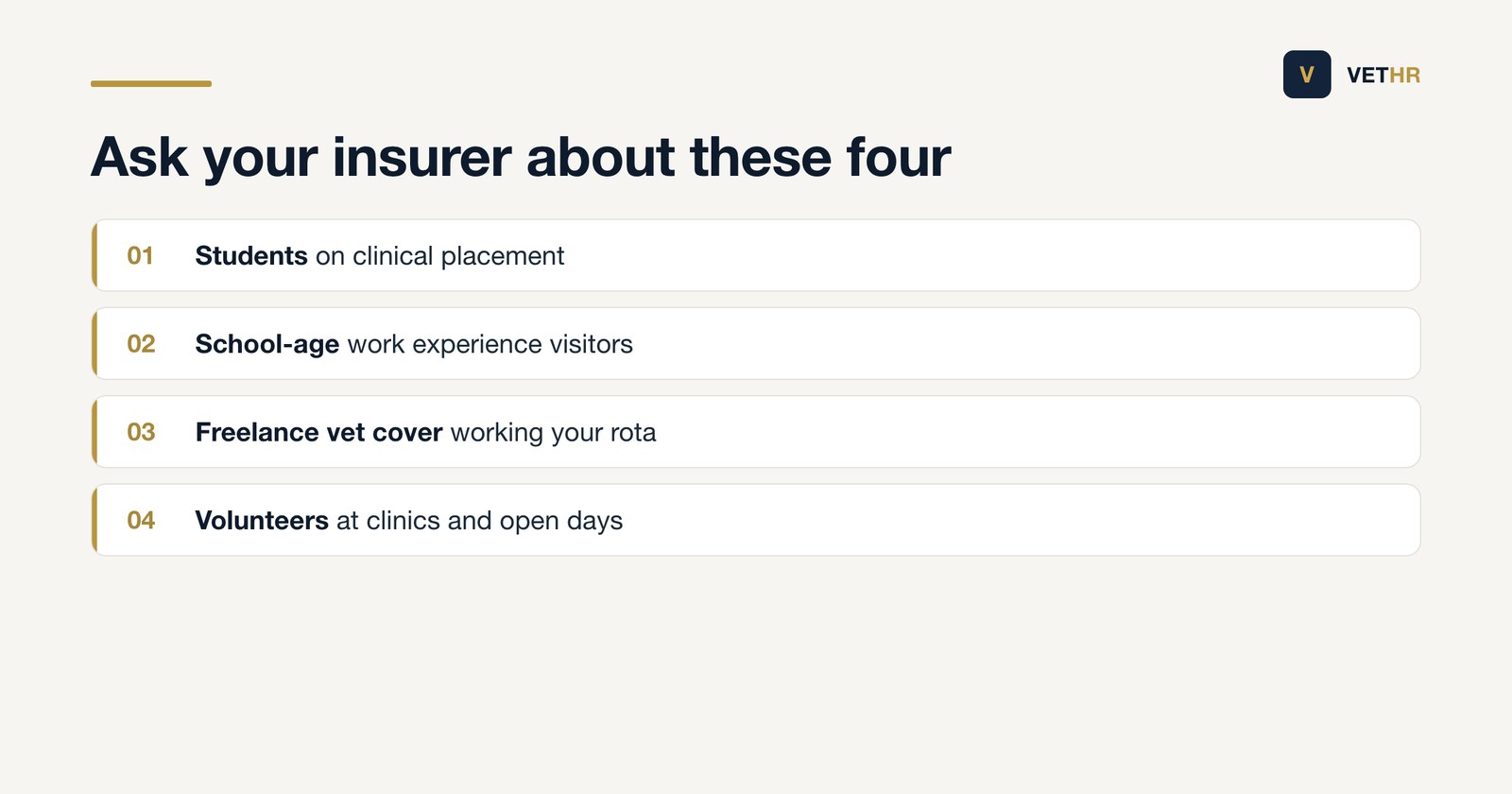
Four situations come up constantly in practice, and the honest answer to all of them is the same: ask your insurer in writing, and keep the reply.
None of this is exotic. It is a phone call and an email, once, and the written answer sits with the policy documents. Our notes on work experience in a veterinary practice cover the rest of what to arrange before somebody shadows your team.
Ask the same question about home visits and branch work. Employers’ liability insurance follows the employee rather than the building, but a policy written around one site should still be checked against how your team actually works.
In veterinary work the pattern is boring and predictable. Bites and scratches. Lifting injuries from large dogs and awkward tables. Needlestick. Slips on wet floors. Anaesthetic gas exposure. Occasionally stress and psychological injury.
Employers’ liability insurance pays out. It does not stop the injury happening, and it does not answer the health and safety question that follows. The practices that rarely claim are the ones with current risk assessments, working extraction and a first aider who is actually on shift.
Our guides to RIDDOR reporting, zoonoses risk assessment, lone working and first aid at work cover the prevention side. Book a free 30-minute HR health check if you want the whole compliance file looked at in one pass.
GOV.UK says the policy must cover you for at least £5 million. Most commercial policies sold to veterinary practices offer £10 million as standard, but £5 million is the floor and it is worth confirming rather than assuming.
GOV.UK states you can be fined £2,500 every day you are not properly insured. There is a separate £1,000 penalty if you do not display the certificate where employees can access it.
Not necessarily. GOV.UK says to display it where employees can access it, giving your workplace, your website or a work intranet as examples, and to show it to inspectors when asked. A branch practice is usually better served by an intranet copy.
Yes. The requirement starts as soon as you become an employer and does not depend on hours or headcount. The only stated exemptions are where you employ only a family member, or only someone based outside England, Scotland and Wales.
Ask your insurer and keep the answer in writing. GOV.UK’s guidance does not address students, work experience or volunteers, so the question belongs to your policy wording rather than to a general rule.
Check the employers’ liability insurance cover is at least £5 million. Check the insurer on the Financial Conduct Authority register. Put the current certificate somewhere every employee can reach it. Get the grey areas confirmed in writing.
That is employers’ liability insurance dealt with for another twelve months. We build the annual compliance calendar that carries it through HR consultancy for veterinary practices and the policy document set.
The Vet HR Team provides HR consultancy and white-labelled staff systems exclusively to UK veterinary practices.
Contracts, rotas, holiday, a difficult conversation. Tell us what you are dealing with and we will come back within one working day. Nothing to sign up to.
Got it. We will come back to you within one working day. If you do not see a reply, please check your spam folder.
