Last updated: 14 June 2026
TL;DR: Work experience in a veterinary practice is worth doing and easy to get wrong. School-age students, 16 to 18 year olds and university placements each follow different rules. This guide covers who can come in, the working hour limits for under 18s, when an unpaid placement quietly becomes a paid worker, insurance and supervision, safeguarding common sense, and a simple placement agreement checklist.
Every practice gets the work experience emails: a Year 10 student who loves animals, a college student who needs placement hours, a vet student between rotations. Saying yes is good for the profession and for your future recruitment. Saying yes safely takes about an hour of setup, and this guide covers all of it.
Three groups, three rule books. School-age students sit under child employment law, with tight limits on when and how long they can be in the building. Young people over school leaving age but under 18 are young workers with their own working time rules. College and university students on course placements follow the minimum wage placement rules.
For paid part-time work, GOV.UK guidance on child employment is specific: children can work part-time from the age of 14, or from 13 in some local council areas, and can only start full-time work once they have reached school leaving age. Local bylaws set the detail, and depending on those bylaws a child may need an employment permit issued by the education department of the local council.
A placement arranged through a school is a different animal from a Saturday job: the school usually brings its own paperwork and expectations. Treat that paperwork as a starting point, not the whole answer. The student is still in your building, around animals, medicines and equipment, and your own rules still need to exist.
Post-16 students and university placements bring more capability and longer availability, but under 18s still have hard hour limits, and degree placements bring the minimum wage questions covered below. A vet student on clinical placement is usually the easiest yes of the three. A Year 10 student is the one that needs the most structure.
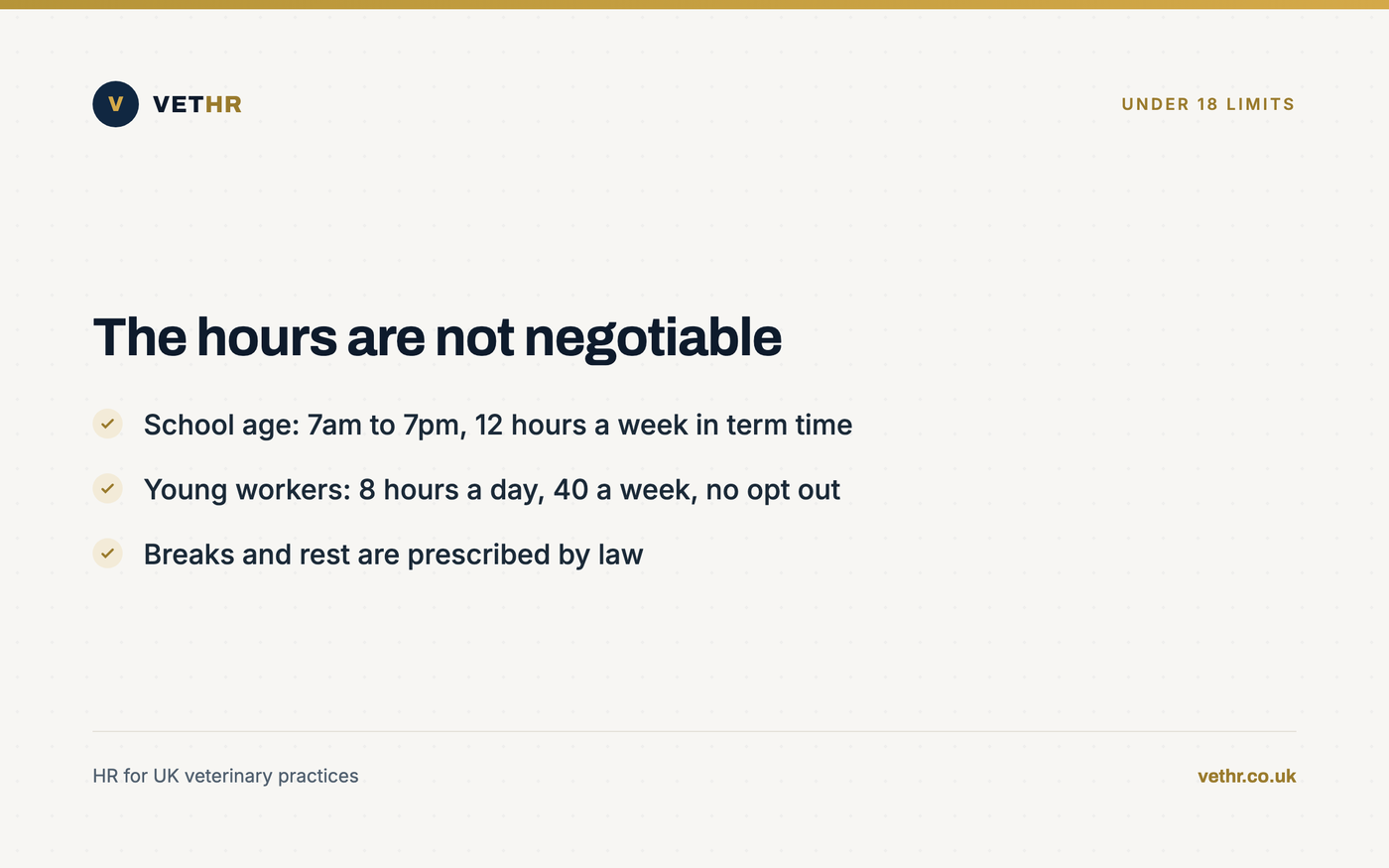
Strict, specific and not negotiable. A school-age student cannot work before 7am or after 7pm, cannot work during school hours, and is capped at 12 hours a week in term time. A young worker over school leaving age but under 18 cannot work more than 8 hours a day or 40 hours a week.
GOV.UK sets out the school-age limits in its guidance on restrictions on child employment. In term time: a maximum of 12 hours a week, no more than 2 hours on school days and Sundays, and Saturdays capped at 5 hours for 14 year olds or 8 hours for 15 to 16 year olds.
School holidays are more generous but still capped: 25 hours a week for 14 year olds and 35 hours a week for 15 to 16 year olds, with Sundays limited to 2 hours for both. Breaks are prescribed too: a rest of at least 1 hour after 4 hours of work, and a 2 week break from any work during the school holidays in each calendar year. If the student has a Saturday job elsewhere, factor it in when you set their days: the caps exist to protect the whole of a child’s week.
For young workers past school leaving age but under 18, GOV.UK is equally plain: no more than 8 hours a day or 40 hours a week, with no adult style opt out. They are also entitled to a 30 minute break once they work more than 4.5 hours, 12 hours of rest between working days and 48 hours of weekly rest, under the rest rules for young workers.
Map that onto a clinic day before you promise anything. A 7.30am to 6.30pm consulting day breaches the daily limit for a young worker on its own, before any Saturday morning is added. Build their week from the limits down, not from the rota up.
The moment the person becomes a worker rather than an observer. GOV.UK guidance on the minimum wage for work experience and internships is clear that entitlement depends on the reality of the arrangement, not the label: calling someone unpaid or a volunteer does not prevent them qualifying if they are in fact working for you.
Four groups can be genuinely unpaid, according to GOV.UK guidance on employment rights for interns. Work experience students of compulsory school age are not entitled to the minimum wage. Students on a placement that is a required part of a UK further or higher education course, and that does not exceed one year, are not entitled either. Someone purely work shadowing, observing and doing no work, sits outside the legislation. And voluntary workers have their own exemption, but only for charities, voluntary organisations and similar bodies, which a commercial practice cannot borrow.
The trap is drift. The student who arrived to observe is, three days later, holding for consults, cleaning kennels on a rota and covering reception at lunch. The same guidance notes that an intern promised a contract of future work is classed as a worker and due the National Minimum Wage. If the practice has started to rely on what they do, stop and reassess: pay them properly or return them to genuine observation.
Not sure which side of the line your placements sit on? Book a free HR health check. In 30 minutes we will look at how your students actually spend their day, what your insurance and paperwork say, and what needs tightening before the next placement starts. Straight answers, nothing sold for the sake of it.
Two phone calls and one named person. Before a placement starts, tell your insurer that students will be on site and confirm in writing that your cover extends to them. Then give every student a named supervisor for every shift, because a placement without a supervisor is just an unaccompanied teenager in a clinical building.
Induct them like a new starter, scaled down to a morning. Day one covers dress and hygiene, where they may and may not go, what to do around animals they do not know, and the flat rule that needles, medicines and imaging areas are out of bounds unless a supervisor says otherwise and stands beside them.
Reread your risk assessments through the eyes of someone young and inexperienced before each placement. The hazards a practice normalises, sharps, zoonoses, anaesthetic gases, a stressed Rottweiler, are exactly the ones a 15 year old does not see coming. Decide in advance which tasks are never theirs, and tell the whole team, not just the student.
If something does happen, treat it exactly like a staff incident: record it the same day and review it. Our See It Report It system gives every practice, and every student, one simple route to report an incident or a near miss from any phone.
With structure, not paranoia. Safeguarding for placements is mostly common sense written down: under 18s are never alone behind a closed door with one adult, never sent off site alone, and always have a named adult to raise worries with. Saying no is part of the same discipline: a good no protects every future yes.
Collect parental or guardian consent and an emergency contact before day one, and brief the team on conduct around the student. Plan for the hard moments too. A student may be present when an animal is put to sleep. Decide beforehand whether they stay in the room, ask the client, and always debrief afterwards.
Saying no well is a system, not an apology. Set fixed placement windows in the year, cap the number of students at a time, keep a waiting list, and hold a warm template reply that points to the next window or a quieter practice nearby. Most placement problems happen in practices that said yes to everyone and prepared for no one.
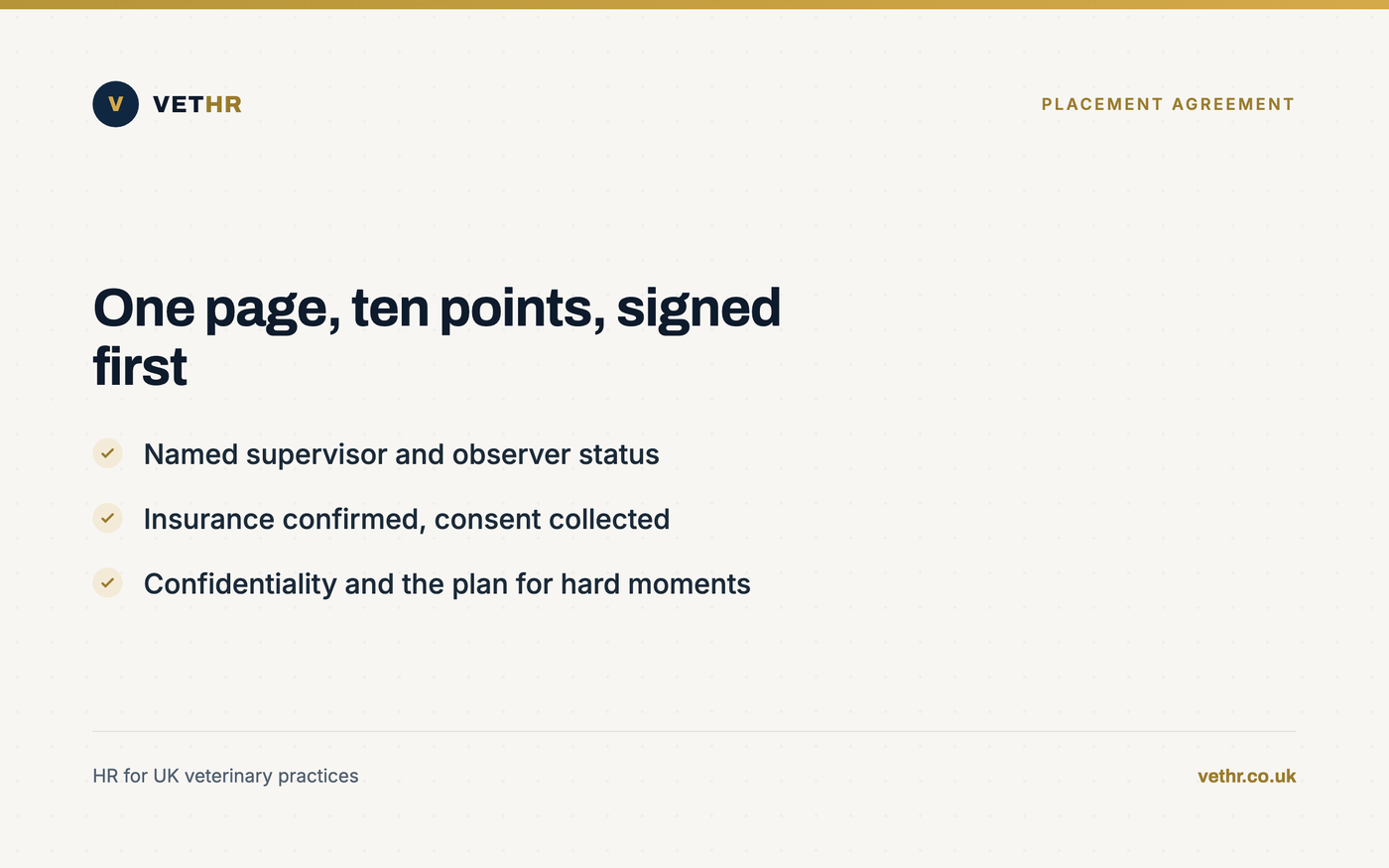
One page, ten points, signed before day one. A placement agreement is not a contract of employment and should not read like one. It is a shared understanding between the practice, the student and, for under 18s, a parent or guardian, about what the placement is and is not.
Keep the agreement beside a short work experience policy so every placement runs the same way whoever arranges it. And treat good placements as the start of a pipeline: the school student who was welcomed properly is tomorrow’s apprentice veterinary nurse, and the practice that structures placements is the one they come back to.
Not if they genuinely fall into an exempt group: students of compulsory school age, students on a required UK further or higher education placement that does not exceed one year, or someone purely observing. Anyone else who is actually working is likely a worker and due the National Minimum Wage, whatever the arrangement is called.
A maximum of 35 hours a week applies to 15 to 16 year olds: up to 8 hours on weekdays and Saturdays and 2 hours on Sundays, never before 7am or after 7pm, with a 1 hour break after 4 hours of work. They must also have a 2 week break from any work during the school holidays each calendar year.
Once they are past school leaving age, yes, within the young worker limits: no more than 8 hours a day or 40 hours a week with no opt out, a 30 minute break when working more than 4.5 hours, 12 hours of rest between working days and 48 hours of weekly rest.
Possibly. Depending on local bylaws, a school-age child may need an employment permit issued by the education department of the local council, and the rules on what children can do vary from area to area. Check with the council covering the child’s school before the placement starts, and keep whatever paperwork they issue on file.
That is your call, not a legal formula. Many practices allow theatre observation with the client’s consent and a supervisor beside the student, and keep euthanasia to older students who have been prepared and are debriefed afterwards. Decide your line before the placement, write it into the agreement, and never let a student discover it in the moment.
Work experience is one of the cheapest recruitment and goodwill tools a practice has, and one of the easiest things to run badly. The rules are not onerous: respect the hour limits, keep observers observing, supervise properly and write the whole thing down once.
If placements at your practice currently run on goodwill and memory, put an hour into fixing that. A short placement policy in a proper policy library keeps every student safe and every yes easy, or book a free HR health check and we will set the whole framework up with you.
The Vet HR Team provides HR consultancy and white-labelled staff systems exclusively to UK veterinary practices.
Contracts, rotas, holiday, a difficult conversation. Tell us what you are dealing with and we will come back within one working day. Nothing to sign up to.
Got it. We will come back to you within one working day. If you do not see a reply, please check your spam folder.
