Last updated: 17 July 2026
TL;DR: An apprentice veterinary nurse has the same employment rights as any employee. The apprentice minimum wage is £8.00 an hour under the April 2026 rates, but only while the apprentice is under 19 or in the first year of the apprenticeship; after that the age rate applies. Add at least 20% paid off-the-job training time, normal holiday, a proper apprenticeship agreement, and a fair process at the end.

Apprenticeships are how many independent practices grow their own nursing team. They are also where quiet payroll and contract mistakes hide, because the rules change with age and year of training. Here is what employing an apprentice veterinary nurse involves, with every rate checked against live GOV.UK guidance.
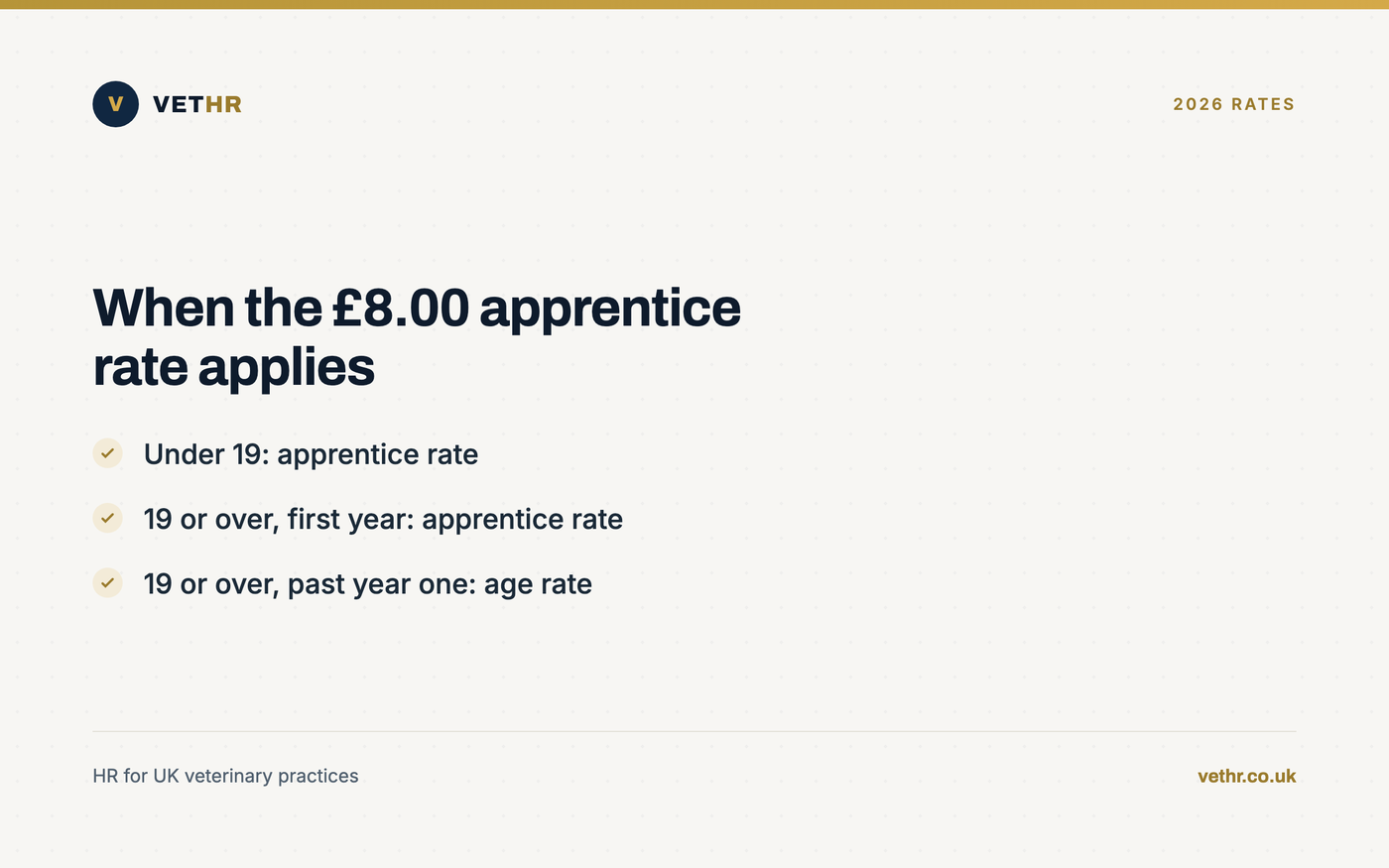
The apprentice rate is £8.00 an hour under the rates that took effect in April 2026. It applies only while the apprentice is under 19, or aged 19 or over and in the first year of the apprenticeship. Everyone else must get the normal minimum rate for their age.
The full set, from GOV.UK’s National Minimum Wage rates page: £12.71 an hour at 21 and over, £10.85 at 18 to 20, and £8.00 for under 18s and eligible apprentices. The under 18 rate and the apprentice rate are currently the same figure, so for an apprentice under 19 both routes arrive at the same number.
GOV.UK’s own worked example is the one to remember: an apprentice aged 21 who has completed the first year of their apprenticeship is entitled to £12.71 an hour, not £8.00. The apprentice rate is a narrow concession for the start of training, not a wage band for the whole programme.
Rates change on 1 April every year, per the same GOV.UK page. Any figure in an offer letter or contract should be written as a floor rather than a fixed promise, and checked against the live page each spring.
The day the apprentice is both 19 or over and past the first year of the apprenticeship. From then on the age band applies. Two dates trigger the change: the first anniversary of the apprenticeship and the relevant birthdays, and payroll needs a reminder set for each of them.
The common failure is not meanness, it is inertia. The rate is set correctly at the start and never revisited, so a nurse who passes the one year mark at 19 or over keeps the starter rate for months. Every one of those payslips is an underpayment the practice will have to put right.
The fix is administrative. Put the apprenticeship start date and each relevant birthday in the payroll calendar on the day the agreement is signed, and check the whole team against the new GOV.UK figures every April. Ten minutes twice a year beats months of back pay corrected the hard way.
At least 20% of their normal working hours, spent on training that is part of the apprenticeship, and that time must be paid. On a full five day pattern that is the equivalent of about one day a week, and it belongs on the rota as a fixed commitment, not a gap to fill.
GOV.UK’s guidance on apprentice pay and conditions states apprentices must be paid for their normal working hours and for training that is part of the apprenticeship, described as at least 20% of normal working hours. Study towards English and maths qualifications is also paid where it is part of the apprenticeship.
In a busy practice the training day is the first thing raided when a vet is off sick or the ops list runs over. Resist that. The 20% is what the agreement is built on, and a student who keeps losing study days falls behind the course while staying on your payroll. Build the day into the rota template itself, the way we treat protected patterns in our rota system for veterinary practices, so covering it is planned rather than improvised.
An apprenticeship agreement and a training plan, alongside the normal employment paperwork. GOV.UK lists both among the employer’s obligations, and ACAS is clear that apprentices have the same employment rights as employees, so everything a normal contract covers still applies: hours, pay, holiday, sickness and notice.
GOV.UK’s guide to taking on an apprentice includes making an apprenticeship agreement and training plan with your apprentice among the required steps, and the pay guidance adds that the employment contract should confirm the rate of pay. The agreement and the contract need to tell the same story about hours, wage and the expected end date of the programme.
This is where drafting earns its keep. A vague end date, a wage clause that names a number with no review, or a contract silent on what happens after qualification all store up problems. Our veterinary contracts service aligns the apprenticeship paperwork with the employment contract so the two never contradict each other.
Taking on your first apprentice, or partway through one and unsure the paperwork is right? Book a free HR health check. In 30 minutes we will check the rate, the agreement and the training time against the current rules and tell you plainly what needs fixing first.
The same statutory holiday as any worker: 5.6 weeks of paid leave a year, which for a full five day week means 28 days. GOV.UK’s apprentice guidance describes this as at least 20 days of paid holiday plus bank holidays. Entitlement keeps building during training days as well as clinic days.
The statutory floor comes from GOV.UK’s guidance on holiday entitlement: almost all workers are legally entitled to 5.6 weeks of paid holiday a year, with statutory paid leave capped at 28 days and part-time staff pro rata. The apprentice-specific page puts it as at least 20 days of paid holiday a year plus bank holidays.
ACAS adds the detail employers miss: apprentices accrue holiday at the same rate as other employees, including during time spent on work-related training. A college day is not a day off. For part-time or irregular patterns the arithmetic gets fiddly, which is exactly the job our holiday calculations system does automatically from the hours actually worked.
Student veterinary nurses train in a practice environment approved for training, with named supervision from suitably qualified colleagues, under requirements set by the RCVS and the training provider. Those requirements are for the RCVS to define and they do change, so confirm the current rules directly before you enrol anyone.
Treat supervision as a rota question as much as a clinical one. The student’s working days need enough qualified cover for supervision to be real rather than nominal, and the supervising colleagues need time in their own week to do it properly. A rota that shows skill mix per shift makes both visible.
Be honest about capacity before advertising the post. An apprentice placed in a practice too stretched to supervise them learns bad habits, progresses slowly, and is more likely to leave the profession. The training plan agreed with your provider is the reference point for what your practice has signed up to deliver.
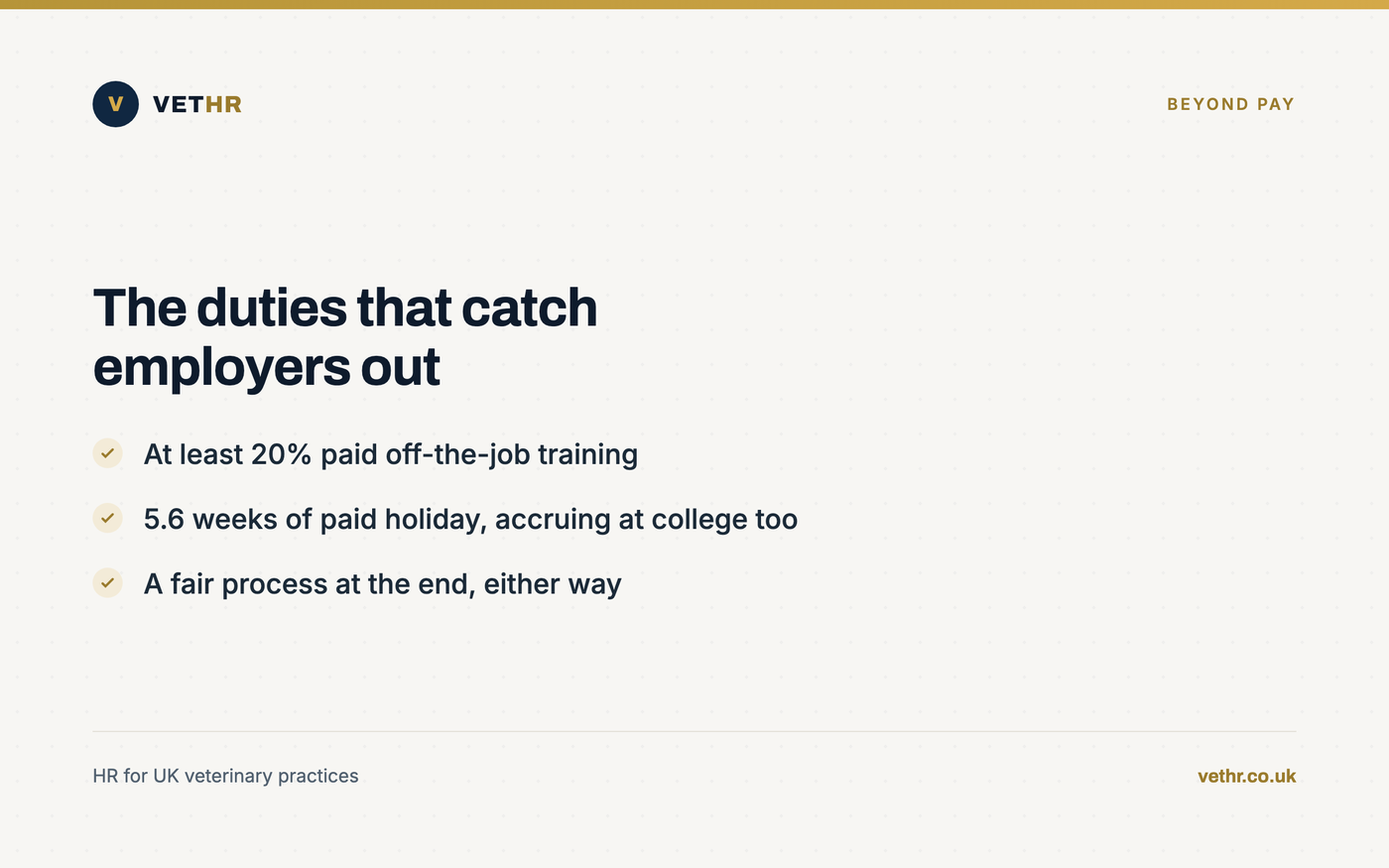
There is no automatic job at the end. ACAS guidance on apprentices states they are not guaranteed a role once the apprenticeship finishes, and that where a fixed-term arrangement is not renewed, that still counts as a dismissal. So the employer needs a fair reason and a fair process either way.
The ACAS guidance on apprentices also notes that employment before and after an apprenticeship counts towards continuous service. A nurse you keep on does not restart the clock, and their apprenticeship years count towards redundancy and other service-based rights later.
Plan the decision months out, not in the final week. If you intend to keep them, budget for the step from apprentice pay to a qualified salary and issue an updated contract before the old arrangement lapses. If you cannot keep them, run the fair process properly and say so early. How a practice ends an apprenticeship is watched closely by the rest of the team.
Only during the first year of the apprenticeship. Once the first year is complete, an apprentice aged 19 or over moves to the rate for their age, and at 21 or over that is the National Living Wage of £12.71 an hour, per GOV.UK’s National Minimum Wage rates. Set a payroll reminder for the anniversary.
Yes. Training that is part of the apprenticeship, at least 20% of normal working hours, must be paid, and study towards English and maths qualifications is paid too where it is part of the programme, according to GOV.UK’s apprentice pay and conditions guidance.
No more than 8 hours a day or 40 hours a week, per GOV.UK guidance on maximum weekly working hours. Adult apprentices fall under the usual limit of a 48 hour weekly average, which they can only exceed by choosing to opt out.
Yes. ACAS states apprentices accrue holiday at the same rate as other employees, including during work-related training. A day at college builds entitlement exactly as a day in the clinic does, so accrual should run from all working hours, not clinic hours alone.
No. There is no automatic right to a permanent role. But letting a fixed-term apprenticeship simply lapse still counts as a dismissal under ACAS guidance, so you need a fair reason and a fair process. Decide early, communicate early, and document the steps either way.
Employing an apprentice veterinary nurse rewards the organised practice. The wage concession expires on dates you can diary today, the training time is a fixed slice of the rota, and the ending is a formal employment decision rather than a drift. Get those three right and the rest is good management.
If you are taking one on this year, start with the paperwork. Have our contracts service align the apprenticeship agreement with the employment contract, let our holiday calculations system handle accrual across college and clinic days, or book a free HR health check and we will check the whole setup in 30 minutes.
The Vet HR Team provides HR consultancy and white-labelled staff systems exclusively to UK veterinary practices.
Read next: Veterinary Payroll: The Nine Checks to Run Before Every Pay Day.
Contracts, rotas, holiday, a difficult conversation. Tell us what you are dealing with and we will come back within one working day. Nothing to sign up to.
Got it. We will come back to you within one working day. If you do not see a reply, please check your spam folder.
