TL;DR: A contractor is anyone you ask to do work for you who is not an employee. HSE says both you and the contractor have responsibilities under health and safety law. Identify the job, choose a contractor after checking competence, assess the risks of the work together, give information, instruction and training, cooperate and coordinate, consult your workforce, and manage and supervise the work in proportion to the risk. A safety method statement is not required by law but helps. If the work is construction, you have client duties under the CDM Regulations. The guide does not cover agency workers.
Last updated: 20 November 2026

A practice hires a firm to replace the extraction fan on the roof. The firm is cheaper than the other quote and starts on Monday. Nobody tells them about the fragile roof light by the plant, the oxygen cylinders stored beneath the access hatch or the fact that the theatre is in use. On Tuesday a ladder is placed in the recovery corridor, a nurse carrying a patient has to step round it, and the practice manager finds out that the contractor has no method statement and no information on who will supervise.
Using contractors does not pass your responsibility to them. HSE’s guide Using contractors: a brief guide sets out what a business must do to comply with health and safety law when it brings someone else’s workers onto its premises. This guide on using contractors applies it to a veterinary practice and covers builders, engineers, cleaners, waste collectors, IT installers and anyone else who is not your employee. It is general information, not legal advice.
HSE says a contractor is anyone you ask to do work for you who is not an employee. In a practice that includes builders, electricians, gas and heating engineers, equipment service engineers, cleaners, window cleaners, waste carriers, IT installers and a freelance handyman. HSE’s guide does not cover temporary or agency workers, who have their own guidance.
The HSE leaflet Using contractors: a brief guide, INDG368(rev1), says both you and the contractor have responsibilities under health and safety law. Everyone needs to take the right precautions to reduce the risks of workplace dangers to employees and the public, and everyone must understand the part they need to play.
Our guide to agency workers covers temporary staff, and HSE says its contractor guide does not apply to them. If in doubt about someone’s status, treat them as covered by your own induction and controls.
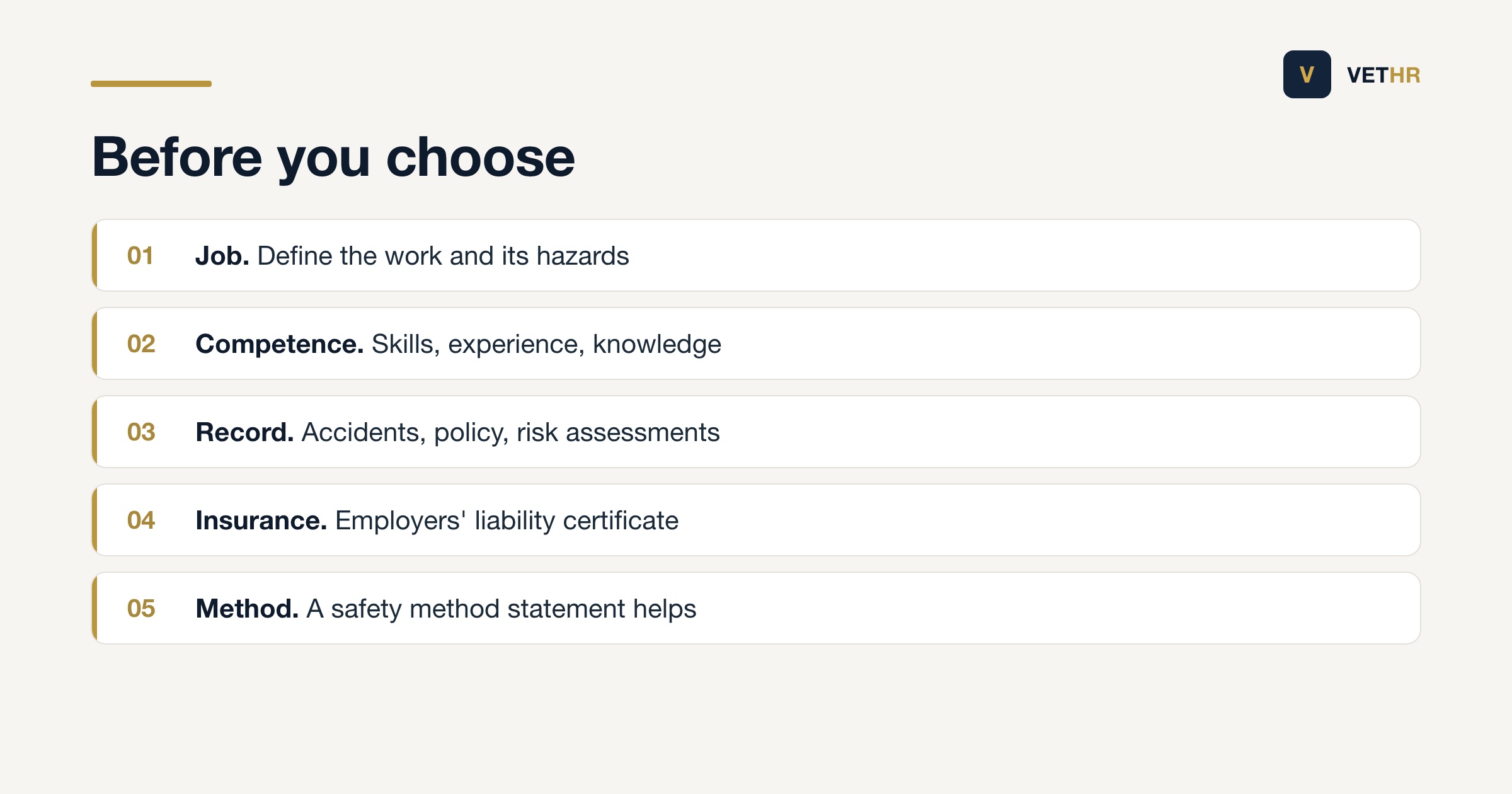
Identify everything the work involves, consider its health and safety implications and put them in the job specification so contractors understand the performance you expect. Then make enquiries about competence, in proportion to the risk. HSE says the degree of competence depends on the work, and that you should not assume someone is competent.
HSE’s example questions for a potential contractor give a ready-made list:
HSE adds that you may also ask about independent assessment of competence, membership of a trade association or professional body, and whether the contractor will produce a safety method statement. A method statement is not required by law, but HSE says it describes in a logical order how a job will be done safely, includes the risks from the risk assessment and the controls needed, and lets the job be properly planned and resourced.
HSE’s own case study makes the point. A tree surgeon felled a branch into a neighbour’s garden, where a woman and child had been playing an hour earlier. He had neither the qualifications to use a chainsaw nor the skill to do the job safely. HSE says that if the person who hired him had checked his competence, the incident would have been avoided. Its advice: do not assume someone is competent, check it yourself.
Check the employers’ liability certificate as well. Our guide to employers’ liability insurance explains what the certificate shows. Ask for a copy and keep it on file, because using contractors without insurance leaves you exposed.
Both you and the contractor must think about what can harm people, who might be harmed and how, and how to control the risks. Your own risk assessment should cover risks to contractors from your business, such as asbestos and on-site vehicles, and you must agree controls with the contractor before work starts.
HSE says the contractor must assess the risks of the contracted work, and then both of you must get together to consider any risks from each other’s work that could affect the workforce or anyone else. Include health risks, such as noise or harmful substances, as well as safety risks, and once you have agreed actions be clear about who will do what and when.
For a practice, the risks from your premises that contractors need to know about include asbestos, fragile roofs and rooflights, compressed gases and cylinders, pressure equipment, radiation areas and controlled areas, zoonotic infection and clinical waste, animals, working anaesthetic equipment and live electrical or pressure systems. Our guides to the asbestos register, work at height and pressure systems cover three of them.
The risks from the contractor’s work to your people and the public matter as well: dust and noise near the theatre, ladders in corridors, open ceilings above patient areas, parked vans in the client car park, doors propped open and unlocked, cables across floors, hot work and fire risk. HSE’s case studies include a worker killed by a contractor’s vehicle where neither side had identified pedestrian routes. Plan the access, parking, storage and routes before the first day, whenever you are using contractors.
If the work is construction or building work, HSE says you have duties as a client under the Construction (Design and Management) Regulations 2007, and points to its guide for clients. For significant building works at a practice, take advice on CDM before you appoint anyone.
HSE says to give contractors and their employees information on the health and safety risks they may face, the measures in place to deal with them and your emergency procedures, in a form that is easy to understand. Take particular care with anyone whose first language may not be English.
HSE’s examples show why. A farm worker was seriously injured when an irrigation pipe touched overhead power lines, because the employer had not discussed the lines or agreed a safe way to move the pipes. HSE says not to assume that contractors will be aware of all risks, even if they seem obvious to you.
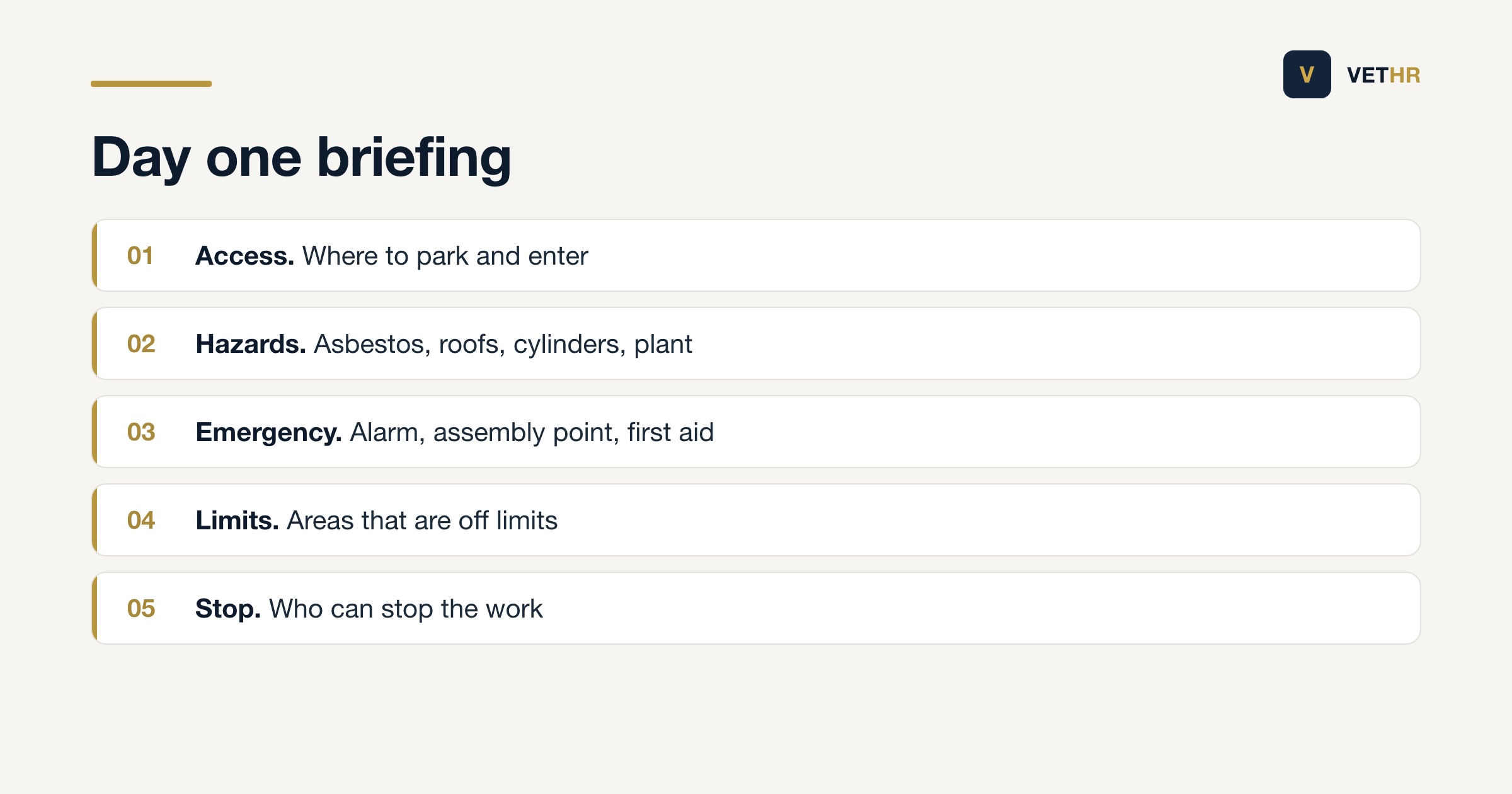
For a practice, a one-page contractor briefing sheet works well. It should cover where to park and where to enter, who to report to, the areas that are off limits, the location of asbestos and other hazards from the register, fire alarms and assembly points, first aid, what to do if an animal is loose or a client approaches, and the contact for stopping work. Ask the contractor to sign it. Our fire safety guide covers the emergency procedures to include.
Give your own employees clear instructions too. They need to know who the contractors are, where they will be working, which routes to avoid and what to do if they have concerns.
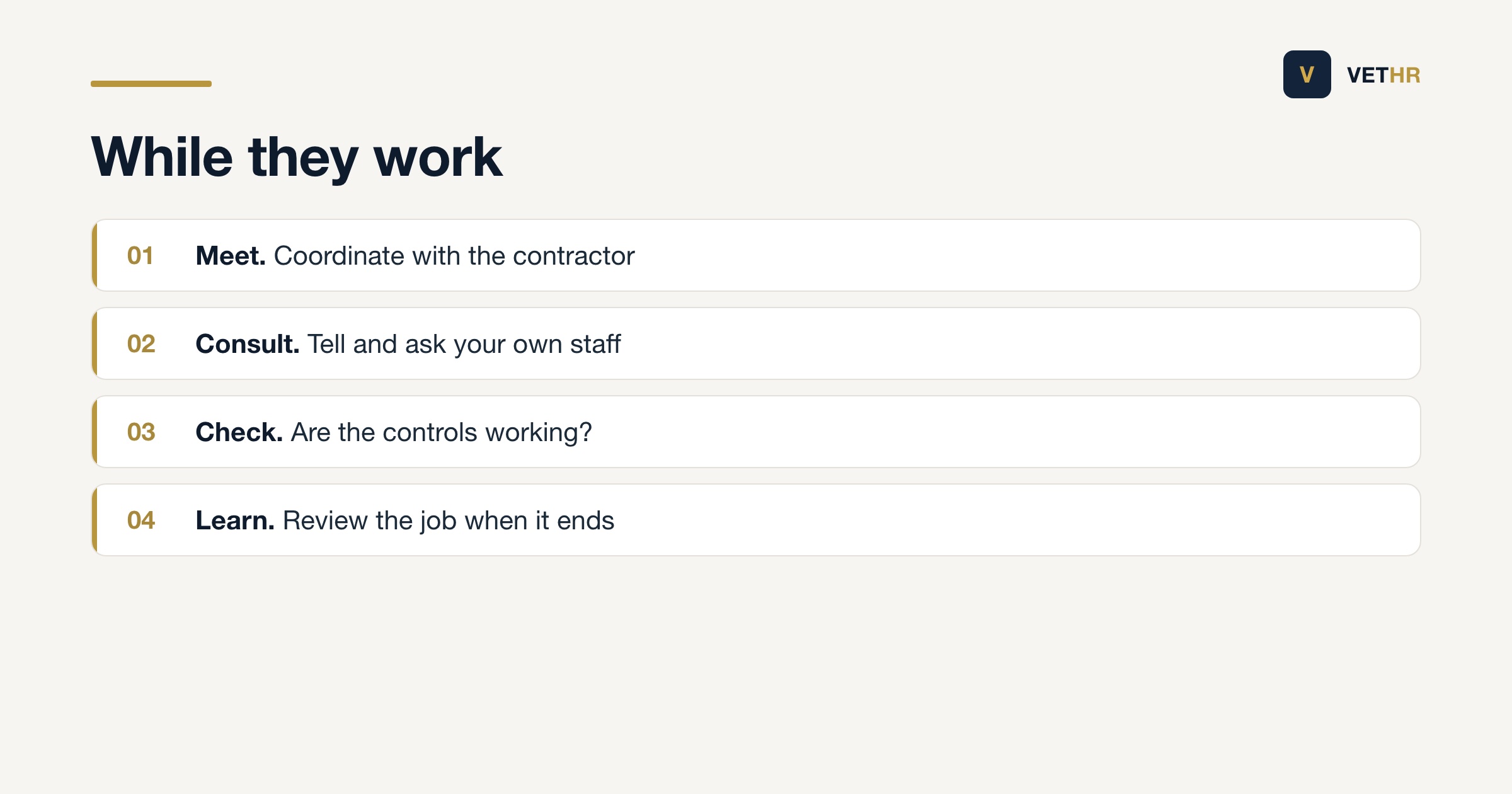
HSE says you and the contractor must work together and coordinate your activities, for example through regular meetings. You must consult your employees about how the contractor’s work affects their safety. You should decide who is responsible for the work, who will supervise it and how, and what arrangements there are for stopping work if there are serious concerns.
The level of cooperation depends on the job, the number of contractors and the risks involved. For a short visit by a service engineer a brief conversation at the start and end may be enough. For a refurbishment, weekly meetings with a standing agenda are more appropriate.
HSE says to consult your employees on how the contractor’s work will affect their health and safety, on information and training, and on how to raise concerns about the contractors. Its case study of a contractor who lost a leg on a conveyor makes the point that consulting employees might have identified the safe method of working. In a practice, the nurses and vets who work in the area every day will know about the corridor that is always busy at 9 am or the door that cannot be blocked.
On supervision, HSE suggests setting out who will be responsible, who will supervise and how, how the work will be done and what precautions will be taken, what equipment and PPE will be used and who provides it, the working procedures, including any permits to work, and the arrangements for stopping work. Keep a check once the work starts when using contractors: are the control measures working, and what went wrong if there is a near miss or an accident?
HSE’s guttering case study is a useful reminder: contractors installing guttering on a 7 m building could reach the roof by a mobile tower at the front, but there was no equipment to stop falls at the back. The employer should have decided how the work would be carried out, what equipment would be used and who would supply it before work started. Do not assume the contractor will have the right equipment.
HSE says to review the job and learn any lessons so that performance can be improved in future. Check the work against what was agreed, make sure the area is safe to return to use, update your records and asbestos register if anything was found, and record any issues for the next time you use that contractor.
Practical points after a job include a walk-round to check for hazards such as unprotected openings, loose cables and debris, testing of any systems that were isolated, confirmation that fire detection and alarms were reinstated, the return of any keys or access cards, and the handover of certificates and documents such as electrical test results and warranties.
Record the contractor’s performance. A short note on whether they arrived on time, followed the agreed procedures, left the area clean and safe, and reported any problems helps you choose between suppliers next time. HSE’s checklist at the end of its leaflet can be used as a review form.
If something went wrong, treat it like any other incident. Our guide to incident reporting explains how to record it, and the RIDDOR guide covers what must be reported to HSE.
Your health and safety policy should say who is responsible for appointing and managing contractors and what the arrangements are. Include a standard contractor checklist, a briefing sheet, a register of approved contractors and a log of permits to work.
Our guide to the health and safety policy explains the three parts HSE expects, and the arrangements section is where contractor management belongs. Name the person who approves contractors, usually the practice manager, and the person who supervises on the day. Keep the evidence of the checks you made for each job.
When using contractors regularly, such as cleaners and service engineers, do the checks once, record them, and refresh them each year or when anything changes. For one-off jobs, scale the checks to the risk. A window cleaner needs a short conversation and an insurance certificate. A roofer needs a method statement, a rescue plan and a site briefing.
The usual mistakes when using contractors are choosing on price alone, not checking competence, not telling them about hazards, no briefing for your own staff, no supervision, letting work start before the risks are agreed and never reviewing the job.
HSE says anyone you ask to do work for you who is not an employee. Its guide does not apply to temporary or agency workers.
Both you and the contractor have responsibilities. You must check competence, share risks, agree controls, coordinate and supervise in proportion to the risk. Hiring a contractor does not pass your duties on.
HSE says a safety method statement is not required by law, but it describes how the job will be done safely and helps planning, so it is good practice for higher risk work.
HSE says if the work is construction or building work you have duties as a client under the Construction (Design and Management) Regulations 2007. Take advice before you appoint anyone.
Information on the health and safety risks they may face, the measures in place to deal with them and your emergency procedures, in a form that is easy to understand.
If you want a checklist for using contractors, a briefing sheet and an approved contractor register set up for your practice, book a free 30-minute HR health check through our contact page. See also our HR consultancy for veterinary practices and the policies and handbook system.
Sources: HSE: Using contractors, a brief guide (INDG368 rev1).
Contracts, rotas, holiday, a difficult conversation. Tell us what you are dealing with and we will come back within one working day. Nothing to sign up to.
Got it. We will come back to you within one working day. If you do not see a reply, please check your spam folder.
