TL;DR: Agency workers have a contract with an agency but work temporarily for you, the hirer. From day one they must have the same access to your facilities and job vacancies as comparable staff. After 12 calendar weeks in the same job they are entitled to equal treatment on pay, working time, rest breaks, night work and annual leave. You must give the agency accurate information, and you are liable for day one failures.
Last updated: 11 November 2026
A branch loses a nurse at short notice and the agency sends a replacement for the week. The week becomes a month, then a quarter. Nobody has told the new nurse where she can park, whether she can see the vacancy for a senior role or what the practice pays its own nurses for the same shifts. Three months in, she asks, and nobody knows the answer.
This guide explains the rules on agency workers in a veterinary practice: what you owe from day one, what changes after 12 weeks, what you must tell the agency and who is liable if it goes wrong. It is general information and not legal advice.
GOV.UK says you are an agency worker if you have a contract with an agency but you work temporarily for a hirer. Agencies include recruitment agencies, often called temp agencies. You are not an agency worker if you use an agency to find permanent or fixed-term employment, because then the practice is the employer.
The GOV.UK page on agency workers’ rights sets out that definition. For a practice, the usual examples are temporary vets, nurses, receptionists and kennel staff supplied by an agency to cover leave, sickness, vacancies or a busy season.
Check the arrangement before assuming. The label does not decide it. If a person contracts directly with you as a genuinely self-employed contractor, the agency rules do not apply, but different issues arise, and you should take advice on employment status. If you are unsure whether someone is an agency worker, GOV.UK suggests contacting Acas.
From the first day of an assignment agency workers must have the same access to the hirer’s collective facilities as comparable direct staff, such as a canteen, crèche, transport or car parking, and must be told about relevant job vacancies that comparable staff can see. The hirer is responsible and liable for these rights.
GOV.UK’s guidance on the Agency Workers Regulations 2010 says less favourable treatment can only be defended on objective grounds, and that cost alone is unlikely to be enough. In practice, that means the temporary nurse uses the same staff room, kitchen, car park and rest area as your employed nurses, and sees the same vacancy notice board or email.
Make it routine. Add agency workers to the welcome checklist, show them the facilities, and send them the vacancy circular. Do not wait to be asked. A failure here is the hirer’s liability, not the agency’s.
After 12 calendar weeks in the same job with the same hirer, the worker is entitled to equal treatment on basic working and employment conditions: key elements of pay, the duration of working time, night work, rest periods and rest breaks, and annual leave. Any 7 day period counts toward the 12 weeks, even if the worker works only a few hours.
GOV.UK’s guidance says the aim is to treat the worker as if they had been recruited directly to the same job. The conditions are usually found in contracts, pay scales, collective agreements and handbooks. Pay excludes items such as occupational sick pay, pensions, redundancy and notice pay and expenses, and bonuses count only if tied to the individual’s own performance.
For a practice, the question to ask at week 10 is: what would we pay our own nurse in this job, and does the agency worker’s rate match? If you pay your employed nurses a shift premium for evenings, the agency worker is entitled to the same after 12 weeks. If you give your employed staff 28 days of annual leave, the agency worker’s entitlement is built from the same terms.
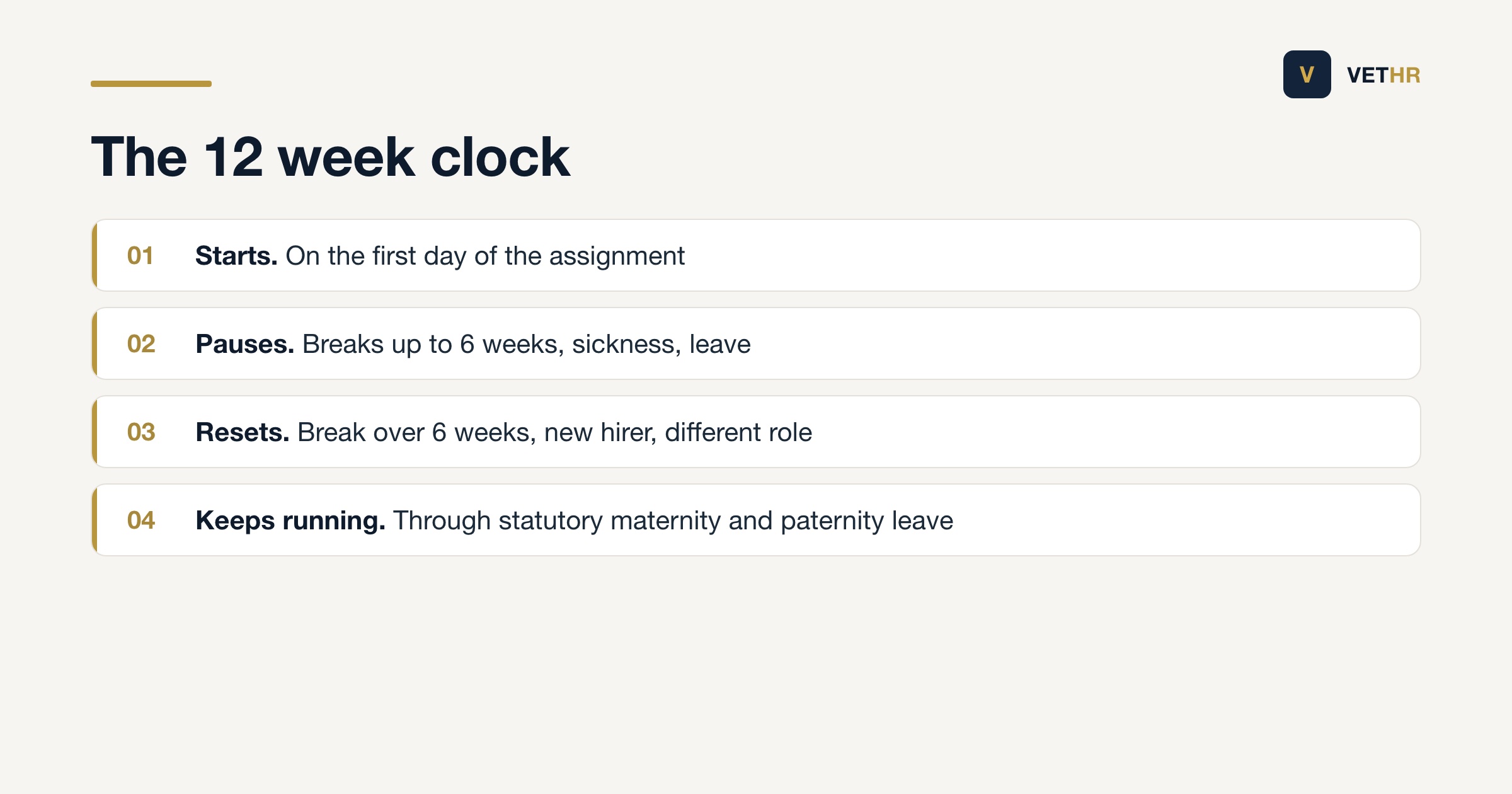
The clock starts when the assignment starts. It resets to zero if the worker moves to a new hirer, takes a substantively different role or has a break of more than 6 weeks. It pauses for breaks of up to 6 weeks, sickness absence, annual leave, shutdowns, jury service and industrial action, and keeps running through pregnancy-related absence and statutory family leave.
GOV.UK’s guidance gives the detail: the clock pauses for sickness absence of up to 28 weeks and for jury service of up to 28 weeks, and keeps running during pregnancy-related absence and statutory maternity, paternity or adoption leave. Keep a simple record of each agency worker’s start date and any breaks so that you can answer the question accurately.
Do not structure assignments to avoid the clock. The guidance describes anti-avoidance rules where assignments are arranged to deny equal treatment, and says a tribunal can award up to £5,000 in such cases. Ending a nurse’s assignment at week 11 and starting a different agency worker in the same job is the sort of pattern that invites a claim.
When an assignment is likely to last more than 12 weeks, the hirer should promptly give the agency details of basic pay, shift and overtime premiums, bonus schemes, vouchers with a monetary value and annual leave. Hirers should also tell the agency about later changes. GOV.UK says the employer must share information about terms and conditions so the agency can ensure equal treatment.
The GOV.UK page on agency staff and employer responsibilities confirms that the employer pays the agency, which covers the worker’s National Insurance contributions and Statutory Sick Pay, must share information about relevant terms and conditions, must let agency workers use shared facilities and must tell them about job vacancies from their first day.
Prepare a one-page pay and conditions summary for each role you use agency workers in. Include the hourly rate or salary equivalent, premiums for evenings, nights, weekends and bank holidays, any bonus tied to individual performance, the annual leave entitlement and the working-time pattern. Update it when pay changes, and send it to the agency. Our guides to on-call pay and the out-of-hours rota show how to describe premiums clearly.
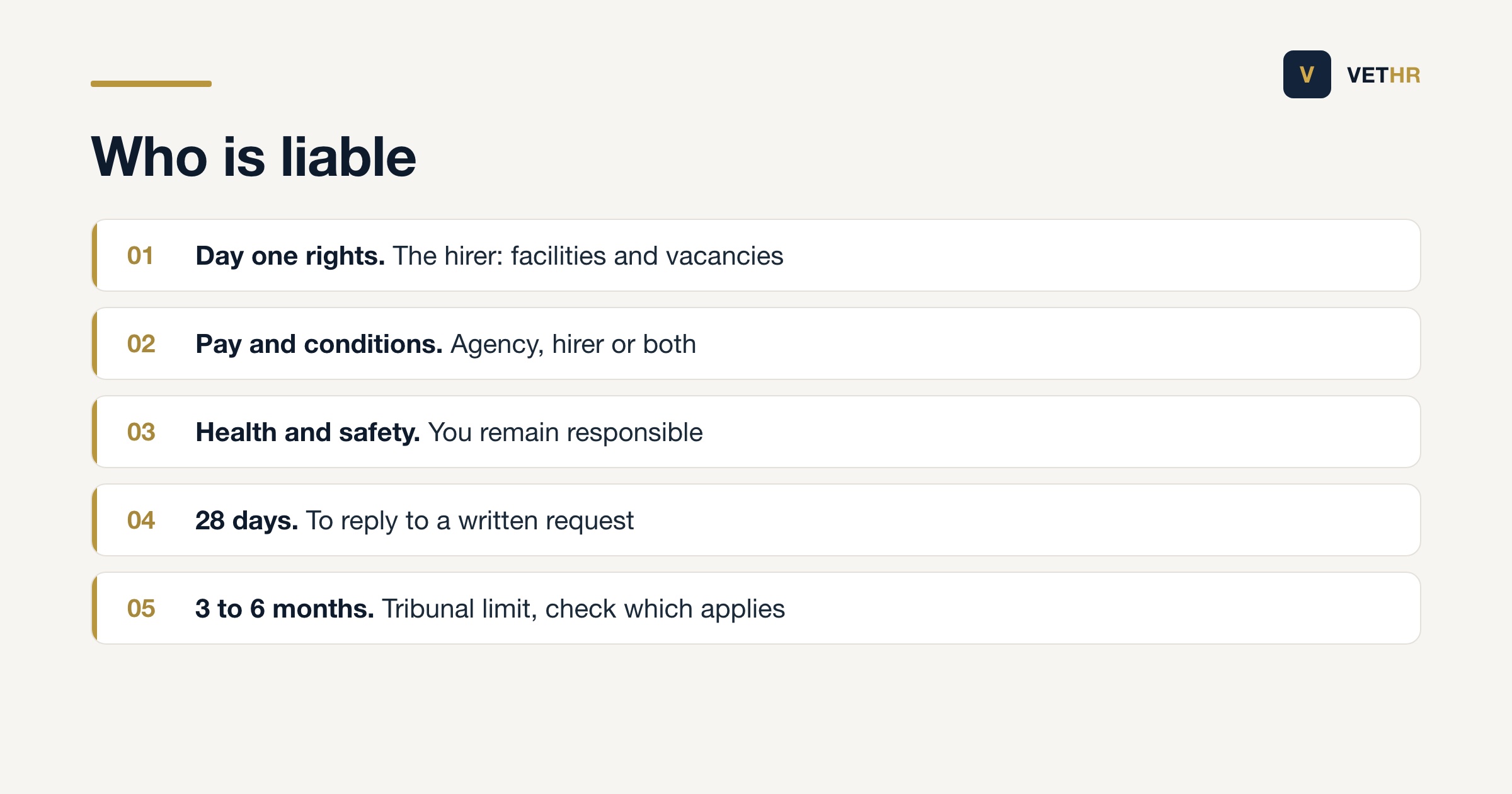
For day one rights the hirer is liable. For basic working and employment conditions after 12 weeks, liability can fall on the agency, the hirer or both, depending on who is responsible. An agency can avoid liability if it took reasonable steps to get accurate information from the hirer, so wrong information from you can leave you solely liable.
GOV.UK’s guidance also gives the time limits. A worker can ask the hirer in writing for day one information, and the hirer has 28 days to reply. For post-12-week information the worker asks the agency first, which has 28 days to reply, and can write to the hirer if there is no written response within 30 days. GOV.UK’s guidance says claims must generally be brought within 3 months of the breach, and the minimum award is 2 weeks’ pay. GOV.UK’s implementation timeline lists the increase in tribunal time limits from 3 to 6 months as taking effect on 1 October 2026, so check which limit applies.
The practical lesson is to answer quickly and accurately. A worker who asks for information and gets silence is a worker with a tribunal claim in preparation. Log requests, reply in writing and, if you are not sure, take advice before sending a position.
GOV.UK says that if you use agency staff you are still responsible for their health and safety. The hirer directs the work on the premises, carries out risk assessments and acts on them. Agency workers need the same induction, briefing and protection as your own team, from day one.
That means a safety induction before they handle animals, drugs or radiography equipment, the same personal protective equipment, access to the same procedures for bites and scratches and a clear line of reporting. Our guide to lone working matters if an agency worker might be alone with animals or clients.
Pregnant agency workers have specific rights. GOV.UK’s guidance says that after 12 weeks they are entitled to paid time off for antenatal appointments and classes, and that if an assignment becomes unsafe the agency must offer suitable alternative work at no less favourable a rate. Our guide to breastfeeding at work covers the wider health and safety duties to new mothers.
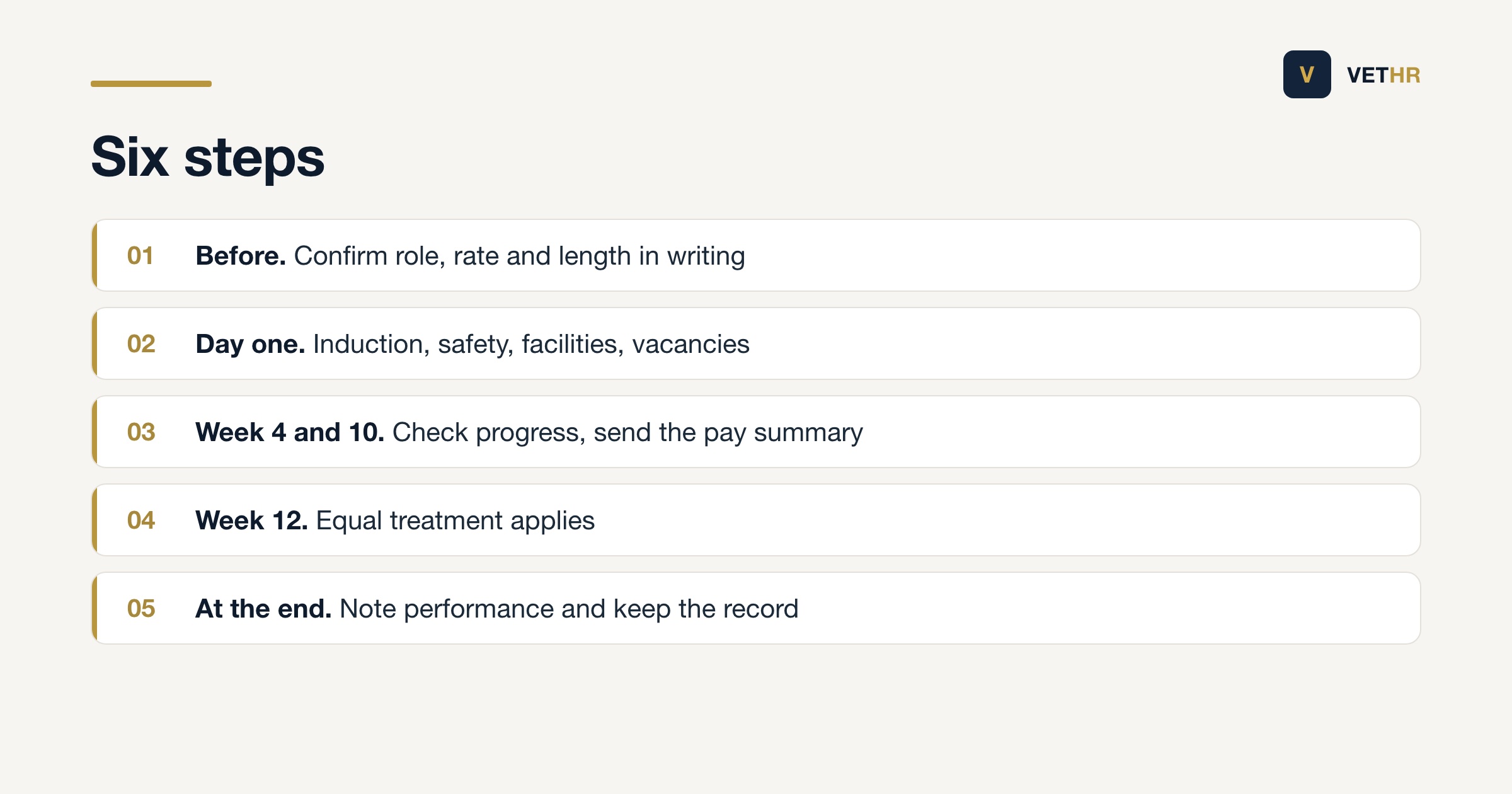
Treat them as part of the team for safety, facilities and respect, and keep the paperwork distinct. Agree the assignment in writing with the agency, brief the worker on day one, keep a record of start dates and breaks, and review at week 10 whether you will exceed 12 weeks.
A simple checklist:
Agency workers are not your employees, so do not issue your employment contract, add them to your payroll or discipline them as if they were staff. The agency contract governs the relationship. Raise concerns with the agency and ask it to act. If you are drifting toward treating a long-term agency worker as one of your own, consider offering a permanent role, which also avoids the 12 week problem.
Often yes, if they are good and the need is long term. Check the agency’s terms first, because many agencies charge a fee if you hire a worker directly. Our guide to employment contracts covers what a permanent offer should include.
GOV.UK’s guidance lists vacancy access as a day one right, which means an agency worker can see and apply for your advertised roles on the same terms as staff. That is both a duty and an opportunity. A temporary nurse who has worked in your practice for six weeks is a low-risk hire, and the practice already knows how she works.
Possibly. A government consultation on modernising the agency work regulatory framework has been published under the Make Work Pay programme, and it proposes among other things that hirers and agencies share responsibility for reasonable notice of shifts. It is a proposal, not law, so check the current position on GOV.UK before relying on it.
Our guide to employment law changes for veterinary practices tracks the wider reform programme. If you use agency workers heavily, it is worth reading each update, because changes to zero hours and shift notice may reach agency arrangements.
The usual mistakes are forgetting day one facilities and vacancies, losing track of the 12 week clock, giving the agency wrong or late pay information, rotating workers to avoid equal treatment, and treating agency workers as staff for discipline. Each can be avoided with a one-page checklist.
The same access to your collective facilities, such as a canteen or car parking, and to information about job vacancies, as comparable direct staff. The hirer is responsible and liable for these rights.
Equal treatment on basic working and employment conditions: key elements of pay, duration of working time, night work, rest periods and breaks, and annual leave. The 12 weeks are counted in calendar weeks in the same job with the same hirer.
Yes. It resets to zero after a break of more than 6 weeks, a move to a new hirer or a substantively different role. It pauses for shorter breaks and some absences, and keeps running through statutory family leave.
GOV.UK says you are still responsible for the health and safety of agency staff on your premises. Give them the same induction and protection as your own team.
GOV.UK’s guidance says claims must generally be brought within 3 months of the breach, and the minimum award is 2 weeks’ pay. GOV.UK’s implementation timeline lists the increase in tribunal time limits from 3 to 6 months as taking effect on 1 October 2026, so check which limit applies.
If you rely on agency cover and want a day-one checklist, a pay and conditions summary for the agency and a clock tracker, book a free 30-minute HR health check through our contact page. See also our HR consultancy for veterinary practices and the policies and handbook system.
Sources: GOV.UK: agency workers, your rights, GOV.UK: Agency Workers Regulations 2010 guidance, GOV.UK: agency staff and employer responsibilities.
Contracts, rotas, holiday, a difficult conversation. Tell us what you are dealing with and we will come back within one working day. Nothing to sign up to.
Got it. We will come back to you within one working day. If you do not see a reply, please check your spam folder.
