Last updated: 24 August 2026
TL;DR: The employment law changes that landed on 6 April 2026 already affect every veterinary practice in the UK. Statutory sick pay now starts on day one with no lower earnings limit, paternity and unpaid parental leave are day one rights, and you must keep annual leave and holiday pay records for at least 6 years. Two more waves follow in October 2026 and January 2027.
Most practice owners heard the phrase “biggest shake up of employment rights in a generation” and filed it under things to worry about later. Later arrived in April. This guide sets out the employment law changes a UK veterinary practice has to act on, the dates they bite, and the handful of documents you need to fix before someone tests them.
Five employment law changes that matter to a small practice took effect on 6 April 2026. Statutory sick pay is paid from the first day of illness and the lower earnings limit has gone. Paternity leave and unpaid parental leave became day one rights. Sexual harassment became a qualifying disclosure for whistleblowing. And employers must now keep records of annual leave and holiday pay.
Acas sets out the full commencement timetable for the Employment Rights Act 2025, and it is worth reading once with your own contracts open beside it. The employment law changes are being switched on in waves rather than all at once, which is why a practice can be compliant in March and non-compliant in May without anything happening internally.
The pattern matters for veterinary practices in particular. Small teams run on custom and practice rather than paperwork, so a rule that changes quietly in the background usually surfaces during a dispute, an exit or an inspection. That is the expensive way to find out.
This is one of the employment law changes with an immediate cash effect: it removes the three unpaid waiting days that used to absorb short absences. From 6 April 2026, statutory sick pay runs from the first day of illness and the lower earnings limit no longer applies, so part-time receptionists and weekend RVNs who previously fell outside the scheme now qualify.
GOV.UK sets the rate at £123.25 a week or 80% of normal weekly earnings, whichever is lower, payable for up to 28 weeks. For a five-partner mixed practice with 22 staff, a single winter of norovirus that once cost nothing in the first three days of each absence now carries a real cost line.
The practical fix is not to fight the change. It is to see absence earlier. Practices that record the first day of every absence, run return to work conversations properly and spot patterns in the rota tend to pay less sick pay overall, because short absences stop turning into long ones.
If your sickness recording still lives in a paper diary at reception, this is the change that will force the issue. Our guide to managing sickness absence in a veterinary practice covers the process end to end.
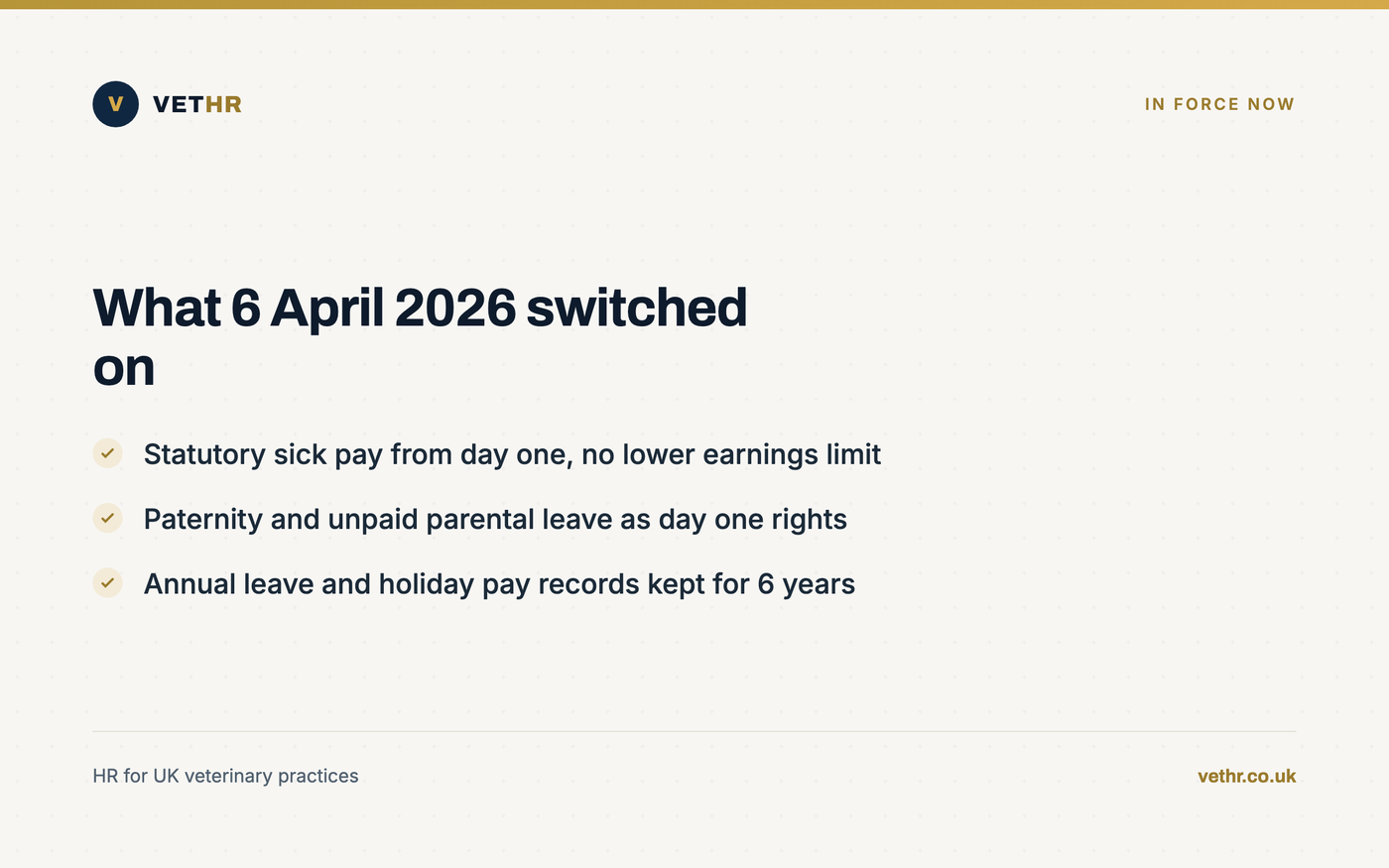
From 6 April 2026, employers must keep records of annual leave and holiday pay, and Acas states those records must be kept for at least 6 years. Of all the 2026 employment law changes this is the most administrative: it is a documentation duty, not a calculation change, and it catches out practices whose leave lives in a wall planner that gets wiped every January.
Six years is longer than most veterinary employment relationships. If a former RVN queries holiday pay from 2027 in the year 2032, the practice needs to produce what she accrued, what she took, what she was paid for it and how the rate was worked out. A photograph of a whiteboard will not do that.
What a compliant record looks like in practice:
This is exactly what a holiday calculation system is for. It keeps the entitlement maths right for part-time and irregular-hours staff, and it leaves an audit trail that survives a change of practice manager.
Both became day one rights on 6 April 2026, and these are the employment law changes most likely to be sitting unnoticed in your handbook. A vet who starts with you on Monday and whose partner gives birth on Friday now qualifies for paternity leave, with no qualifying service. Unpaid parental leave works the same way. The old service thresholds in your handbook are now wrong, and wrong in a direction that creates a claim.
The GOV.UK implementation timeline also brought in bereaved partners’ paternity leave of up to 52 weeks where the mother or primary adopter dies within the child’s first year. It is rare. It is also the kind of clause a practice absolutely does not want to be drafting from scratch in the week it becomes relevant.
Check the family leave section of your handbook for any sentence beginning “after 26 weeks’ service” or “after one year”. Those employment law changes make such wording unenforceable and, worse, they make the practice look as though it is withholding a statutory right.
The harassment duty tightens. This is the next wave of employment law changes and the one client-facing teams should plan for. From 30 October 2026, employers must take all reasonable steps to prevent sexual harassment, and become liable for harassment of their staff by third parties unless they can show they took all reasonable steps. For a client-facing practice, that second limb is the one to plan for now.
Veterinary teams absorb a great deal from the public. A distressed owner at 9pm, a rude comment to a young receptionist, a client who keeps making the same remark to the same nurse. Under the new duty, “clients are like that” stops being an answer, because the question becomes what the practice did about it.
All reasonable steps for a practice of 5 to 50 people usually means four things: a policy that names third-party harassment, a risk assessment that considers reception and out of hours, a reporting route staff will actually use, and evidence that reports were acted on. Our See It Report It system exists to produce that last piece of evidence.
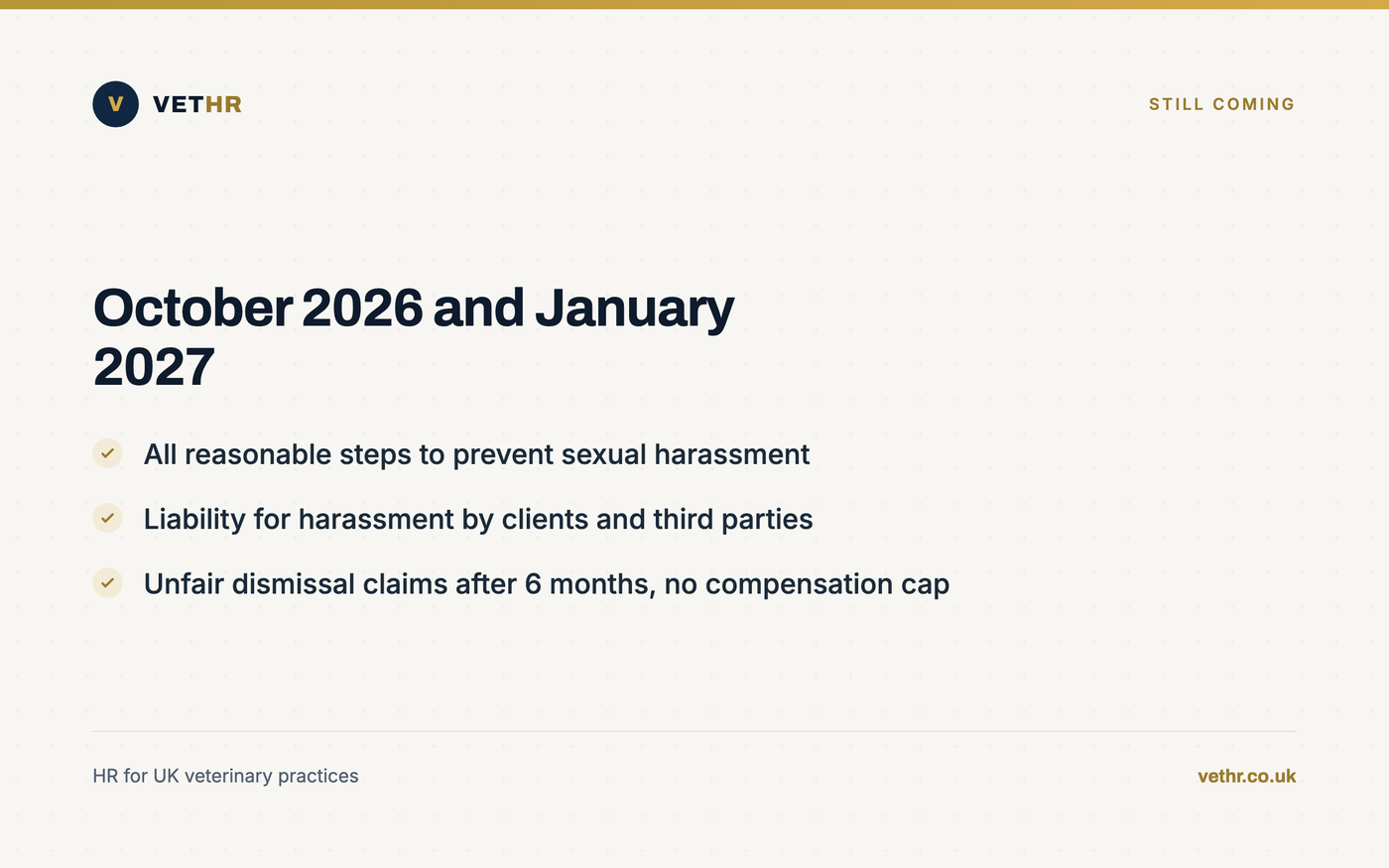
The qualifying period drops. From 1 January 2027, employees can claim unfair dismissal after 6 months rather than 2 years, the cap on compensation for unfair dismissal is removed, and dismissal and rehire becomes automatically unfair in most cases. Acas lists all three under the same commencement date.
For veterinary practices this is the single most consequential of the employment law changes, because so much recruitment risk is currently parked in the first two years. The unspoken safety net of “we can let them go before the two year mark” halves, and then loses its ceiling.
What replaces the safety net is ordinary good practice: a real probation review with written outcomes, honest one to one records, and a documented process before anyone is dismissed. If a practice has that, the change is survivable. If it does not, the exposure grows quietly until the first claim.
Start with probation periods done properly and make sure every contract issued from now on matches the process you actually follow.
Seven jobs, in this order, each mapped to one of the employment law changes above. Each is small on its own, and together they close almost all of the exposure the 2026 employment law changes create for a small independent practice.
Not sure which of these your practice has already covered? Book a free 30-minute HR health check and we will tell you plainly, with no obligation. Book your HR health check.
Yes. The employment law changes now in force under the Employment Rights Act 2025 apply regardless of headcount. There is no small employer exemption for day one paternity leave, day one statutory sick pay or the holiday record duty. A two-vet branch surgery carries the same obligations as a 40-person hospital.
No. Self-certification and fit note rules are unchanged. What has changed is when payment starts and who qualifies. You can still require notification on the first day of absence, self-certification for short absences and evidence for longer ones, provided your absence policy says so clearly and you apply it consistently.
The duty applies from 6 April 2026 onwards, so you are building a record from that date rather than reconstructing history. That said, holiday pay claims can reach back further, so keeping whatever earlier evidence you already hold is sensible rather than optional.
There is no fixed list, which is why evidence matters more than wording. A practice that has a current policy covering third parties, a risk assessment, a used reporting route and a record of acting on reports is in a far stronger position than one relying on a handbook paragraph nobody has read since 2023.
No, because parts of your contracts are already out of date. Contracts issued now will still be in force when the unfair dismissal change lands, so it is cheaper to reissue once, correctly, than to patch twice. Anyone joining your team this autumn should get the current version.
None of these employment law changes is dramatic on its own. The risk is cumulative: a sick pay clause that is a year out of date, a handbook with a service condition that no longer exists, a leave record nobody can produce. Each is a small thing until it becomes evidence.
Practices that stay ahead of this treat compliance as maintenance rather than crisis, which is what our monthly HR subscription and contract and policy service are built around. If you would rather just find out where you stand, the free HR health check takes 30 minutes and gives you the list.
The Vet HR Team provides HR consultancy and white-labelled staff systems exclusively to UK veterinary practices.
—
This page is the overview. Each of the changes below now has its own guide written for veterinary practices.
Read next: The Veterinary Practice HR Calendar.
Contracts, rotas, holiday, a difficult conversation. Tell us what you are dealing with and we will come back within one working day. Nothing to sign up to.
Got it. We will come back to you within one working day. If you do not see a reply, please check your spam folder.
