Last updated: 4 September 2026
TL;DR: On 1 January 2027 the unfair dismissal qualifying period falls from two years to six months. Anyone already holding six months’ service on that date is protected immediately, with no run in. It did not become a day one right, and the proposed statutory probation period was dropped. The practical effect is that a six month probation now ends exactly where protection begins.
Six months, from 1 January 2027. Until then the unfair dismissal qualifying period is unchanged: an employee generally needs two years’ continuous service to bring an ordinary unfair dismissal claim. From that date they need six.
Commencement regulations under the Employment Rights Act 2025 confirmed the date. It is not provisional and it is not subject to a further consultation.
Two things were widely reported and then did not happen, and practices that planned around the headlines will have planned wrongly.
So nothing replaces the judgement you already have to exercise. The unfair dismissal qualifying period simply gets shorter, and the room you had to make a late decision gets smaller with it.
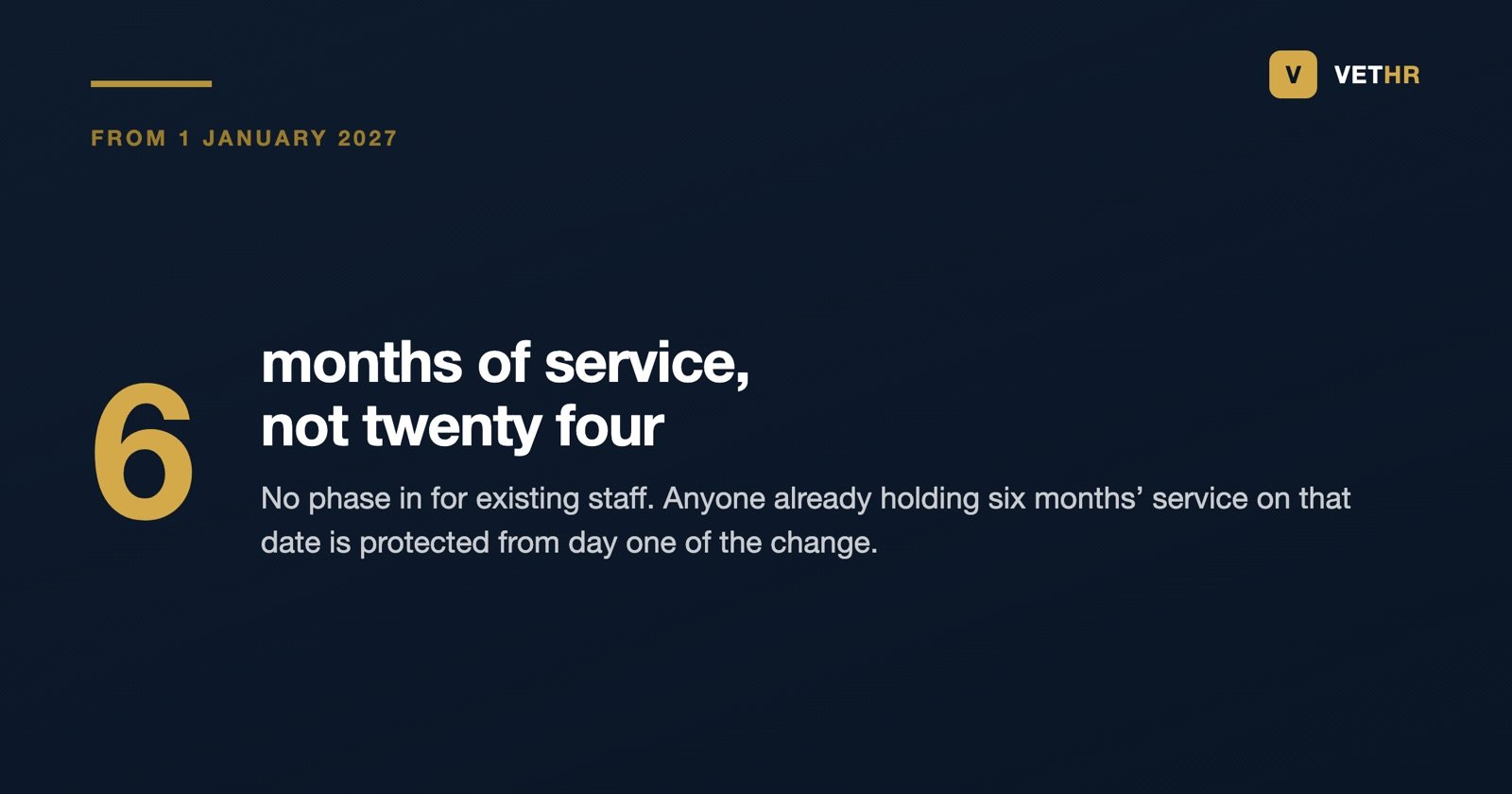
Anyone who already has six months’ service on 1 January 2027 meets the new unfair dismissal qualifying period. There is no phase in for existing staff, which is the detail most practices miss.
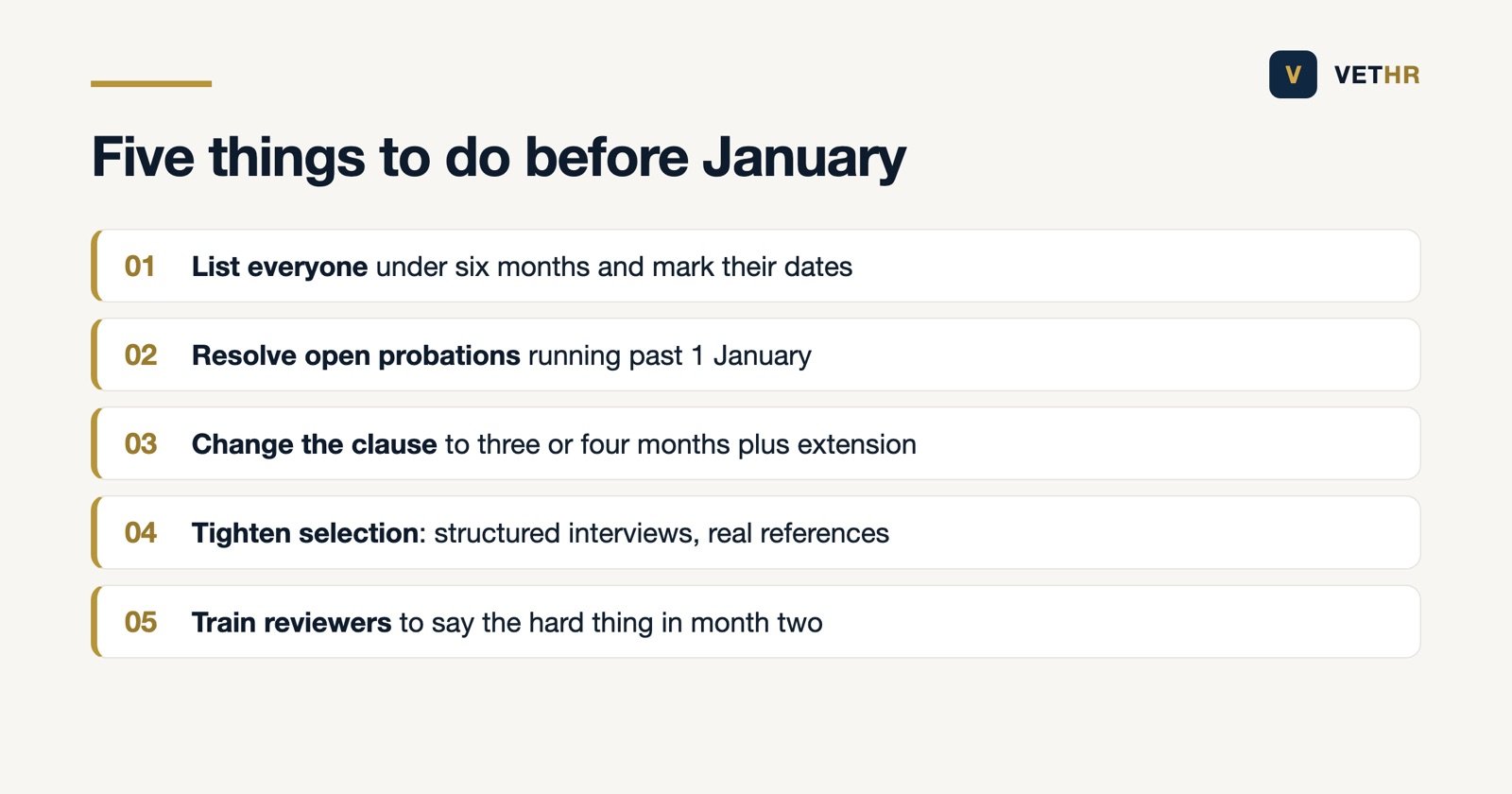
Work it backwards. Every member of your team who started on or before roughly the end of June 2026 will be protected the moment the change takes effect. So will everyone hired since, once they reach six months. If you have someone on an open or extended probation running across the new year, that probation should be resolved before it rather than after.
This is the part that turns a safe looking decision into a claim. Where employment ends just short of the unfair dismissal qualifying period, statutory minimum notice is added on when qualifying service is calculated.
An employee with more than a month’s service is entitled to at least one week’s statutory notice. So dismissing someone at five months and three weeks does not reliably keep them below six months, because that week can be added and push them over. Acting close to the line is not the margin it appears to be, and it never has been under the two year rule either. The difference is that the line now arrives far sooner.
Plan the decision point at four months, not five and a half.
The standard six month probation stops working. It ends at precisely the point the unfair dismissal qualifying period is reached, which leaves no room to extend, no room for a concern that surfaces late, and no room for someone to be off sick through the decision window.
Three changes fix it, and none of them are difficult.
If you want the structure ready made, our probation review form template is free and now carries the 2027 timing guidance built in.
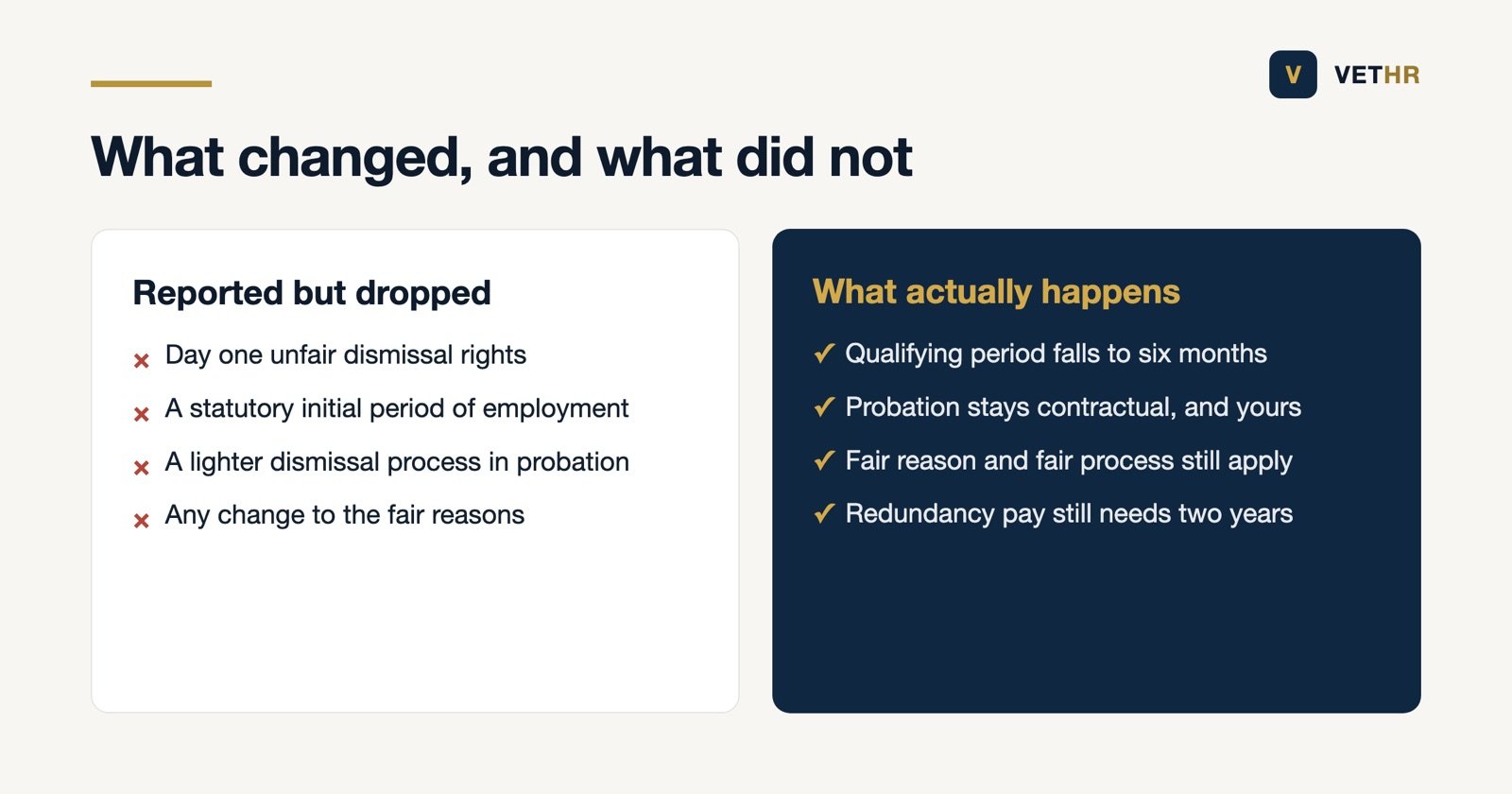
No, and this is worth saying plainly because the change generates more anxiety than it deserves. You can dismiss an employee with six months’ service. You simply need a fair reason and a fair process, which is what good practices do anyway.
The five potentially fair reasons are unchanged: conduct, capability, redundancy, illegality, and some other substantial reason. Nothing about the shorter unfair dismissal qualifying period narrows those. What changes is that from six months onward you have to be able to show which one applied and that you followed a reasonable procedure, rather than relying on service length as a shield.
Note too that a long list of claims never needed any qualifying service at all. Dismissal connected to pregnancy, whistleblowing, trade union activity, asserting a statutory right or a protected characteristic has always been available from day one. If your only defence for a dismissal was the qualifying period, the exposure was probably already there.
Fair process is not complicated, it is just documented. Once an employee is past the unfair dismissal qualifying period, a conduct or capability dismissal needs four things you can point to.
The Acas Code of Practice on disciplinary and grievance procedures is the reference point, and an unreasonable failure to follow it can increase compensation by up to 25 per cent. Note that Acas consulted on a revised Code between July and September 2026; the 2009 Code still applies until a new one takes effect.
In a small practice the practical obstacle is usually the appeal, because there are only two managers and one of them made the decision. Plan for it: a partner from another site, or an external HR adviser sitting in, both work.
No, and conflating the two is a common error. The change is to the unfair dismissal qualifying period specifically. Other rights keep their own service thresholds.
Statutory redundancy pay, for example, still requires two years’ continuous service. So does the right to a written statement of reasons for dismissal on request. Meanwhile a long list of protections, including anything connected to a protected characteristic, pregnancy, whistleblowing or asserting a statutory right, requires no service at all and never did. The picture after January 2027 is simply a shorter unfair dismissal qualifying period sitting inside an otherwise unchanged framework. Gov.uk sets out the general position on dismissal.
Both. Anyone with six months’ service on 1 January 2027 is protected from that date. There is no transitional period that exempts people hired before the change.
You can, but it does not help. Probation is contractual and has no effect on statutory rights. An employee reaches the unfair dismissal qualifying period at six months whether or not they are still described as on probation.
No. It applies to employees regardless of role or seniority. The practical difference is that clinical roles usually have clearer competency evidence, so the record for a receptionist or animal care assistant often needs more deliberate attention.
Non renewal of a fixed term contract is a dismissal in law. Once the person has six months’ service, the same fair reason and fair process requirements apply as for anyone else.
Change the template you issue to new starters now, because a probation agreed today will run into 2027. Existing contracts do not need reissuing for this; the statutory position changes regardless of what the contract says.
This change rewards practices that were already running probation properly and punishes the ones treating it as a formality. If your reviews happen on the dates you booked and your concerns are written down while they are small, the shorter unfair dismissal qualifying period costs you almost nothing. If probation has been a box ticked at month six, you now have a real problem arriving on a known date.
Four months is the number to move to. If you want the contract clause and the review structure sorted before January, our free HR health check covers both, and you keep the written summary either way. See also our guide to the 2026 employment law changes.
Contracts, rotas, holiday, a difficult conversation. Tell us what you are dealing with and we will come back within one working day. Nothing to sign up to.
Got it. We will come back to you within one working day. If you do not see a reply, please check your spam folder.
