Last updated: 4 September 2026
TL;DR: The Fair Work Agency opened on 7 April 2026 as a single enforcement body for statutory sick pay, holiday pay and the national minimum wage. It can investigate without waiting for anyone to complain. Its powers are phasing in, with holiday pay and minimum wage enforcement arriving in April 2027, which makes the next few months the cheapest time to get your records straight.
The Fair Work Agency is the enforcement body created by the Employment Rights Act 2025. It became operational on 7 April 2026 and pulls together enforcement functions that used to sit in several places, including HMRC’s national minimum wage team and the state’s role in statutory payments.
For a veterinary practice the practical summary is short. There is now one body whose job is to check that employers are paying people correctly, and it has inspectors.
It can investigate, inspect and penalise. In broad terms the Fair Work Agency can enter business premises, require documents and records to be produced, issue notices of underpayment, recover arrears on behalf of workers, and impose civil penalties where it finds non compliance.
The detail that surprises most practice owners is this: it does not need a complaint. The Fair Work Agency can open an investigation proactively rather than waiting for a member of staff to raise something. The old mental model, where nothing happens unless somebody falls out with you on the way out of the door, no longer holds.
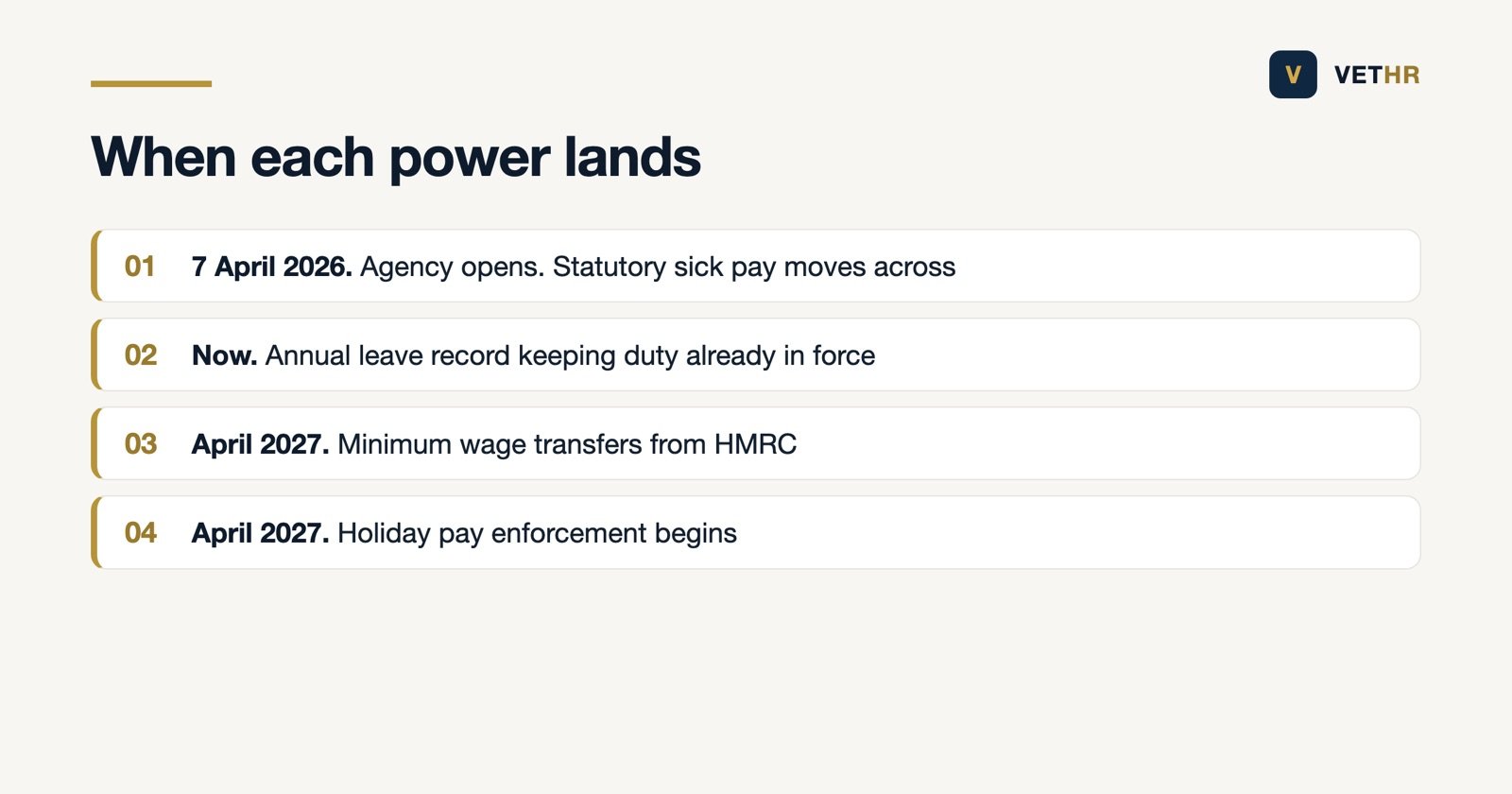
2026 and 2027 are a transition. Treating every power as live today would be wrong, and so would assuming nothing applies yet.
That gap is the opportunity. You have roughly seven months before the Fair Work Agency starts enforcing holiday pay, and the records it will ask for are the ones you are required to be keeping already.
Because the three things the Fair Work Agency enforces are the three things veterinary rotas make complicated.
A practice paying well above minimum wage can still fail a minimum wage check, because the test is pay divided by hours worked, and the hours worked figure is the one nobody records properly.
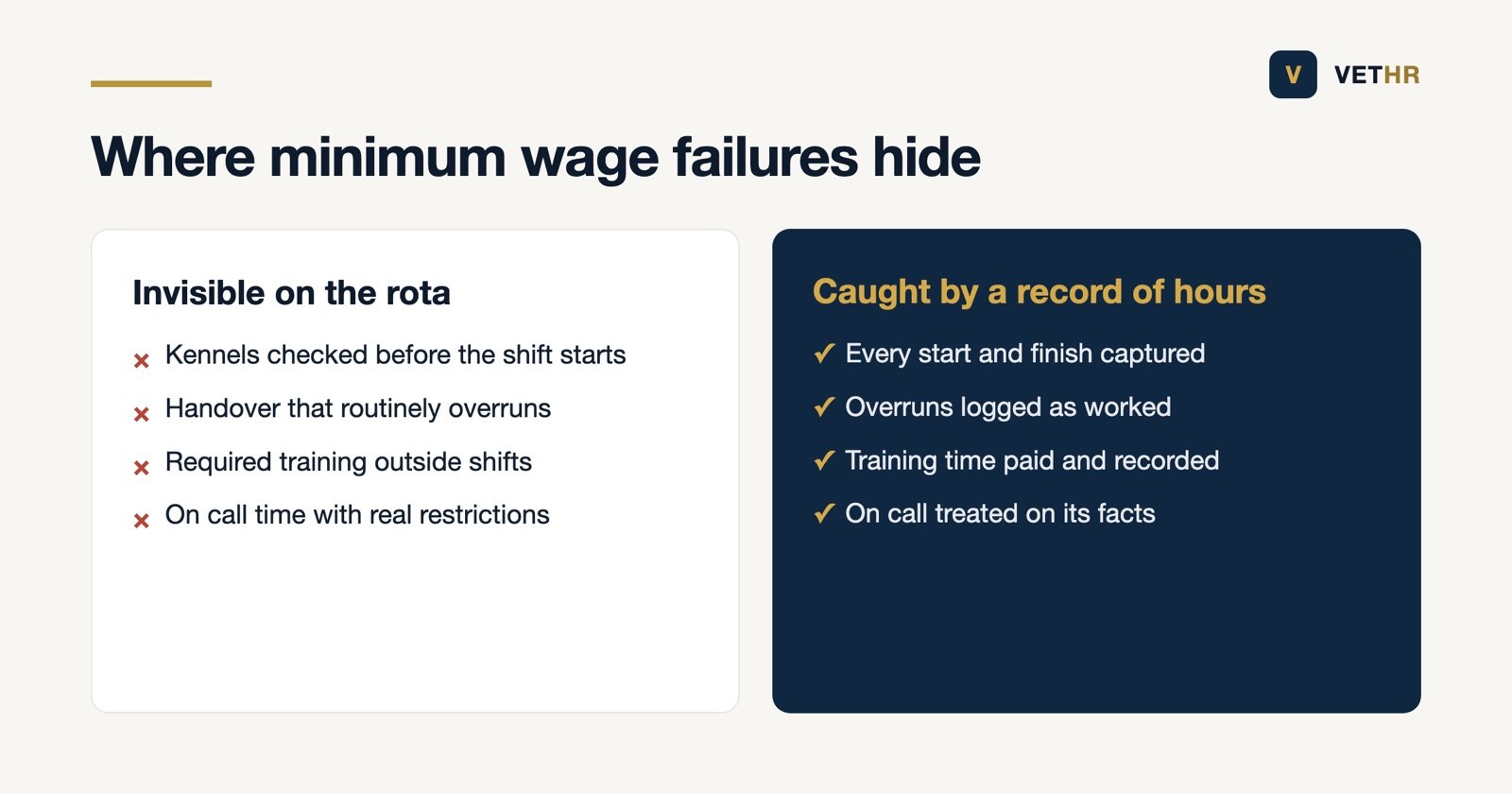
Almost never as a low hourly rate. It shows up as hours that were worked and never counted, which drags average pay below the floor without anyone intending it. These are the four that come up most often in veterinary practices.
The uncomfortable part is that all four are invisible in a rota. Only a record of hours actually worked catches them, which is why the Fair Work Agency will ask for that record first. The government’s own employer guidance on the Fair Work Agency is worth ten minutes of a practice manager’s time.
Statutory sick pay changed on 6 April 2026, and it matters here because SSP is one of the things the Fair Work Agency enforces from day one.
Two things went: the three waiting days, so SSP is now payable from the first qualifying day rather than the fourth, and the lower earnings limit, so entitlement no longer depends on earning above a threshold. SSP is paid at whichever is lower of 80 per cent of average weekly earnings or the flat weekly rate. Acas sets out the current position on sick pay.
For a veterinary practice the effect is concentrated in one group: the bank receptionist, the Saturday nurse, the part timer doing eight hours a week. Many of them previously earned below the limit and received nothing. They now qualify from their first day of sickness, and a practice still running the old rule is underpaying without knowing it.
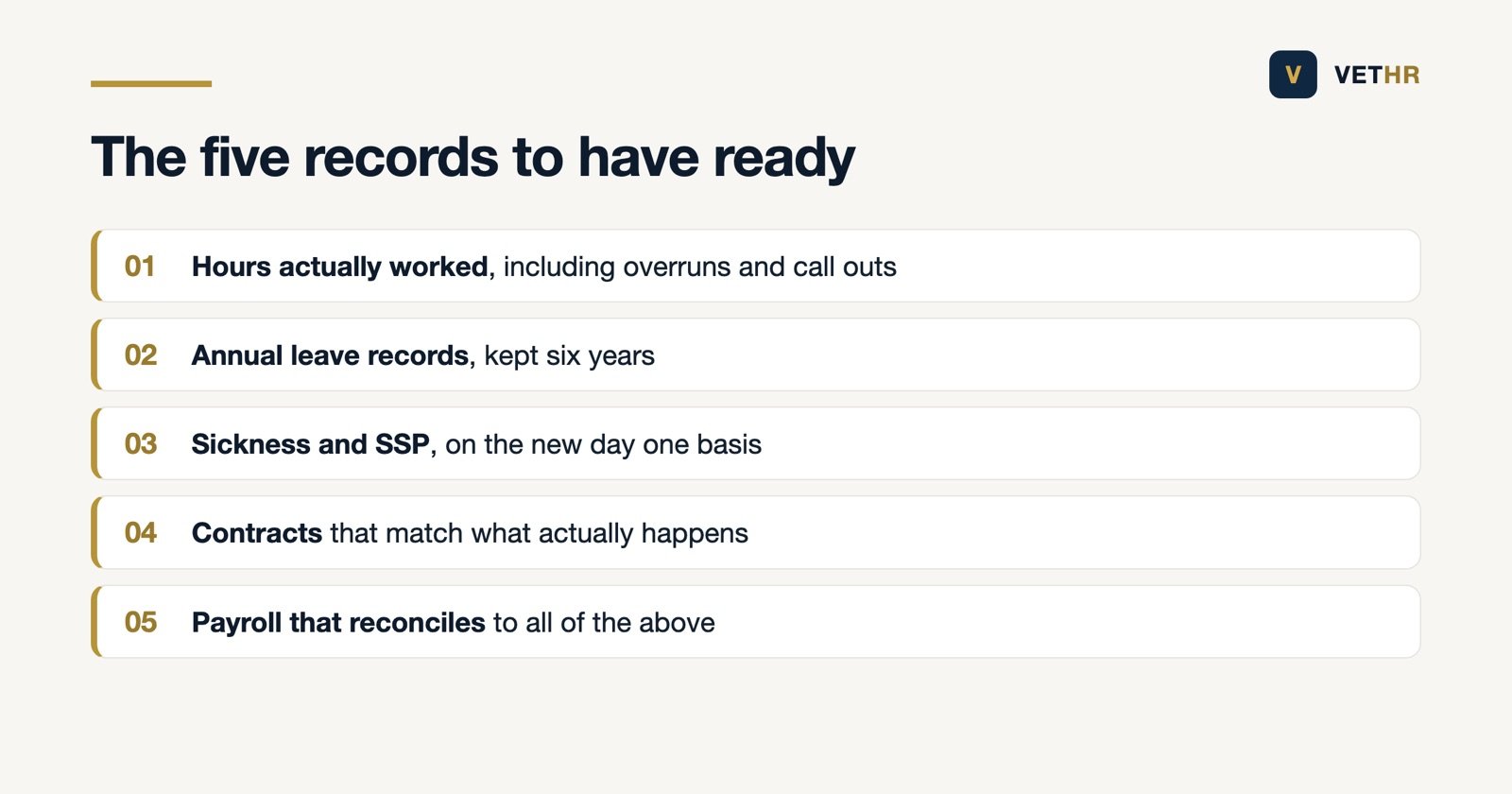
Five, and you almost certainly hold four of them somewhere already. The problem is usually that they live in four different places and do not reconcile.
If you want to test yourself cheaply, take one part time RVN and one bank receptionist and try to produce all five for last leave year. Most practices find the gap is between points one and five: the hours are somewhere, the pay is somewhere, and nothing ties them together. Our clock in and out system exists to close exactly that gap.
Expect a request for records before anything else. The Fair Work Agency is a records first regulator. Enforcement of this kind usually begins on paper, and the quality of what you hand over shapes everything that follows. A practice that produces a clean, reconciled set within days is treated very differently from one that asks for an extension and then sends a spreadsheet.
Where underpayment is found, the pattern in minimum wage enforcement has long been arrears plus a penalty, and the Fair Work Agency inherits that model. The arrears are usually the smaller number. The penalty, and the time it takes, are what hurt a small practice.
It has powers to enter business premises and inspect documentation, and it can act without a worker complaint. In practice most enforcement of this type starts with a written request for records rather than an unannounced visit, but the powers exist.
No. Tribunals still deal with claims between an individual and their employer. The Fair Work Agency is state enforcement running alongside that, which means a practice can now face action even where no individual has brought a claim.
No. There is no headcount threshold. Small employers have historically featured heavily in minimum wage enforcement, usually through unpaid working time rather than deliberate underpayment.
Not by itself. A bureau processes the numbers you give it. If the hours you supply are wrong or incomplete, the output is wrong, and the liability stays with the practice as employer.
It depends on status rather than the label. Someone genuinely in business on their own account is outside the employment rights the Fair Work Agency enforces. Someone working your rota, under your direction, on your terms may well not be, whatever the invoice says.
Nothing about the Fair Work Agency should frighten a practice that pays people properly. The risk is not dishonesty, it is untidiness: hours in one place, leave in another, and no way to show the two agree.
Seven months is a comfortable amount of time to fix that, and no time at all if it is left. If you want a second pair of eyes on where you stand, our free HR health check covers hours, holiday and contracts, and you keep the written summary either way. Start with the annual leave records duty, because that one is already live.
Contracts, rotas, holiday, a difficult conversation. Tell us what you are dealing with and we will come back within one working day. Nothing to sign up to.
Got it. We will come back to you within one working day. If you do not see a reply, please check your spam folder.
