Last updated: 27 June 2026
TL;DR: On-call pay for veterinary staff is usually built from three parts: a standby allowance for being available, call-out pay for time actually worked, and an enhanced hourly rate for unsocial hours. The legal floor is the National Minimum Wage. Time spent working, including answering calls and coming in, must be paid. Time genuinely free at home usually need not be. Structure it clearly, record it accurately, and write it into the contract.
Out-of-hours cover keeps emergencies answered, but it is also where pay disputes start. Get the structure right and your rota feels fair. Get it vague and you risk a minimum wage problem you did not see coming. This is a calm, practical guide to paying for on-call work the right way.
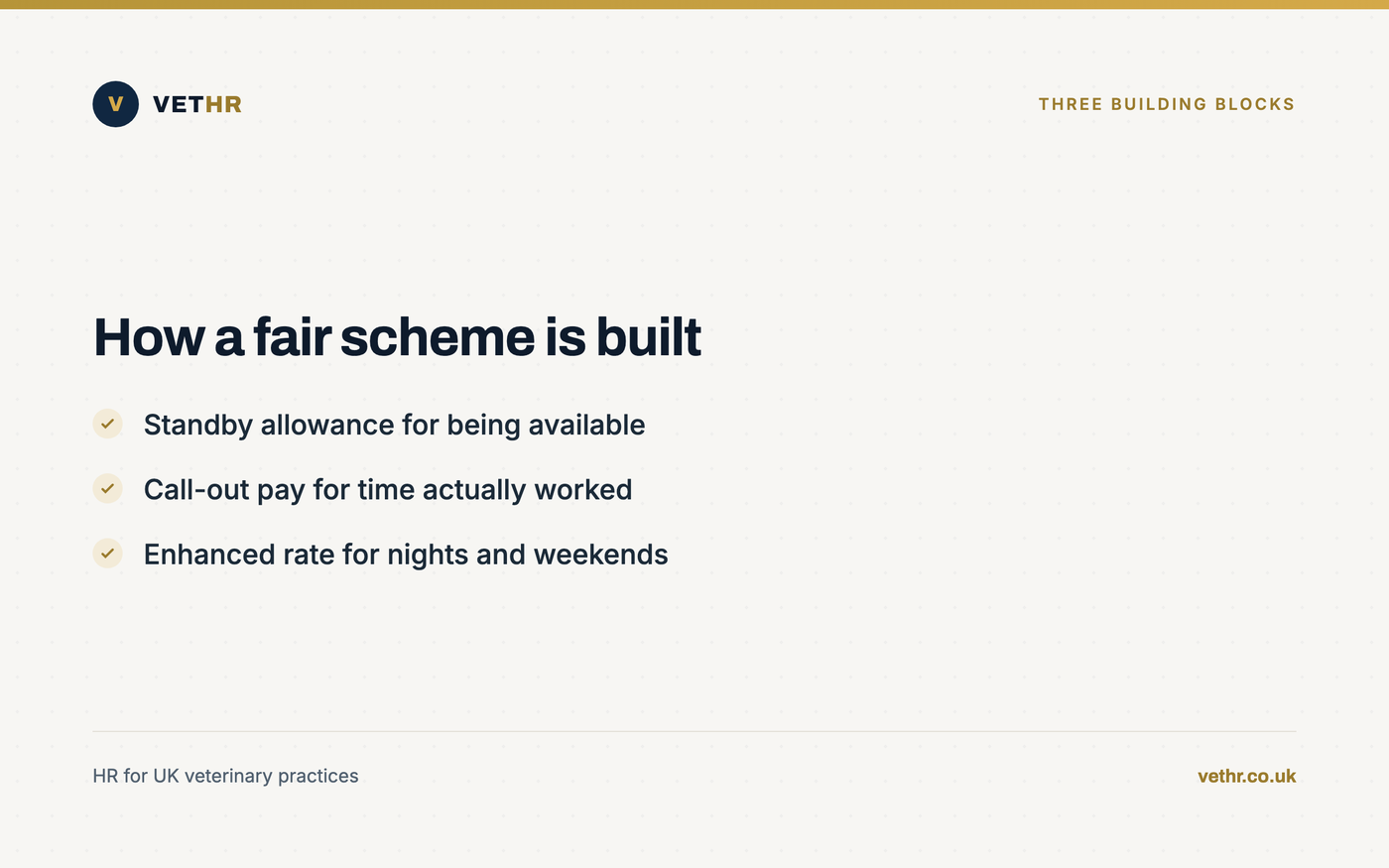
On-call pay for veterinary staff is usually structured from three building blocks: a standby allowance for being available, call-out pay for time actually worked, and sometimes an enhanced hourly rate for nights, weekends or bank holidays. You can use one, two or all three. What matters is that each part is named, predictable and never drops the worker below the legal floor.
Think of it as paying for two different things. The first is availability: the worker carrying the phone, unable to fully switch off, ready to come in. The second is the work itself: the call answered, the advice given, the drive in and the consult. Confusing the two is where rotas turn unfair, because availability and active work are not the same burden and should not be paid as if they were.
There is no single legally required formula. A practice is free to design its own scheme, provided the total pay holds up against the National Minimum Wage. ACAS notes that workers “must be paid at least the National Minimum Wage on average during their pay reference period for any hours they work”, in its guidance on staff who are on call or sleep in. That averaging test is the anchor for everything below.
For most independent practices, the cleanest model is a flat standby allowance per on-call session plus call-out pay at an enhanced rate for hours worked. It is easy to explain, easy to budget and easy to defend. The complexity comes not from the design but from recording it honestly, which is why the recording section below matters as much as the rates.
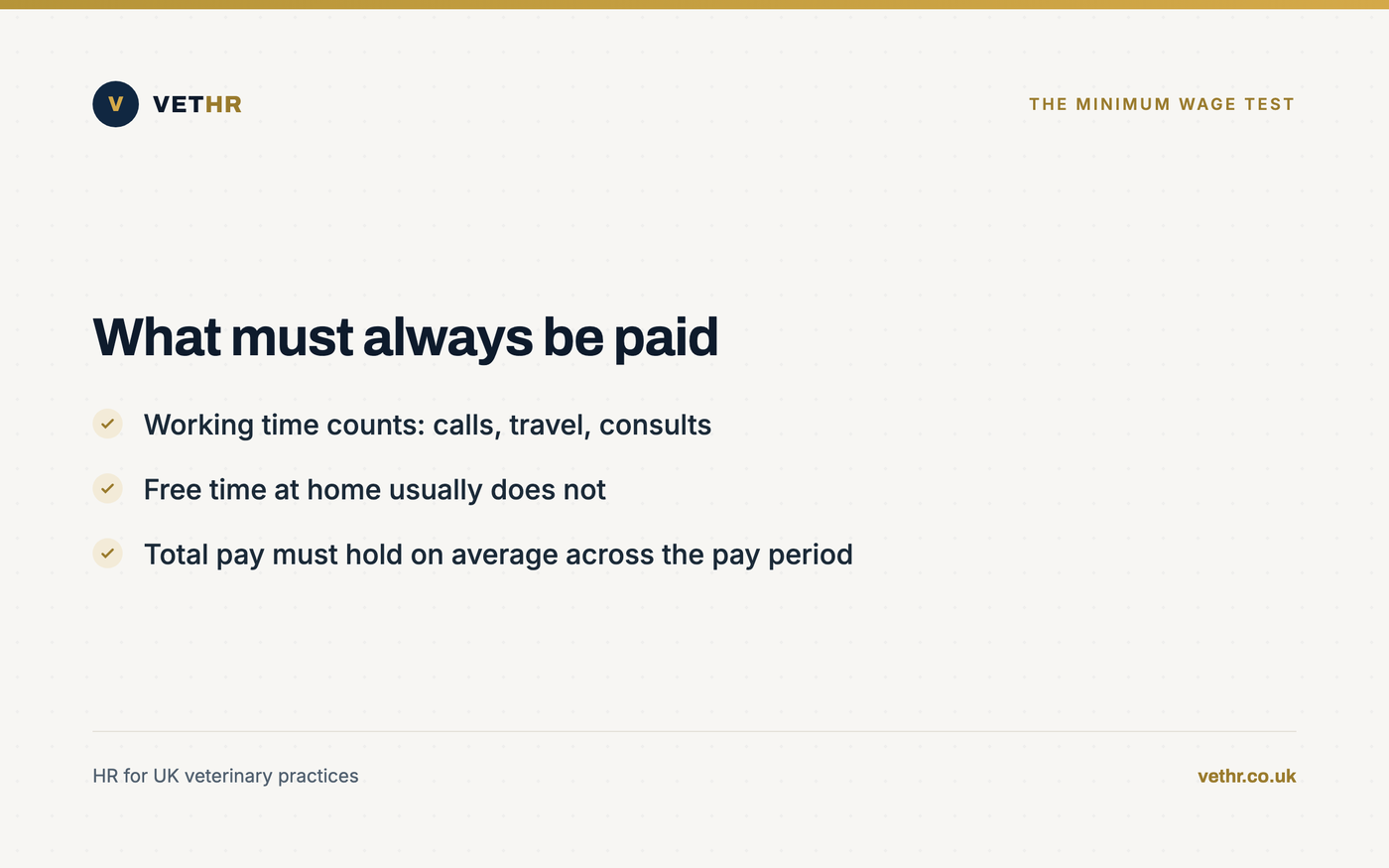
It depends on where the worker is and what they are doing. Time spent actually working while on call, answering the phone, giving advice, travelling in and treating a patient, counts and must be paid. Time spent genuinely free at home, able to do as they please, usually does not count as working time. The location and the freedom are the deciding factors.
ACAS puts it plainly. Time on call “can count as working time if the worker is doing work that their employer requires them to do under their employment contract”, and “does not usually count as working time if the worker is away from the workplace and can spend the time in any way they choose”, per the same ACAS on-call guidance. So a vet at home with the phone is in a different position from one required to wait at the practice.
GOV.UK is more specific for staff kept near the workplace. Its minimum wage guidance treats “time required to be available for work either on standby or on-call at or near their workplace, unless the worker is at home” as working time, on the page covering working hours for which the minimum wage must be paid. Keep someone waiting at the practice and you are paying for that whole period.
The practical upshot is the averaging test. Even with a modest standby allowance, your total payment for the hours that count must not fall below the minimum wage once spread across the pay reference period. A low allowance plus a busy night of unpaid call-outs is exactly the combination that fails, so the call-out side has to be paid properly, not absorbed.
This is the nuanced part, and it splits two ways. If a worker is required to be at the practice on standby, that time generally counts as working time. But there is a specific carve-out for sleep-in arrangements where the worker is allowed to sleep and is given suitable sleeping facilities, and the two sources frame it slightly differently.
GOV.UK sets out the exception. Standby or on-call time at or near the workplace counts, “however there is an exception if the worker is permitted to sleep during this time and is provided with suitable sleeping facilities”, and in that case workers are “only working and eligible for minimum wage when they are awake for the purposes of working”, per the GOV.UK minimum wage guidance.
ACAS, covering the working time side rather than the pay calculation, states that “sleep-in time usually counts as working time, even if the person spends it asleep”, because the worker is required to be at the workplace. The two are not in conflict: one is about hours that count for working time and rest, the other about which hours attract the minimum wage. Where sleep-in applies, treat it carefully and take advice.
For most small-animal practices this is academic, because true sleep-in cover at the building is rare and most on-call is phone-based from home. But if you run residential or hospital cover where staff sleep on site, the distinction is real money and a real compliance point. ACAS also notes that workers with sleep-in time “are still entitled to take their legal rest breaks”, which the rota must allow for.
Not sure your on-call scheme holds up? A 30-minute conversation usually settles it. Book a free HR health check and we will look at how you pay for standby and call-outs today, sanity-check it against the minimum wage averaging test, and tell you honestly where it is fine and where it needs tightening. No jargon, nothing sold for the sake of it.
Each lever pays for something different, and the fair schemes usually combine them. A standby allowance rewards availability. Call-out pay covers hours actually worked. An enhanced hourly rate recognises that nights, weekends and bank holidays cost people more. Choose the mix that matches how your on-call actually behaves, not a template borrowed from an office.
Whatever you choose, the design must survive a busy night. The classic failure is a generous-looking standby allowance attached to call-out pay that quietly does not keep total earnings above the legal floor when the phone rings repeatedly. Because the test is applied “on average during their pay reference period”, a quiet month can mask a bad rate that a busy one then exposes.
Fairness also has a non-legal dimension. Staff accept on-call far more willingly when the scheme is predictable, evenly shared and visibly tied to real burden. That is a rota design question as much as a pay one, which is why our veterinary rota system keeps planned cover, actual hours and the resulting pay in one place rather than three.
You record on-call accurately by logging two things separately: the standby session and the actual work within it. Capture when each call-out started and ended, what it involved, and the travel time if relevant. Real timestamps beat hours recalled at the end of a long week, and they are what protect you if pay is ever questioned.
Record-keeping is not optional. GOV.UK guidance on the minimum wage states that “employers are required to keep records for a minimum of 6 years after the end of the pay reference period”, for records created after 1 April 2021, on its page about enforcing the minimum wage. On-call pay is exactly the area where vague records turn an honest scheme into a dispute you cannot evidence.
The same guidance adds teeth: if an employer fails to produce records on request, a worker can complain to an employment tribunal, which may award “80 times the hourly minimum wage rate”. That penalty is not about bad intent. It is about not being able to show your working, which is precisely what a tired team and a paper diary tend to produce.
A simple system fixes this. Clock the standby session, log each call-out as it happens, and let the totals feed payroll automatically. Our rota and on-call tools are built so the night’s record exists by morning, not by memory, which makes both payroll and any future request a non-event rather than a scramble.
Write it so any team member could read the clause and predict their own pay. Name the standby allowance, the call-out rate, any unsocial-hours enhancement, the minimum call-out unit, and how each is recorded and paid. Ambiguity in an on-call clause is the seed of nearly every dispute, so spell out the mechanics rather than gesturing at them.
A clear clause does double duty. It reassures staff that on-call is paid fairly, and it gives the practice a clean reference point if a query ever arises. A vague one does the opposite, leaving both sides to argue from memory about what was meant, usually after a hard night when goodwill is already thin.
This is where documentation and advice meet. The wording has to fit your real rota and stay the right side of the rules, which is what our veterinary employment contracts and HR consultancy are built to do. Vet HR is HR consultancy and documentation support, not a law firm, so for a formal legal opinion on a specific case we will point you to the right route.
You must pay for time actually worked, such as phone advice, travel and consults. Time spent genuinely free at home, able to do as they choose, usually does not count as working time. ACAS confirms on-call “does not usually count as working time if the worker is away from the workplace and can spend the time in any way they choose”. Most practices still pay a standby allowance for the availability.
It forms part of total pay, but the test is whether total earnings stay above the National Minimum Wage on average across the pay reference period for the hours that count as working time. A standby allowance alone will not satisfy that if a busy night of unpaid call-outs drags the effective rate below the floor. Pay the call-out time properly as well.
It is nuanced. ACAS says sleep-in time usually counts as working time because the worker must be at the workplace. GOV.UK applies a minimum wage exception where the worker is permitted to sleep and given suitable sleeping facilities, paying the minimum wage only for time awake to work. Where sleep-in applies, record it carefully and take advice on your specific arrangement.
GOV.UK requires minimum wage records to be kept for at least six years after the end of the relevant pay reference period, for records created after 1 April 2021. On-call is the area most likely to be queried, so log every standby session and call-out as it happens. If you cannot produce records on request, a tribunal can award a worker 80 times the hourly minimum wage rate.
No. Overtime is extra hours worked beyond the normal schedule. On-call pay covers a different situation: being available outside normal hours, plus any work that availability turns into. The two can overlap, but a fair scheme prices them separately, with a standby allowance for availability and call-out pay, often enhanced, for the hours actually worked.
On-call pay for veterinary staff is not complicated once you separate availability from work. Pay something fair for carrying the phone, pay properly for the hours that follow, keep total earnings above the minimum wage on average, and record both sides as they happen. Do that and your out-of-hours rota stops being a source of friction and becomes something staff trust.
If you want a second pair of eyes on your scheme, start with the structure and let it point to the fix. See how cover and hours fit together in our rota system, get the clause right with our contracts, or simply book a free HR health check and we will give you a straight read on your on-call pay. Nothing sold that you do not need.
The Vet HR Team provides HR consultancy and white-labelled staff systems exclusively to UK veterinary practices.
—
Related reading: HR for out of hours veterinary practices
Read next: Staff Benefits in a Veterinary Practice and Pay Bands for a Veterinary Practice.
Contracts, rotas, holiday, a difficult conversation. Tell us what you are dealing with and we will come back within one working day. Nothing to sign up to.
Got it. We will come back to you within one working day. If you do not see a reply, please check your spam folder.
