TL;DR: PILON is payment in lieu of notice. If an employee’s contract has a PILON clause, the practice may be able to end employment straight away and pay them for the notice period instead. Without a clause the employer cannot force an employee to accept it, and ending employment early without agreement can be a breach of contract. Acas says the employee must get full pay for the notice period, and GOV.UK says that includes basic pay and any extras in the contract, such as pension contributions. PILON is different from garden leave, where employment continues and notice is worked out, which HMRC treats differently for tax.
Last updated: 16 November 2026

A practice manager decides a vet nurse’s behaviour has reached the point where she should leave today. Her notice is four weeks. Paying her to go sounds simple. She is told to collect her things and that she will be paid up to the end of the week. Three weeks later a solicitor’s letter arrives, claiming the remaining notice and the contractual benefits the practice stopped. The practice has never looked to see whether the contract allowed it to pay in lieu.
PILON is one of the most misunderstood terms in employment practice. This guide explains what it means, when a veterinary practice can use it, what the employee must be paid, how it differs from garden leave and working notice and how the tax is viewed. It is based on Acas, GOV.UK and HMRC guidance and is general information, not legal advice.
PILON stands for payment in lieu of notice. Instead of the employee working their notice period, the employer ends the employment straight away and pays them what they would have earned during it. Acas says a clause in the contract might allow this, and depending on the wording the employer might be able to insist.
The Acas page on when an employee does not have to work notice lists three routes for someone with employee status: they ask to leave during the notice period, they are offered payment in lieu of notice or they are offered garden leave. Someone is not likely to be an employee if they are an agency worker or a casual worker on a zero-hours contract, so the rules do not apply in the same way to them.
Acas says a clause in the contract might allow payment instead of working the notice. The employee stops working straight away, the contract ends straight away and the employer must give the employee full pay for their notice period. Because the contract ends immediately, it is unlikely the employer must provide other contractual benefits, but that depends on the wording.
Our guide to notice periods in a veterinary practice explains how long notice is. PILON is what happens when notice is not worked.
Not on its own. Acas says if PILON is not in the contract the employer can ask the employee to agree to it, and if the employee agrees they must receive full pay for the notice period. The employer cannot force an employee to agree, and dismissing sooner than notice allows could lead to a breach of contract claim.
The Acas page says an employee could make a claim to an employment tribunal for breach of contract if they are dismissed sooner than their notice period ends. If the employer is considering PILON and it is not in the employee’s contract, Acas says to get legal advice.
GOV.UK’s page on redundancy notice periods says the same from the employee’s side: employment can be ended without notice if payment in lieu of notice is in the contract, and an employer may still offer it even if the contract does not mention it. If the employee accepts, they should receive full pay and any extras in the contract.
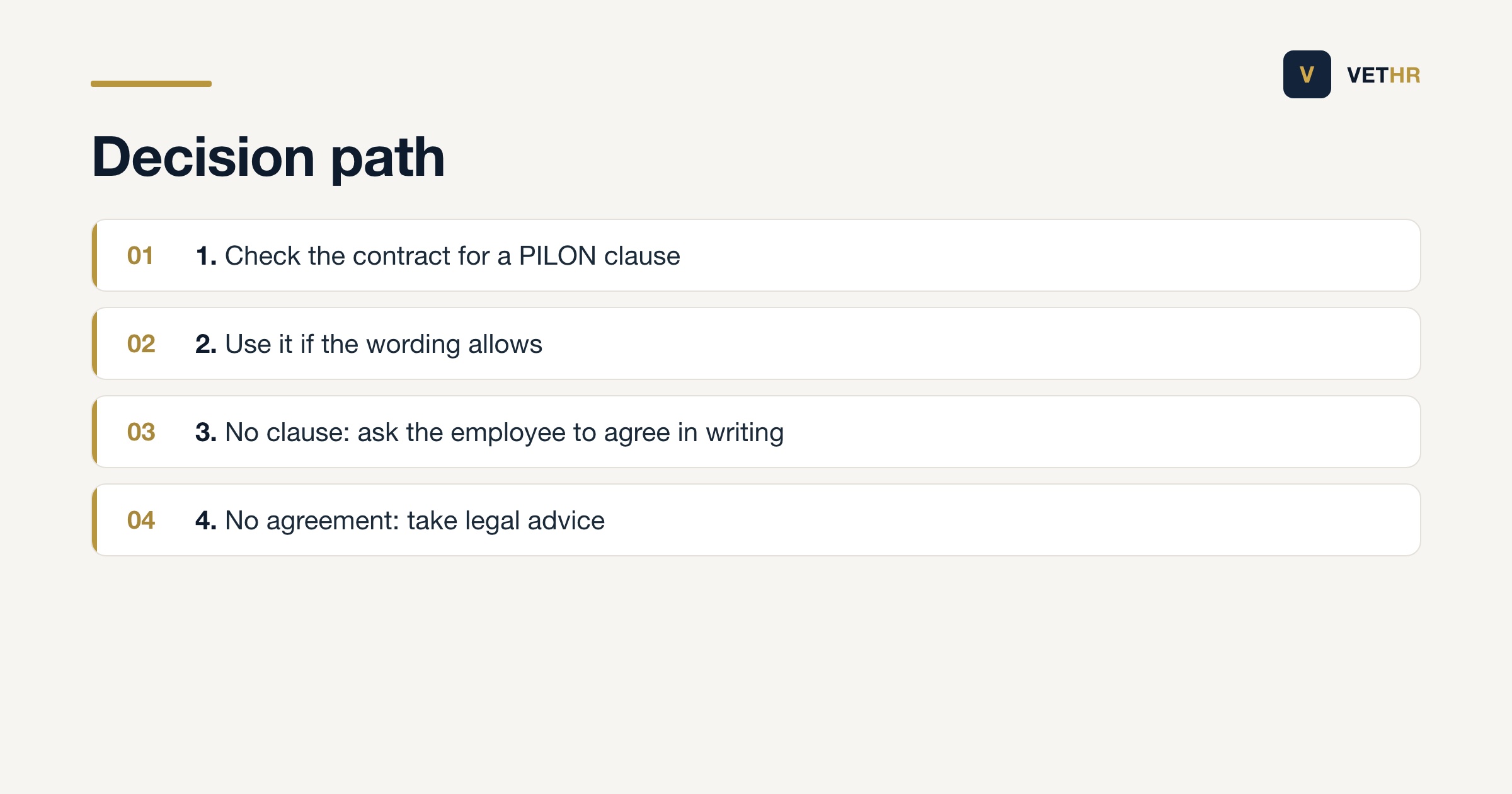
For a practice, the sensible steps are to look at the contract for a PILON clause, check the wording, and if there is none, agree it in writing with the employee before you act. A settlement agreement may be the right vehicle for a negotiated early exit. Our guide to settlement agreements explains when to use one.
Acas says the employer must give the employee full pay for their notice period. GOV.UK says that means all the basic pay they would have received during the notice period, plus extras such as pension contributions or private health care insurance if those are in the contract.
For redundancy, GOV.UK adds that notice pay is based on the average the employee earned per week over the 12 weeks before the notice period starts. That is the redundancy rule on that page. For other terminations the contract and the employee’s normal pay pattern are what matter, so check the contract and any variable elements, such as regular on-call or overtime pay, that formed part of what they would have earned.
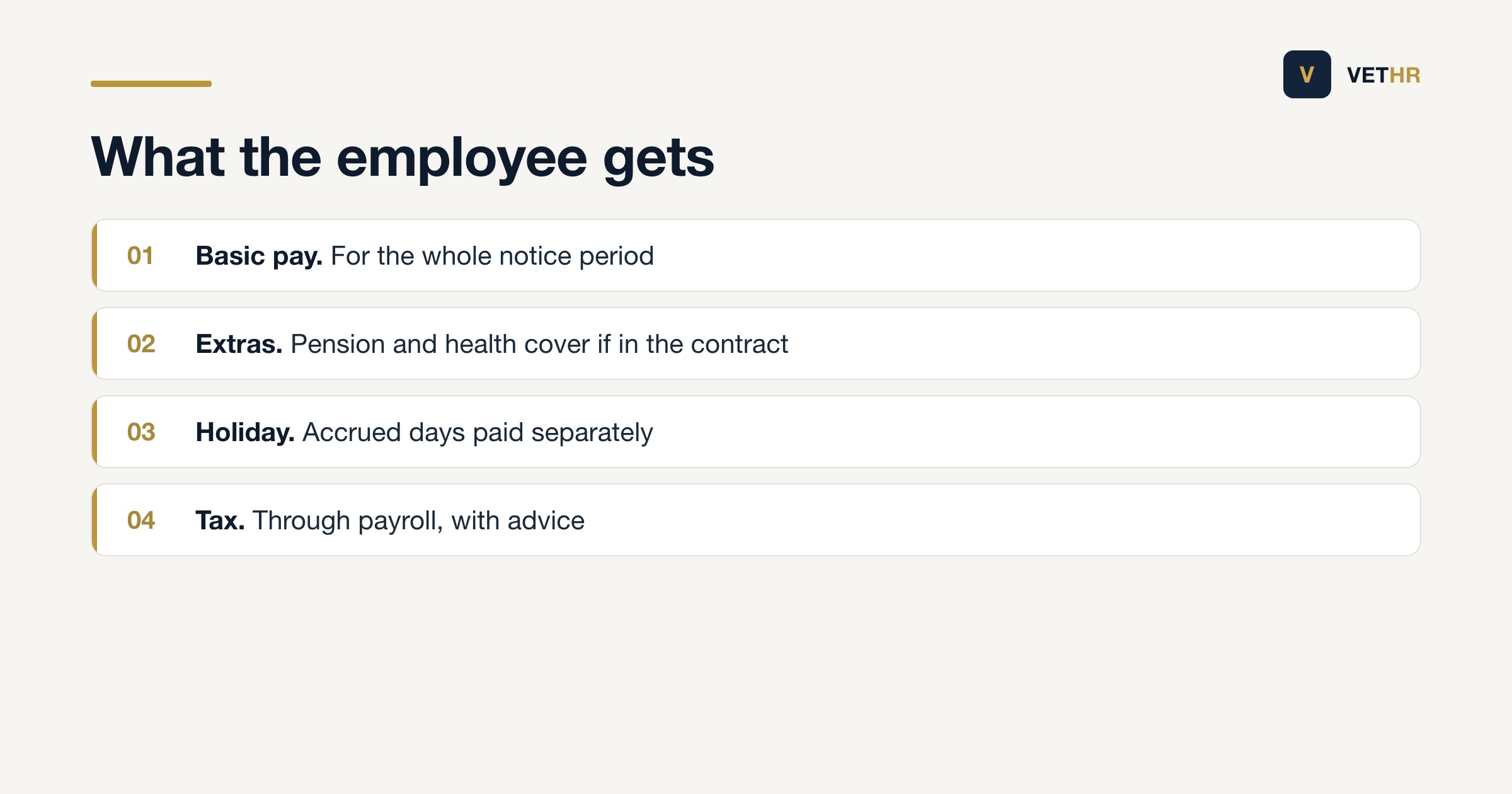
Think about what is included. Basic salary is the starting point. Contractual extras might include pension contributions, private health insurance, a car allowance and similar benefits that the employee would have received had they worked the notice. Acas says that when the contract ends straight away it is unlikely other contractual benefits must be provided, but GOV.UK says an employee may get extras if they are in the contract, so the safest approach is to read the clause and, if in doubt, include them.
Accrued holiday is separate. If the employee has untaken holiday at the termination date they are due pay for it. Our guide to final pay lists what goes into the last payslip.
On garden leave the employee stays employed and is paid as usual, including contractual benefits, until the notice period ends, but is told not to work. With PILON the contract ends straight away. HMRC treats the two differently because garden leave is salary for a notice period actually given.
Acas describes garden leave as when an employer tells an employee not to work either part or all of their notice period, often because the employer does not want the employee to have access to sensitive or confidential information they could use in a new job. The employee must get paid as usual during the notice period, including for any work benefits in their contract. They remain employed during garden leave.
The HMRC manual says it is necessary to distinguish a PILON from a garden leave situation. In the latter the employee is typically given proper notice but told not to attend work, so payment for the period cannot properly be described as made in lieu of notice. It is simply the salary due for the period and taxable as earnings, whether or not paid as a lump sum.
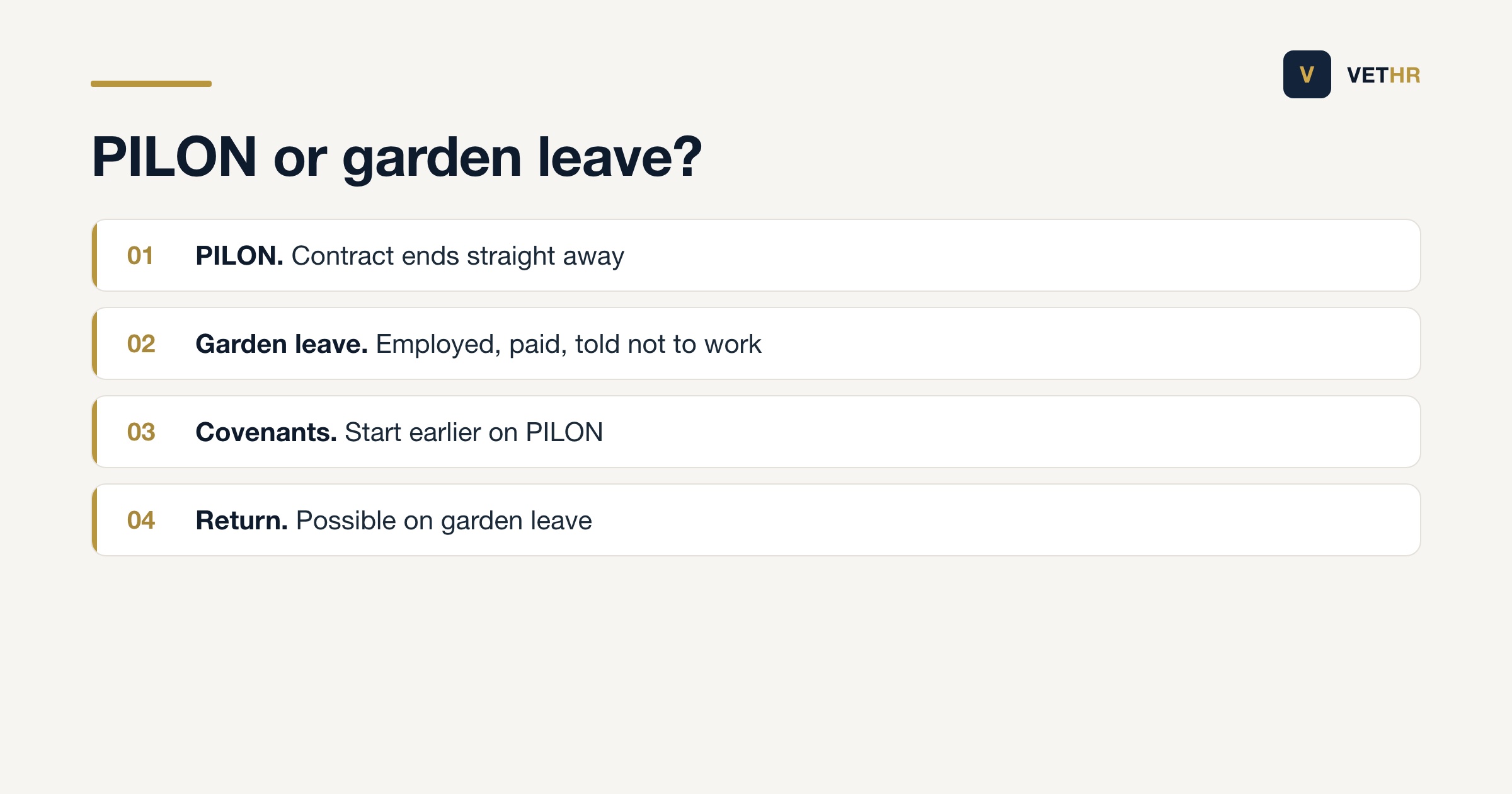
For a practice the practical difference is important. On garden leave the contract continues, so restrictive covenants, holiday accrual and benefits continue as normal and the employer can ask the employee to return if needed. On PILON the contract ends, and the clock on post-termination restrictions starts. Our guides to garden leave and restrictive covenants explain the points.
HMRC says that from 6 April 2018 an element of all payments received in connection with the termination of employment is chargeable to income tax as general earnings. How a PILON is taxed depends on when the employment ended and the payment was received, and whether it is contractual, customary or a payment of damages. Take payroll advice.
The HMRC page, EIM12975, notes that the phrase PILON is used to describe a range of payments made in different legal situations, so the precise circumstances matter. It points to separate sections for contractual PILONs, customary PILONs and damages. The rules are not simple and change, so do not rely on a rule of thumb: ask your accountant or payroll provider before you make a termination payment, and tell them whether the payment is made under a contractual clause, as an agreed payment or in settlement of a claim.
Practices often assume everything under a certain figure is tax-free. HMRC’s wording does not say so. Treat the payment as taxable earnings unless your adviser confirms otherwise, and deduct tax and National Insurance through payroll.
PILON suits situations where continued attendance is unwise and the contract allows it: gross misconduct is a different route, but where relationships have broken down, where there is a conflict of interest, where a vet is leaving for a nearby competitor or where a safety risk makes working notice undesirable.
It is a decision to make with the contract, the facts and the risk in front of you. Before using it, ask four questions:
Gross misconduct is separate. Acas notes elsewhere that an employee dismissed for gross misconduct is not usually entitled to notice, but that requires a fair process. Our guide to gross misconduct explains it. Using PILON to avoid a process that should have been followed can create risk in unfair dismissal claims.
Think about the practical side too. A vet who leaves immediately takes their client relationships and knowledge with them, and the rota loses a shift pattern with no warning. For a practice already struggling to cover, a full notice period may be worth more than the saving. Our guide to being short staffed looks at covering gaps.
Add a clear PILON clause to new contracts: say the practice may end employment immediately by paying a sum equal to basic salary for the unexpired notice, state what extras are included or excluded and say that it does not affect accrued holiday. Take legal advice on the drafting.
Acas says depending on the wording of the clause the employer might be able to insist on PILON. That is why the wording matters. A clause that says the practice may, at its discretion, pay in lieu of notice is quite different from one that says nothing. A clause that is silent on benefits leaves room for argument.
Review existing contracts at the next change point. Our guide to employment contracts shows the clauses a practice contract should include, and if you plan to change terms for existing staff, the guide to contract changes explains the consultation process.
Confirm the end date, the amount and what it covers, the treatment of accrued holiday, the return of property and any continuing obligations, and say whether PILON is being exercised under the contract or agreed with the employee. Keep a copy and payroll records.
A short letter is enough: state that the practice is ending employment on a given date and will pay a sum equal to the pay for the notice period, under clause X of the contract, or as agreed with the employee, list the figures, say what happens to holiday, the P45 and any pension, and remind the employee of continuing duties such as confidentiality. Get acknowledgement where you can.
If the employee is unhappy, treat it as a possible dispute and consider early conciliation advice. Our guide to employment tribunals explains the process and the costs.
The usual mistakes with PILON are assuming a right that is not in the contract, forgetting contractual extras, confusing it with garden leave, ignoring tax and holiday, using it to avoid a disciplinary process and failing to put it in writing.
Payment in lieu of notice. The employee stops work immediately and is paid for the notice period instead of working it.
Only if the contract allows it. Acas says the employer cannot force an employee to agree to PILON if it is not in the contract, and a dismissal sooner than the notice period ends could lead to a breach of contract claim.
Acas says full pay for the notice period. GOV.UK says all the basic pay and, if they are in the contract, extras such as pension contributions or private health care insurance.
No. On garden leave the employee stays employed and is paid as usual until the notice period ends. With PILON the contract ends straight away. HMRC treats them differently for tax.
HMRC says termination payments are chargeable to income tax as general earnings in part, and the treatment of a PILON depends on the circumstances. Ask your payroll provider or accountant.
If you want PILON and notice clauses checked in your contracts, with a template letter and a decision guide for managers, book a free 30-minute HR health check through our contact page. See also our HR consultancy for veterinary practices and the policies and handbook system.
Sources: Acas: when an employee does not have to work notice, Acas: what a notice period is, GOV.UK: redundancy notice periods, HMRC: EIM12975.
Contracts, rotas, holiday, a difficult conversation. Tell us what you are dealing with and we will come back within one working day. Nothing to sign up to.
Got it. We will come back to you within one working day. If you do not see a reply, please check your spam folder.
