Last updated: 5 September 2026
TL;DR: A settlement agreement is a written, legally binding document that ends an employment dispute on agreed terms. It is only valid if it meets strict conditions, including that the employee takes advice from a named, insured independent adviser. It is voluntary on both sides and is negotiated, not imposed.
Some employment situations in practice do not resolve. The relationship with a long-serving vet has broken down, a performance process has stalled, or a grievance has left two people who cannot work in the same building. A settlement agreement is the tool that ends that cleanly, and it is widely misunderstood by both sides.
Acas describes it as a document that sets out the terms and conditions for settling an employment dispute. It must be in writing, must be legally binding, must be voluntary and is reached through negotiation rather than instruction.
In exchange for agreed terms, usually a payment and an agreed reference, the employee gives up the right to bring the specified claims at an employment tribunal. That certainty is what the practice is buying.
It is not a way to remove someone quickly without a process. If the underlying situation would have required a fair procedure, and you skip it because you assume a payment will follow, you have simply made a weak position more expensive.
Both sides can walk away. A settlement agreement that is presented as the only option is not voluntary, and pressure of that kind is exactly what undermines the protection the practice is trying to secure.
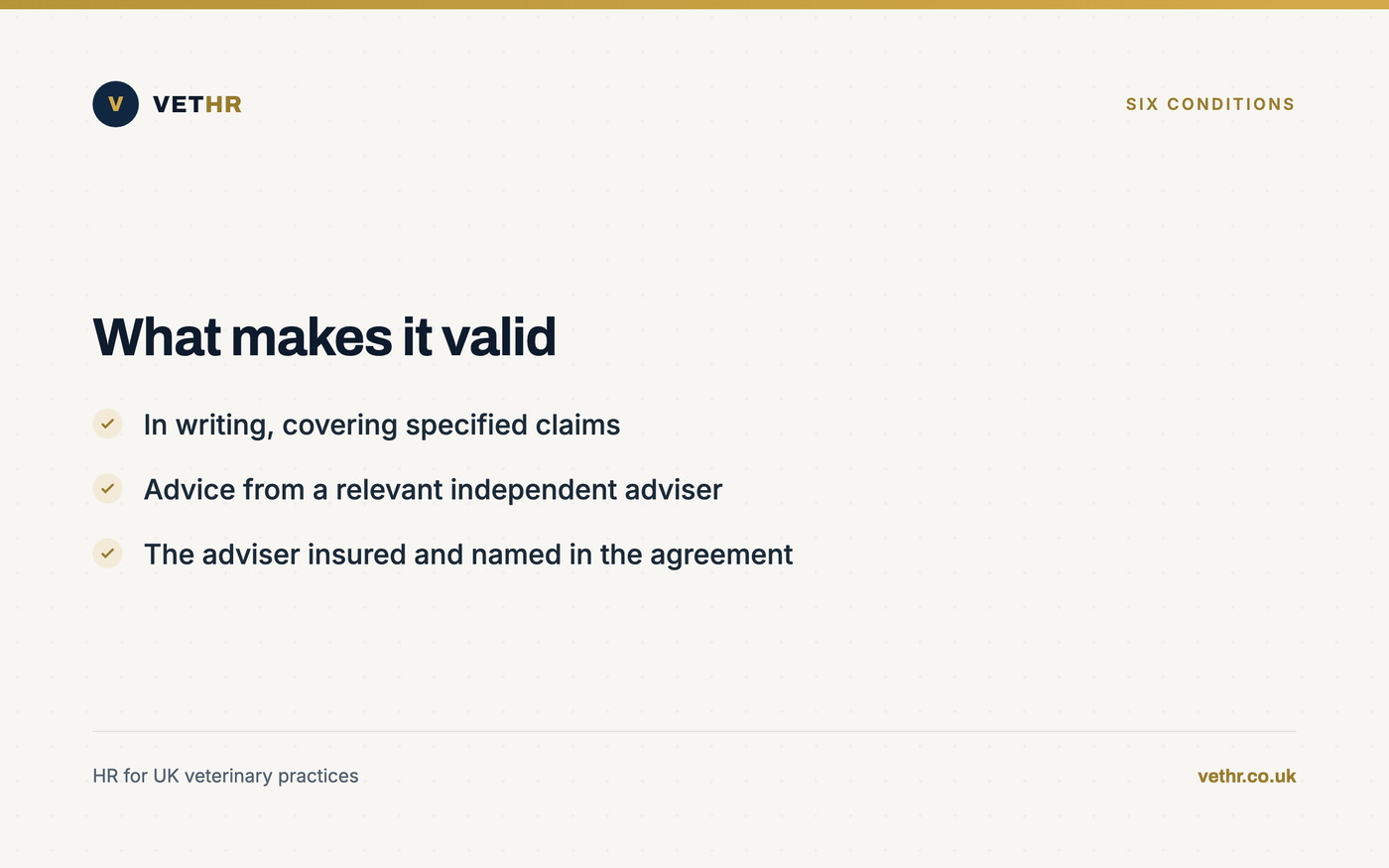
Six conditions, and missing any one of them can leave the agreement unenforceable. Acas sets out the legal requirements clearly, and a practice should treat them as a checklist rather than as background.
Acas is explicit that the worker must obtain advice from a relevant independent adviser who is insured and named in the agreement. That advice requirement is not a formality you can waive to save time or money.
This is the point where the difference between HR support and legal advice matters. Vet HR is an HR consultancy rather than a law firm, and a settlement agreement should be drafted or reviewed by a solicitor. Our guide to whether you need an HR consultant or an employment lawyer explains where that line sits.
When the relationship cannot be repaired and a formal process would cost more than it resolves. That is a narrow set of situations, and it is worth being honest about which one you are actually in.
It is the wrong tool for ordinary underperformance that has never been addressed, or for a first conduct issue. Those need a proper procedure, and a practice that reaches for money instead teaches the whole team that difficult conversations get paid for. Our guides to managing underperformance and disciplinary procedures cover the alternative.
Timing matters as much as suitability. Raising a settlement agreement in the middle of a live grievance can look like an attempt to buy the complaint off, whereas raising it once a process has genuinely reached an impasse reads very differently to everyone involved, including a tribunal.
Weigh it against the cost of the alternative rather than against zero. A defended tribunal claim absorbs management time for a year and produces no better outcome in many cases, which is the arithmetic our piece on what an employment tribunal really costs sets out.
Carefully, in a planned conversation, having taken advice first. Employment law provides a route for confidential discussions about ending employment, but the protection has limits and improper behaviour removes it.
Have one person lead the conversation and one person take notes, and keep both roles consistent throughout. Practices sometimes rotate who speaks to the employee across a fortnight, and the inconsistency in what was offered and when becomes the thing that is later argued about.
Do not describe the outcome as inevitable. Telling someone they will be dismissed anyway converts a protected discussion into evidence, and it is the single most common way a practice damages its own position in these conversations.
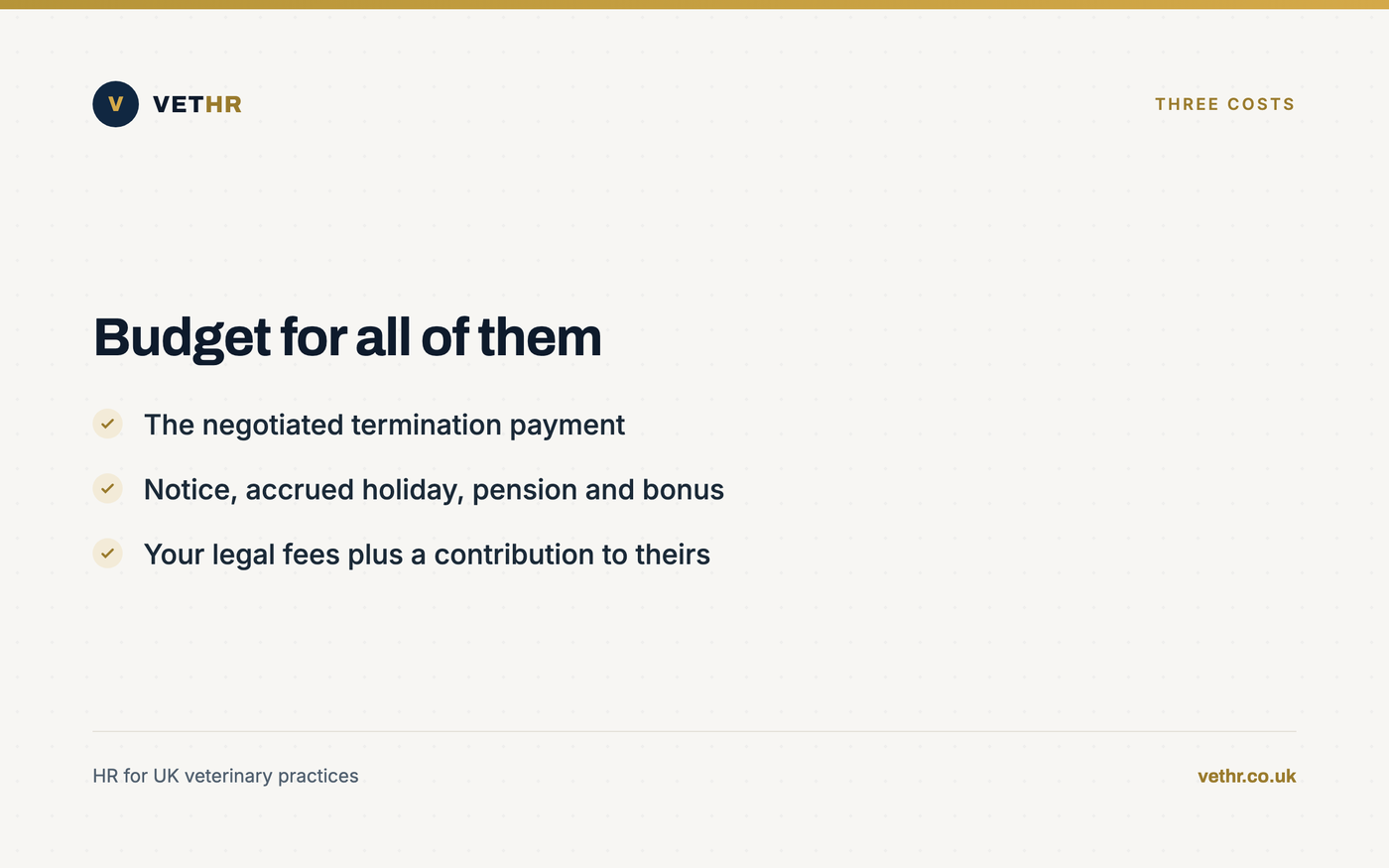
Three separate costs, and practices routinely budget for only the first. Getting the full picture before you open the conversation prevents an offer being withdrawn halfway through, which is worse than never making it.
A contribution to the employee’s advice is standard practice because the agreement cannot be valid without that advice being taken. Treating it as an optional extra tends to stall the whole thing at the last step.
Calculate accrued holiday properly before you make an offer. A vet with a large untaken balance changes the arithmetic, and our holiday calculations system exists so that figure is not a guess made in the middle of a negotiation.
Facing a situation that may end this way? A free 30-minute HR health check will help you weigh the options first. Book your HR health check.
Everyone works out that something happened. In a practice of eighteen people, a vet leaving abruptly with no explanation generates a story, and the story is always worse than the truth you are not allowed to tell.
Agree the wording of what will be said internally as part of the agreement itself. A short, neutral, agreed line delivered to the team on day one closes the gap that rumour otherwise fills.
Agree the reference wording too. A settlement agreement typically fixes an agreed reference, and having it written into the document avoids an awkward request six months later. Our guide to employment references for veterinary staff covers what a safe reference looks like.
Handle the practical exit properly as well. Rota removal, system access, controlled drugs authorisations, client communication and the RCVS position on ongoing cases all need a named owner and a date, and none of that is covered by the agreement itself.
Then look at what led here. If two settlement agreements in three years both followed the same unresolved rota or management issue, the agreements are treating a symptom at considerable cost.
Yes. Acas lists advice from a relevant independent adviser as a legal condition for a valid settlement agreement, and that adviser must be insured and named in the document. Without it the agreement does not do the job it was written for, which is why employers usually contribute to the cost.
Only through a fair process, and the offer must never be presented as though the outcome is already decided. Saying that dismissal will follow regardless is the behaviour most likely to remove the confidentiality protection around the discussion. Take advice before the conversation, not after.
A reasonable period, and ten calendar days is the benchmark widely used in practice. Pushing for a same day answer looks like pressure, undermines the voluntary nature of the agreement and rarely produces a faster conclusion in reality.
The tax treatment depends on what each element represents, and it is not something to assume. Notice pay and contractual entitlements are treated differently from compensation for loss of employment. Have the tax position confirmed by the solicitor drafting the agreement before any figure is communicated.
We are an HR consultancy rather than a law firm, so the agreement itself should be drafted or reviewed by a solicitor. What we do is help you decide whether this is the right route, prepare the process and paperwork around it, and manage the practical fallout in the team afterwards.
A settlement agreement is a legitimate, sometimes sensible way to end a relationship that is not going to recover. It buys certainty, and in a small clinical team certainty has real value. It is not a shortcut around a process you should have run.
Take advice before the first conversation, get the six validity conditions right, budget for all three costs, and agree what the team will be told. Our HR consultancy works alongside your solicitor on exactly this, and the free HR health check is the place to start if you are weighing it up.
The Vet HR Team provides HR consultancy and white-labelled staff systems exclusively to UK veterinary practices. We are not a law firm; settlement agreements should be drafted or reviewed by a solicitor.
Contracts, rotas, holiday, a difficult conversation. Tell us what you are dealing with and we will come back within one working day. Nothing to sign up to.
Got it. We will come back to you within one working day. If you do not see a reply, please check your spam folder.
