Last updated: 6 November 2026
TL;DR: Final pay is due on the date the person is normally paid. It must include holiday accrued but not taken, and money can only be deducted for holiday taken in excess if that was agreed in the contract or in writing beforehand. The employer must give a P45, and should make sure the leaver understands how the figure was reached.

A nurse leaves in March having taken eleven days of a twenty eight day entitlement, with a certificate the practice part funded in January and two weeks of notice she did not work. Her final pay arrives with a single figure on it and no explanation. Within a fortnight there is an email, and within a month there is a formal complaint about a sum nobody has ever set out on paper.
On the normal payday. Acas states that a worker should get their final pay on the date they are normally paid.
Final pay carries no obligation to run a special payroll on the last day, and no right to hold the money back until equipment is returned or a handover is finished. Those are separate issues with separate remedies.
Acas also notes that the employer must give the worker a P45 when they leave. Send it promptly, because a missing P45 is the single most common reason a leaver contacts the practice after they have gone.
It gets paid. Acas states that employers must pay workers in lieu for any untaken statutory holiday entitlement they have accrued when leaving, meaning the employer pays holiday pay instead of the person taking the holiday.
Work out the accrual to the last day of employment rather than to the end of the month, and be careful with anyone on irregular hours, where the calculation is not a simple fraction of the year.
Contractual holiday above the statutory minimum follows the contract rather than the statutory rule. If your practice gives thirty three days and the contract is silent about what happens on leaving, that silence will be read against you. Our note on carrying over holiday covers the neighbouring question.

This is where final pay most often goes wrong. Acas says an employer can deduct money from final wages where the person has taken more holiday than they built up, but only if that is agreed in the contract or in writing beforehand.
Beforehand is the operative word. A clause signed on day one works. A conversation on the last day does not, and neither does a line in a handbook the person never signed.
Check your contract template now rather than at the point you need it. Our guide to employment contracts for veterinary staff covers where this clause belongs, alongside the others you only discover are missing under pressure.
Bank staff and people on fixed term contracts need the same arithmetic. A fixed term contract that simply reaches its end date is still a leaver with holiday accrued, and it is the group most likely to be paid a flat final figure with nothing added for untaken leave.
Watch the timing of resignations around the leave year end too. Somebody leaving in the last month of the leave year with most of their entitlement untaken produces a large payment that nobody has budgeted for, and it is entirely predictable if anyone is watching balances.
Acas lists money deducted for training courses among the reasons final pay may differ from usual pay. That is only true where a signed training cost agreement exists, made before the course started.
The same rule covers everything else a practice might want back: unreturned equipment, a staff account, an overpayment. Each needs a lawful basis, and the general rules on deductions still apply on the last payslip exactly as on every other one.
Our guides to training cost agreements and deductions from wages cover both, including the minimum wage floor that applies even to a lawful deduction.
Redundancy changes the picture again, because statutory redundancy pay sits on top of everything else and has its own calculation. If a leaver is being made redundant, work the final pay out as a separate exercise rather than folding it into a normal payroll line. Our guide to redundancy in a veterinary practice covers the process.
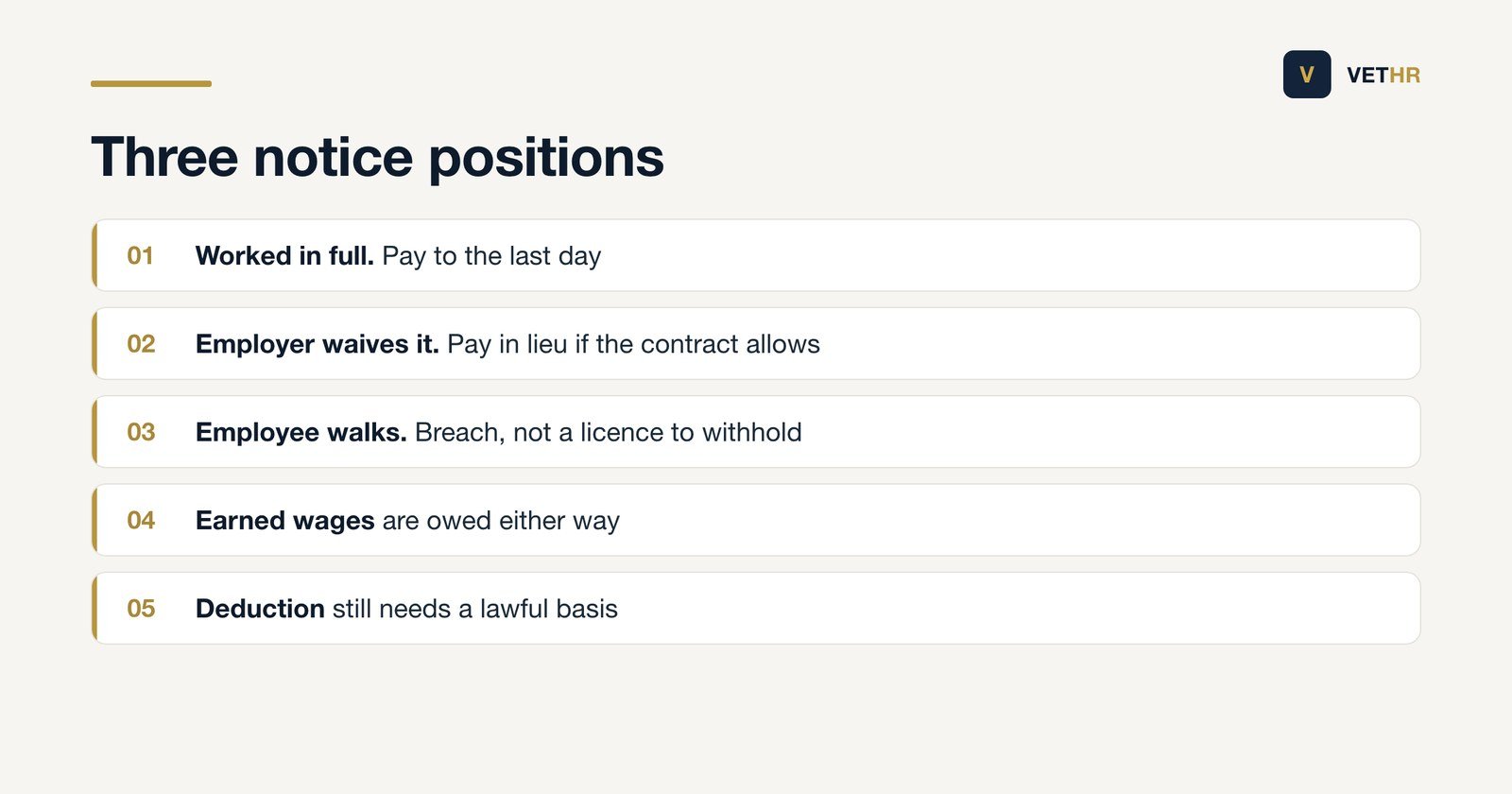
Acas notes that whether notice was worked affects the figure. Three situations cover almost every leaver in practice.
That third one trips practices up regularly. Somebody walking out without working notice does not forfeit wages already earned, and deducting them needs the same lawful basis as any other deduction. Our notes on notice periods and garden leave cover the options.

Acas says employers should make sure the person leaving understands how their final pay was calculated. That one sentence prevents most leaver disputes.
Send a short breakdown before the payslip lands: days worked in the final month, holiday accrued and paid or holiday overtaken and deducted, any agreed deduction with the clause it rests on, and anything paid in lieu of notice. Set it out as a list rather than a paragraph, so the person can check each line against what they expected.
Six lines in an email. It takes ten minutes and it is the difference between a leaver who recommends the practice and one who posts about it. Our note on payslips covers what the document itself must show.
Keep the breakdown with the leaver file rather than only in a sent items folder. If a query arrives six months later, the person who answers it is often not the person who worked the figure out, and a saved calculation answers in minutes what memory cannot answer at all.
Run those six for every leaver, including bank staff and anyone on a fixed term contract who simply reaches the end date. Book a free 30-minute HR health check if you want your contract checked for the clauses this list depends on.
Acas states that a worker should get their final pay on the date they are normally paid. There is no requirement to pay early, and no right to delay it while waiting for equipment to come back or a handover to finish.
Yes. Employers must pay in lieu for untaken statutory holiday accrued at the point of leaving. Contractual holiday above the statutory minimum follows whatever the contract says, which is why the contract needs to say something.
Only where the person has taken more holiday than they built up and it is agreed in the contract or in writing beforehand. Without that written agreement in advance, the deduction is not available however clear the arithmetic is.
Not as a penalty. Wages already earned are owed. Failing to work notice may be a breach of contract with its own remedies, but it does not create a right to keep money for work that was done.
Acas states that an employer must give a P45 when a worker leaves. Issue it with the final payroll run rather than waiting to be asked, because chasing it is the most common reason a leaver gets back in touch.
Almost every dispute about final pay is a communication failure rather than an arithmetic one. The figure is usually right. Nobody explained it.
Run the six checks, write the breakdown, send the P45. We review leaver processes and the contract clauses behind them through HR consultancy for veterinary practices and employment contract drafting.
The Vet HR Team provides HR consultancy and white-labelled staff systems exclusively to UK veterinary practices.
Contracts, rotas, holiday, a difficult conversation. Tell us what you are dealing with and we will come back within one working day. Nothing to sign up to.
Got it. We will come back to you within one working day. If you do not see a reply, please check your spam folder.
