Last updated: 5 September 2026
TL;DR: Without an agreement, workers must take their 5.6 weeks within the leave year. Where carry over applies, the maximum is generally 4 weeks. Someone on long term sick leave can carry over up to 4 weeks and must use it within 18 months of the end of that leave year. Someone who could not take leave because of maternity or other statutory leave must be allowed to carry it over.
Every practice has the December conversation about carrying over holiday. Two nurses have six days left, the rota cannot absorb them, and somebody says the words “use it or lose it” without being entirely sure whether that is true. Sometimes it is. Often it is not, and the difference is worth knowing before the last week of the leave year.
The default position on carrying over holiday is that leave is taken in the year it accrues. Acas states that without a relevant agreement, workers must take the 5.6 weeks’ holiday entitlement during the leave year, except where there is a good reason such as long term sickness.
A relevant agreement can be a workforce agreement, a collective agreement or the employment contract itself. So a practice that wants to permit carry over can simply write it into contracts and apply it consistently.
The default on carrying over holiday is therefore stricter than most practices assume, and the exceptions are wider. Both halves of that sentence catch people out in different directions.
The underlying entitlement is unchanged: GOV.UK confirms almost all workers get 5.6 weeks’ paid holiday a year, capped at 28 days. Carry over decides when it is used, never whether it exists.
Get your leave year stated clearly first. Many practices cannot say with certainty whether theirs runs January to December or April to March, which makes every carry over question harder than it needs to be.
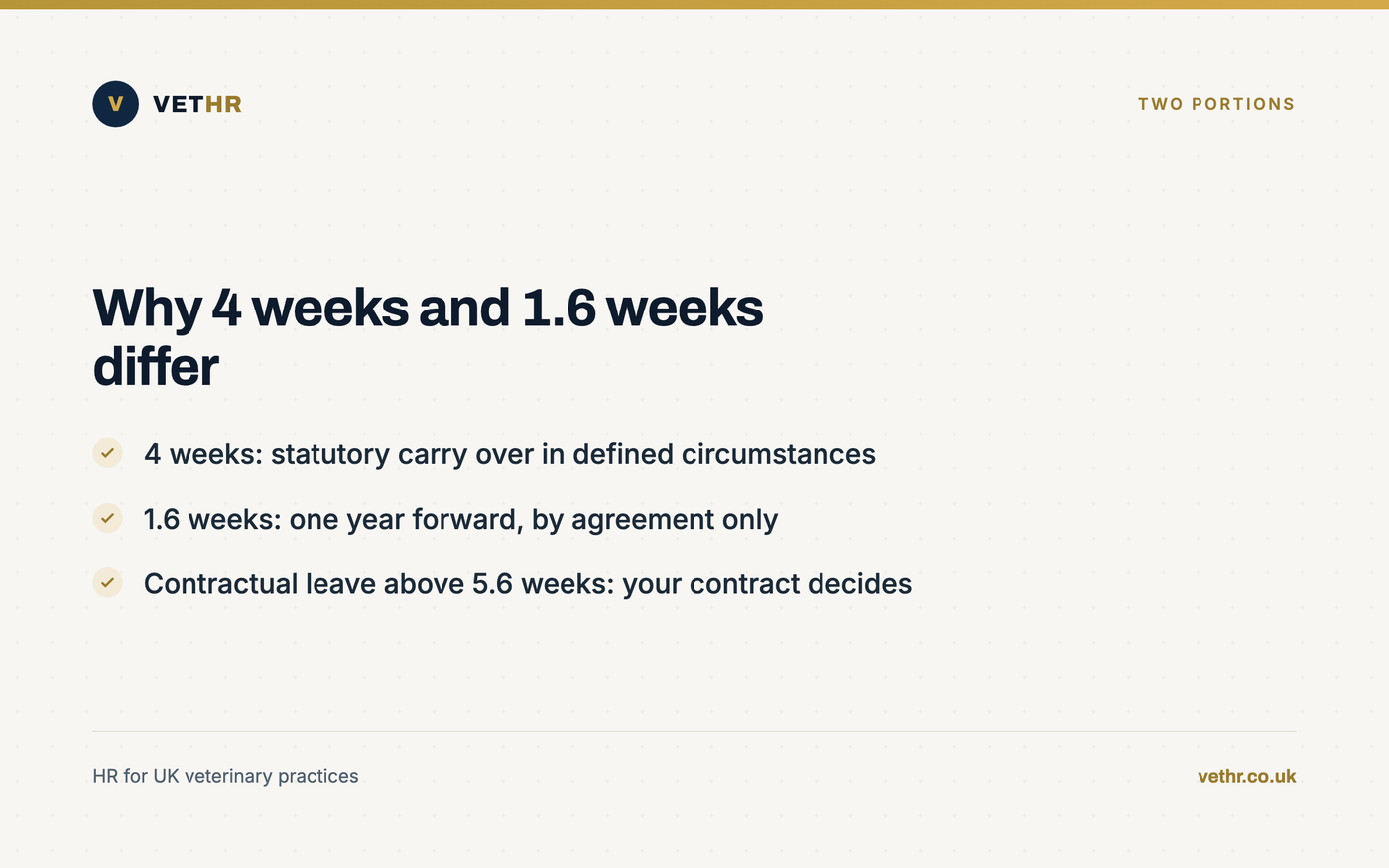
Because the 5.6 weeks is made of two different entitlements with different rules. Acas explains that where circumstances permit carry over, workers can carry over a maximum of 4 weeks, and that the remaining 1.6 weeks cannot be carried over without a relevant agreement.
Most practices never separate these two portions when carrying over holiday is discussed, which is why the answer to a carry over request tends to depend on who is asked. Write the distinction down once and the question stops recurring.
Irregular hours and part-year workers have their own accrual method, which sits alongside this rather than inside it, as our guide to rolled-up holiday pay explains.
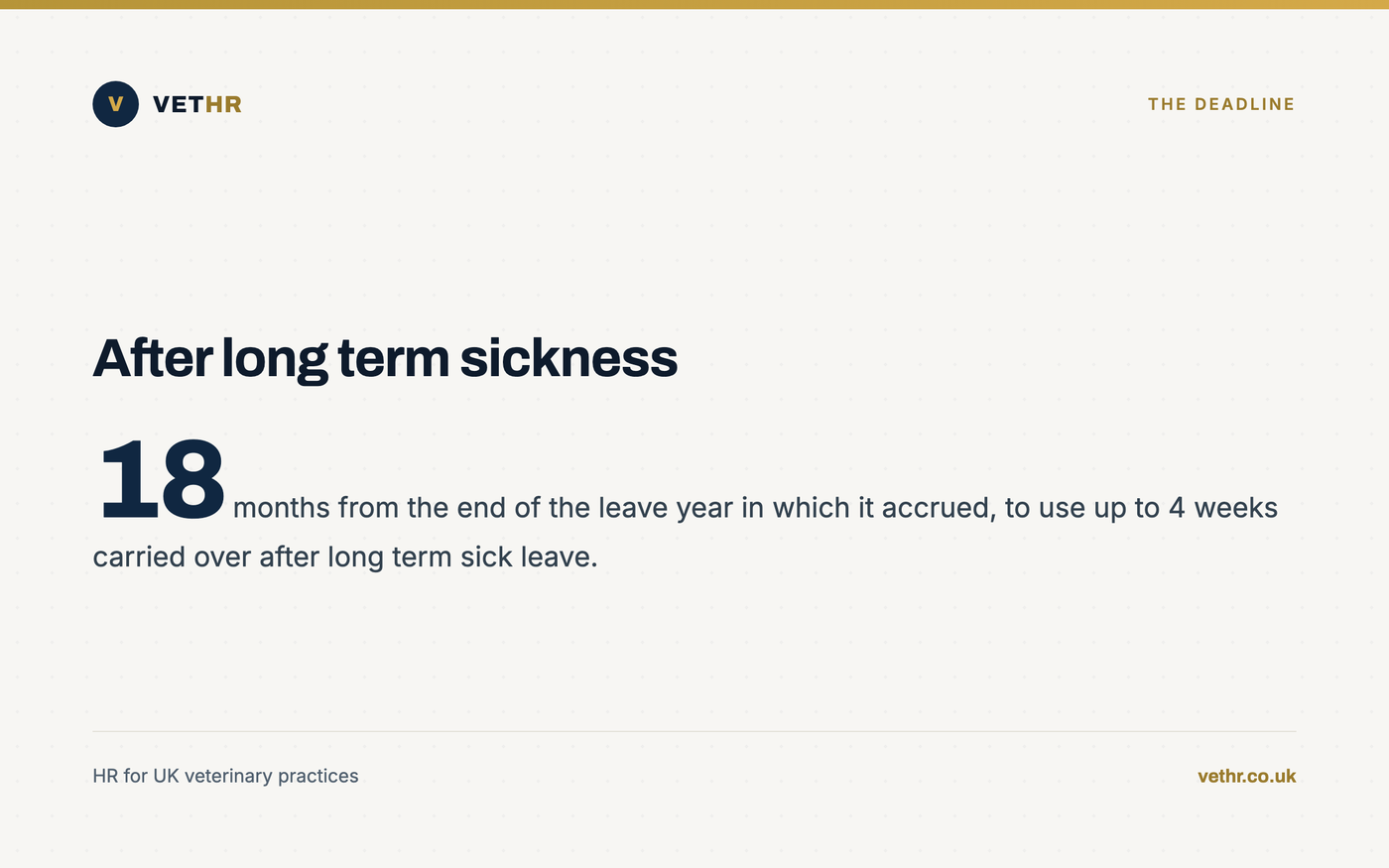
Up to 4 weeks carries over, with a deadline attached. Acas confirms that workers on long term sick leave may carry over up to 4 weeks and must use it within 18 months starting from the end of the leave year in which it accrued.
That 18 month window is the part practices miss entirely when carrying over holiday. It is a genuine deadline, so a nurse returning in March from a long absence needs a plan for using that leave rather than an open-ended balance nobody tracks.
Holiday continues to accrue during sickness absence, which surprises owners. Someone off for five months has been building entitlement throughout, and that balance is waiting when they return.
Plan the leave into the return rather than after it. A phased return that also has to absorb four weeks of accrued holiday needs designing, as our guide to managing sickness absence covers.
Carrying over holiday must be allowed in this situation. Acas is clear that someone unable to use holiday while on statutory leave, such as maternity leave, must be allowed to carry the holiday over to the next leave year.
Holiday accrues throughout maternity leave, so a nurse taking a full year returns with a substantial balance. In a small practice that is a genuine rota event and it needs planning during the leave, not on the return date.
The same logic on carrying over holiday applies to adoption, shared parental and other statutory leave. Where the person genuinely could not take holiday, refusing carry over is not an option available to you.
Many practices use accrued leave to bridge the end of maternity leave into a phased return, by agreement. That works well when it is discussed early, as our guide to maternity leave sets out.
The employer’s. Acas states that employers have a legal responsibility to make sure workers can take the holiday they are entitled to, which is a considerably more active duty than approving requests as they arrive.
Keep a record of what you did to enable leave, not only of what was taken. Reminders sent, balances shared and requests approved all evidence that carrying over holiday was not forced on anybody by a rota that never had room.
That changes the December conversation. A practice that repeatedly declined leave requests all year because the rota was tight cannot then rely on a use it or lose it rule against the person who asked.
Step five is the practical fix that resolves most of it. Where the rota appears four to six weeks out, leave gets booked early and evenly, as our guide to the annual leave approval workflow covers.
Leave year ending and balances everywhere? A free 30-minute HR health check will sort the rules out. Book your HR health check.
Six things about carrying over holiday, stated plainly, so the same answer applies to everyone. Ambiguity here produces the impression that carry over is a favour granted to whoever asks most persistently.
Keep the carrying over holiday policy non-contractual in the handbook while the leave year itself sits in the contract, as our guide to the staff handbook explains.
Say what happens to leave carried over that is still unused at the next year end. Practices that leave this silent end up with balances rolling forward indefinitely, which turns carrying over holiday into a growing liability nobody has priced.
Then automate the balances. Manual tracking across a team with eight working patterns is where the December surprises come from, which is why our holiday calculations system exists.
As a general default, yes: without a relevant agreement, workers must take their 5.6 weeks within the leave year. But it cannot override the exceptions for long term sickness or statutory leave, and it is weakened considerably if you have been declining requests all year.
Generally a maximum of 4 weeks where carry over applies. The remaining 1.6 weeks can only be carried forward one leave year, and only by agreement between worker and employer. Contractual leave above the statutory 5.6 weeks follows whatever your contract says.
It applies to holiday carried over because of long term sick leave. Up to 4 weeks can be carried over and must be used within 18 months starting from the end of the leave year in which it accrued, which makes it a real deadline rather than an indefinite balance.
Yes. Statutory holiday continues to accrue during maternity and other family leave, and where someone could not take it because they were on that leave, they must be allowed to carry it over. Plan for the balance during the leave rather than discovering it on the return date.
Statutory annual leave generally cannot be paid in lieu except on termination of employment. Buying out leave from someone still employed is not a route around a carry over problem, and it defeats the purpose of a rest entitlement.
Carrying over holiday is a symptom rather than a problem. Where a practice ends the year with everyone holding a balance, the real issue is a rota that never made room, and the carry over rules simply decide who absorbs the consequence.
Write down your leave year and the rules on carrying over holiday, check balances quarterly, remember the sickness and family leave exceptions, and publish the rota far enough ahead that people can actually book. Our holiday calculations and HR consultancy handle both halves, and the free HR health check is where to start.
The Vet HR Team provides HR consultancy and white-labelled staff systems exclusively to UK veterinary practices. Holiday rules change, so check current Acas and GOV.UK guidance before altering your policy.
Contracts, rotas, holiday, a difficult conversation. Tell us what you are dealing with and we will come back within one working day. Nothing to sign up to.
Got it. We will come back to you within one working day. If you do not see a reply, please check your spam folder.
