Last updated: 14 June 2026
TL;DR: A good annual leave approval workflow has five parts: one way to request, shared visibility of who is already off, a written rule for clashes, a minimum cover line per role, and a quick decision with a recorded reason. Set the rules once, apply them the same way every time, and most holiday tension in a small team simply disappears.
In a five to fifteen person practice, two nurses wanting the same week off in August is not a payroll problem. It is a fairness problem, and fairness problems are what staff actually leave over. This guide gives you a workflow you can write on one page, plus the law behind each decision, so a “no” never feels personal.
An annual leave approval workflow is the agreed path a holiday request follows from the moment a team member asks to the moment they get a yes or a no. It names who requests, who sees the calendar, who decides, by when, and on what rule. In a small practice it can fit on a single side of A4, and that is the point.
The alternative is the default most practices drift into: a quiet word at reception, a note on the kitchen whiteboard, a text to the practice manager on her day off. That works until two people want the same Friday. Then the decision looks like favouritism, because nobody can see the rule behind it.
Every worker is legally entitled to 5.6 weeks of paid holiday a year, which for a five-day week is at least 28 days, according to GOV.UK holiday entitlement guidance. A clear process does not change that entitlement. It simply governs the timing of when those days are taken, which is where small teams actually struggle.
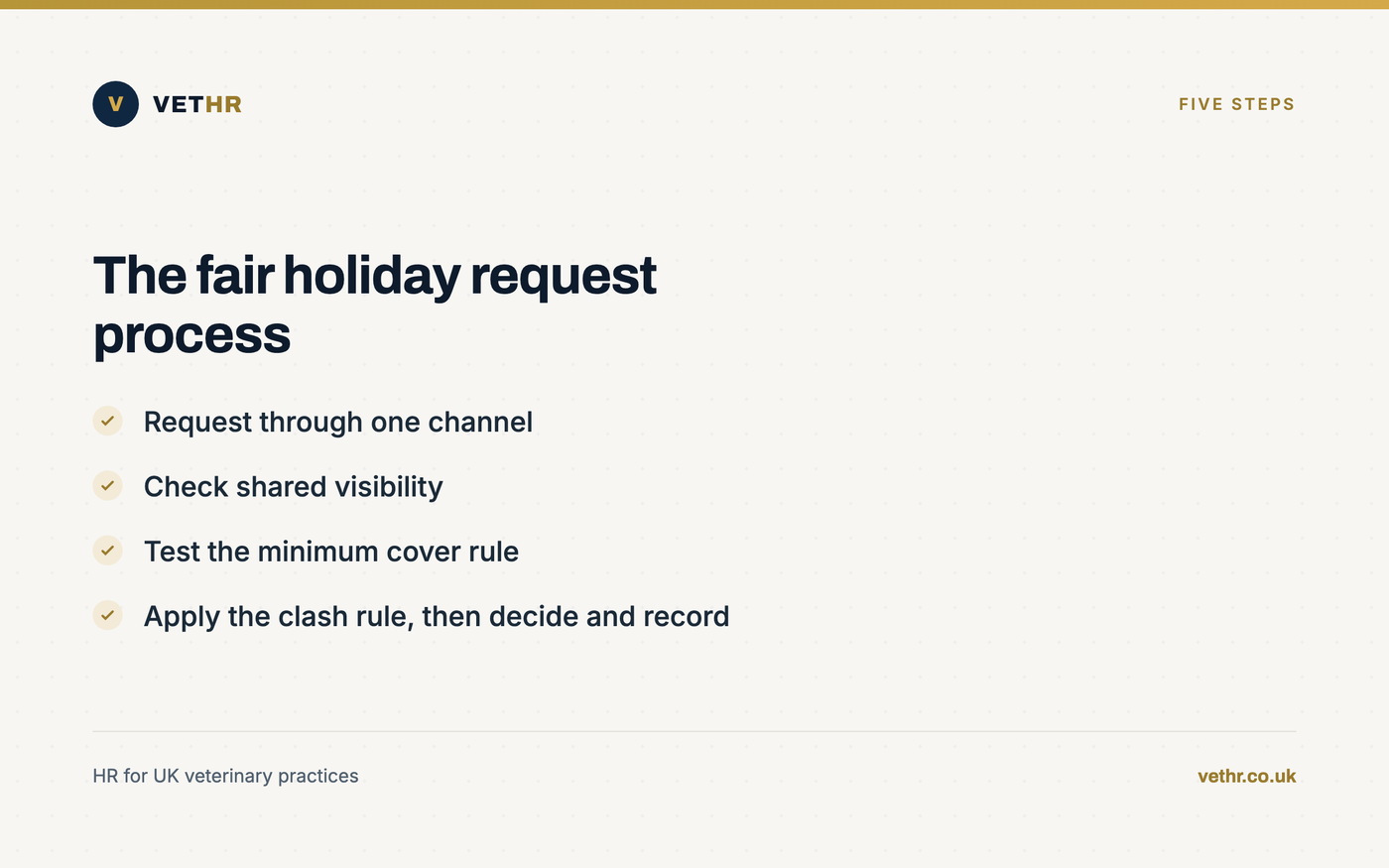
A fair holiday request process has five steps: request through one channel, check shared visibility, test against the minimum cover rule, apply the clash rule if needed, then decide and record. Each step removes one common source of resentment. Run them in order and the same workflow handles a quiet Tuesday and the Christmas scramble.
Notice that approval is step five, not step one. Most managers jump straight to “can I say yes?” before they have checked cover or visibility, which is exactly how an arbitrary-looking decision gets made. The whole point is to slow that instinct down by two minutes.
Decide clashes with a written rule chosen before any clash happens, then apply it every time. The fair options are first come first served by request date, a rotating priority so the same people do not always win the school holidays, or business-critical priority where one role must be present. Pick one, publish it, stick to it.
A clash rarely feels unfair because of the outcome. It feels unfair because of the suspicion that the outcome was decided by who asked the manager most charmingly. A published rule kills that suspicion. People can disagree with a rule and still trust it, as long as it applied to them exactly as it applied to everyone else.
The simplest rule: the earliest dated request for a given week wins. It rewards planning and is easy to defend because the timestamp is objective. Its weakness is that the same organised person can claim every peak week year after year, which is why many practices soften it.
For the genuinely contested weeks, Christmas, the late-August bank holiday, the first week of the summer holidays, keep a simple rota of who had first pick last year. People-management guidance recommends rotating popular periods so that the same employees do not always get the most coveted times off, per this People Management piece on managing holiday requests. Whoever was bumped last December goes to the front of the queue this December.
Sometimes a role simply has to be covered. If only one team member can run the lab or cover out-of-hours triage, their leave is constrained by that, and the policy should say so plainly in advance. This is not favouritism. It is the practice protecting its ability to see patients, and staff accept it far more readily when it is written down before the clash, not invented during it.
Whichever rule you choose, the closing move is the same: write down the decision and the reason. Arbitrary, undocumented decisions are where grievances begin, so a one-line note on each refusal is the cheapest insurance you will ever buy. Our guide to holiday calculations for veterinary teams covers how to keep the entitlement maths clean alongside this.
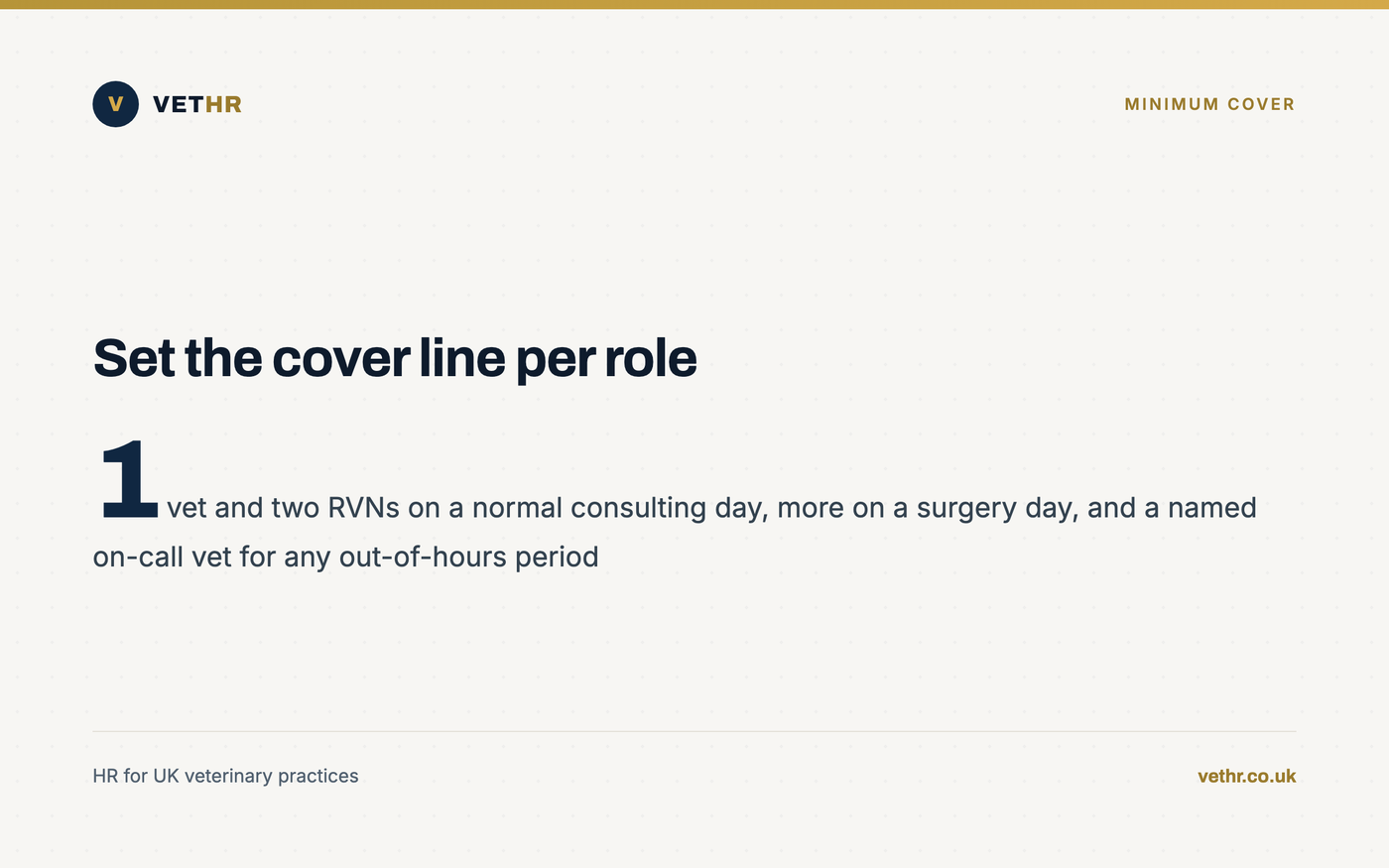
Set minimum cover by writing the smallest safe headcount for each role on each type of day, then treating that line as the wall every holiday request hits first. A typical rule reads: at least one vet and two RVNs on a consulting day, more on a surgery day, and a named on-call vet for any out-of-hours period.
The cover line does two jobs. It tells the approver instantly whether a request is even possible, and it gives staff an honest reason for any “no” that has nothing to do with them personally. GOV.UK confirms an employer can restrict when leave is taken, for example at certain busy periods, so a cover-based limit is within your rights when you communicate it in advance (GOV.UK, booking time off).
Build the cover line into your rota tool so a request that breaches it is flagged automatically. If you are still cross-checking a spreadsheet against a wall planner, our veterinary rota system shows who is off before anyone books.
Yes, you can refuse a specific holiday request, but you cannot refuse to let someone take their leave at all, and you must give proper counter-notice. ACAS is explicit: an employer “cannot refuse to let workers take any holiday at all,” and must give notice of a refusal “by at least the same amount of time as the amount they requested” (ACAS, asking for and taking holiday).
GOV.UK puts a precise figure on the counter-notice. An employer can refuse or cancel leave “but they must give as much notice as the amount of leave requested, plus 1 day. For example, an employer would give 11 days’ notice if the worker asked for 10 days’ leave” (GOV.UK, booking time off). Build that arithmetic into your process so a late “no” never becomes an unlawful one.
Two guardrails follow. First, decide quickly: the longer a request sits unanswered, the harder the counter-notice maths becomes as the date creeps closer. Second, if the contract sets different notice terms, the contract wins, so check what your own contracts say. Our veterinary employment contracts page covers getting that wording right.
The statutory default is that a worker must give notice of at least twice the length of the leave they want, plus one day. GOV.UK gives the worked example: “a worker would give 3 days’ notice for 1 day’s leave” (GOV.UK, booking time off). For a full week off, that is at least eleven days’ notice under the default rule.
In practice, the statutory minimum is too short for a small clinical team. Eleven days is rarely enough to arrange freelance vet cover for a week, so most practices set a longer window in policy: often four weeks for a single day and longer for peak periods. You are free to do this, as long as the rule is written, applied consistently, and never used to block the leave entirely.
The aim is not red tape. It is to give the practice enough runway to say yes more often. A longer, predictable notice window usually means fewer refusals, because there is time to arrange cover rather than a last-minute scramble that forces a “no”.
Here is the whole thing on one page. Copy it, change the numbers to fit your practice, and pin it where the team can see it.
An independent veterinary practice we supported replaced kitchen-whiteboard holiday booking with a written process like this. The first change managers noticed was not fewer requests. It was fewer arguments, because every decision now pointed to a rule instead of a mood.
If you want a second pair of eyes on your version before the summer rush, we will review it free. Book a free 30-minute HR health check and we will pressure-test your annual leave approval workflow against your contracts and your rota in plain English.
Yes, an employer can refuse a particular request for a good business reason, such as minimum cover, but cannot refuse to let a worker take their statutory leave at all. ACAS states an employer “cannot refuse to let workers take any holiday at all” and must give counter-notice at least as long as the leave requested.
Under the statutory default on GOV.UK, an employer must give counter-notice equal to the length of leave requested plus one day. For a ten-day request, that is eleven days’ notice. A different figure in the employment contract will take precedence over this default.
Apply a clash rule you set in advance: first come first served by request date, a rotating priority so the same people do not always win peak weeks, or business-critical role priority. Whatever you choose, document the decision and the reason so it is transparent and consistent.
The statutory default is at least twice the length of the leave plus one day, so three days’ notice for one day off. Most practices set a longer policy window, such as four weeks, to allow time to arrange cover. The rule must be written and applied to everyone the same way.
Yes, but the same counter-notice rule applies: the employer must give as much notice as the leave booked, plus one day under the statutory default. Cancelling approved leave should be rare, because it damages trust and may leave staff out of pocket on travel.
Not automatically. GOV.UK confirms bank or public holidays do not have to be given as paid leave, and an employer can choose to include them within the 5.6 weeks of statutory entitlement. What matters is that your contract states clearly which approach your practice uses.
A small team does not need a complicated system. It needs one clear set of rules, applied the same way every time, so that a “no” points at a rule and a “yes” never breaches your cover. Write the five steps down, build them into your rota, and most holiday friction quietly stops being your problem.
If you would like help turning this into a policy your team will actually follow, look at our rota and cover tools, get the entitlement maths right with holiday calculations, then book a free HR health check. We will help you put a fair workflow in place before the next clash, not after it.
Written by The Vet HR Team. We provide HR consultancy and staff systems exclusively to UK veterinary practices, so your rota, your contracts and your holiday rules all pull in the same direction.
Read next: Clock In and Out for Vet Practices.
Contracts, rotas, holiday, a difficult conversation. Tell us what you are dealing with and we will come back within one working day. Nothing to sign up to.
Got it. We will come back to you within one working day. If you do not see a reply, please check your spam folder.
