Last updated: 5 September 2026
TL;DR: Rolled-up holiday pay adds 12.07 per cent to each pay packet instead of paying holiday when it is taken. It is lawful for irregular hours and part-year workers only, for leave years beginning on or after 1 April 2024, and it must appear as a separate line on every payslip. Using it for salaried full-time vets is not permitted.

Most practices have at least one person whose hours move week to week. A bank nurse who covers holidays. A student who works Saturdays in reception. A part-year kennel assistant. Working out their holiday used to take an afternoon and a spreadsheet nobody trusted, and rolled-up holiday pay is the legal shortcut that now exists for exactly those people.
It is an uplift added to every pay packet in place of paying holiday at the time it is taken. Government guidance explains that it is calculated as 12.07 per cent of a worker’s total pay, paid at the same time as the pay for the work done in that period.
For years this practice sat in a legal grey zone. The reforms made it explicitly available again for a defined group, and the key date is that it applies to leave years beginning on or after 1 April 2024. If your leave year runs January to December, that meant 1 January 2025.
The change came out of a wider simplification of holiday rules. For irregular hours and part-year staff, entitlement is now built up as a percentage of hours actually worked in each pay period rather than estimated in advance, and rolled-up holiday pay is the payment method that sits alongside that accrual method.
The worker still has the leave. Rolled-up holiday pay changes only how the money is delivered, not the entitlement to time off, so someone paid this way still takes their weeks away from the practice and still needs to be in the rota planning.
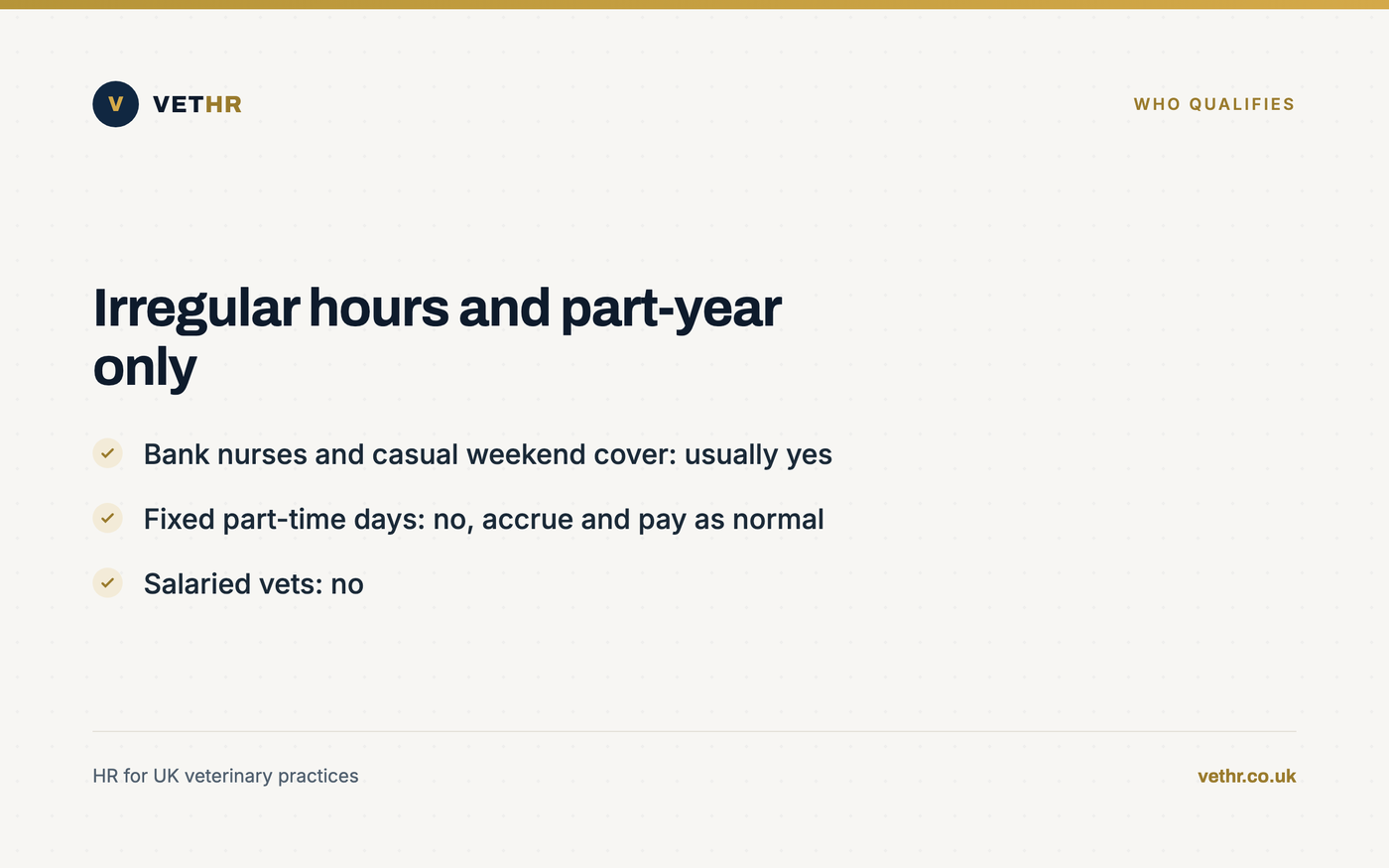
Irregular hours workers and part-year workers, and nobody else. The guidance is explicit that rolled-up holiday pay applies to irregular hour and part-year workers only, for leave years beginning on or after 1 April 2024.
In a small animal practice that usually means bank nurses, weekend receptionists, students, and animal care assistants whose hours are genuinely unpredictable. It does not mean a nurse contracted to 24 hours a week over fixed days, however part-time that feels.
The classification is the whole ball game. Getting it wrong means underpaying holiday for years, and unpaid holiday claims are cumulative. Our guide to casual workers in a veterinary practice covers how to work out which category someone actually falls into.
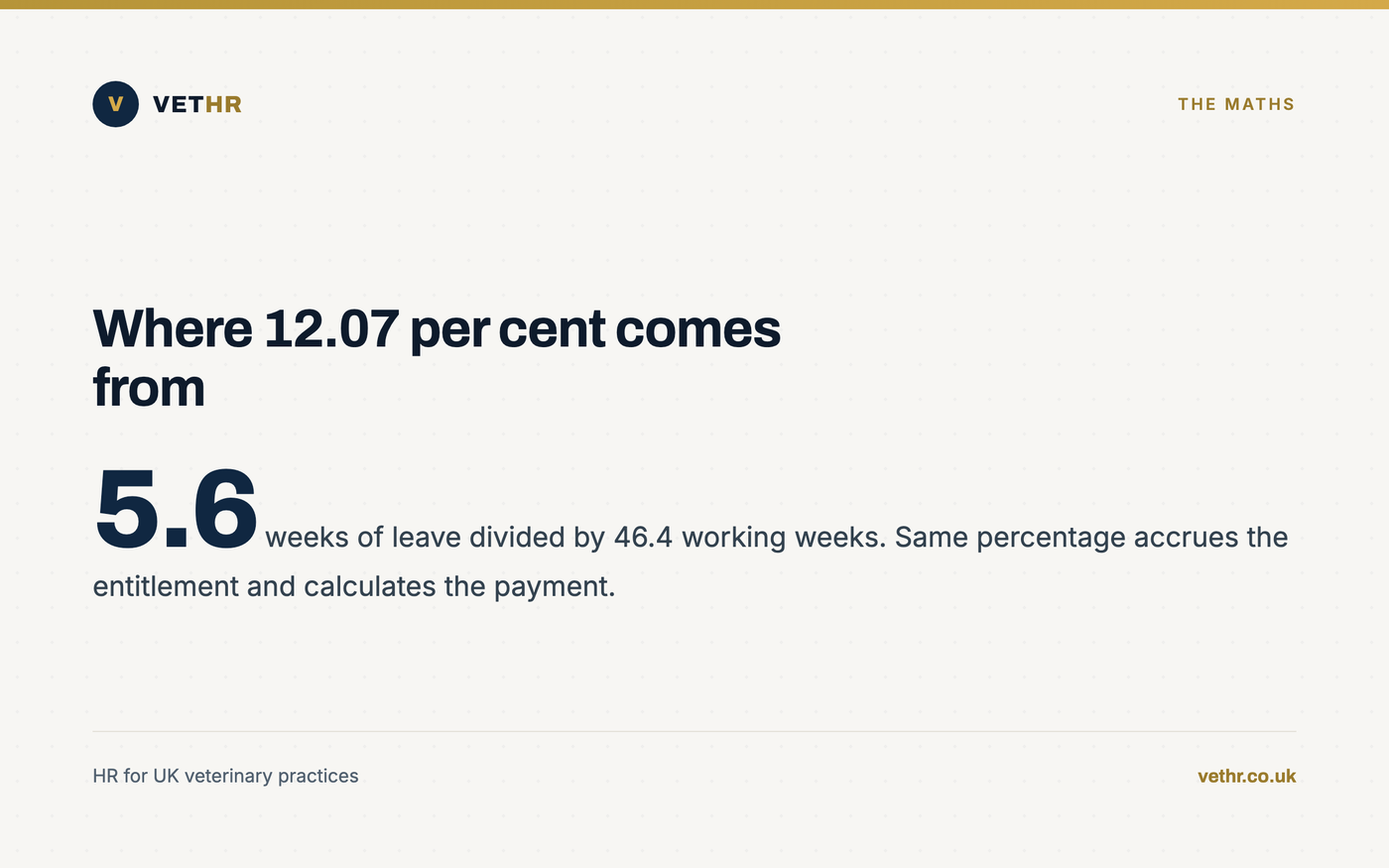
From the statutory minimum itself. Everyone gets 5.6 weeks of paid leave, which leaves 46.4 working weeks in the year, and 5.6 divided by 46.4 is 12.07 per cent. The guidance states the figure is the proportion of statutory annual leave in relation to the working weeks of each year.
The same percentage does two jobs. Entitlement for these workers is calculated as 12.07 per cent of the hours actually worked in a pay period, and rolled-up pay is 12.07 per cent of the pay for that period. One number, two calculations, which is why it is worth understanding rather than copying.
Note the limit. The 12.07 per cent figure is tied to the statutory 5.6 weeks. If your practice gives contractual leave above the statutory minimum, the percentage that reflects your actual entitlement is higher, and paying 12.07 per cent will short the worker.
Work it out once and write it into the contract. A bank nurse on £16 an hour earning £480 in a fortnight is owed roughly £57.94 of rolled-up pay on top at the statutory rate, and that sum should be visible rather than absorbed into the hourly figure.
A separate line, every time. The guidance requires the payment to be clearly marked as a separate item on each payslip, which rules out the old habit of quoting an inclusive hourly rate and hoping nobody asks.
This matters more than it sounds. An inclusive rate is not rolled-up holiday pay, it is an unpaid holiday claim waiting to be made, because the worker cannot see that they were ever paid for their leave.
Payslip rules reinforce it. GOV.UK requires payslips to show the number of hours worked where pay varies depending on time worked, so a bank nurse’s payslip should show hours, the pay for those hours and the holiday uplift as its own line.
Then you accrue and pay in the normal way, which is still perfectly lawful. Entitlement builds at 12.07 per cent of hours worked in each pay period, the worker books time off, and you pay it at their average weekly earnings over the relevant reference period.
You also keep more control over cash flow. Under the accrual route the money leaves the practice when the leave is taken, which for a seasonal team can mean the cost lands in quieter months rather than in the middle of a busy summer of cover.
Plenty of practices prefer this. It keeps holiday visible as time off rather than money, which matters when the person concerned is a nurse who will otherwise work fifty weekends in a row because the leave never felt like it existed.
The accrual route needs a system that tracks hours accurately. Doing it on paper produces the classic small practice failure, where nobody knows the balance until someone asks in December. Our holiday calculations system exists because that calculation is exactly the kind of thing software should own.
Not sure whether your bank staff are irregular hours workers? A free 30-minute HR health check will sort the classification out. Book your HR health check.
Three, and they are all avoidable with paperwork rather than with money. The mechanism is simple, so the failures come from applying it to the wrong people or documenting it badly.
The third one is the one practice managers underestimate. A bank nurse paid holiday in every packet has no financial prompt to stop, and in veterinary work the people with irregular hours are often the ones already covering the awkward shifts. Our guide to managing burnout in a veterinary practice covers why that pattern matters.
There is a fourth risk worth naming, which is inconsistency. Practices sometimes apply rolled-up holiday pay to one bank nurse and accrual to another doing identical work, usually because the two were hired by different managers in different years. Pick one approach per worker category and document it.
Keep a record of leave taken even when the pay is rolled up. It is not a payroll requirement, it is how you know whether a member of your team has had a week off since March.
Yes, for irregular hours workers and part-year workers, for leave years beginning on or after 1 April 2024. It must be calculated at 12.07 per cent of pay for the period, paid alongside that pay, and shown as a separate item on the payslip. For other workers, holiday must still be paid when the leave is taken.
No. Part-time is not the same as irregular hours. A nurse contracted to work Tuesdays and Thursdays every week has a regular, predictable pattern, so their holiday must be accrued and paid when taken in the usual way, even though they work fewer hours than a full-time colleague.
Yes. The entitlement to 5.6 weeks of leave is unchanged; only the timing of the payment differs. Practices should still record leave taken, because a worker who never books time off is a retention and wellbeing problem regardless of how their holiday pay is delivered.
Then 12.07 per cent is too low. That percentage is derived from the statutory 5.6 weeks against 46.4 working weeks. If your contractual entitlement is higher, recalculate the percentage so it reflects what you actually promise, and state the figure in the contract.
No, it is an option rather than a requirement. Many practices keep accruing and paying holiday when it is taken because it keeps rest visible. If you do switch, agree the change with the worker, put it in writing and start it from the beginning of a leave year rather than mid-year.
Rolled-up holiday pay solves a genuine administrative problem for practices that rely on bank and weekend staff. It is simpler than a reference period calculation, it is transparent when it is done properly, and it removes the December argument about balances nobody tracked.
What it does not do is fix classification. Decide honestly who is an irregular hours worker, put the 12.07 per cent line on the payslip, and keep recording the time off. Our holiday calculations and HR consultancy handle both halves, and the free HR health check is where most practices start.
The Vet HR Team provides HR consultancy and white-labelled staff systems exclusively to UK veterinary practices. Holiday pay rules change, so check current GOV.UK guidance before altering payroll.
Contracts, rotas, holiday, a difficult conversation. Tell us what you are dealing with and we will come back within one working day. Nothing to sign up to.
Got it. We will come back to you within one working day. If you do not see a reply, please check your spam folder.
