Last updated: 24 September 2026
TL;DR: Deductions from wages are only lawful if the law requires them, the contract allows them, or the employee agreed in writing before the event that caused them. A deduction cannot normally take pay below the National Minimum Wage. Unpaid drug bills, lost stethoscopes and unreturned scrubs do not create an automatic right to deduct.

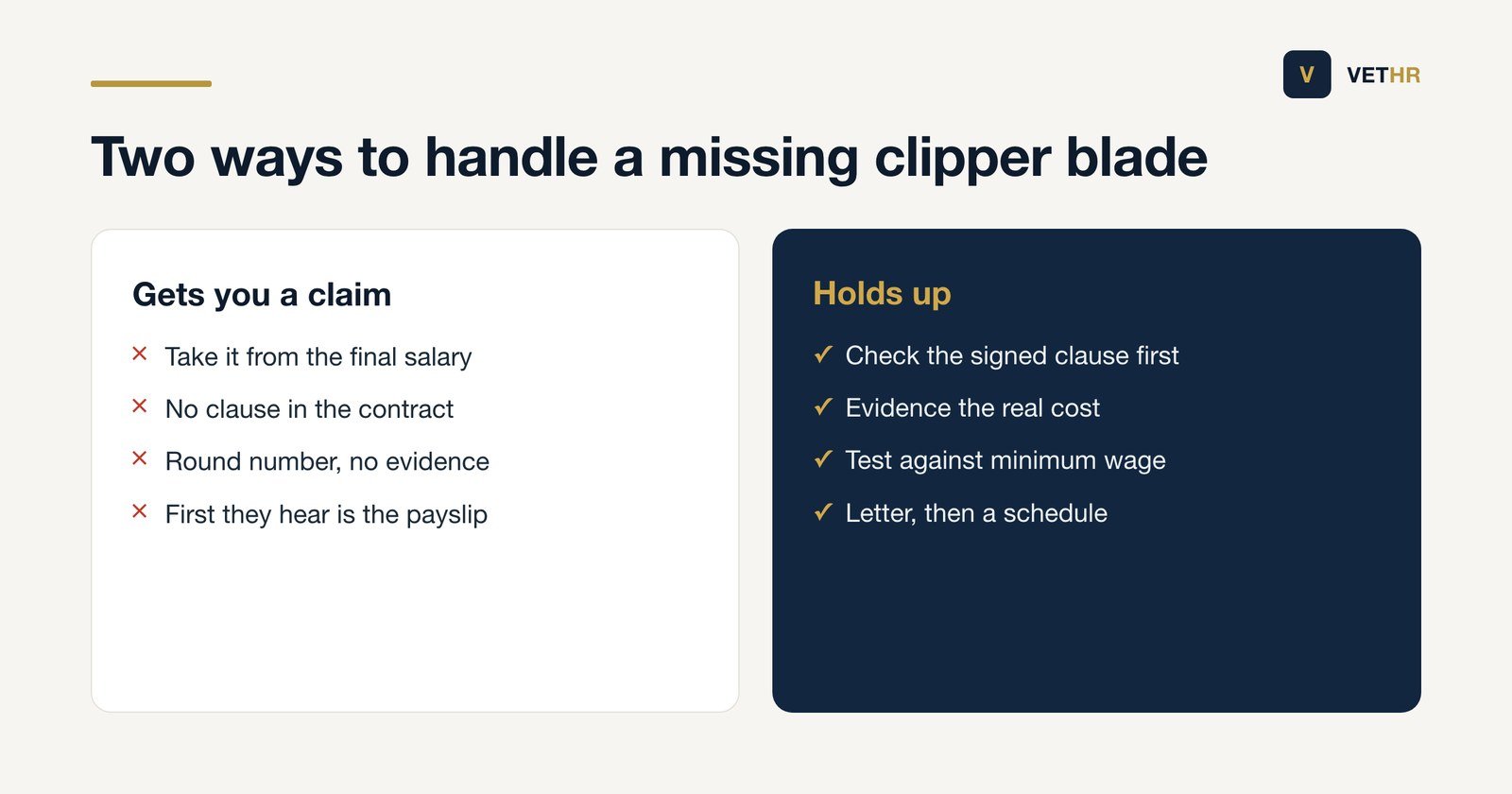
A nurse resigns owing for a bag of prescription food, a clipper blade nobody can find, and half of a certificate the practice funded in March. Someone in payroll takes the lot out of her final salary. Six weeks later a tribunal claim arrives, and the practice discovers that being owed money and being allowed to deduct it are two different things.
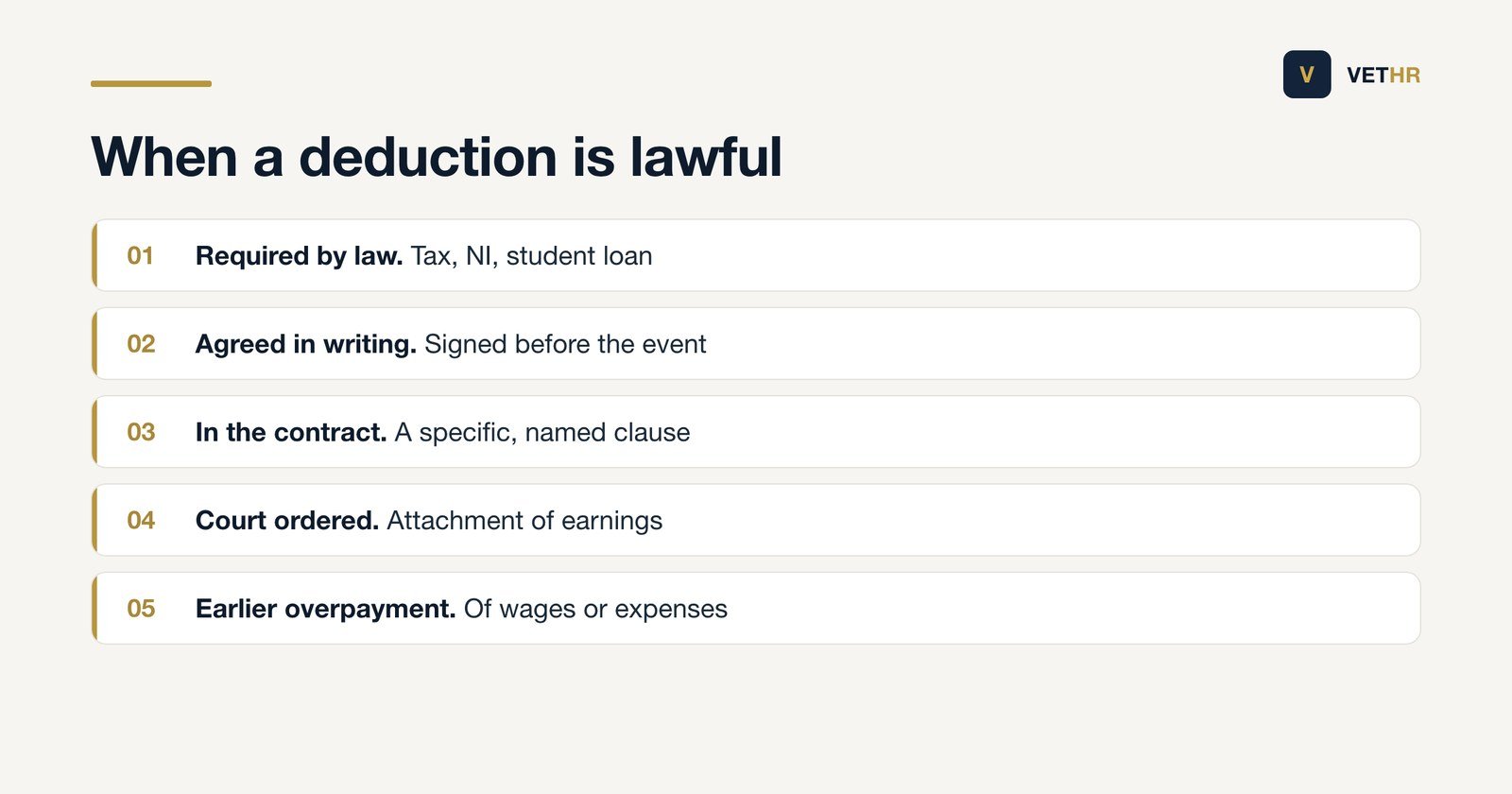
There is a short list, and GOV.UK sets it out. An employer can only make deductions where it is required or allowed by law, where the worker agrees in writing, where the contract says they can, where a court has ordered debt payments, where a statutory payment is due to a public authority, where the worker took part in a strike, or where there has been an earlier overpayment of wages or expenses.
Deductions from wages for tax, National Insurance and student loan repayments fall in the first category and nobody argues about them. Everything else on that list needs a document behind it.
Deductions from wages that cannot be traced to a clause or a signature are unlawful, however reasonable they feel. That is the whole test, and it is the one most practices fail.
Timing is the trap with deductions from wages. The agreement or contract clause has to exist before the event that gives rise to the deduction. Getting someone to sign a form on their last day, after the clipper blade went missing, does not fix a deduction that was never permitted.
That is why the clause belongs in the employment contract, signed on day one, rather than in a letter you write when you need it. Our guide to employment contracts for veterinary staff covers where this sits alongside notice, hours and restrictive covenants.
A workable clause is specific. It names what can be recovered, says the practice will tell the employee before any deduction is made, and commits to taking it over more than one pay run where the sum is large. Vague wording about any monies owed is both unfair and hard to rely on.
Even lawful deductions from wages have a ceiling. GOV.UK guidance is explicit that a deduction cannot normally reduce pay below the National Minimum Wage, even if the worker agreed to it. A small number of exceptions apply, including tax and National Insurance, accidental overpayment of wages, share purchases, employer provided accommodation and personal expenses such as union dues.
Deductions from wages bite hardest on your lowest paid roles, which in most practices means kennel assistants, weekend reception cover and student veterinary nurses. Run the number before the pay run, not after.
A practical rule: if recovering the money in one go would take someone near the minimum wage, take it over three or four months instead. Our note on the minimum wage in a veterinary practice covers the traps in working out the hourly rate in the first place.
There is a special rule on deductions from wages for retail work. GOV.UK states that an employer cannot take more than 10 per cent from gross pay in any pay period to cover shortfalls, giving the example of £25 from £250 of weekly gross pay, with the rest recovered over later pay runs.
Whether a veterinary receptionist is doing retail work is a question of fact, and a practice with a counter selling diets, flea treatments and accessories may well be in scope. Take advice before you rely on being outside it.
The better answer is usually not to deduct at all. A till that is short by £40 on a busy Saturday is a process problem more often than a dishonesty problem. Look at how many people share a login, how refunds are authorised and who reconciles the drawer, before you look at anyone’s pay.
Certificate funding is where the largest sums sit, and where practices most often get it wrong. A clawback only works if there is a signed training cost agreement in place before the course starts, setting out the amount, the repayment period and how it tapers.
The agreement also has to be a genuine recovery of cost rather than a penalty for leaving. A full repayment demanded on the last day of a two year window looks like a deterrent, and deterrents are the ones that get struck down.
We set out what a defensible agreement looks like in our guide to training cost agreements for veterinary staff, including the taper most practices should be using.
An earlier overpayment sits on the permitted list for deductions from wages, so you can recover it. That does not mean you should take it all back in one run without telling anyone.
Write to the employee, explain how the overpayment happened, state the total, and propose a schedule. Most people agree to a sensible plan. The ones who do not are usually reacting to being surprised, not to the debt.
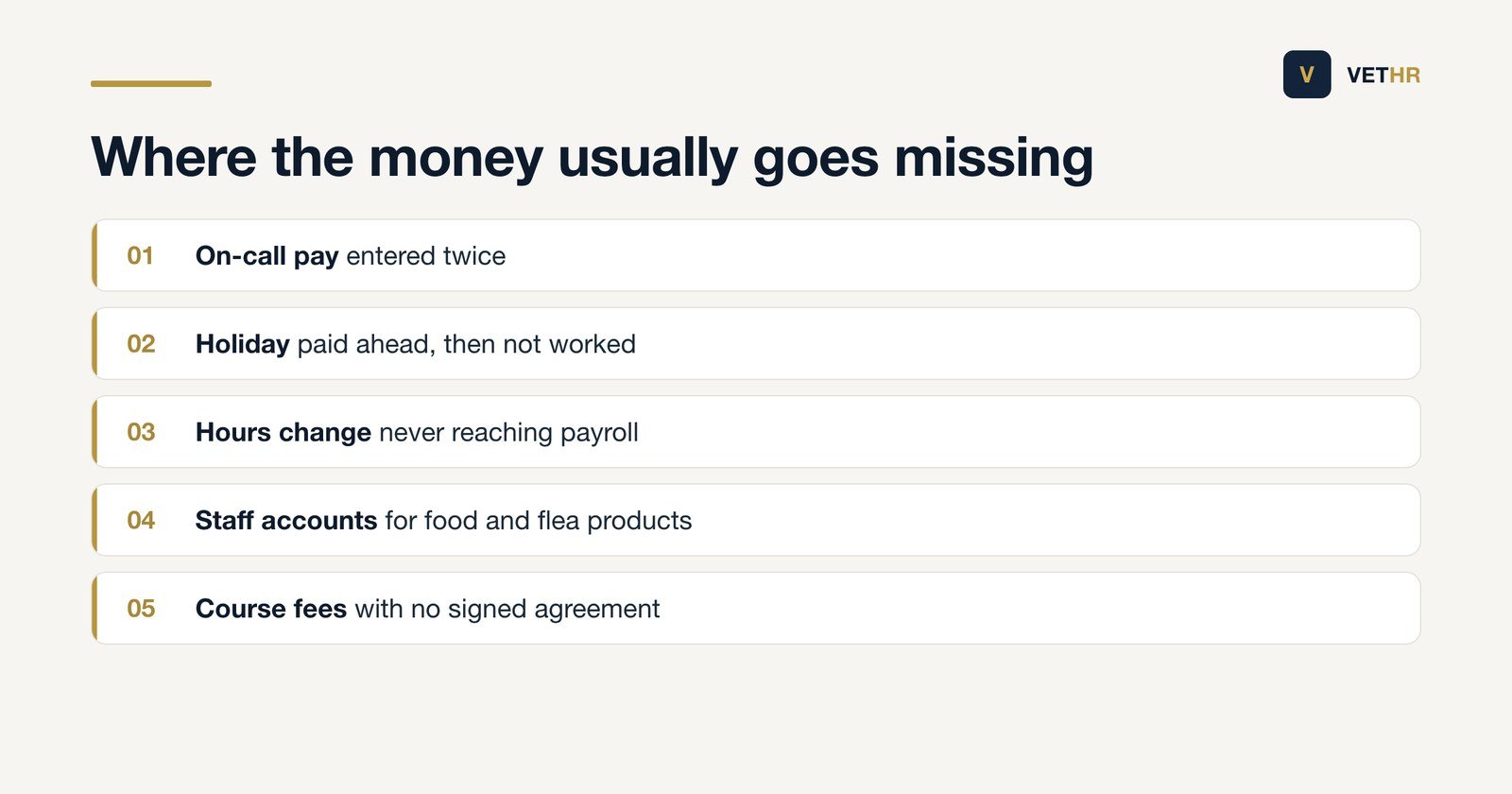
Overpayments in veterinary practice usually come from the same three places: out of hours and on-call payments entered twice, holiday paid in advance and then not worked, and a shift pattern change that payroll never received. Fixing the handover between the rota and payroll removes most of them. Our note on veterinary payroll covers that handover.
Every one of your deductions from wages has to be visible. GOV.UK requires payslips to show earnings before and after deductions, the amount of any deductions that may change each time, and the number of hours worked where pay varies with time worked. Fixed deductions can be explained on the payslip or in a separate written statement.
Deductions from wages that appear as a single unexplained figure is the fastest route to a grievance. Name it on the payslip, in words the employee will recognise.
Tell the person before the pay run, not on it. Sixty seconds of warning prevents most of the arguments that follow deductions from wages, and it costs nothing.
If the answer to any of the first five is uncomfortable, stop. Recovering £200 is never worth an unlawful deduction claim and the time it eats. Book a free 30-minute HR health check if you want a view on a specific case before payroll runs.
Only if the contract or a signed written agreement allows it, and the amount reflects the real cost. Without that clause there is no right to deduct, however clear it is that the item has not come back. Invoice for it instead.
Any deduction not required by law, permitted by the contract, or agreed in writing in advance. Underpaying agreed overtime or on-call pay counts too, because a shortfall in wages properly payable is treated the same way as money taken out.
The same rules apply on the last payslip as on every other one. There is no special final pay exception. Check the clause, check the minimum wage position, tell the person in writing, and describe it on the payslip.
An earlier overpayment of wages or expenses sits on the permitted list, so recovery is allowed. Doing it without notice is what creates disputes, so set out the total and offer a schedule before anything changes on a payslip.
Employment tribunal time limits are short, and the government timeline raises the general limit from 3 to 6 months on 1 October 2026. Assume any deduction can be challenged and keep the paperwork that justifies it.
Almost every dispute about deductions from wages traces back to a contract that never contained the clause, or a clause so vague it could not be used. Fixing that takes an afternoon and removes the problem permanently.
We draft and review contracts for independent practices, either as a one-off through employment contract drafting or as part of ongoing HR support on subscription.
The Vet HR Team provides HR consultancy and white-labelled staff systems exclusively to UK veterinary practices.
Contracts, rotas, holiday, a difficult conversation. Tell us what you are dealing with and we will come back within one working day. Nothing to sign up to.
Got it. We will come back to you within one working day. If you do not see a reply, please check your spam folder.
