Last updated: 5 September 2026
TL;DR: From 1 April 2026 the National Living Wage is £12.71 an hour for those aged 21 and over, £10.85 for 18 to 20 year olds and £8.00 for under 18s and eligible apprentices. Practices rarely breach the minimum wage on the headline rate. They breach it through unpaid handovers, training time, uniform costs and misapplied apprentice rates.

No practice manager sets out to underpay a nurse. What happens instead is that the shift officially ends at six, the handover runs to twenty past, the rate is right on paper and the actual hourly figure quietly drops below the legal floor. That is how most minimum wage breaches in veterinary practice happen.
GOV.UK sets the rates that apply from 1 April 2026, and confirms that the rates change on 1 April every year. Diary that date, because the increase applies to the first full pay reference period beginning on or after it.
The entitlement is wide. GOV.UK confirms that part-time staff, casual workers hired for a single day, agency workers, apprentices, trainees and workers on probation all get the minimum wage, and that contracts for payments below the minimum wage are not legally binding. Nobody can agree to be paid less.
The age bands matter operationally as well as legally. A weekend animal care assistant who turns 18, or an 20 year old receptionist who turns 21, moves up a band on their birthday, and payroll needs to know before the birthday rather than after it.
Set a reminder against every date of birth in your staff records. This is a two-minute task in a digital system and a recurring failure in a paper one, which is one of the arguments for digital staff records.
It is narrower than practices assume. GOV.UK states that apprentices receive the apprentice rate if they are either under 19, or aged 19 and over and in the first year of their apprenticeship. After that first year, an apprentice aged 19 or over qualifies for the age-based rate.
So a 22 year old student veterinary nurse in year two of her apprenticeship must be paid at least the National Living Wage of £12.71 an hour, not the £8.00 apprentice rate. Practices that miss that transition create an underpayment that runs for months.
Off the job training time is working time and must be paid. That includes college days and structured study built into the apprenticeship, which is a common gap in small practices where the training day is treated as time away rather than time worked.
Our guide to the apprentice veterinary nurse covers the wider employment picture, including supervision and the point at which the apprenticeship rate stops applying.

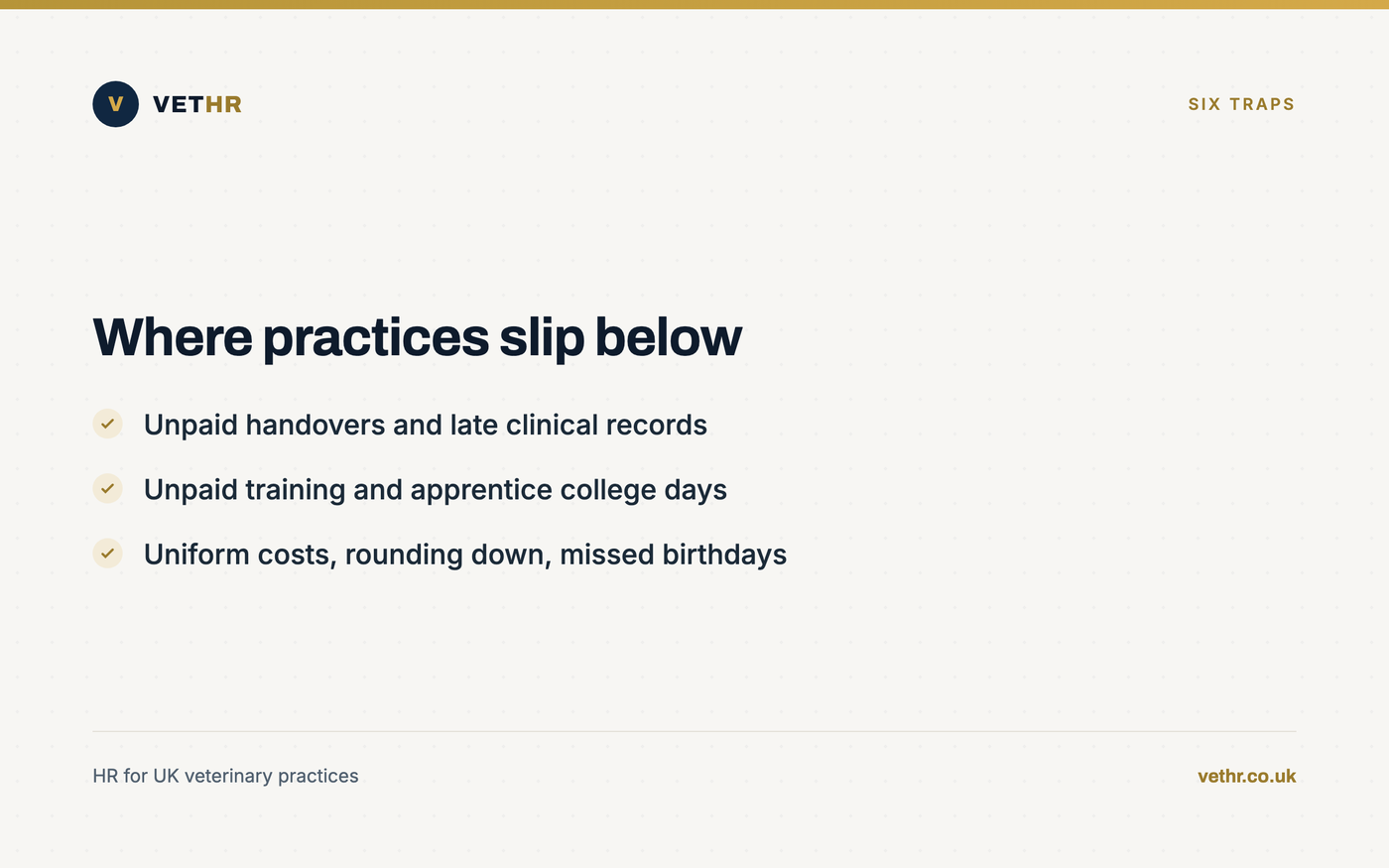
All six reduce the effective hourly rate below the minimum wage without changing the number on the contract. That is what makes them dangerous: the payroll looks compliant while the arithmetic is not.
Uniform is the most easily fixed. If a practice requires branded scrubs and the employee pays for them, the cost can reduce their effective pay below the minimum wage, so provide them or reimburse rather than deduct.
Handovers are the hardest, because they are clinical rather than administrative. The answer is to build the handover into the paid shift on the rota rather than to pretend it happens instantly, which our guide to building a veterinary rota covers in detail.
More than the hours on the rota. Time spent working, training, travelling between sites during the working day and waiting where required to be available all generally count, and each is a normal feature of veterinary work.
Waiting time is worth checking specifically. A nurse asked to stay at the practice between a morning theatre list and an afternoon clinic, unable to leave, is generally working for minimum wage purposes even if the building is quiet, and unpaid gaps of that kind are common in branch rotas.
Records finish late in every practice. A vet who routinely writes up for half an hour after the last consult is working, and if that time is invisible to payroll it is also invisible to your understanding of how long the day really is.
This is where a clock in and out system pays for itself twice, once for compliance and once for planning. Our clock in and out system exists to make the real hours visible rather than assumed.
Take one pay period and do the minimum wage arithmetic properly for your three lowest paid people. Total pay for the period, divided by total hours actually worked in that period, compared against the rate for that person’s age band.
Run the same minimum wage test on any month with unusual patterns. A December of extra shifts, a summer of branch cover or a fortnight of freelance vet cover changes hours and pay in ways that a single quiet month will not reveal.
Keep the records. Employers are expected to be able to evidence minimum wage compliance, and a practice that cannot produce hours worked is in a weak position regardless of what it actually paid.
Not sure your lowest paid roles clear the floor once handovers are counted? A free 30-minute HR health check will tell you. Book your HR health check.
Because the floor rises every April and the market rises with it. A practice that sets reception and animal care pay at exactly the legal rate is re-recruiting those roles every year, and each departure costs more than the difference would have.
Minimum wage compression is the quieter problem. When the bottom rate rises sharply, the gap between an experienced animal care assistant and a new starter narrows to nothing, and the experienced person notices immediately even if nobody says anything.
Deal with it in an annual review rather than in a corridor. Our guides to the veterinary practice salary review and what staff turnover actually costs set out how to run that properly.
From 1 April 2026 the National Living Wage is £12.71 an hour for workers aged 21 and over, £10.85 for those aged 18 to 20, and £8.00 for under 18s and eligible apprentices. GOV.UK confirms the rates change on 1 April each year.
Yes. Off the job training that forms part of the apprenticeship counts as working time and must be paid. Treating a college day as unpaid time away from the practice is one of the most common apprenticeship pay errors, and it also breaches the training commitment.
Be very careful. If a deduction or a required purchase reduces someone’s effective pay below the legal rate for their age band, that is an underpayment even though the contractual rate looks correct. The safe route is to provide required uniform and equipment at the practice’s expense.
Yes, and it adds up faster than people expect. Twenty unpaid minutes at the end of five shifts a week is more than eighty hours across a year. For someone paid close to the floor, that is enough to move their effective hourly rate below it for every pay period.
New rates apply from the first full pay reference period beginning on or after 1 April. For a practice paying monthly on the last working day, that usually means the April pay run, and payroll should be briefed in March rather than reacting in May.
Minimum wage compliance in a veterinary practice is an hours problem, not a rates problem. The rates are published, unambiguous and easy to apply. The hours are the part nobody measures, and that is exactly where the underpayment lives.
Count the handover, pay the training, provide the uniform, track the birthdays and redo the test every April. Our clock in and out system and HR consultancy make that routine, and the free HR health check will show you where your floor really sits.
The Vet HR Team provides HR consultancy and white-labelled staff systems exclusively to UK veterinary practices. Statutory rates change each April, so check current GOV.UK figures before setting pay.
Read next: Pay Bands for a Veterinary Practice.
Contracts, rotas, holiday, a difficult conversation. Tell us what you are dealing with and we will come back within one working day. Nothing to sign up to.
Got it. We will come back to you within one working day. If you do not see a reply, please check your spam folder.
