Last updated: 5 September 2026
TL;DR: Without pay bands, every pay decision is a negotiation, the best negotiators end up paid the most, and the person who never asks subsidises the person who threatens to leave. Building a structure takes an afternoon and three tables. The third table, where you place everybody against a band, is the uncomfortable one and the reason to do it.
Nothing was designed. Salaries were set at interview, when each person had different information and different confidence. They then moved when somebody asked, or when somebody resigned, and never when somebody quietly got on with it.
The result is a set of pay bands nobody would have chosen, that cannot be explained, and that the team half knows about anyway. Pay bands are simply the decision to design it on purpose.
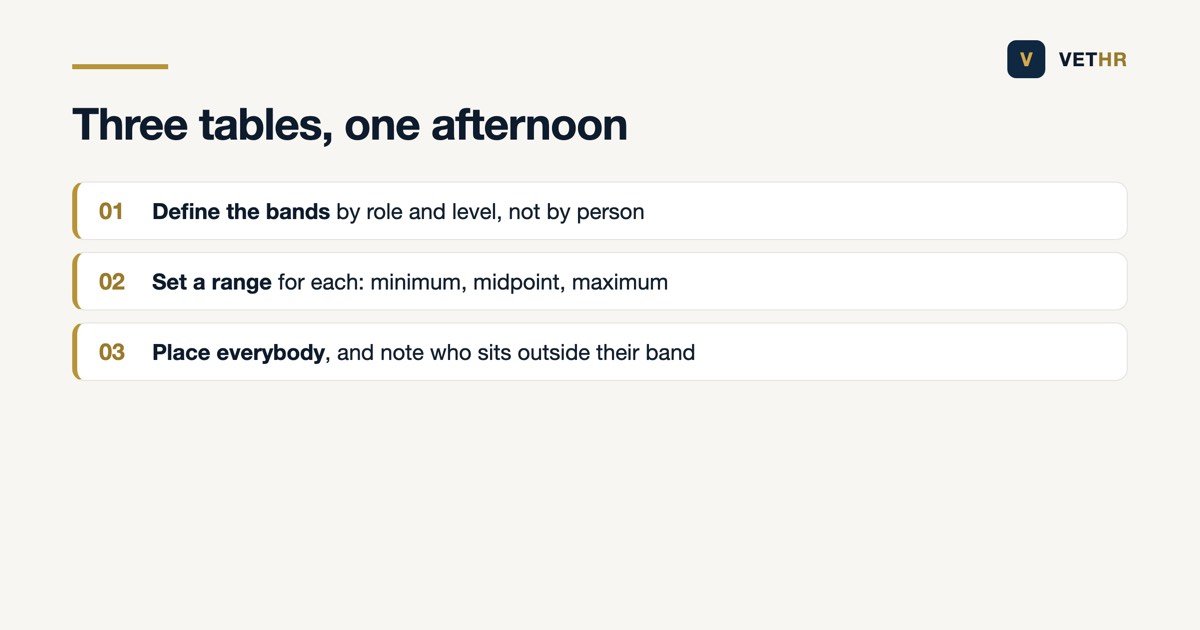
Pay bands take an afternoon, a spreadsheet, and the willingness to look at the answer.
Steps one and two are administrative. Step three is the point of the exercise.
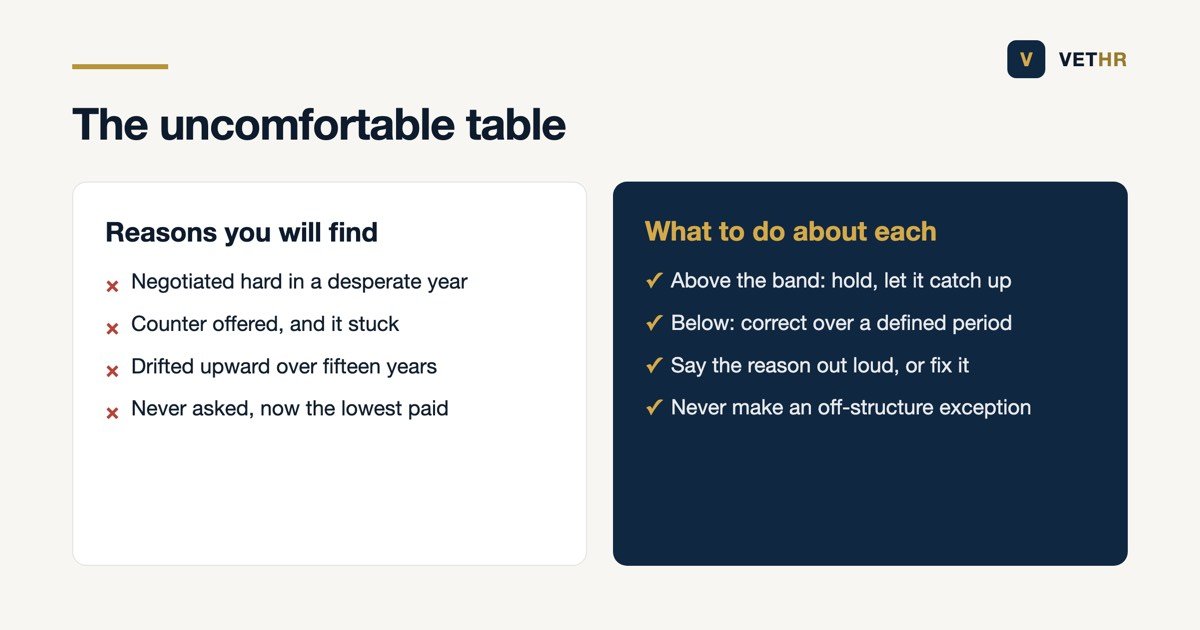
Every practice that does this finds at least one person sitting outside their band, and usually two or three. The reasons are always the same and they are always awkward.
Each of those needs an explanation you would be willing to say out loud. “They negotiated hard” is not one. Where an anomaly is above the band, hold it and let the band catch up rather than cutting pay. Where it is below, plan a correction over a defined period, and be honest with yourself about why it happened.
Our free pay and reward pack has the three tables laid out, with a review form and a consistency check.
Pay bands without progression criteria just relocate the argument. If nobody knows what takes them from the minimum to the midpoint, the answer defaults to asking loudly, which is the problem you were trying to solve.
Write down three or four things, and make them observable:
Note what is not on that list. Length of service on its own moves nobody through pay bands, or you end up paying for time rather than contribution, and the newly qualified RVN who is already running clinics stalls behind somebody who is not.
The fear is that publishing pay bands invites everybody to demand the maximum. In practice the opposite tends to happen, because most people discover they are roughly where they expected and stop wondering.
The one thing that destroys it is making an exception in year one, off structure, because somebody threatened to leave. Everybody finds out and the pay bands become decoration.
Two people doing equal work, or work rated as equivalent, or work of equal value, are entitled to equal pay regardless of sex. Job titles are irrelevant to that test.
In a veterinary practice the classic exposure is two RVNs doing materially the same work on materially different pay, where the only difference is that one negotiated at interview and one did not. That is not a defence. It is close to a description of how equal pay claims arise.
Pay bands with a consistency check across the band are the practical protection, because the check forces you to look sideways before you sign a decision rather than judging each one on its own.
Worth knowing before you rely on confidentiality to hold the current arrangement together. A clause preventing staff from discussing pay is unenforceable to the extent it stops somebody making or seeking a relevant pay disclosure, meaning a conversation held to find out whether a pay difference is connected to a protected characteristic.
You can ask for discretion. You cannot discipline somebody for comparing notes, and attempting to is a serious problem in its own right. Practices relying on secrecy are usually relying on it to conceal something they would rather fix.
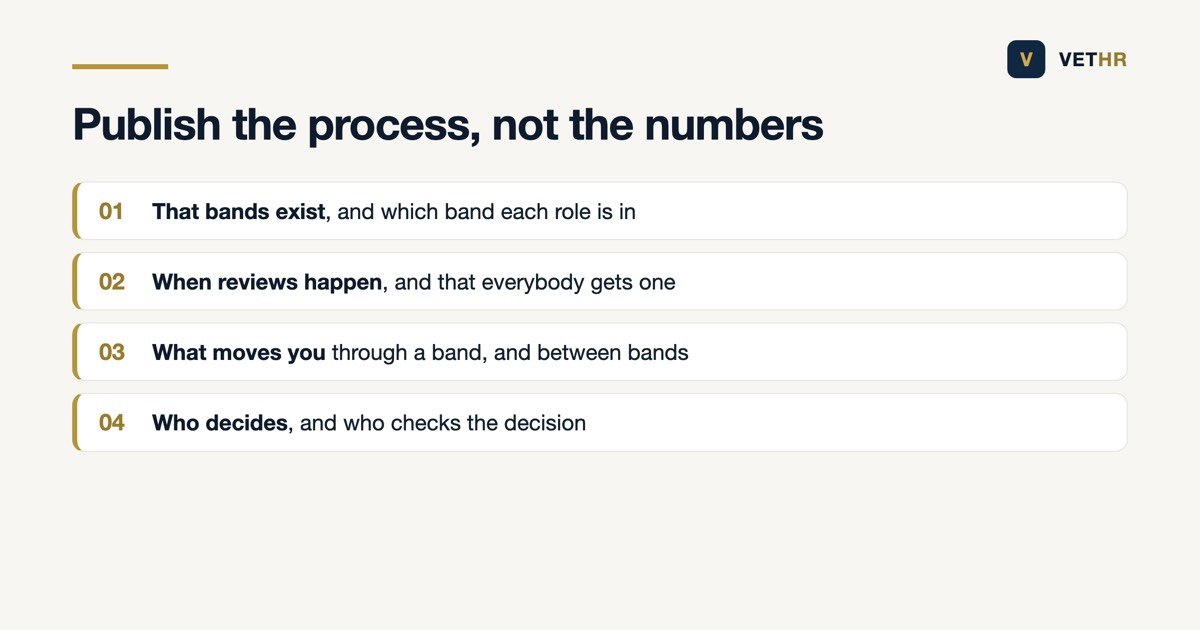
You do not have to publish salaries, and most practices will not want to. You should publish how pay is decided and that pay bands exist.
Most of the resentment about pay in a practice is about the absence of a process rather than the size of the number. People will accept being told the answer is no this year. They will not accept not knowing how the answer was reached.
While you have the numbers open, run a minimum wage check on your lowest banded and part time staff. The test divides total pay by hours actually worked, so a practice paying comfortably above the floor can still fail it.
The usual culprits are unrecorded early starts, handovers that routinely overrun, and required training outside shifts. Gov.uk publishes the current minimum wage rates. Note also that minimum wage enforcement transfers to the Fair Work Agency in April 2027, and it does not need a complaint to start looking.
Fewer pay bands than you think. Six to eight covers most practices. Too many bands makes progression meaningless and creates arguments about which band a role sits in rather than about how somebody is doing.
From your own market, which means your region and your type of practice. A benchmark from the wrong region or a very different practice is worse than none because it feels authoritative. Use several sources and be sceptical of all of them.
Correct it over a defined period and tell the person that is what you are doing. A plan with dates is a completely different conversation from silence, and silence is what turns an anomaly into a resignation or a claim.
Pay bands change what negotiation is about. Instead of arguing about a number, the conversation becomes about which band the role is in and where in the range somebody sits, both of which have stated criteria. That is a far better argument to have.
Usually not. Keep it as a separate, clearly stated payment so that people doing different amounts of out of hours are not being compared on a headline salary that means different things.
Building pay bands does not commit you to spending more. It commits you to being able to explain what you already spend, which is a different and much more useful thing.
Do the three tables this month, before the next resignation forces a decision under pressure. If you want a second pair of eyes on the anomalies, our free HR health check covers pay structure, and Acas has general guidance on pay and wages.
Contracts, rotas, holiday, a difficult conversation. Tell us what you are dealing with and we will come back within one working day. Nothing to sign up to.
Got it. We will come back to you within one working day. If you do not see a reply, please check your spam folder.
