Last updated: 14 June 2026
TL;DR: A salary review is a scheduled, recorded decision about pay, not a corridor conversation. This guide sets out a simple annual process for a small veterinary team: link pay to the appraisal record, check the minimum wage floor for junior roles, apply equal pay basics, budget honestly when margins are tight, and communicate every outcome in writing, including a no.
In most small practices, pay is decided one confident conversation at a time, and the quiet RVN ends up subsidising the colleague who asks. A proper salary review replaces that with one process, one date and one written record. Here is how to run it without a payroll department.
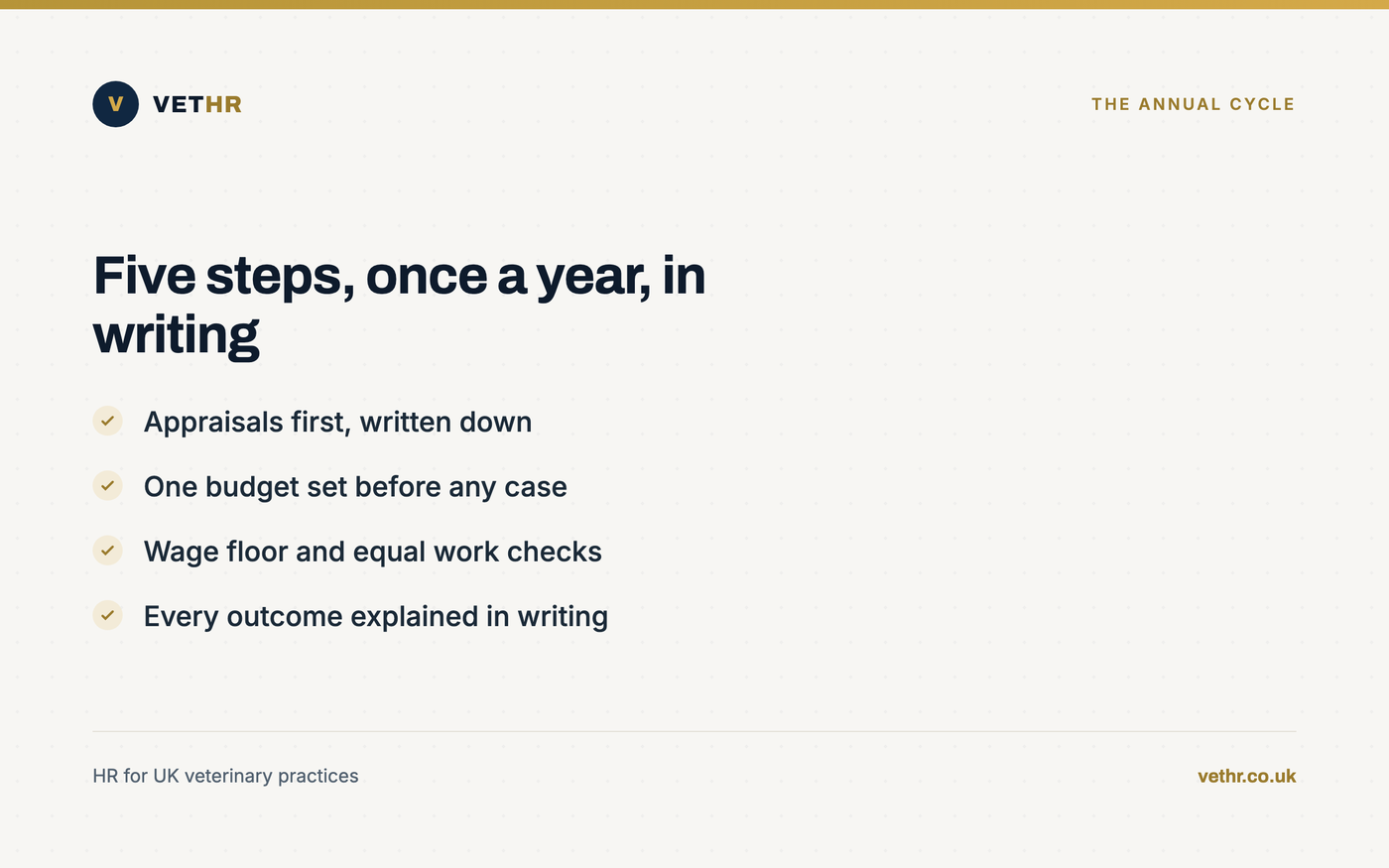
A fair salary review runs on a fixed date, uses criteria staff know in advance, draws on the appraisal record rather than memory, checks every outcome against the minimum wage floor and equal pay basics, and ends with a written decision. In a small practice the whole cycle takes a few focused hours, once a year.
The alternative is what most practices actually run: pay set at hiring in whatever the market looked like that month, then adjusted whenever someone pushes hard enough. Nobody designed that system. It rewards confidence over contribution, and it quietly builds pay gaps nobody can explain later.
None of this needs software or a consultant on retainer. It needs a diary entry, a folder of appraisal notes and the discipline to hold the date even in a rough year, because skipping the review is itself a message to the team.
Not usually. Acas guidance on pay rises says there is no legal requirement to give one unless the person earns the minimum wage and it increases, or their contract states they are entitled to a rise. Discretionary reviews still need care: Acas notes that an employer who does not act fairly and reasonably may face a legal claim.
Read your contracts before your first review. Acas explains that a contractual pay rise must be paid where the agreed criteria are met, so a clause promising an annual increase is a promise, not a target. Most well-drafted contracts commit to a review, meaning pay will be looked at, not that it will rise.
Habit can harden into obligation too. The same Acas guidance describes how custom and practice can create expectations where increases are awarded regularly without any formal agreement. If the practice has raised pay every April for a decade, treat this year’s decision with respect for that history and communicate any change early.
Hold appraisals before the pay decision and write them down. The review then reads the year’s record: objectives met, skills gained, extra responsibility taken. Pay decisions built on a dated record are explainable and consistent. Pay decisions built on corridor conversations reward confidence over contribution and are impossible to defend later.
Keep the two meetings separate. The appraisal is a development conversation, and it collapses the moment it becomes a negotiation. Appraise first, close the record, then decide pay a few weeks later against the whole-team budget. Staff get a better conversation, and you get a cleaner decision.
Hours belong in the record as well as achievements. Overtime, out-of-hours cover and the shifts someone reliably picks up are part of their contribution, and they should come from data, not recollection. A clock in and out system gives you the actual hours worked over the year, which makes both the contribution case and the pay maths honest.
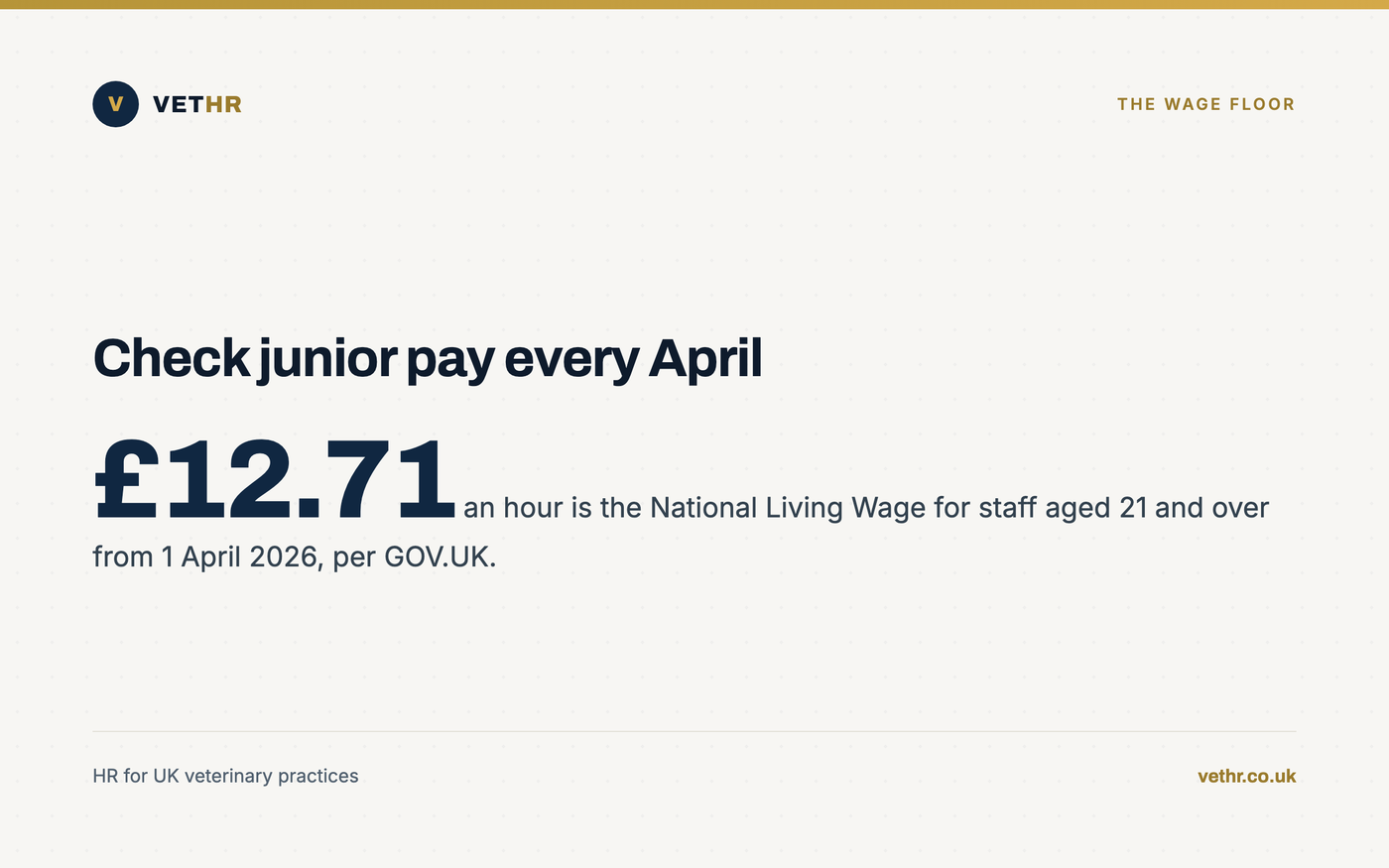
Every salary review should end with an hourly rate check on junior pay. From 1 April 2026 the National Living Wage for those aged 21 and over is £12.71 an hour, with £10.85 for 18 to 20 year olds and £8.00 for under 18s and apprentices, according to GOV.UK. The rates change every April.
The current figures are always on the GOV.UK National Minimum Wage rates page, and the wider GOV.UK guidance on the minimum wage is blunt about scope: it is the minimum pay per hour almost all workers are entitled to, and it does not matter how small the employer is. A four-person branch surgery has the same floor as a hospital group.
Salaried juniors are where practices get caught. A salary that cleared the floor comfortably at hiring can drift towards it as hours creep up or as April increases land, because the hourly figure depends on the hours actually worked. This is another place accurate clock in and out records earn their keep: divide real pay by real hours and the check takes minutes.
Watch birthdays too. The bands are set by age, so a receptionist turning 18 or a student nurse turning 21 moves to a higher floor between reviews, not at the next one. Put age-band changes on the same calendar as the April rate change.
Not confident your junior pay clears the current floor, or that your review process would look fair from the outside? Book a free HR health check. In 30 minutes we will look at how pay decisions are made in your practice and tell you plainly what needs attention first. Straight answers, nothing sold for the sake of it.
By law, men and women must get equal pay for doing equal work, as Acas guidance on equal pay states plainly. In a salary review that means comparing outcomes across the team before confirming them: where two people do equal work, pay should not diverge without a clear, defensible reason.
Small practices rarely create pay gaps deliberately. They inherit them. One vet was hired in a desperate market, another in a quiet one, and the difference simply persisted. The annual review is the one moment those inherited differences are all on the table at once, so use it to spot them and plan the correction.
The same fairness logic applies to who gets a rise at all. Acas guidance on pay rises is direct about it: where some employees will not receive the pay rise, there should be clear reasons for this. Criteria set in advance and applied to everyone are what turn a pay decision from an opinion into a position you can defend.
Set the budget before you hear any individual case. Decide the affordable total for the whole team, then allocate it against the records. If the honest number is small or zero, say so and explain why. A modest rise explained honestly damages trust less than a generous promise the practice cannot keep.
Benchmark from published sources, not from rumour. For veterinary roles, sector sources such as the SPVS salary survey exist precisely so practices are not guessing at market rates from job adverts and gossip. We will not quote figures here because they date quickly; the point is to anchor decisions to something published rather than to the last confident anecdote.
When cash is genuinely constrained, look at what else is on the table. Rota predictability, protected CPD time and how out-of-hours cover is shared all shape whether people stay, and they belong in the same annual conversation. Predictable fixed costs help the budget too, which is one reason our monthly subscription is priced per practice and agreed in writing.
In person first, then in writing. Every outcome letter should state the decision, the reasons, the date pay changes if it does, and when the next salary review happens. When the answer is no, add what would need to change for a different answer next year. Vague reassurance helps nobody.
A no with reasons keeps more people than a maybe with none. Staff can disagree with a decision and still trust the process that produced it, but only if the process is visible: the date was known, the criteria were known, and the letter explains how they were applied.
Put the process itself in writing once, as a short pay review policy in your policy library: when the review happens, what it considers and how outcomes are communicated. Then handle mid-year requests through it. Log them, acknowledge them, and fold them into the next review unless something genuinely cannot wait.
No. Acas guidance says there is no legal requirement for a pay rise unless the person earns the minimum wage and it increases, or their contract entitles them to one. Regular unpromised increases can build expectations through custom and practice, though, and discretionary decisions still have to be made fairly and reasonably, so run a proper process even when the answer is no.
From 1 April 2026, GOV.UK lists the National Living Wage at £12.71 an hour for those aged 21 and over, £10.85 for 18 to 20 year olds, and £8.00 for under 18s and apprentices. The rates change on 1 April every year, so build the check into every annual review and confirm the current figures on GOV.UK each April.
No. Hold the appraisal first as a genuine development conversation, close the written record, then decide pay separately against the whole-team budget a few weeks later. Combining them turns every appraisal into a negotiation, which spoils the conversation and pressures the manager in the room into promises the budget has not confirmed.
Hold the review anyway. Legally, Acas is clear there is usually no obligation to increase pay unless a contract or a minimum wage rise requires it. Practically, run the process, check the wage floor, explain the position honestly in writing, and give a date when it will be looked at again. Skipping the review reads as indifference; an honest no does not.
Yes. The Acas principle is stated without any size threshold: by law, men and women must get equal pay for doing equal work. For a small team the practical protection is the same as the fairness protection: criteria set in advance, outcomes compared across the team before they are confirmed, and a written record of the reasons for every decision.
A salary review is not about finding money that is not there. It is about making pay decisions the same way every year: on a known date, from a written record, against one budget, checked for the wage floor and for equal work, and explained in writing. That is achievable in any practice, in any year, whatever the answer turns out to be.
If pay in your practice is still set corridor by corridor, start with the process, not the numbers. Put a short pay review policy in your policy library, get real hours data from a clock in and out system, or book a free HR health check and we will help you design the cycle for your team.
The Vet HR Team provides HR consultancy and white-labelled staff systems exclusively to UK veterinary practices.
Read next: Veterinary Payroll: The Nine Checks to Run Before Every Pay Day.
Contracts, rotas, holiday, a difficult conversation. Tell us what you are dealing with and we will come back within one working day. Nothing to sign up to.
Got it. We will come back to you within one working day. If you do not see a reply, please check your spam folder.
