Last updated: 24 September 2026
TL;DR: Equal pay law requires men and women to receive equal pay for equal work. Equal work has three forms: like work, work rated as equivalent, and work of equal value. Pay includes far more than salary. Differences can be lawful where a genuine material factor explains them, but the practice has to be able to explain it.
Two vets joined the practice in the same month, four years ago, with the same experience. One negotiated hard and one did not. Nobody has looked at the two salaries side by side since. Last week a receptionist mentioned a number in the staff room, and now the practice manager has a question about equal pay that nobody in the building can answer.
Acas puts it simply: by law, men and women must get equal pay for doing equal work, and equal pay law is covered by the Equality Act 2010.
It is not a general fairness rule. It is specifically about sex. Two nurses paid differently for the same job is a management problem; two nurses of different sexes paid differently for the same job is potentially an equal pay claim.
That distinction matters because practices often assume the question does not apply to them. Veterinary teams are heavily female, which changes the shape of the risk rather than removing it. The comparison can run in either direction.
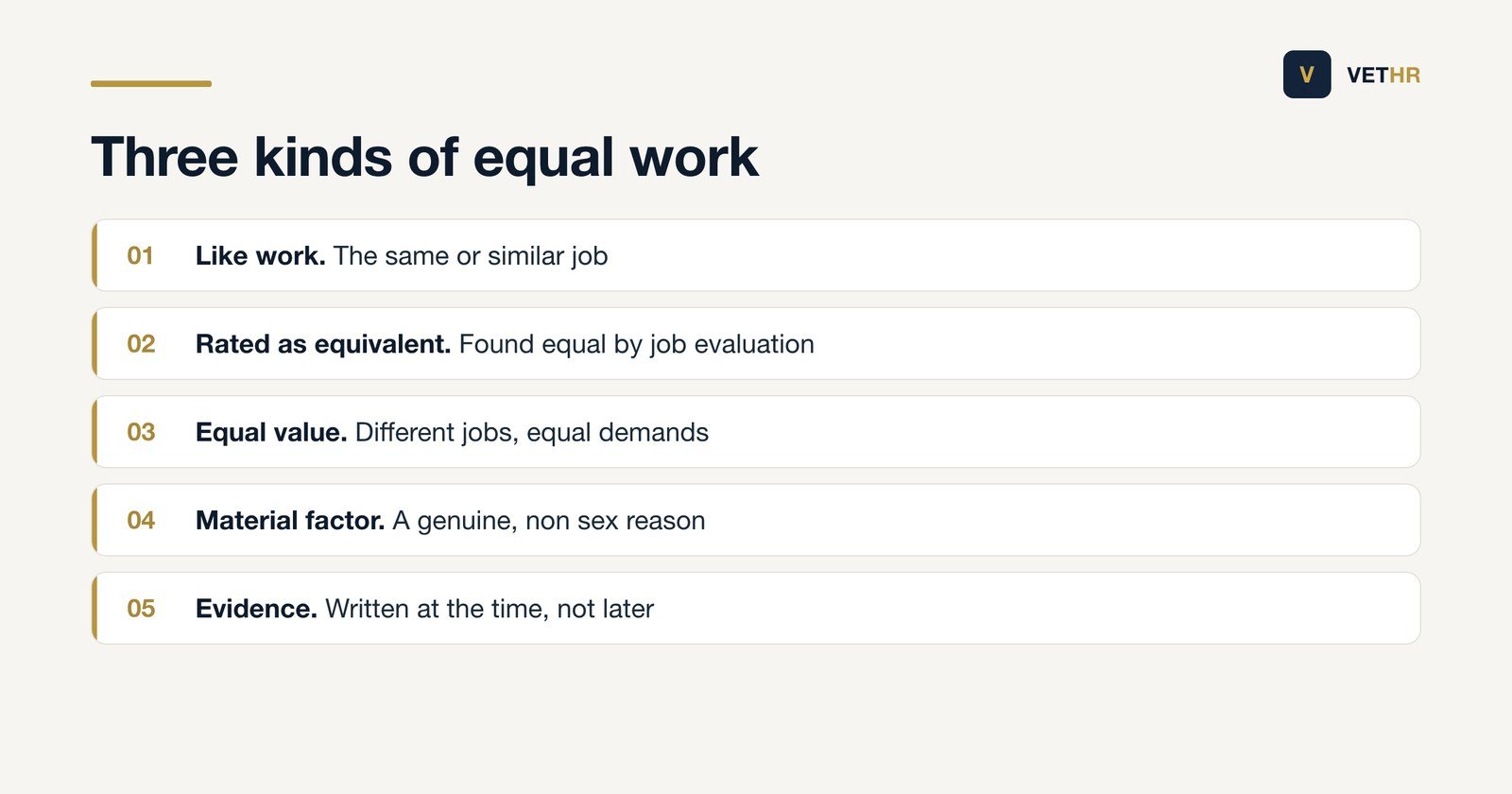
Acas sets out three categories, and only the first is obvious.
The third one is where practices get surprised. A head nurse and a practice manager do entirely different jobs, and an equal pay comparison between them is perfectly possible if the skill, training and responsibility line up.
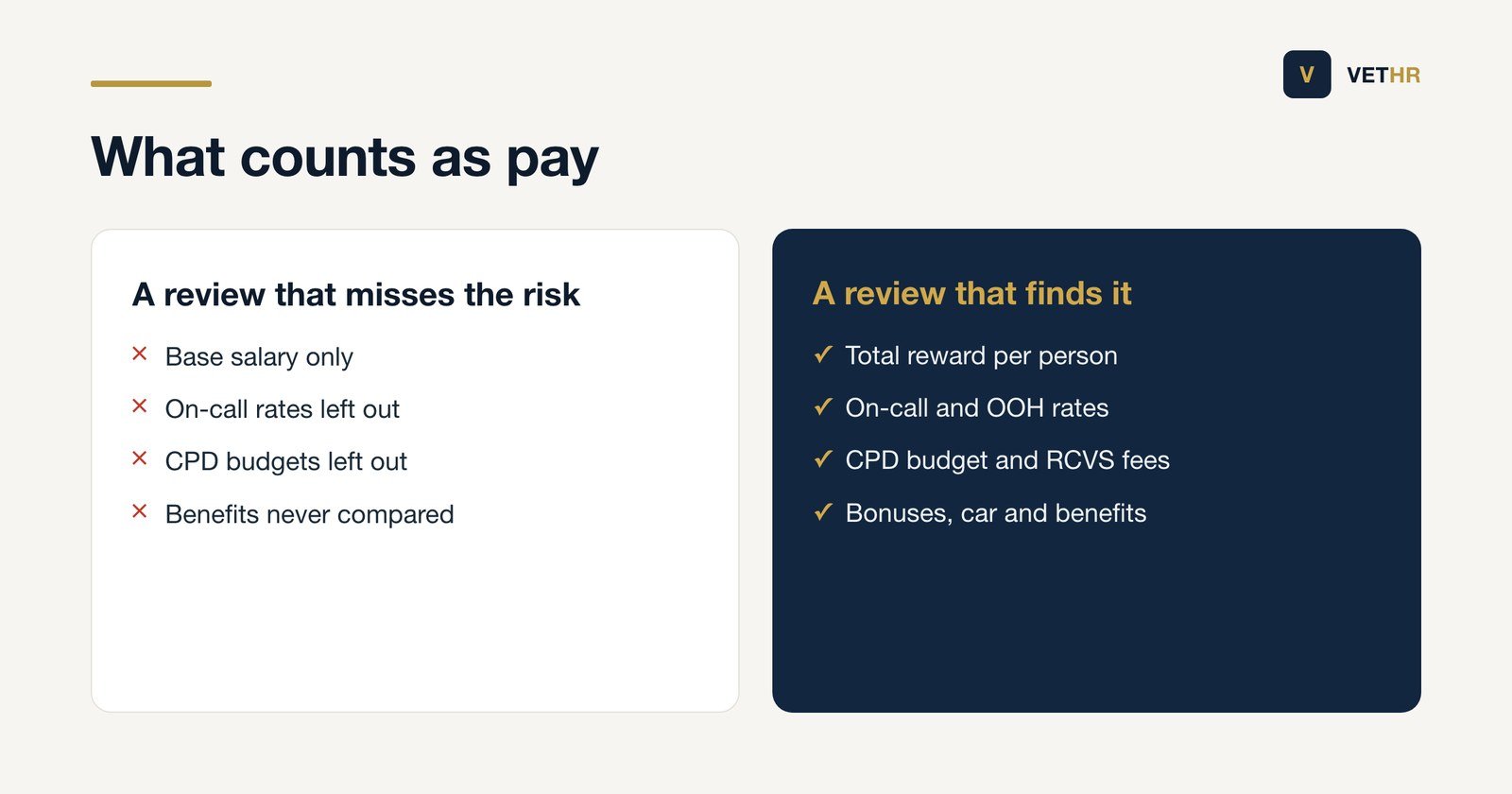
Much more than the salary line. Acas lists basic salary and wages, pension, working hours, annual leave allowance, holiday pay, overtime pay, redundancy pay, sick pay, performance related pay such as a contractual bonus, and benefits such as gym membership or a company car.
Translate that into a veterinary practice and the list grows quickly: on-call allowances, out of hours session rates, CPD budgets, RCVS and professional fees, contractual bonuses, enhanced sick pay, extra leave and car allowances.
This is why an equal pay review that only looks at base salary misses most of the risk. Two vets on identical salaries can be substantially unequal once CPD budgets and on-call rates are counted. Our note on bonus schemes in a veterinary practice covers the element that varies most.
Part-time staff deserve a separate look. Where an allowance or a budget is expressed as an annual figure, pro rata arithmetic gets done by hand and rarely gets checked. A nurse on three days a week should be receiving three fifths of the CPD budget and three fifths of the professional fees contribution, not a round number somebody guessed. Our note on part-time workers in a veterinary practice covers the less favourable treatment rules that sit alongside this.
Differences can be justified where there is a genuine material factor that is not related to sex. Acas gives examples including someone being better qualified, where they are located, and working different shifts where the employer has a good reason to pay one shift more than another.
The test is whether you can explain it, with evidence, today. A reason that has to be reconstructed four years later from memory is not much of a defence, and negotiated harder at interview is not a material factor in itself.
Write the reason down at the point you set the salary. One line in the file, saying why this person is on this number, resolves almost every future equal pay question before it starts.
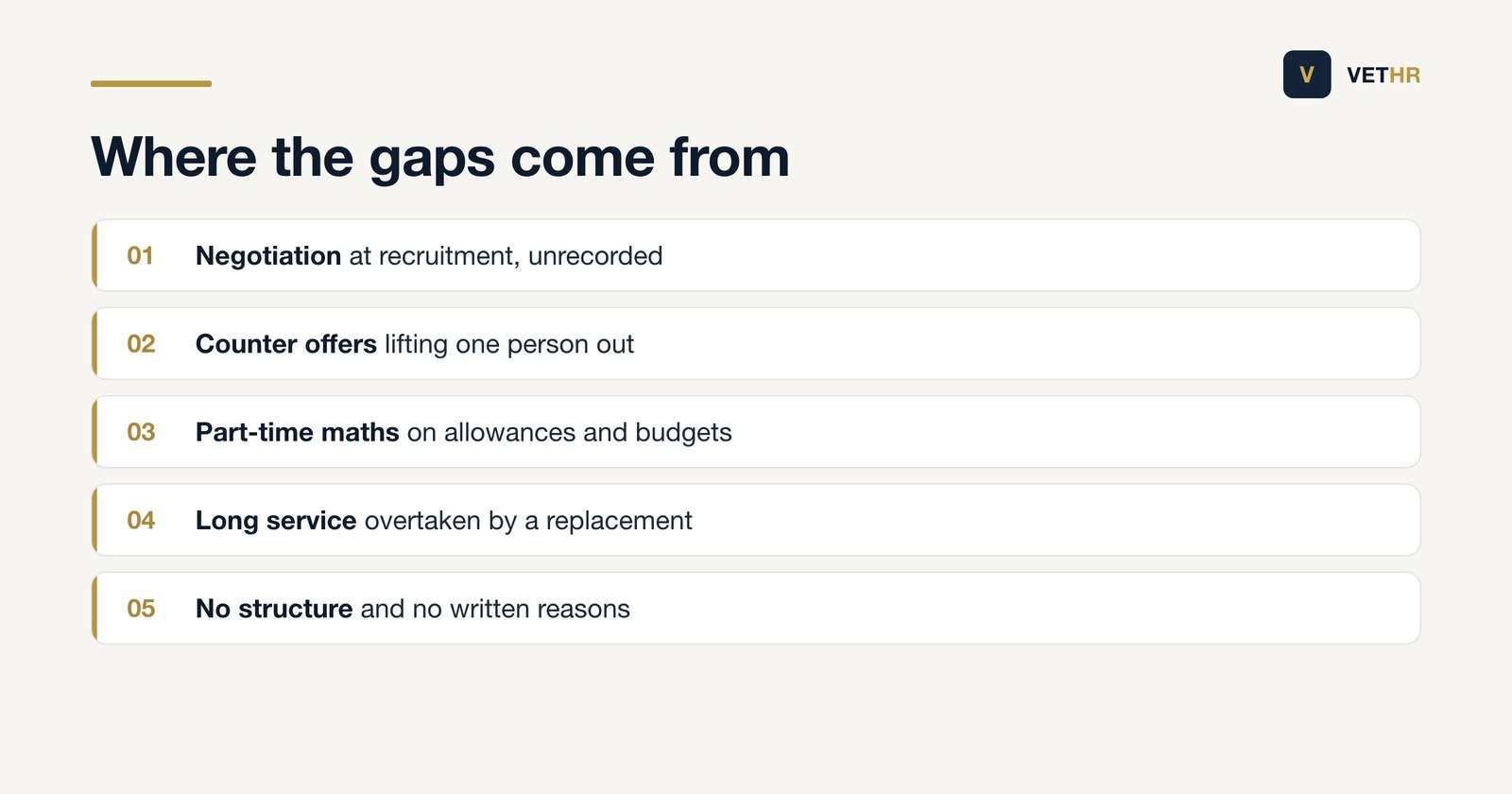
Four places, in order of how often we see them.
All four are structural rather than deliberate, and all four are fixed by the same thing: a pay structure with defined bands and a written reason for every position within them. Our guides to pay bands for a veterinary practice and the annual salary review cover how to build one.
Acas guidance on employer responsibilities describes the sequence: check whether people are doing equal work, carry out job evaluations where needed, gather pay and contractual terms for those doing equal work, and check whether any differences could be linked to sex. In a practice of twenty people, that is an afternoon.
Keep the working papers. An equal pay review you can show is evidence of a practice taking the question seriously, which counts for a great deal if a question ever arrives formally.
Do the review before the salary round rather than after it. A gap found in March can be closed as part of the normal uplift, which costs less and looks like good management. The same gap found in November has to be corrected on its own, which is more expensive and looks like a response to a complaint.
Tell the person once it is fixed. An unexplained rise creates its own staff room arithmetic, and a short honest sentence about a pay review finding an anomaly does far more for trust than a silent correction.
Acas advises that employers can prevent many equal pay issues by being clear and open with staff about pay and contractual terms. Published bands, with the criteria for moving between them, remove most of the staff room arithmetic that causes the problem in the first place.
You also cannot stop the conversation. Discussing pay for reasons relating to equal pay is protected, so a policy telling staff not to discuss their salaries is both unenforceable and a signal that something is being hidden.
Change is coming too. The government’s Employment Rights Act implementation timeline lists mandatory menopause and gender equality action plans among the measures for 2027. Practices with a structure already in place will find that a formality. Book a free 30-minute HR health check if yours does not.
Yes. There is no minimum size. The Equality Act 2010 applies to every employer, and a team of eight is as capable of having an unexplained pay difference as a team of eighty. Smaller teams simply notice it faster.
They can, through work of equal value. The jobs do not have to be similar if the skill, training, responsibility or demands of the working conditions are of equal value. A head nurse and a practice manager can be compared this way.
It can be, as a material factor, where the reason is genuine and not related to sex. Record it at the time, review whether it still applies each year, and think about how you will close the gap once recruitment eases.
Not where the discussion relates to equal pay. That kind of conversation is protected, and a blanket confidentiality rule about salaries is unenforceable as well as counterproductive.
Work out whether a genuine material factor explains it. If one does, record it. If not, close the gap and document the decision. Delay makes the sum larger, because a difference in pay accrues every month it continues.
Most equal pay problems in independent practice are not discrimination. They are four years of individual decisions nobody wrote down, and the fix is a structure plus a one line reason beside every salary.
We build pay structures and run reviews for independent practices through fixed-price HR consultancy for veterinary practices and ongoing HR support on subscription.
The Vet HR Team provides HR consultancy and white-labelled staff systems exclusively to UK veterinary practices.
Contracts, rotas, holiday, a difficult conversation. Tell us what you are dealing with and we will come back within one working day. Nothing to sign up to.
Got it. We will come back to you within one working day. If you do not see a reply, please check your spam folder.
